

The true employer cost of a South African employee is the gross salary plus three statutory levies (UIF, SDL and COIDA) plus whatever benefits you promise, most commonly a 13th cheque. The statutory part is small, roughly 1.5% to 2.5% of pay. The part that moves your budget is the package you offer. This guide gives you the formula, the current 2026/2027 limits, and a worked example in rand.
TL;DR
- Statutory employer on-costs are UIF (1%, capped at R177.12 per month), SDL (1% of payroll above R500,000 a year) and COIDA (a rate set by your industry risk class).
- Budget the 13th cheque at about 8.3% of base salary. It is not law, but skilled candidates expect it.
- Employer contributions to a pension or medical scheme are optional by statute, yet often part of a competitive offer.
- A US or European company with no local entity also needs a legal employer. That cost belongs in the model.
- Do the sum on total cost-to-company, not on the headline salary.
Table of Contents
- The formula behind every calculator
- The statutory employer contributions
- A worked example: a senior developer on R50,000 a month
- The costs that are not statutory
- Employing through an entity or an Employer of Record
- Our view: price the whole package, not the headline salary
- What our service costs
- A short checklist before you make the offer
- FAQ
- Sources
The formula behind every calculator
The structure is the same whichever tool you use:
Total employer cost = gross salary + 13th cheque (if offered) + UIF + SDL + COIDA + optional benefits + employment administration
Most free calculators stop after the statutory items. That is a fair starting point, but it leaves out the lines a finance lead has to approve. Our employment cost calculator runs the full sum, and our total cost to company guide explains the logic line by line.
All amounts below are in South African rand (ZAR, written R). Salaries in South Africa are normally quoted per month, and most professional roles are quoted as cost-to-company (CTC), meaning the employee’s package includes benefits rather than adding them on top. Agree early which basis your offer uses, or you will argue about it later.
The statutory employer contributions
UIF: 1%, with a hard ceiling
For the 2026/2027 tax year, SARS sets the Unemployment Insurance Fund contribution at 1% of monthly remuneration, capped at R177.12 per employee per month. That cap reflects an earnings ceiling of R17,712 a month. The employee pays a matching 1%, so the combined contribution is up to R354.24 a month, but only your half is an employer cost.
Because of the ceiling, UIF is effectively a flat R177.12 per month for any mid-level or senior hire. It does not grow with salary. Our page on UIF contributions and the R17,712 cap covers the EMP201 filing mechanics.
SDL: 1% of payroll, with a threshold
The Skills Development Levy is 1% of total monthly payroll. It applies only when your annual payroll exceeds R500,000. A single senior developer on R50,000 a month crosses that line alone, so for a skilled hire you should assume SDL applies from the first month. Unlike UIF, SDL has no monthly cap.
COIDA: a company-specific rate
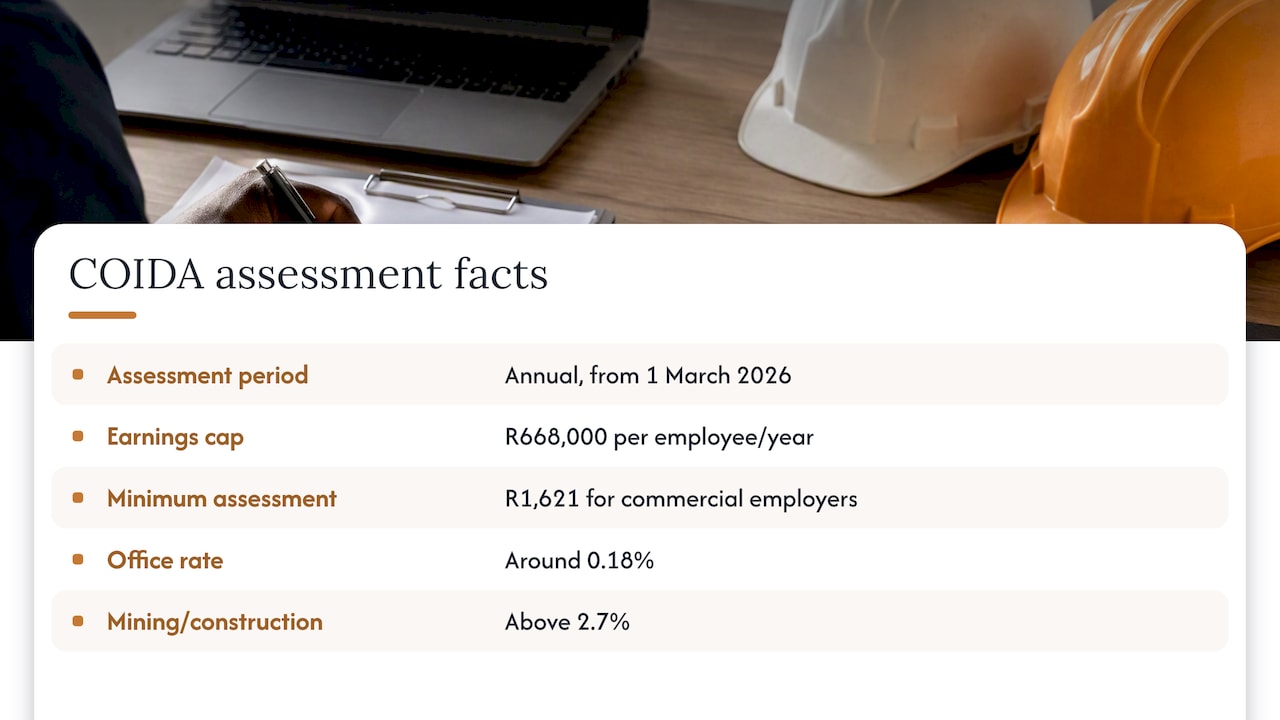
COIDA is the workplace injury and disease insurance run by the Compensation Fund. It is assessed annually, not monthly. For the assessment period starting 1 March 2026, earnings are capped at R668,000 per employee per year, with a minimum assessment of R1,621 for commercial employers. We explain the new threshold in our COIDA earnings cap article.
The percentage depends on your risk class. Office-based work sits at the bottom of the range, around 0.18%, while mining and construction run above 2.7%, according to the government gazette notice that sets the assessment framework. Rates are reviewed each year and tied to your business classification, so you cannot copy a figure from another company.
The classification matters more than most guides admit. Payroll specialists warn that declaring administrative staff as office-based while the company’s registration sits in a higher-risk industry can lead to reclassification of the whole payroll and back-payments after an audit. Register under the code that matches what the business does.
Statutory summary
| Item | 2026/2027 rate | Limit | Paid |
|---|---|---|---|
| UIF (employer) | 1% of remuneration | R177.12 a month (ceiling R17,712) | Monthly |
| SDL | 1% of payroll | Applies above R500,000 annual payroll | Monthly |
| COIDA | Risk-class rate | Earnings capped at R668,000 a year; minimum R1,621 a year | Annually |
PAYE is not an employer cost. You withhold it from the employee’s pay and pay it over to SARS. It affects net pay and your cash flow, not your total cost. If you want the filing calendar, see our overview of employer payroll taxes, which includes the 21-day registration step.
A worked example: a senior developer on R50,000 a month
This example is our own illustration, built from the limits above. It assumes a business with an office-based risk class and a COIDA rate of 0.18%, which you must replace with your own assessed rate.
| Line | Calculation | Annual cost |
|---|---|---|
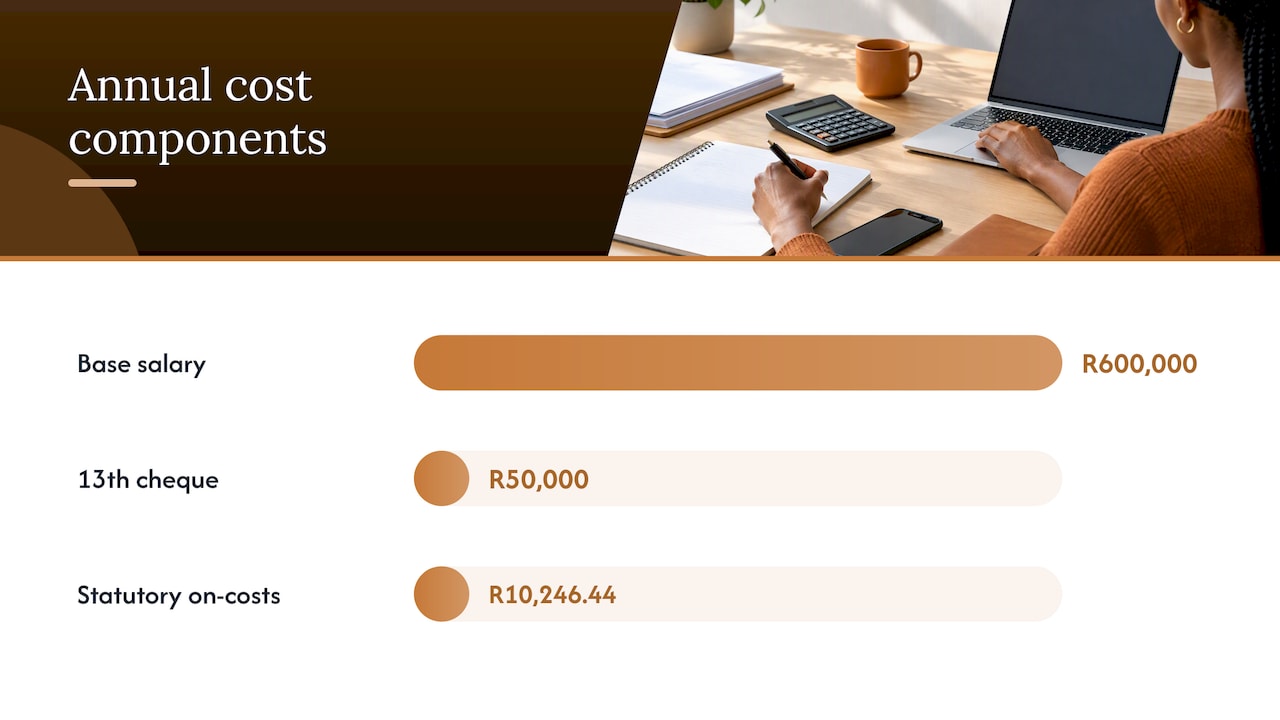
| Base salary | R50,000 × 12 | R600,000.00 |
| 13th cheque | One extra month | R50,000.00 |
| Total remuneration | R650,000.00 | |
| UIF | R177.12 × 12 | R2,125.44 |
| SDL | 1% × R650,000 | R6,500.00 |
| COIDA | 0.18% × R650,000 = R1,170, below the minimum, so R1,621 applies | R1,621.00 |
| Statutory on-costs | R10,246.44 | |
| Total employer cost | R660,246.44 |
Statutory on-costs come to about 1.6% of remuneration, which sits inside the 1.5% to 2.5% range that payroll tools publish for 2026/2027. The 13th cheque is the larger item: R50,000 against R10,246.44.
Two details trip people up. First, the UIF cap applies to monthly remuneration, so a month with a bonus does not raise your UIF above R177.12. Second, COIDA is capped per employee at R668,000, so on this R650,000 package you are under the cap, but a package of R800,000 would be assessed only on R668,000.
The costs that are not statutory
The 13th cheque
The 13th cheque is a bonus, not a legal entitlement. It is still a strong norm in finance, professional services and tech. Experienced employers budget it as 8.3% of annual base salary, and leaving it out of an offer can read as a below-market package. If your contract says “cost-to-company”, you can legitimately build the 13th cheque inside the total, but be explicit about whether it is paid in December or spread monthly.
Retirement, medical and other benefits
There is no mandatory employer pension in South Africa. Voluntary retirement fund contributions, medical aid and income protection are where a package becomes competitive. The same payroll guide puts the true cost of a professional hire in tech or finance at 10% to 20% above base salary once customary benefits are counted. Treat that as a planning range, then replace it with your actual offer.
Leave
Under the Basic Conditions of Employment Act, employees are entitled to 21 consecutive days of annual leave, and you may not pay them in place of leave except when employment ends. Leave is not an extra cash line, but it reduces productive days, which matters when you compare cost per working day with a contractor. For sick leave and public holidays, see our pages on sick leave under the BCEA and public holiday pay.
Working hours and thresholds
The BCEA earnings threshold exempts higher earners from some protections, such as overtime rules, but not from core rights such as annual leave. Misreading this is a common source of disputes at the CCMA. Our guide to BCEA working hours shows how to reflect this in the contract.
Recruitment
Hiring costs sit outside payroll but inside the real budget. Even the job title in your advert affects who applies, and these job title tips for South African recruiters are worth reading before you post a role. If you want us to find the person, see our talent sourcing service.
Employing through an entity or an Employer of Record
A foreign company cannot simply add a South African employee to a home-country payroll. You need a local employer. There are two routes.
Your own South African subsidiary (Pty Ltd). You gain full control, but you also take on registration, monthly PAYE, UIF and SDL returns, the annual COIDA declaration, and local accounting. Regional specialists suggest this often pays off only at around 15 to 20 employees.
An Employer of Record (EOR). A licensed local partner is the legal employer, issues a BCEA-compliant contract, runs ZAR payroll and files everything. You direct the daily work. You pay a monthly fee per employee on top of the costs above. For the US angle, including permanent establishment questions, read our guide to the routes for US companies hiring in South Africa and our EOR risk overview.
For a team of one to five, the EOR fee is usually smaller than the cost of an accountant, a payroll bureau and the time you would spend on compliance.
Our view: price the whole package, not the headline salary
We work in one country only, and the same mistakes keep appearing in the budgets we see.
First, founders compare a South African salary with a US or UK salary and stop there. Skilled roles in South Africa typically come in 40% to 60% below UK or EU salaries, which is a real advantage. But the saving is on salary, so it should be shown against a fully loaded figure on both sides, not against a base pay on one side and a total on the other.
Second, the statutory levies are small and predictable, so do not agonize over them. Spend your attention on the 13th cheque, the benefits you promise, and the COIDA classification, which is the one line that can produce a surprise.
Third, ask any provider, us included, who the legal employer is. In our model a licensed local partner employs your people and we are open about that. You should know whose name is on the contract before you sign anything.
Finally, working hours matter. South Africa is within about an hour of Central European Time, so European teams get a full working day of overlap. US teams get the morning, since South Africa is six to seven hours ahead of New York.
— Roel
What our service costs
We charge a flat fee of $399 (€350 or £299) per employee per month. There are no setup fees and no FX loading, and the fee covers the contract, ZAR payroll and the PAYE, UIF, SDL and COIDA filings. Add the statutory levies and any benefits you choose from the model above, and you have the full figure. You can see the current pricing here, and the complete EOR guide shows how onboarding works, with signed contracts typically within 48 hours.
A short checklist before you make the offer
- Decide whether the offer is quoted as base salary or as cost-to-company.
- Decide on the 13th cheque and write it into the contract.
- Confirm your COIDA risk class and the registration code behind it.
- Add UIF at R177.12 a month and SDL at 1% of payroll.
- List any retirement, medical or other benefits you will fund.
- Add your employment administration cost, whether an EOR fee or a local payroll provider.
- Run the total through a calculator, then compare it with the salary you would pay at home.
For the payroll side, our page on payroll services in South Africa and the note on paying employees in ZAR cover the monthly cycle.
FAQ
How much does it cost to hire an employee in South Africa on top of salary?
Statutory employer costs add roughly 1.5% to 2.5% of pay: UIF at 1% (capped at R177.12 a month), SDL at 1% of payroll, and COIDA at a rate set by your risk class. A 13th cheque adds about 8.3% of base salary if you offer one. Benefits such as retirement funding and medical aid come on top.
Do I pay SDL on every employee?
SDL is assessed on your total payroll, not per person, and it applies only when annual payroll exceeds R500,000. A single senior hire on R50,000 a month puts you above that line, so budget for it from the start.
Is the employee’s UIF contribution an extra cost to me?
No. The employee’s 1% is deducted from their pay and paid over with yours. Your cost is your own 1%, limited to R177.12 a month at the 2026/2027 ceiling.
Is a 13th cheque compulsory?
No. It is a customary bonus rather than a statutory benefit, so it depends on your contract. In tech and finance, skilled candidates commonly expect it, so leaving it out may make your offer look lower than it is.
Sources
- SARS PAYE-GEN-01-G21, Guide for Employers for 2027
- Department of Employment and Labour, COIDA maximum earnings and minimum assessment notice
- Department of Employment and Labour, Basic Guide to Annual Leave
- South Africa EOR and Payroll Guide 2026
- Payroll Cost Calculator South Africa 2026