

Under the BCEA, ordinary work is capped at 45 hours a week, with daily limits of 9 hours for a five-day workweek or 8 hours if employees work more than five days. Overtime is voluntary, capped at 10 hours a week, and the combined daily total (ordinary hours plus overtime) cannot exceed 12 hours. Overtime must be paid at 1.5 times the normal rate, unless the employee agrees to paid time off instead.
TL;DR:
- Overtime is voluntary under the BCEA and capped at 10 hours per week, with the total daily hours not exceeding 12 hours, including ordinary hours.
- Ordinary hours are limited to 45 hours weekly, with daily limits of 9 hours for a five-day week or 8 hours for longer workweeks, excluding high-earning exempt employees.
- Employees working more than 5 hours daily are entitled to a minimum 60-minute unpaid meal break, which becomes paid if they remain on standby.
- Night workers and those working on Sundays or public holidays are entitled to specific protections and double pay unless otherwise agreed.
- Fixed flexibility options include compressed workweeks up to 12 hours daily (with written consent) and averaging hours over four months through collective agreements.
Table of Contents
- What Counts as Ordinary Hours Under the BCEA
- Overtime Rules: When It’s Allowed and How to Pay It
- Meal Intervals and Rest Periods You Can’t Skip
- Night Work, Sunday Work, and Public Holiday Pay
- Who Is Exempt From BCEA Working-Time Rules
- Compressed Weeks and Averaging: Building In Flexibility
- Worked Examples: Calculating Hours and Overtime Pay
- How Expand to South Africa Supports BCEA Compliance
- Author Perspective: Getting the Basics Right First
- Hire Compliantly in South Africa Without the Guesswork
- Sources
- FAQ
What Counts as Ordinary Hours Under the BCEA
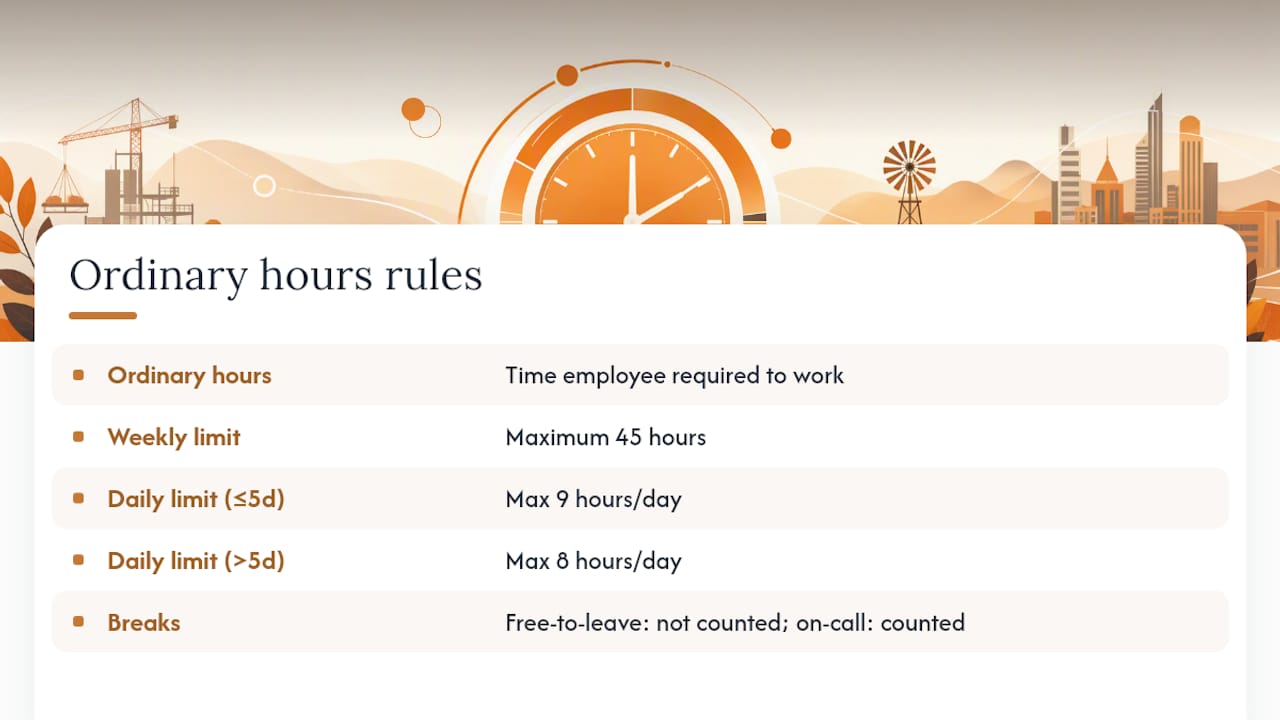
Ordinary hours are the time an employee is actually required to work, not simply the time spent at the workplace. A lunch break where the employee is free to leave doesn’t count toward the total, but a break where the employee must stay on call and available does.
The Basic Conditions of Employment Act sets ordinary working time at a maximum of 45 hours per week. Daily limits follow the workweek structure: 9 hours a day if the employee works five days or fewer per week, or 8 hours a day if they work more than five days. These figures work together, not separately. You cannot schedule 9 hour days five days a week and call it compliant if the weekly total creeps past 45.
Not every employee falls under these rules. Workers earning above the earnings threshold set by the Minister of Employment and Labour, along with several role-based categories covered later, are excluded from the working-time chapter entirely. Getting this classification wrong is one of the most common payroll errors we see among international employers hiring in South Africa, and it has direct consequences for how overtime gets calculated and paid.
Overtime Rules: When It’s Allowed and How to Pay It
Overtime under the BCEA is never automatic. It requires an agreement between employer and employee, whether that’s built into the employment contract or arranged case by case. Once agreed, overtime is capped at 10 hours per week, and the combined total of ordinary hours plus overtime cannot exceed 12 hours on any single day.
A collective agreement can temporarily stretch that weekly overtime cap to 15 hours, but only for a limited period, no more than two months within any 12-month cycle. Outside that narrow exception, the 10-hour weekly ceiling holds.
Paying for overtime comes down to two options:
- Pay 1.5 times the employee’s normal hourly wage for every overtime hour worked.
- Grant paid time off instead, by agreement, matched to the overtime worked.
Payroll teams should build these rules directly into contracts rather than handling them informally. Our guide to essential employment contract clauses walks through the specific language that keeps overtime terms enforceable and audit-ready.
Meal Intervals and Rest Periods You Can’t Skip
Employees working more than 5 continuous hours are entitled to a meal interval of at least 60 minutes. A written agreement between employer and employee can shorten that to 30 minutes, and the interval can be dropped altogether if the employee works fewer than 6 hours in a day.
Meal breaks are unpaid by default. If an employee has to remain reachable or on standby during that time, the break must be paid as working time. Shorter tea breaks generally don’t count as statutory meal intervals, but if they’re paid, they form part of ordinary hours.
Beyond meals, the BCEA sets daily rest at 12 consecutive hours and weekly rest at 36 consecutive hours. There’s a narrow exception: daily rest can drop to 10 hours where an employee lives on the employer’s premises and gets a 3-hour meal break. Employers frequently overlook this rest period entirely, and it’s worth documenting any exception in writing rather than relying on informal arrangements.
Night Work, Sunday Work, and Public Holiday Pay
Employees who regularly work between 11 p.m. and 6 a.m. get specific protections. Employers must inform them of health and safety hazards tied to night work and provide medical checks at the employer’s expense, along with reasonable transport arrangements where public transport isn’t available during those hours.
Sunday work follows its own pay structure. An employee who works occasionally on a Sunday is entitled to double pay for those hours. If Sunday work is a regular part of the role, the rate drops to 1.5 times the normal wage, unless the employer and employee agree on paid time off instead.
Public holidays follow a similar logic to Sundays: work on a public holiday is paid at double the normal rate, though employers and employees can agree to exchange the holiday for another day off with normal pay.
Who Is Exempt From BCEA Working-Time Rules
Several categories fall outside the BCEA’s working-time chapter entirely. Senior managerial employees who can determine their own hours, employees who travel and regulate their own working time (such as sales staff), and anyone working fewer than 24 hours a month for an employer are all excluded. Employees earning above the ministerial earnings threshold are exempt as well.
Misclassifying an employee here creates real payroll exposure: overtime miscalculated, hours undocumented, and compliance gaps that surface during a CCMA dispute. The fix is straightforward. Spell out job responsibilities, decision-making authority, and expected hours clearly in the employment contract, and revisit that classification whenever a role changes.
Compressed Weeks and Averaging: Building In Flexibility
The BCEA allows two lawful ways to flex working hours beyond the standard daily pattern, provided they’re properly documented.
- Compressed working week. An employee can agree, in writing, to work up to 12 hours a day without triggering overtime pay, as long as the total for the week doesn’t exceed 45 ordinary hours and doesn’t go over five days.
- Averaging of hours. A collective agreement can average ordinary hours over a period of up to four months, smoothing out busy and quiet periods while still limiting the overtime worked during that window.
Both mechanisms depend on getting the paperwork right. A compressed week needs individual written consent; averaging needs a collective agreement in place. Contracts should specify the exact arrangement, the review period, and how the employee can withdraw consent, since flexibility here still has to respect the weekly caps baked into the Act.
Worked Examples: Calculating Hours and Overtime Pay
Say an employee works a standard five-day week at 9 hours a day. That’s 45 hours exactly, the legal ceiling. Any time beyond that, even 15 extra minutes, counts as overtime and needs the employee’s agreement plus 1.5× pay.
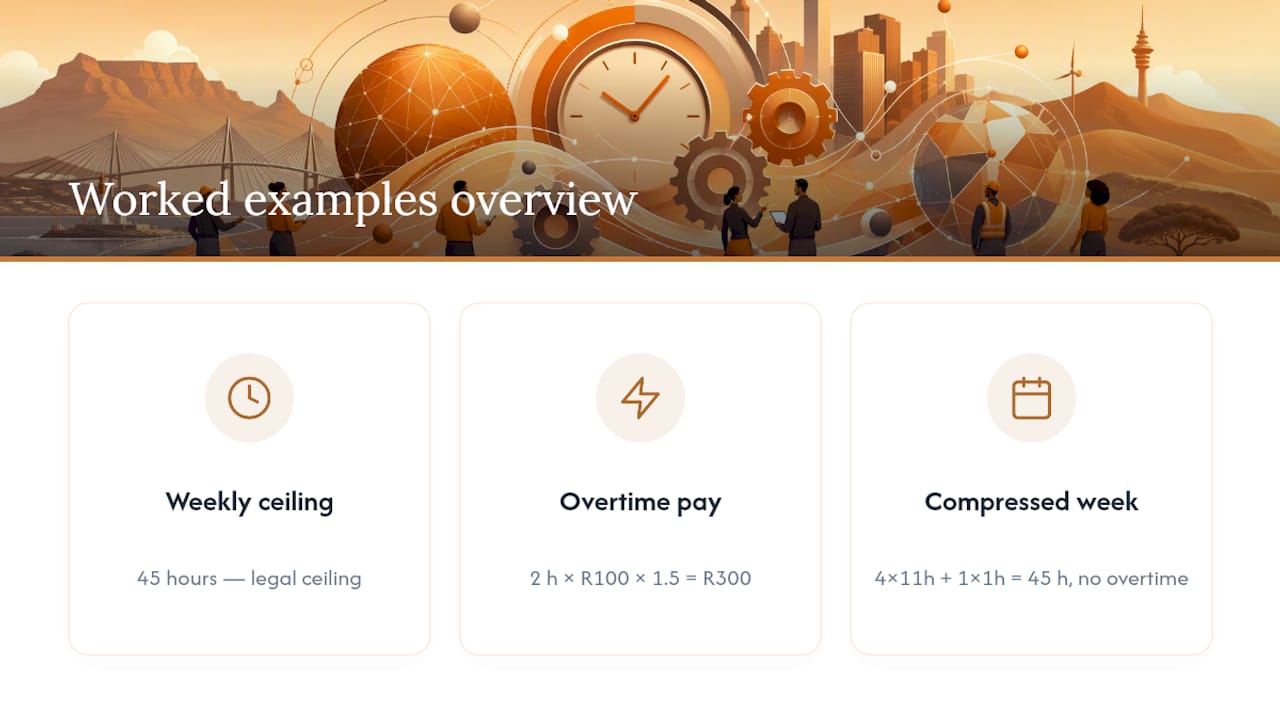
For overtime pay, take an hourly wage of R100. Two hours of overtime at 1.5× works out to R300 for that shift (2 hours × R100 × 1.5), instead of the standard R200.
A compressed week example: an employee works four 11-hour days plus one 1-hour day, totaling 45 hours across five days. No overtime pay applies, because the arrangement respects both the weekly ceiling and the written agreement requirement.
How Expand to South Africa Supports BCEA Compliance
Getting these calculations right across every employee, every pay cycle, is where international employers stumble. Expandtosouthafrica structures BCEA-compliant employment contracts, runs ZAR payroll, and handles statutory filings including PAYE, UIF, SDL, and COIDA through a licensed local partner. Contracts get signed within 48 hours, and full onboarding wraps within days, not the weeks it typically takes to set up compliant hiring from scratch.
Author Perspective: Getting the Basics Right First
Most working-hours disputes trace back to a missing written agreement, not a genuinely disputed rule. Get overtime consent, meal-break adjustments, and any flexibility arrangement in writing before problems start. Audit your contracts and actual hours worked at least twice a year. If you’re hiring across borders, specialist support catches classification errors before they become CCMA cases.
— Roel
Hire Compliantly in South Africa Without the Guesswork
Expandtosouthafrica is the alternative to setting up your own South African entity just to hire compliant staff. Instead of navigating BCEA working-hours rules, PAYE registration, and UIF filings on your own, you get a licensed local partner handling contracts, ZAR payroll, and statutory compliance for a flat €350 / $399 / £299 per employee per month, with no setup fees and no FX loading tacked on.
Global EOR platforms often charge higher fees for coverage across multiple countries, while some providers specialise in South African labour law and compliance. Contracts get signed within 48 hours, and if you’re already using another EOR provider, transfers to Expandtosouthafrica come free. If you’re ready to hire in South Africa without building working-hours policies from a blank page, check current Employer of Record pricing and get your first contract moving this week.
Sources
- Form BCEA1A – Summary of the Act – University of the Witwatersrand
- The Basic Conditions of Employment Act | Western Cape Government
- Basic Conditions of Employment Act (amended) – Department of Employment and Labour (gov.za)
- Understanding employee working hours – PaySlip
FAQ
Can an Employee Be Dismissed for Refusing Overtime?
Generally, no. Overtime under the BCEA is voluntary and requires the employee’s agreement, so refusing to work beyond ordinary hours isn’t valid grounds for dismissal on its own. An exception exists only where the employment contract includes a lawful, pre-agreed overtime clause the employee is refusing to honor, and even then, employers should tread carefully and document everything.
What Is the Longest You Can Legally Work in a Day?
The absolute daily ceiling is 12 hours, combining ordinary hours and overtime together. On a standard schedule that means up to 9 ordinary hours plus 3 hours of agreed overtime, never more.
Is Working Over 38 Hours Considered Overtime?
Under the BCEA specifically, no. The statutory ordinary-hours ceiling is 45 hours per week. Overtime only kicks in once the agreed ordinary hours (up to 45) are exceeded.
How Many Hours Can You Legally Work in a Day?
Ordinary hours max out at 9 hours a day for a five-day workweek, or 8 hours a day if you work more than five days. Add agreed overtime on top, and the combined total still can’t pass 12 hours in any single day.
Does Expand to South Africa Handle Overtime Calculations?
Yes. Expandtosouthafrica’s payroll services calculate BCEA-compliant overtime pay, statutory deductions, and filings as part of its Employer of Record offering, so international employers don’t have to build these calculations in-house.