

The COIDA maximum earnings cap is R668,000 per employee per year, effective 1 March 2026. Employers pay a minimum assessment of R1,621, while domestic employers pay a minimum of R560, both effective the same date. These figures come directly from the Government Gazette prescribing the new maximum and minimum earnings thresholds.
When you complete your Return of Earnings (ROE), you’re actually working with two separate caps:
- Actual Earnings (01/03/2025–28/02/2026): capped at the prior threshold, R633,168 per employee.
- Provisional Earnings (01/03/2026–28/02/2027): capped at the new threshold, R668,000 per employee.
Key Takeaways
The COIDA earnings cap rises to R668,000 per employee for the 01/03/2026–28/02/2027 period, while minimum assessments hold at R1,621 for employers and R560 for domestic employers.
| Point | Details |
|---|---|
| New maximum cap | R668,000 per employee per year, effective 1 March 2026, up from R633,168. |
| Two caps, two periods | Actual Earnings (01/03/2025–28/02/2026) use R633,168; Provisional (01/03/2026–28/02/2027) use R668,000. |
| Minimum assessments apply regardless | R1,621 for employers and R560 for domestic employers, even with low total earnings. |
| Annualize irregular payments | Spread bonuses and lump sums across relevant months before capping to avoid overstating earnings. |
| Let Expandtosouthafrica manage filings | We update payroll thresholds, prepare ROEs, and keep audit-ready records for both reporting periods. |
Table of Contents
- What Changed in the COIDA Earnings Cap for 2026/2027
- How to Apply the Cap in Your Return of Earnings
- Who the Earnings Cap Applies To
- Minimum Assessment Amounts You Still Owe
- Common COIDA Filing Mistakes and How to Avoid Them
- Why This Threshold Change Matters More Than It Looks
- How Expandtosouthafrica Handles COIDA and ROE Reporting for You
- Frequently Asked Questions
- Sources
What Changed in the COIDA Earnings Cap for 2026/2027
The maximum earnings cap increased from the prior threshold to the new threshold effective 1 March 2026. This change requires payroll adjustments for the reporting cycle.
This isn’t a cosmetic update. It changes how much of each high-earning employee’s salary is exposed to assessment, and it directly affects your total COIDA liability if your workforce includes employees earning above the old cap.
The tricky part is timing. You apply the two caps to two different filing periods:
- Use R633,168 for Actual Earnings covering 01/03/2025–28/02/2026, the cycle that’s already closed.
- Use R668,000 for Provisional Earnings covering 01/03/2026–28/02/2027, the cycle you’re estimating now.
Mixing these up is the single most common ROE error payroll teams make, according to practitioner guidance on the 2026 tariffs. Industry payroll vendors have echoed the same warning as the new limit went live.
How to Apply the Cap in Your Return of Earnings
The rule in one sentence: Actual Earnings use the historic cap for the cycle that just ended, and Provisional Earnings use the new cap for the cycle ahead. Get that sequencing wrong, and your entire ROE submission needs correcting.
Here’s the process for completing the relevant ROE fields correctly:
- Pull each employee’s gross annual earnings for the completed period (01/03/2025 to 28/02/2026).
- Cap any employee’s Actual Earnings figure at R633,168, even if their real salary was higher.
- Estimate each employee’s expected earnings for the upcoming period (01/03/2026 to 28/02/2027).
- Cap those Provisional Earnings figures at R668,000 per employee.
- Total both figures separately, then submit through the Compensation Fund online submissions portal.
Worked example: An employee earning R60,000 a month grosses R720,000 annually. For the Actual period, you report R633,168, not the full R720,000. For the Provisional period, you report R668,000. The difference between actual salary and capped earnings never disappears. It simply doesn’t count toward the assessment base.
Before you submit, run through this checklist:
- Confirm your payroll system’s threshold fields reflect both caps, not just one.
- Recheck any bonus or commission-heavy employees whose annualized earnings might cross either cap.
- Validate the ROE upload against both reporting periods before final submission.
Pro Tip: Directors and members who receive irregular, lump-sum payments cause the most annualization errors. Spread one-off bonuses across the months they relate to before calculating the annual figure, rather than dumping the full amount into a single month. That practice, recommended by compliance specialists, keeps your capped total accurate instead of artificially inflated.
Who the Earnings Cap Applies To
The R668,000 ceiling applies per person, per year, whether that person is a standard employee or a director or member reported separately on your ROE. The Gazette doesn’t create a different cap for company officers. It applies the same numeric limit across categories, but you still need to report them in the correct line items.
A few classification notes worth flagging for your payroll team:
- Casual workers are included if they meet the earnings and hours thresholds set out in the Compensation Fund’s ROE guidance.
- Independent contractors generally fall outside COIDA coverage, but misclassification here creates real exposure if the relationship functions like employment.
- Domestic workers use the separate minimum assessment structure, not the standard employer minimum.
Minimum Assessment Amounts You Still Owe
Even if your total capped earnings are modest, you still owe a minimum assessment. For employers, that’s R1,621, effective 1 March 2026. For domestic employers, it’s R560, effective the same date, per the Gazette notice.
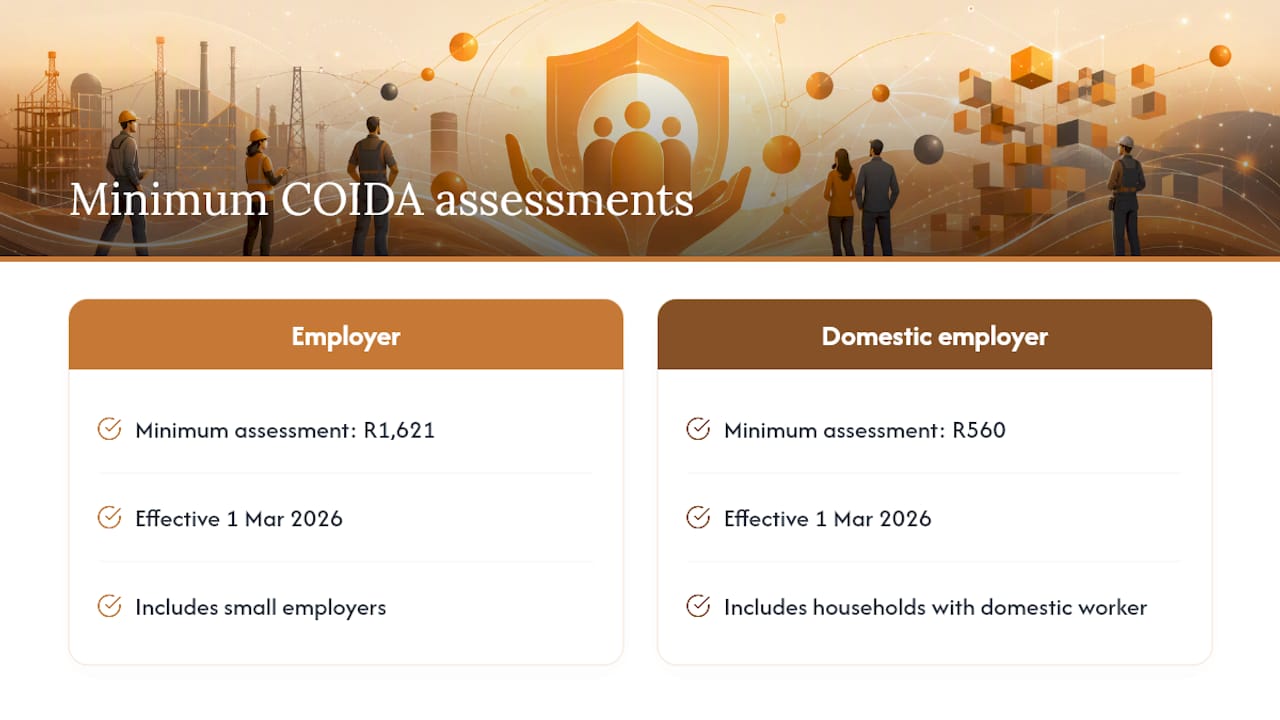
These minimums apply regardless of how few employees you have or how low their earnings are. If your calculated assessment falls below the minimum, you pay the minimum instead. Small employers and households employing a single domestic worker still trigger this floor.
Common COIDA Filing Mistakes and How to Avoid Them
Payroll teams repeat the same handful of errors every cycle. Watch for these:
- Applying the new R668,000 cap retroactively to the Actual Earnings period instead of R633,168.
- Reporting an employee’s full bonus in the month paid instead of annualizing it correctly.
- Misclassifying directors or members under the wrong reporting category.
- Skipping a reconciliation step between payroll totals and the ROE figures before submission.
Getting this wrong isn’t just an inconvenience. Incorrect assessments can trigger reassessments, back payments, and administrative penalties, and compliance specialists warn that misalignment with the prescribed thresholds creates real financial exposure, not just paperwork headaches.
Build these controls into your process:
- Update payroll system thresholds for both caps before running your next payroll cycle.
- Generate a validation report comparing employee-level earnings against both R633,168 and R668,000 before ROE submission.
- Reconcile payroll totals against your ROE figures line by line, not just at the aggregate level.
- Keep a filing checklist that separates Actual from Provisional calculations at every step.
For broader compliance habits beyond COIDA specifically, common payroll compliance mistakes tend to cluster around the same root cause: teams treating annual thresholds as static when they change every cycle.
Pro Tip: Document how you arrived at every Provisional Earnings estimate, including the assumptions behind bonus annualization. If the Compensation Fund later queries your figures, a clear audit trail showing your calculation method is far more persuasive than reconstructing the logic after the fact.
Why This Threshold Change Matters More Than It Looks
Employers who treat COIDA thresholds as a once-a-year copy-paste exercise consistently underestimate how much the shift affects their total liability, especially when several employees sit right near the old cap.

The bigger issue we see isn’t the math. It’s timing discipline. Teams that get tripped up almost always applied the wrong cap to the wrong period, not because they didn’t know the numbers, but because their payroll system carried over last cycle’s settings without a manual check. The fix isn’t complicated. It just requires someone to own the reconciliation step every single cycle, rather than assuming the software handles it.
How Expandtosouthafrica Handles COIDA and ROE Reporting for You
If you’re managing South African employees from abroad, getting COIDA thresholds, ROE periods, and payroll system settings aligned every cycle is one more compliance task competing with running your business. Expandtosouthafrica handles COIDA filings, ROE preparation, and payroll configuration to the correct statutory caps as part of a flat monthly fee, so you’re never reconciling Actual versus Provisional earnings yourself.

Here’s what that looks like in practice:
- We update payroll thresholds the moment the Gazette publishes a new cap, before your next cycle runs.
- We prepare and submit your ROE with Actual and Provisional earnings correctly separated.
- We maintain audit-ready documentation for every provisional estimate, so you have a clear trail if the Compensation Fund queries a figure.
Explore our payroll services or see the full scope of our EOR services in South Africa to get your COIDA and ROE reporting handled correctly this cycle.
Frequently Asked Questions
What is the current COIDA earnings cap for 2026?
The COIDA earnings cap is R668,000 per employee per year, effective 1 March 2026, applied to Provisional Earnings for the 01/03/2026–28/02/2027 cycle.
What was the previous COIDA salary limit?
The prior cap was R633,168, which still applies to Actual Earnings for the 01/03/2025–28/02/2026 period.
What are the minimum COIDA assessment amounts?
R1,621 for standard employers and R560 for domestic employers, both effective 1 March 2026.
Does the COIDA earnings cap apply to directors?
Yes. Directors and members are subject to the same numeric cap as standard employees, though they’re reported in a separate ROE category.
What happens if I apply the wrong cap to the wrong ROE period?
You risk a reassessment, potential back payments, and administrative penalties, since the Compensation Fund expects Actual and Provisional periods to use their respective thresholds.
This article is general information, not a substitute for advice from a qualified lawyer. Consult a qualified legal professional about your own circumstances before acting on anything here.
Sources
For verification, go straight to the primary sources. The Government Gazette notice carries the legal authority for both caps and minimums. The Labour Department’s ROE guidance provides reporting templates, and the Compensation Fund’s e-filing portal is where you actually submit.
- Government Gazette: Maximum amount of earnings and minimum assessment on which the assessment of an employer shall be calculated (2026)
- COIDA tariffs of assessment 2026 — ClearComply
- Compensation Fund online submissions portal
Recommended
- South Africa PAYE Thresholds 2026: What HR Needs to Do | Expand to South Africa
- Data Analyst Salary South Africa: 2026 Employer Guide | Expand to South Africa
- Accountant Salary South Africa: 2026 Employer Cost Guide | Expand to South Africa
- Public Holidays South Africa 2026: HR & Payroll Guide | Expand to South Africa