

If a public holiday falls on a day an employee normally works, that employee gets a full ordinary day’s wage whether they work or not. If they do work, you owe whichever is higher: double the ordinary daily wage, or the ordinary daily wage plus whatever they earned for hours actually worked. On a non-ordinary working day, no pay is due unless the employee agrees to work it. Payment always lands on the usual payday.
TL;DR:
- Employees working on a public holiday generally receive either double their daily wage or their daily wage plus hours worked, whichever is higher.
- Public holiday pay rules apply to all employees working more than 24 hours a month, with no minimum employment period required.
- Employers must obtain written consent to require employees to work on holidays and can offer paid leave in lieu instead of double pay, if agreed upon.
- Pay inaccuracies often stem from miscalculating the greater-of rule, delay in payments, or neglecting proper consent documentation.
- Handling statutory filings like PAYE, UIF, and COIDA correctly is critical, and specialized payroll services can minimize legal risks and ensure compliance.
Table of Contents
- Public Holiday Pay Rules Under the BCEA
- Calculating Public Holiday Wages: The “Greater Of” Rule
- Getting Consent Right: Agreements and Time Off in Lieu
- Sundays, Shift Boundaries, and the Earnings Threshold
- A Payroll Compliance Checklist for Employers
- What Employees Should Do About a Suspected Underpayment
- Why Specialist Payroll Support Matters Here
- How Expandtosouthafrica Keeps You Compliant
- Sources
- FAQ
Public Holiday Pay Rules Under the BCEA
South Africa’s public holiday pay rules sit in one place: Section 18 of the Basic Conditions of Employment Act. The Act covers any employee working more than 24 hours a month, which means casual staff, part-timers, and full-time employees all qualify. There’s no minimum tenure requirement and no carve-out for probationary staff.
Section 18(1) sets the baseline: you cannot require an employee to work on a public holiday unless they agree to it, whether through a standing contract clause or a specific request. That agreement is the legal hinge for everything that follows.
Section 18(2) governs the common case, a holiday landing on a day the employee would ordinarily work:
- If they don’t work, you still pay the ordinary daily wage.
- If they do work, you pay the greater of double that wage or the wage plus hours worked.
Section 18(3) covers non-ordinary working days, days the employee wasn’t scheduled to work anyway. Here, if they agree to work, you owe the ordinary daily wage plus payment for the hours worked, though this subsection carries an earnings-threshold exclusion covered later. Layered on top of both rules is the Public Holidays Act’s Sunday provision: when a public holiday falls on a Sunday, the following Monday becomes a public holiday too.
Calculating Public Holiday Wages: The “Greater Of” Rule
Payroll calculations for public holidays hinge on one figure: Relevant Daily Pay (RDP), the amount an employee would ordinarily earn for a day’s work. Where hours or earnings fluctuate week to week, such as with commission-based or variable-shift staff, payroll teams fall back on Average Daily Pay (ADP), typically calculated over the preceding 13 weeks.
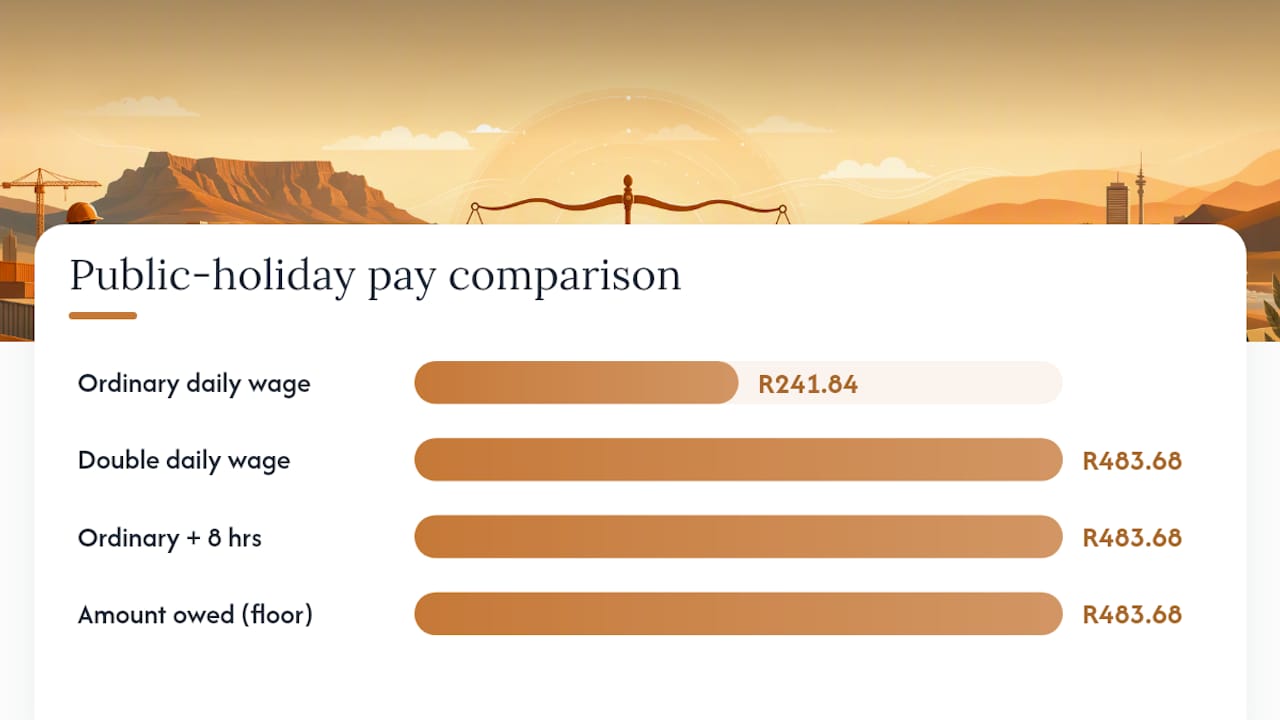
Once you have that daily figure, the “greater of” rule takes over for anyone who works on the holiday. You compare two numbers, double the ordinary daily wage against the ordinary daily wage plus actual hours worked, and pay whichever is higher. This protects employees on both ends: someone who works a short shift still gets double pay as a floor, while someone who works a long shift gets properly compensated for the extra hours.
Here’s how that plays out for a worker earning R30.23 an hour on an 8-hour day, a figure drawn from a widely used payroll worked example:
| Calculation | Amount |
|---|---|
| Ordinary daily wage (8 hrs × R30.23) | R241.84 |
| Double ordinary daily wage | R483.68 |
| Ordinary wage + hours worked (if equal to 8 hrs) | R483.68 |
| Amount actually owed | R483.68 (the floor) |
Pro Tip: If an employee works only 4 hours on the holiday, don’t pay half of R483.68. Compare double the full daily wage (R483.68) against the ordinary wage plus 4 hours’ pay, and pay the higher figure. Double pay usually wins for partial shifts.
For shift work spanning midnight into a public holiday, apply the majority-of-hours rule: whichever day carries the bulk of the shift is the day the law treats as worked, which settles most disputes over which rate applies before they start.
Getting Consent Right: Agreements and Time Off in Lieu
An employer can only require holiday work with the employee’s agreement, whether that’s a general clause in the employment contract or a specific request closer to the date. Refusing to work an unagreed holiday shift is not misconduct.
Employers also have a lawful alternative to double pay: offering a paid day off in lieu, but only with the employee’s written agreement at the time. You cannot impose this unilaterally, and a verbal understanding won’t hold up if the arrangement is ever disputed.
Solid contracts and internal policy should cover:
- A clear consent clause addressing holiday work, ideally reviewed against current employment contract standards.
- A substitution or “swap” clause explaining how alternative days off are requested and confirmed.
- A recordkeeping requirement that captures every agreement in writing, even a quick email confirmation.
Keep dated copies of every consent and substitution agreement in the employee’s file. If a wage dispute ever reaches the CCMA, the paper trail is what settles it.
Sundays, Shift Boundaries, and the Earnings Threshold
Four situations account for most public holiday pay disputes:
- Sunday holidays. When a public holiday falls on a Sunday, both that Sunday and the following Monday count as public holidays, a position confirmed in practice and reported on by industry commentary. Employers sometimes miss the Monday obligation entirely.
- Shift boundaries. Apply the majority-of-hours rule to decide which calendar day governs pay, and document the method used so it’s consistent across your workforce.
- Closedown periods. Public holidays falling within an annual shutdown are still paid as public holidays; they don’t get absorbed into annual leave allocations.
- The earnings threshold. Employees earning above the specified annual earnings threshold fall outside Section 18(3), meaning the “ordinary wage plus hours worked” rule for non-ordinary days doesn’t apply to them. Crucially, this exclusion doesn’t touch their Section 18(1) right to refuse unagreed work, or their Section 18(2) right to full pay when a holiday falls on a normal working day.
A Payroll Compliance Checklist for Employers
Getting public holiday pay right is mostly a matter of sequencing. Start by identifying, for each employee and each holiday, whether that day counts as an “ordinary working day” for them individually, since rosters vary and one employee’s holiday might be another’s regular day off.
From there, calculate RDP or ADP as appropriate, apply the greater-of rule, and keep the calculation on file, not just the final number. Payslips should separately show ordinary hours and holiday hours, consistent with standard payslip requirements, and payment must land on the employee’s usual payday, not a delayed catch-up cycle.
The most common pitfalls are simple to avoid once you know to look for them:
- Paying only the normal daily rate when double pay or the greater-of calculation was due.
- Delaying payment past the usual payday, even by a few days.
- Skipping the written consent step and treating holiday work as automatically owed.
Pro Tip: Run a quarterly audit comparing holiday-hour payslip entries against your roster. Most underpayment errors get caught here, long before an employee raises a formal query.
What Employees Should Do About a Suspected Underpayment
If your payslip looks off, work through this sequence before escalating anything:
- Recalculate your own pay using your hourly or daily rate against the greater-of rule described above.
- Gather your payslip, roster for that week, employment contract, and any written consent or lieu-day agreement.
- Raise the discrepancy with HR or payroll in writing, referencing the specific date and your calculation.
- If it isn’t resolved within a reasonable timeframe, escalate to the CCMA or your provincial labour inspectorate, or consult an employment lawyer for larger or repeated disputes.
Most underpayment cases trace back to a simple miscalculation rather than bad faith, so a written query often resolves things faster than a formal complaint.
Why Specialist Payroll Support Matters Here
Public holiday pay looks straightforward until you’re running it across dozens of employees with different rosters, rates, and thresholds. Getting the greater-of calculation wrong, or missing an EMP201 filing deadline, creates real liability. Specialist South African payroll and Employer of Record support exists precisely because these calculations compound quickly at scale, and accuracy on statutory filings like PAYE, UIF, and COIDA isn’t optional.
— Roel
How Expandtosouthafrica Keeps You Compliant
Getting public holiday pay wrong isn’t a rounding error, it’s a labor law violation that can land you in front of the CCMA. Expandtosouthafrica exists to take that risk off your plate entirely. We handle BCEA-compliant employment contracts, run your ZAR payroll with correct greater-of calculations built in, and manage every statutory filing your South African employees generate: PAYE through EMP201, UIF, SDL, and COIDA.
Instead of building an internal payroll function to track earnings thresholds and Sunday-Monday rules, you get a licensed local partner handling it for a flat fee starting from £299 per employee per month, with no setup fees and no FX loading. If you’re hiring in South Africa or already have staff there and want your payroll audited for compliance, check our EOR pricing and start onboarding within days.
This article is general information, not a substitute for advice from a qualified lawyer. Consult a qualified legal professional about your own circumstances before acting on anything here.
Sources
- Public Holidays Act 36 of 1994
- BCOE97: 18. Public holidays
- Public Holidays
- Working on a Public Holiday: Your Right to Rest — or Double Pay?
FAQ
Are public holidays double pay in South Africa?
Only if the employee works on a public holiday that falls on their ordinary working day. In that case, the employer pays the greater of double the ordinary daily wage or the ordinary wage plus hours worked, under Section 18(2) of the BCEA.
Are there any paid public holidays in South Africa if I don’t work?
Yes. If a public holiday falls on a day you’d normally work but you don’t work that day, you still receive your full ordinary daily wage. This applies to full-time, part-time, and casual employees covered under the BCEA.
How much will I get paid for holiday pay?
It depends on whether the day is an ordinary working day for you and whether you work it. Using a R30.23 hourly rate over an 8 hour day as an example, the double-pay floor comes to R483.68, though your own rate and hours will produce a different figure.
What are public holiday rates in South Africa?
There’s no separate flat “rate,” it’s a calculation. You either receive your ordinary daily wage for not working, or the greater of double pay versus wage plus hours worked if you do work, with an earnings threshold of R261,748 per year excluding higher earners from the non-ordinary-day rule.
Does Expandtosouthafrica handle public holiday pay calculations for employers?
Yes. As part of its Employer of Record service, Expandtosouthafrica runs BCEA-compliant ZAR payroll, including the greater-of public holiday calculation, alongside PAYE, UIF, SDL, and COIDA filings for employers hiring in South Africa.