

To source talent in South Africa from abroad, match the channel to the role (referrals, niche boards and professional bodies for technical hires; search firms for senior ones), screen remotely with consent-based checks, and decide early who will legally employ the person. Sourcing is only half the job. A candidate you find on Monday still needs a compliant contract, ZAR payroll and statutory filings before the first working day.
This guide is written for founders, HR leads and finance decision-makers in the US, UK and Europe who are hiring their first South African employee, or their tenth. It covers where the talent is, which channels work, how to vet candidates, what the law expects, and how the cost and timeline add up.
TL;DR
- South Africa has the deepest online job market among the Sub-Saharan countries studied by the World Bank, so skilled candidates are findable; the work is in filtering, not finding.
- Use several channels and match them to the role: referrals and niche communities for technical roles, job boards for volume roles, search firms for executives.
- Background checks need the candidate’s consent, and criminal record checks require fingerprints. Start them before the offer is final.
- Decide between contractor and employee before you source. South African law looks at how the work is done, not at the label on the contract.
- Sourcing and employment are separate costs. We deliver both for a flat employment fee of $399 per employee per month, with sourcing quoted on our talent sourcing page.
Table of Contents
- Why South Africa works as a hiring market
- Choose the channel by role type
- Screening South African candidates remotely
- Contractor or employee: decide before you source
- What South African law means for a new hire
- Costs and timelines to plan for
- Our perspective: source and employ in one place
- How we can help
- FAQ
- Sources
Why South Africa works as a hiring market
A World Bank study of nearly 5 million online job vacancies between 2020 and 2024 found that South Africa had the highest volume of online postings among the four countries studied, with over 1 million unique postings in 2023. The same study found that nearly half of postings across the four countries require at least one digital skill. For you, that means an active, digitally oriented labor market with employers competing for the same people, and candidates who are used to structured recruitment.
Three practical advantages explain why European, UK and US teams look here:
- Time zone overlap. South Africa sits within about one hour of Central European Time, so a European team shares nearly its whole working day. For a US East Coast team the overlap is shorter, typically a morning window, which is workable for async-first engineering and support teams.
- Cost. For skilled roles, salaries typically run 40 to 60 percent below UK and EU levels, which is the range we see when clients compare offers. Treat this as a planning figure, then check it against the role and seniority you need with our public employment cost calculator.
- English-language business culture. Contracts, documentation and day-to-day work happen in English.
The flip side is competition for senior engineers, who are often courted by several international employers at once. Speed and a clear, compliant offer matter more than a low number.
Choose the channel by role type
No single channel fits every role. General recruiting guidance is consistent on this: technical roles are best served by referrals, AI-assisted sourcing, niche job boards and professional associations, entry-level or high-volume roles suit job boards and social media, and executive roles suit search firms, referrals and professional networks. Applied to South Africa, that looks like this:
| Role type | Channels that tend to work | Watch out for |
|---|---|---|
| Software engineers, data, DevOps | Referrals, niche developer communities, professional associations, outbound sourcing on professional networks | Counter-offers from current employers; long notice periods |
| Customer support, operations | Local job boards, social media, structured assessments | Volume of unqualified applicants; consistency of screening |
| Finance, marketing, sales | Specialist recruiters, professional networks, referrals | Compensation expectations that include bonuses or 13th-cheque structures |
| Directors and executives | Retained search firms, board and peer networks | Longer timelines; confidentiality |
Industry bodies are also building their own talent pipelines. In August 2026 SAICTA launched a careers portal connecting ICT professionals and jobseekers with opportunities, which is worth watching if you hire technology staff.
Combine inbound and outbound
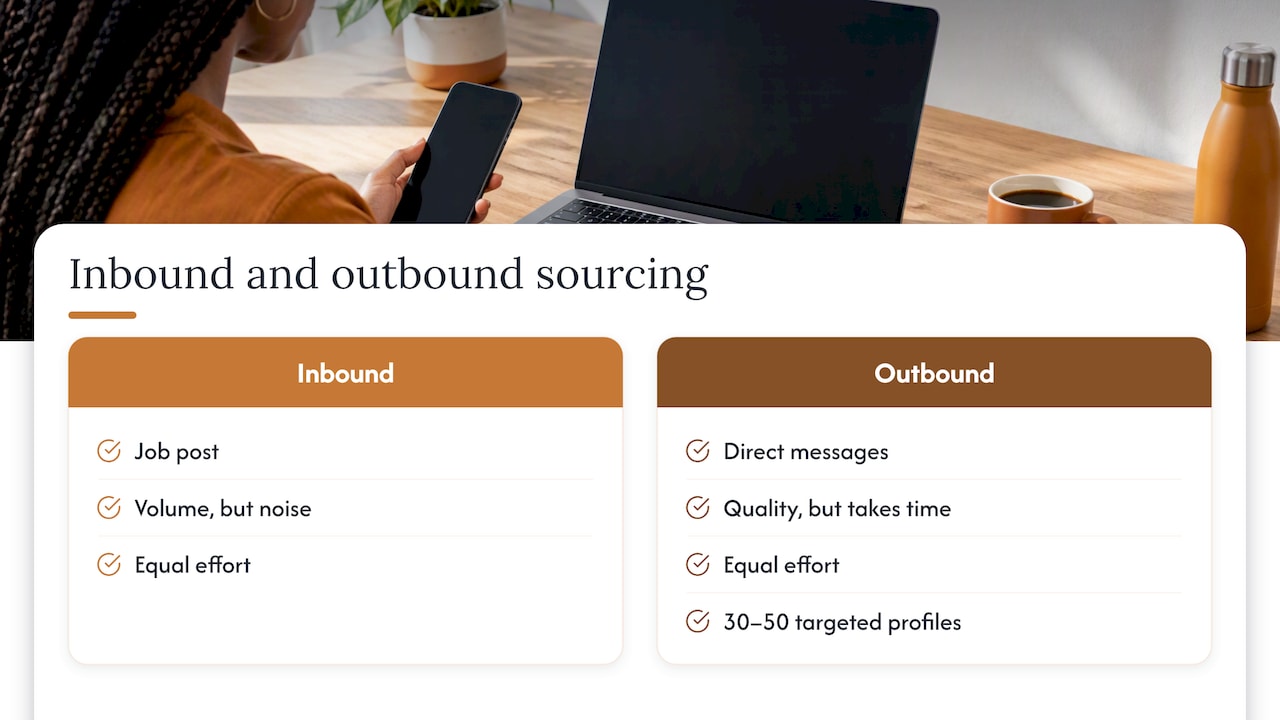
A sound sourcing plan uses several channels and balances inbound applications with outbound outreach. Inbound (a job post) gives you volume but also noise. Outbound (direct messages to people who match) gives you quality but takes time. For a first hire abroad, we suggest posting a precise role description, then spending equal effort on a shortlist of 30 to 50 targeted profiles.
Re-engage the people you already know
If you have run South African searches before, or have a pool of past applicants, start there. Rediscovering candidates already in your ATS or CRM is often the highest-return sourcing method, because they already know your brand. Simple tools help here: a QR code hiring setup for re-engaging candidates can bring people from events or printed material back into your pipeline, with scan tracking showing which touchpoints worked.
Screening South African candidates remotely
Remote screening works well when you standardize it. A process we recommend to clients:
- Written role scorecard. Four to six outcomes the person must deliver in the first six months, with the skills each requires.
- Short structured first call. The same questions for every candidate, scored against the scorecard.
- Work sample. A paid or time-boxed task that mirrors real work, such as a code review, a support-ticket queue or a reporting exercise.
- Panel interview with the future manager. Include a conversation about working hours, because overlap with your time zone should be agreed before the offer, not after.
- References and checks. Run these once you have a preferred candidate, with written consent.
Pay attention to communication in writing. In a remote role, clear written English is a core skill, and a work sample reveals it faster than a conversation does.
What you can verify
Employers may check qualifications, references and employment history, with consent advisable; criminal record checks require the candidate’s consent and fingerprints. Because fingerprinting requires the candidate to attend in person, build that step into your timeline. Our guide to background checks in South Africa walks through what to request and in what order.

Also confirm the candidate’s right to work in South Africa. A South African citizen or permanent resident is straightforward; a foreign national living in the country needs the right permit, and you should ask for documentary proof rather than relying on a statement.
Contractor or employee: decide before you source
Many foreign companies begin by engaging a South African freelancer, then discover the arrangement has become full-time employment in practice. South African law has a rebuttable presumption of employment for lower-earning workers: if factors such as control over hours, integration into the business or economic dependence are present, the person may be treated as an employee. The earnings threshold is adjusted periodically, so check the current figure with the Department of Employment and Labour.
The practical rule of thumb: if the person works set hours for you, uses your tools, takes instructions from a manager and depends on you for most of their income, plan on employment. That brings leave, notice, UIF and unfair dismissal protection into play.
You then have three routes:
- Set up your own South African entity. Full control, but company registration, a payroll registration with SARS, a bank account and ongoing compliance come first. It rarely pays off for fewer than a handful of hires.
- Keep a contractor. Appropriate for genuine project work with a real independent business, not for a de facto full-time team member.
- Use an Employer of Record (EOR). A licensed local entity is the legal employer, and you direct the daily work. This is the route we provide. See our guide to US hiring routes in South Africa for how the three compare on payroll and risk, and our overview of EOR risks for what to check with any provider.
If you are converting an existing contractor, tell them early. They gain statutory protection and benefits, and it is usually best explained as a move to a more secure arrangement with the same day-to-day work.
What South African law means for a new hire
Sourcing a candidate commits you to a set of rules from the first day. The headline ones:
- The BCEA applies to almost all employees. The Basic Conditions of Employment Act covers all employees and employers except members of specified defence and intelligence services and unpaid volunteers. Its working-time chapter excludes senior managers, certain sales staff and employees working fewer than 24 hours a month. See our note on BCEA working hours.
- Annual leave. The same Act entitles employees to at least 21 consecutive days of paid annual leave per leave cycle.
- Sick leave, public holidays and notice. These are statutory too. We cover them in sick leave, public holiday pay and notice periods.
- Written terms. Contracts must state the core terms of employment; our checklist of essential contract clauses shows what to include. If you plan a fixed-term arrangement, read the 3-month rule for fixed-term contracts first.
- Payslips. Every employee must receive a compliant payslip; see the payslip requirements.
- Proposed changes. The Department of Employment and Labour has published proposed BCEA amendments, including written terms for on-call, zero-hours or min-max contracts that state guaranteed hours, maximum hours, availability periods and reasonable notice. Standard full-time roles are not the target, but the direction of travel is toward more written certainty.
Tax and payroll
If you employ people directly, SARS expects you to register: employers must register for employees’ tax within 21 business days of becoming an employer, unless none of their employees are liable for normal tax. The same guide covers the Skills Development Levy (SDL) and Unemployment Insurance Fund (UIF) obligations. Employers and employees each contribute 1 percent of remuneration to UIF monthly, and the employer remits both shares to SARS. Our page on employer payroll taxes puts the steps in order, and our payroll services page explains how monthly ZAR payroll and reconciliation are handled.
Also factor in COIDA (workplace injury cover) and POPIA, South Africa’s data protection law, which applies to the candidate and employee data you collect during sourcing.
Costs and timelines to plan for
Budget in three layers, and keep them separate so you can compare offers fairly.
- Sourcing. Recruiter or sourcing fees are usually a one-off charge tied to the hire. Ask any provider whether the fee is charged once or monthly, what the replacement guarantee is, and whether it is calculated on base salary or total package. Our sourcing terms are on the talent sourcing page.
- Employment cost. Gross salary plus employer contributions (UIF, SDL, COIDA) plus any benefits such as a retirement fund or medical aid that the role calls for. Use the public calculator for an estimate by role.
- Employment platform fee. With an EOR, a per-employee monthly fee. Ours is flat: $399 per employee per month (€350 or £299 in those currencies), with no setup fees or FX loading. Full details sit on our pricing page.
A realistic timeline for a skilled hire:
| Stage | Typical duration |
|---|---|
| Role definition and sourcing | 2 to 4 weeks |
| Screening, work sample and interviews | 2 to 3 weeks |
| Reference and background checks | 1 to 2 weeks |
| Notice period of the candidate | 1 to 4 weeks, depending on their contract |
| Contract and onboarding with an EOR | Contracts within 48 hours; onboarding within days |
The first four rows are planning estimates that vary by role and seniority, not guarantees. The last row reflects our own process. The candidate’s notice period is the item most often forgotten; ask about it in the first call.
Our perspective: source and employ in one place
Most foreign employers treat sourcing and employment as two unrelated projects, then discover the gap between them. A recruiter delivers a great candidate, and the hiring company has no entity, no payroll and no one to issue a BCEA-compliant contract. Offers go cold in that gap.
We built Expand to South Africa around one country because that gap is a local problem. A licensed local partner is the legal employer, and we are open about that: you direct the work, the partner holds the employment relationship, handles ZAR payroll, and files PAYE, UIF, SDL and COIDA. When we source for you, the same team already knows what the contract, the notice period and the payroll will look like, so the candidate gets a clear offer fast.
Two things we tell every client. First, spend more time on the scorecard than on the job ad; the right brief halves the screening effort. Second, if you ever need to part ways, South African dismissal rules are procedural and the CCMA reviews the process as much as the reason. Document performance from week one.
— Roel
How we can help
If you want one team to find the person and employ them, our Employer of Record service covers compliant contracts, payroll and filings for a flat fee, and our talent sourcing service supplies vetted candidates for skilled roles. Already working with a provider? We handle transfers from other EOR providers at no charge.
For tech roles specifically, our overview of South African tech recruiters for US employers shows what to expect from the market.
FAQ
How do I find skilled professionals in South Africa if I have no local presence?
Use a mix of referrals, niche communities and professional associations for technical roles, and add a sourcing partner if you want vetted shortlists. Pair that with a way to employ the person legally, such as an Employer of Record, so an offer can be made quickly.
Can I run background checks on South African candidates?
Yes. You can check qualifications, references and employment history, ideally with written consent. Criminal record checks need the candidate’s consent and fingerprints, so allow time for the candidate to complete that step.
Should I hire a South African professional as a contractor or an employee?
If they work set hours, take direction and depend on you for most of their income, treat them as an employee. Genuine independent project work can stay contractual. South African law presumes employment for lower-earning workers when certain factors are present.
How long does it take to hire someone in South Africa?
The search itself commonly takes several weeks, plus the candidate’s notice period. Once a candidate accepts, we issue signed contracts within 48 hours and complete onboarding within days.
Do I need a South African company to hire there?
No. An Employer of Record acts as the legal employer, so you can hire full-time staff without a local entity. You still direct the work, and the provider carries payroll and statutory filings.
Sources
- World Bank: Digital skills for Africa
- Recruitee: Recruitment methods and when to use them
- Engineering News: SAICTA job portal
- Gem: How to source candidates
- Cognitive: Candidate sourcing channels compared
- DLA Piper: Global Expansion Guide, Employment (South Africa)
- Department of Employment and Labour: Basic Conditions of Employment Act
- Department of Employment and Labour: Labour law amendment bills
- SARS: Guide for Employers in respect of Employees’ Tax