

UK employees earn more in nominal terms, with median gross annual earnings of £39,039 in April 2025, while South African wages sit far lower in rand terms. Once you account for cost of living and purchasing power, that gap narrows considerably, and in some categories South African earners come out with similar local buying power. The sections below walk through the headline figures, the tax treatment, and what employers should budget for each market.
TL;DR:
- South Africa publishes aggregate quarterly wage bills rather than a national median, so compare salaries by role, sector, seniority, and city instead of headline averages.
- For fair comparisons, convert gross pay with World Bank or OECD purchasing power data, then compare after tax income and local rent, food, and transport.
- UK employees receive a £12,570 Personal Allowance, while South Africa’s primary rebate creates an approximately R99,000 tax threshold for people under 65 in 2026/27.
- South African employers owe UIF, SDL, and COIDA contributions, while UK employers pay National Insurance and workplace pensions; compare total employment cost, not salary alone.
- Sponsored UK work applicants generally need £1,270 for maintenance unless their employer certifies support, and should budget for a deposit, flights, and first month’s living costs.
Table of Contents
- 1. Headline Salary Statistics in the UK and South Africa
- 2. How Rent, Groceries and Transport Compare Across Both Countries
- 3. Using a PPP Converter to Compare Real Wages
- 4. Role-by-Role Salary Gaps: Software, Finance and Audit
- 5. Tax Rules That Change Take-Home Pay in Each Country
- 6. Relocation Costs and UK Visa Financial Requirements
- 7. Statutory Contributions: UIF and COIDA vs National Insurance
- 8. Working Hours, Overtime and Leave Entitlements Compared
- 9. Why the ZAR-GBP Exchange Rate Matters for Pay in Either Currency
- 10. Healthcare and Social Security: Who Covers What
- 11. What BCEA and UK Employment Law Mean for Pay Negotiations
- Why the Salary Gap Gets Overstated in Most Comparisons
- A Faster Way to Hire in South Africa Without Setting Up a Local Entity
- FAQ
- Sources
1. Headline Salary Statistics in the UK and South Africa
Before comparing purchasing power or tax treatment, you need a reliable gross baseline. The most recent ONS Annual Survey of Hours and Earnings puts median gross annual earnings for full-time UK employees at £39,039 in April 2025, up from £37,439 the year before. That increase reflects broader wage growth across most UK sectors rather than a shift in any single industry.
South Africa’s equivalent data comes from Statistics South Africa’s Quarterly Employment Statistics, which track aggregate wage bills rather than a single median figure. The June 2026 QES release shows total basic salary and wages paid to employees in South Africa reached R930.1 billion for the quarter, a year-on-year increase across most sectors Statssa tracks.
These national averages mask real variation:
- UK earnings skew higher in London and the South East, with finance and tech roles pulling the median up well above the figure for the North East or Wales.
- South African pay varies by industry too, with mining, finance and professional services sitting above the national QES average and retail or hospitality typically below it.
- Public sector and private sector pay structures differ in both countries, so a direct role-to-role comparison needs sector context, not just a national headline number.
Treat these figures as a starting point rather than a precise match for any individual role. A software engineer salary breakdown for South Africa illustrates how far actual pay for in-demand roles sits above the national average.
2. How Rent, Groceries and Transport Compare Across Both Countries
Gross salary numbers only tell part of the story. What that salary buys locally, particularly for rent, food, and getting to work, determines whether a UK paycheck actually stretches further than a South African one.
Rent is the biggest swing factor. London rents consume a large share of gross pay for most tenants, especially for anyone renting alone inside Zones 1 to 3. Cape Town and Johannesburg rents sit well below London in absolute terms, though salaries are proportionally lower too, so the share of income spent on housing can land in a similar range depending on the neighborhood and property type.
Groceries and dining out tend to cost noticeably less in South African rand terms when converted to pounds, though city-level cost indexes show meaningful gaps between Johannesburg, Cape Town and smaller metros, so a single national average can be misleading for budgeting purposes.
A few patterns show up consistently when comparing the two markets:
- Fuel and private transport costs in South Africa are generally lower than UK equivalents, though public transport coverage is far more limited outside major city centers.
- Home internet and mobile data in South Africa have become more competitively priced in recent years, narrowing what was once a wider gap with UK providers.
- Utilities in South Africa carry more variability due to load-shedding related backup power costs, which many UK renters simply do not factor into a household budget.
City choice inside each country often matters more than the country-level average, since London versus a smaller UK city creates a gap nearly as wide as the one between the UK and South Africa overall.
3. Using a PPP Converter to Compare Real Wages
Purchasing power parity adjusts a salary for what it actually buys locally, rather than what it converts to at the market exchange rate. A rand salary that looks small once converted to pounds at the daily exchange rate can represent solid local purchasing power once rent, food and transport in South Africa are factored in.
World Bank PPP conversion data shows a substantial gap between the PPP conversion factor for South Africa and the UK, which is exactly why a straight currency conversion overstates how much poorer a rand salary looks next to a pound one.
To run a sanity-checked comparison yourself:
- Start with the gross salary in each currency and convert it at the current market exchange rate as a baseline.
- Apply a PPP adjustment using a converter built on World Bank or OECD price-level data, rather than the spot exchange rate alone.
- Compare net, after-tax pay rather than gross, since tax treatment differs significantly between the two systems.
- Check the PPP-adjusted figure against actual local prices for rent, groceries and transport in the specific city you are comparing, not just the national average.
Pro Tip: Never rely on a single PPP number in isolation. Cross-check it against at least one real category, like average rent for a one-bedroom flat, so the final comparison reflects a place you can actually picture.
4. Role-by-Role Salary Gaps: Software, Finance and Audit
National averages hide how much the UK to South Africa pay gap shifts depending on role and seniority. Skilled, globally traded roles like software engineering tend to show a smaller real gap once cost of living is factored in, while entry-level administrative roles show a wider one.
- Software engineers: mid-level South African engineers often earn in the range outlined in our software engineer salary guide, which sits well below UK nominal pay but closes significantly on a PPP-adjusted basis given lower South African living costs.
- Financial analysts: UK financial analyst pay tends to run meaningfully higher in nominal terms, though South African financial centers like Sandton offer competitive local packages against the cost of living in Johannesburg.
- IT managers: the nominal gap for IT management roles is often wider than for individual contributor tech roles, reflecting a thinner senior tech leadership market in South Africa relative to the UK.
- Audit and accounting roles: qualified auditors in South Africa, particularly those with SAICA accreditation, earn salaries that compare favorably on a PPP basis to UK equivalents, since professional qualifications transfer well internationally.
Seniority, bonuses, and equity compensation widen these gaps further in the UK, where senior tech and finance roles frequently include substantial bonus or share components that are less common in equivalent South African packages. Our salary benchmark guide breaks these ranges down by role for employers budgeting a South African hire.
5. Tax Rules That Change Take-Home Pay in Each Country
Gross salary comparisons mean little without accounting for how much each country takes in tax. The UK’s Personal Allowance lets individuals earn £12,570 tax-free before the basic rate of 20% applies to income above that threshold.
South Africa’s system works differently, through a primary rebate rather than a flat allowance. SARS tax tables for 2026/27 show the primary rebate produces an effective tax threshold of around R99,000 for individuals under 65, below which no income tax is due.
To see how this plays out:
- A UK employee earning the £39,039 median salary pays basic rate tax on everything above £12,570, after National Insurance is also deducted.
- A South African employee earning the QES-reported average wage pays no income tax at all if their annual income falls under the roughly R99,000 threshold, though most full-time salaries sit above that line.
- Employers budgeting South African hires need to register for PAYE and file EMP201 returns monthly, a process our PAYE threshold guide walks through for HR teams new to the system.
6. Relocation Costs and UK Visa Financial Requirements
Moving between the two countries involves cash requirements beyond the cost of the plane ticket. Anyone relocating to the UK on a sponsored route should check current GOV.UK financial evidence guidance, which generally requires showing access to £1,270 for maintenance unless the sponsor certifies it will cover this cost.
For sponsored skilled worker routes specifically, UK employers also need to meet salary threshold tests, which a detailed breakdown of the £41,700 threshold explains for employers planning to sponsor overseas hires.
Beyond the visa maintenance figure, budget for these common relocation costs:
- Rental deposits in the UK typically run five to six weeks’ rent upfront, on top of the first month’s payment.
- One-way flights and shipping personal belongings add a one-time cost that varies widely by how much is being moved.
- Initial living costs for the first month before a first paycheck lands are worth budgeting separately from ongoing monthly expenses.
Sponsorship through an employer removes much of the personal financial-proof burden, which is one reason many movers prefer a sponsored route over a personal visa application where funds have to be demonstrated independently.
7. Statutory Contributions: UIF and COIDA vs National Insurance
Gross salary is never the full employment cost. Both countries require mandatory statutory contributions on top of pay, and these differ enough to change total cost to company by several percentage points depending on the structure chosen.
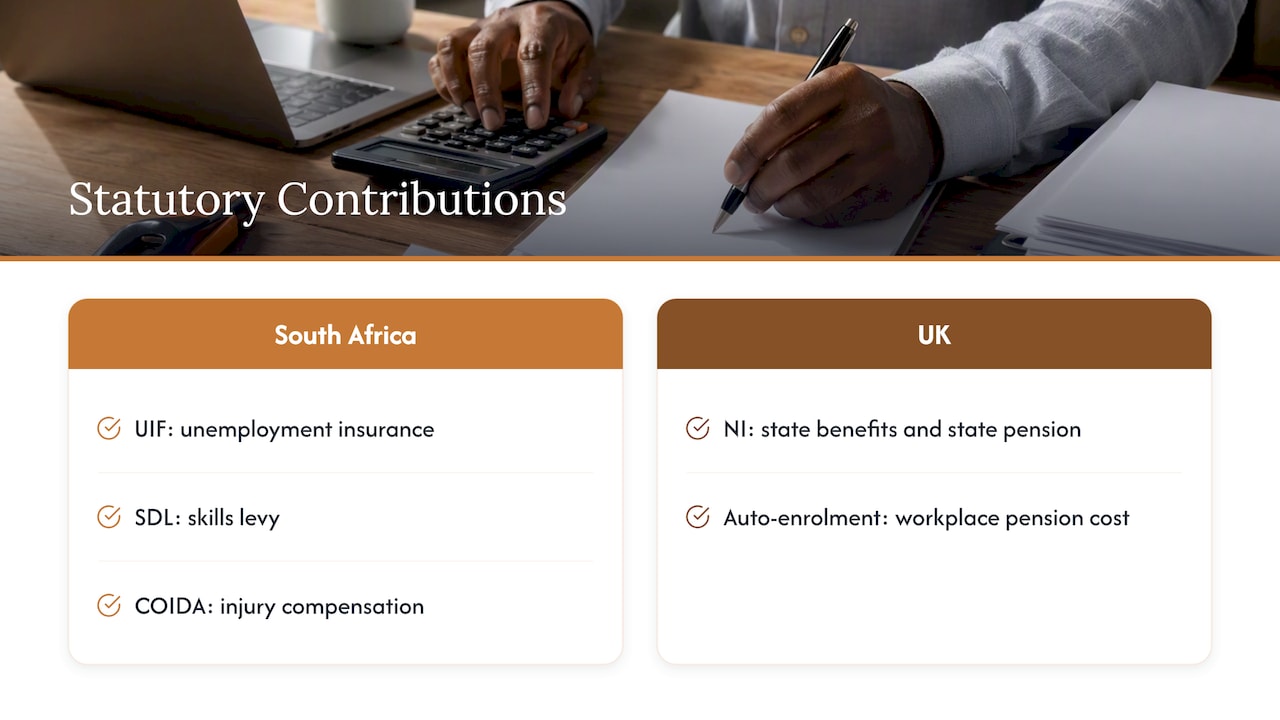
In South Africa, employers contribute to the Unemployment Insurance Fund, the Skills Development Levy, and the Compensation for Occupational Injuries and Diseases fund. These are standard payroll obligations alongside PAYE withholding, and getting the filings wrong creates compliance exposure that a total cost to company breakdown sets out in full for employers new to the South African system.
In the UK, the equivalent employer obligations run through National Insurance contributions and, for most employees, auto-enrollment pension contributions under workplace pension rules. National Insurance funds state benefits and the state pension, while pension auto-enrollment adds a separate, ongoing cost that UK employers must factor into every salary offer.
Neither system is simply cheaper than the other across the board. South African statutory contributions are proportionally smaller as a share of salary, but the UK’s higher nominal salaries mean the absolute pension and National Insurance cost per employee can still be substantial. Employers comparing total employment cost, not just gross salary, need to model both sides of this equation before deciding where a role gets filled.
8. Working Hours, Overtime and Leave Entitlements Compared
Total compensation is not only about the number on the payslip. Working hours, overtime rules and leave entitlements shape how much a salary is actually worth in time and flexibility.
South Africa’s Basic Conditions of Employment Act sets ordinary working hours and overtime pay rules that apply to most employees, along with statutory annual leave and sick leave entitlements that employers must honor regardless of what is written into an individual contract. UK employment law sets its own framework for working time, with statutory limits on average weekly hours and a minimum statutory holiday entitlement that most full-time UK employees receive on top of public holidays.
The practical difference employers and relocating workers notice most is how leave accrues and how overtime gets calculated, since neither system maps neatly onto the other. A role that looks identical on paper can carry meaningfully different work-life balance depending on which country’s statutory floor applies, and employers hiring across both markets need contracts that reflect the correct local minimum rather than assuming one country’s norms apply everywhere. Our employment contract clauses guide for South Africa covers how these entitlements need to appear in a compliant contract.
9. Why the ZAR-GBP Exchange Rate Matters for Pay in Either Currency
Anyone paid in one currency while living in, or comparing costs to, the other needs to understand how exchange rate movement affects real income over time. The rand has historically been more volatile against the pound than many developed-market currency pairs, which means a salary that looks competitive in GBP terms today can shift meaningfully in local purchasing power within a single year if the exchange rate moves.
For employees paid in ZAR while covering any GBP-denominated costs, such as UK loan repayments or family support, rand depreciation effectively cuts the real value of that support without any change to the nominal salary. The reverse applies for anyone paid in GBP while living with rand-denominated costs: currency strength in their favor stretches a fixed salary further, though it can reverse just as quickly.
This volatility is a real factor employers should flag when structuring pay for cross-border roles. A contract that pins pay to GBP but delivers services or sourcing on the ground in rand terms removes some of this exposure from the employee, which is one reason many employers prefer a locally denominated, fixed-fee arrangement over running informal cross-currency payroll themselves.
10. Healthcare and Social Security: Who Covers What
Healthcare coverage and social security structure differently enough between the two countries that they materially affect what an employment package is actually worth to the person receiving it.
The UK’s National Health Service provides tax-funded healthcare access to all residents, which means a UK salary offer does not need to account for private health insurance as a baseline expectation, though many employers add it as a benefit on top. South Africa’s public healthcare system exists alongside a large private healthcare and medical aid market, and most mid-level and senior roles come with an expectation of employer-supported medical aid contributions as part of a competitive package, since relying solely on public healthcare is less common for professional-level employees.
This difference changes how employers should think about total package value. A South African offer that excludes medical aid support looks less competitive locally than the same nominal salary would suggest, even though no equivalent gap exists on the UK side where NHS access is a given. Employers building offers for South African hires need to budget this in explicitly, not treat it as an optional add-on the way it might be treated in a UK context.
11. What BCEA and UK Employment Law Mean for Pay Negotiations
Salary negotiations do not happen in a legal vacuum, and the statutory floor each country sets shapes what is actually negotiable. South Africa’s Basic Conditions of Employment Act and Labour Relations Act set minimum standards for pay, notice periods, and dismissal procedures that every employment contract must meet, regardless of what a candidate and employer agree to informally.
UK employment law operates on a different statutory framework entirely, with its own rules on minimum wage, notice periods, and unfair dismissal protections that accrue differently based on length of service. A contract drafted for a UK hire cannot simply be relabeled for a South African one, since core protections like CCMA dismissal procedures in South Africa have no direct UK equivalent and need their own compliant drafting.
For employers negotiating pay across both markets, this matters most at the contract stage. A salary figure that looks generous on paper can create compliance exposure if the underlying contract terms do not meet the statutory minimums each country requires, which is why role-specific, country-compliant contract templates matter more than a generic offer letter copied across borders.
Why the Salary Gap Gets Overstated in Most Comparisons
Most salary comparison content treats the UK-South Africa gap as a simple currency conversion problem, and that framing misses what actually matters to someone deciding where to work or where to hire. A rand figure that looks modest next to a pound salary can represent genuinely comparable local purchasing power once rent, food and transport are priced in at the city level rather than the national average.
The more useful question is rarely “which country pays more” but “what does this salary actually buy where the person lives.” Employers who skip that step end up either overpaying for South African roles relative to local market rates or underpaying for UK roles relative to what London or Manchester actually costs. Both mistakes are avoidable with the same discipline: compare net pay, not gross, and check at least one real local price category before finalizing an offer.
— Roel
A Faster Way to Hire in South Africa Without Setting Up a Local Entity
Once you have modeled the salary gap and total cost picture, the practical question becomes how to actually employ someone in South Africa compliantly. An Employer of Record handles the local employment relationship on your behalf: compliant contracts, ZAR payroll, PAYE filings with SARS, and statutory UIF, SDL and COIDA contributions, so you never need to register a local entity just to hire one person.

We focus exclusively on South Africa rather than spreading across dozens of markets, which means every contract, payroll run and filing reflects current BCEA and SARS rules rather than a generic template. Our Employer of Record services in South Africa run from £299 per month per employee with no setup fees, and signed contracts typically land within 48 hours.
- Employment is delivered through a licensed local partner, ensuring clear legal responsibility for your team.
- We offer flat monthly pricing to help keep budgeting predictable regardless of currency fluctuations.
- Vetted talent sourcing is available for employers who need help finding the right South African hire, not just employing one already identified.
| What you need | How we handle it |
|---|---|
| Compliant BCEA contract | Drafted and issued through our licensed local partner |
| ZAR payroll and PAYE filing | Processed monthly with SARS EMP201 filings included |
| UIF, SDL and COIDA contributions | Filed and paid as part of the flat monthly fee |
Small and mid-size international employers who want a South African hire onboarded in days rather than months typically find this route faster than setting up a subsidiary. Check current pricing and get started on our Employer of Record services in South Africa page.
FAQ
What is the average salary in South Africa?
South Africa does not publish a single national median salary the way the UK does, but Statssa’s Quarterly Employment Statistics report total basic salary and wages paid to employees reaching R930.1 billion in June 2026, with figures broken down by industry. Mining, finance and professional services sectors tend to sit above the broader average, while retail and hospitality sit below it.
Are salaries better in the UK or the USA?
This article focuses on the UK and South Africa, and nominal UK salaries, with a median of £39,039 as of April 2025, are generally higher than South African equivalents in pound terms. A direct UK versus USA comparison depends heavily on role, state or region, and is not covered by the South African data referenced here.
How much money do I need to move to the UK from South Africa?
For sponsored work routes, GOV.UK guidance generally requires showing access to £1,270 for maintenance unless your sponsor certifies it will cover this cost. On top of that, budget for a rental deposit, flights, and at least one month of living costs before your first UK paycheck arrives.
Is it cheaper to live in South Africa or the United Kingdom?
Day-to-day costs like groceries, transport and rent are generally lower in South Africa than in the UK, particularly outside London. PPP conversion data shows the gap between the two currencies narrows significantly once local purchasing power is factored in, rather than relying on the market exchange rate alone.
Sources
- Annual Survey of Hours and Earnings (ASHE) 2025 – ONS
- Quarterly Employment Statistics (QES) – June 2026 – Statssa
- Rates of tax for individuals – SARS