

Every South African employment contract must include, at minimum: the parties’ details and start date; job title and duties; place of work; ordinary working hours and overtime arrangements; remuneration, deductions, and statutory contributions (PAYE, UIF, SDL, COIDA); leave entitlements; probation or fixed-term terms; confidentiality and IP assignment; a restraint of trade clause where relevant; termination and notice provisions; POPIA data-handling obligations; and health and safety references. These requirements flow from the Basic Conditions of Employment Act (BCEA), the Labour Relations Act (LRA), POPIA, and COIDA. A contract that covers only the statutory floor is still a liability. The CCMA sees disputes daily that trace back to vague or missing clauses on probation, IP ownership, and restraints.
If you need a compliant contract drafted now, request a BCEA-ready template from Expandtosouthafrica or run your existing contract against the enforceability checklist in Section 9 below.
- Parties, start date, and employment type (permanent, fixed-term, part-time)
- Job title, duties, and performance standards
- Place of work, mobility, and remote work arrangements
- Ordinary hours, overtime, rest breaks, and meal intervals
- Remuneration, pay frequency, allowances, and statutory deductions (PAYE, UIF, SDL, COIDA)
- Annual, sick, family responsibility, and parental leave entitlements
- Probation period, review criteria, and conversion to permanent employment
- Confidentiality obligations and IP assignment
- Restraint of trade and non-solicitation (with enforceability requirements)
- Termination, notice periods, and disciplinary/grievance procedure references
- POPIA data protection clause and data subject rights
- Health and safety obligations and COIDA incident reporting
- Collective agreement incorporation and dispute resolution mechanism
Key Takeaways
Every South African employment contract must cover the BCEA’s written particulars, go beyond the statutory floor with probation, IP, and restraint clauses, and be backed by consistent documentation to be defensible at the CCMA.
| Point | Details |
|---|---|
| BCEA Section 29 is the floor | Written particulars must be provided on day one; missing them creates inspector and CCMA exposure. |
| Restraint of trade enforceability | Courts uphold restraints that protect a defined interest with reasonable scope; typical enforceable durations are 6–24 months. |
| Probation requires documentation | Written criteria, midpoint feedback, and a signed written outcome are required to defend a probation dismissal. |
| POPIA applies to every employer | Every contract must identify the responsible party and state the employee’s data subject rights under POPIA. |
| Expandtosouthafrica as EOR | Delivers BCEA-compliant contracts within 48 hours, with ZAR payroll and all statutory filings at a flat €350/month. |
This article is general information, not a substitute for advice from a qualified lawyer. Consult a qualified legal professional about your own circumstances before acting on anything here.
Table of Contents
- The statutory framework governing South African employment contracts
- Core employment contract clauses: what to include and how to word them
- Clauses that are unlawful, routinely unenforceable, or high-risk
- How to draft and manage fixed-term contracts and probationary periods
- Termination, notice periods, dismissal categories, and retrenchment basics
- Data protection, confidentiality, and intellectual property clauses
- Health and safety obligations and occupational injury clauses (COIDA)
- Practical drafting tips and an enforceability checklist
- How Expandtosouthafrica helps international employers get BCEA-compliant contracts quickly
- What a specialist who drafts South African contracts actually recommends
- Ready-made BCEA-compliant contracts with payroll and statutory filings included
- Sources
The statutory framework governing South African employment contracts
South African employment law is not a single statute. Five pieces of legislation interact directly with your contract, and each one controls a different layer.
The Basic Conditions of Employment Act (BCEA) is the foundation. Section 29 requires employers to supply written particulars of employment covering the employer and employee details, job title, place of work, start date, hours, remuneration, deductions, leave, and notice periods. These particulars must be given when work commences, not weeks later. Failure to supply them creates an enforcement gap: a labour inspector can issue a compliance order, and at the CCMA, the absence of written terms almost always weakens the employer’s position. Note that Chapter 4 of the BCEA (which covers working hours) does not apply to employees working fewer than 24 hours per month, and there are limited relaxations for employers with fewer than five employees and for domestic workers.
The Labour Relations Act (LRA) governs fixed-term contracts, unfair dismissal protections, and collective bargaining. Sections 198B and 198C constrain fixed-term and part-time arrangements: courts scrutinize renewal patterns, and an employer who cannot document an objective reason for a fixed-term engagement risks a finding of indefinite employment. Schedule 8 of the LRA provides the Code of Good Practice on dismissal, which sets the standard for probation management and procedurally fair termination.
POPIA (the Protection of Personal Information Act) applies the moment you collect, store, or process an employee’s personal data. Employers must have a lawful basis for processing, must limit retention to what is necessary, and must implement security safeguards. For international employers, cross-border transfer of employee data to a country without adequate protection requires a contractual mechanism or operator agreement. Every employment contract should include a clause identifying the employer as responsible party and referencing the employee’s data subject rights.
COIDA (the Compensation for Occupational Injuries and Diseases Act) requires employers to register with the Compensation Fund, report occupational injuries and diseases, and cooperate with claims. Contracts should reference the employer’s COIDA procedure and the employee’s obligation to report incidents promptly.
SARS/PAYE, UIF, and SDL are payroll obligations, not optional contract terms. Employers must deduct PAYE and remit it to SARS via monthly EMP201 returns, contribute to the Unemployment Insurance Fund, and pay the Skills Development Levy where applicable. Your contract must state gross remuneration clearly and identify the lawful basis for every deduction. Vague deduction clauses are a common CCMA flashpoint.
Core employment contract clauses: what to include and how to word them
Going beyond the BCEA minimums is not optional for employers who want defensible contracts. Probation terms, IP ownership, restraints, and remote-work provisions are the clauses most frequently absent from contracts and most frequently litigated at the CCMA.
Parties, job title, place of work, and start date
State the full legal name and registration number of the employer, the employee’s full name and ID number, the job title, a brief description of duties, the commencement date, and the employment type. For fixed-term contracts, state the end date or the objective event that terminates the contract.
Sample: “The Employee is appointed as [Job Title] with effect from [Date]. The primary place of work is [Address]. The Employee may be required to work at other locations on reasonable notice.”
Working hours and overtime
The BCEA sets ordinary hours at 45 per week (9 hours per day for a 5-day week, 8 hours for a 6-day week). Overtime requires a written agreement and is capped at 10 hours per week. The overtime rate is 1.5 times the ordinary wage, or double time on Sundays and public holidays. Compressed workweek arrangements and averaging agreements are permitted under BCEA sections 11 and 12 but must be in writing.
Sample: “Ordinary hours of work are [X] hours per day, [X] days per week. Overtime will be worked only by written agreement and compensated at 1.5 times the ordinary hourly rate, except on Sundays and public holidays where double the ordinary rate applies.”
Remuneration, deductions, and statutory contributions
State the gross monthly or annual salary, the payment date, and the currency (ZAR). List all allowances separately. Any deduction beyond these statutory ones requires a written agreement signed by the employee. Blanket deduction clauses (“the employer may deduct any amount owed”) are unenforceable and draw inspector scrutiny.
For a detailed breakdown of current PAYE bands and thresholds, the South Africa PAYE thresholds guide covers the current tax year figures.
Sample: “The Employee’s gross monthly remuneration is ZAR [X]. The Employer will deduct PAYE in accordance with SARS tables, UIF at the statutory rate, and SDL where applicable. No other deductions will be made without the Employee’s prior written consent.”
Leave entitlements
The BCEA provides: 21 consecutive days (15 working days on a 5-day week) of annual leave per cycle; 30 days of sick leave over a 3-year cycle (6 days in the first 6 months); 3 days of family responsibility leave per year; and 4 consecutive months of unpaid maternity leave. The Parental Leave amendments also provide 10 days of parental leave and adoption/commissioning parental leave entitlements. Contracts should state the leave cycle, the accrual method, and the employer’s policy on leave encashment or forfeiture.
Confidentiality and IP assignment
A confidentiality clause should define “confidential information” specifically rather than using a catch-all. Courts give little weight to clauses that describe everything as confidential. IP assignment should be explicit: work created in the course of employment belongs to the employer, but pre-existing IP the employee brings to the role should be carved out.
Sample IP clause: “All intellectual property created by the Employee in the course of employment, using the Employer’s resources or time, vests in the Employer on creation. Pre-existing intellectual property owned by the Employee prior to the commencement date and listed in Schedule A is excluded from this assignment.”
Probation and performance standards
Schedule 8 of the LRA requires that probation be used to assess suitability, not as a mechanism to avoid procedural fairness. The probation period must be reasonable in length relative to the role. The employer must provide feedback, set measurable criteria, and give the employee an opportunity to respond before any adverse action. Extensions are permissible but must be in writing and justified.
Sample: “The Employee will serve a probationary period of [X] months from the commencement date. Performance will be assessed against the criteria in Schedule B. The Employer will provide written feedback at [intervals]. Successful completion of probation will be confirmed in writing.”
Restraint of trade and non-solicitation
A restraint of trade is presumed valid in South Africa but is enforceable only if it protects a legitimate business interest and is reasonable in scope, duration, and geographic area. Courts apply the Basson v Chilwan test, balancing the employer’s protectable interest (confidential information, client relationships, goodwill) against the employee’s right to earn a living. Practical drafting steps that increase enforceability include defining confidential information, limiting the geographic area and activities covered, fixing a reasonable duration, and including a severability clause so courts can read down over-broad terms.
South African courts treat restraints as valid until shown unreasonable, and typical enforceable durations often fall in the 6–24 month range depending on role seniority and the nature of the protectable interest.
Sample: “For a period of [12] months following termination of employment, the Employee will not, within [defined geographic area], solicit or service clients of the Employer with whom the Employee had material contact during the [24] months preceding termination.”
Termination and notice periods
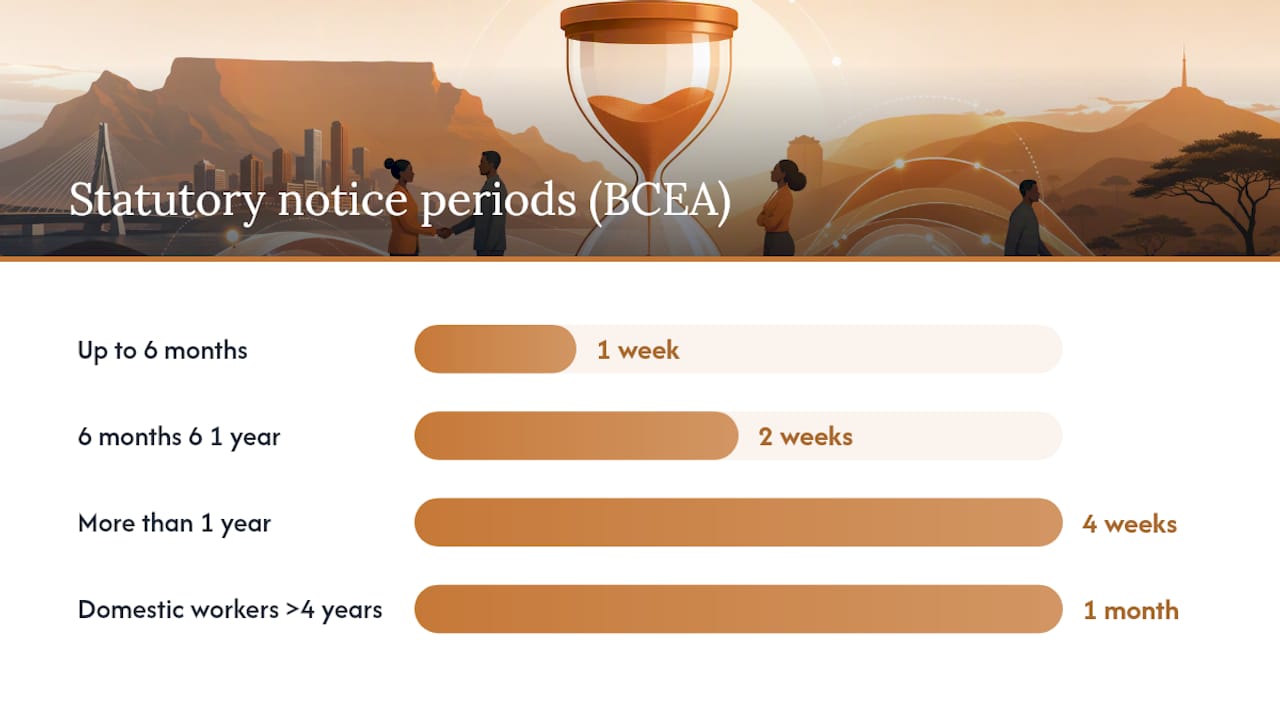
The BCEA sets minimum notice: 1 week for employment of 6 months or less; 2 weeks for 6 months to 1 year; 4 weeks for more than 1 year (or 1 month for domestic workers employed for more than 4 years). Contracts may provide longer notice but not shorter. The disciplinary and grievance procedure should be incorporated by reference to the employer’s policy or set out in a schedule.
| Clause | Required elements | Sample wording (short) | Statutory reference | Common drafting mistakes |
|---|---|---|---|---|
| Parties and start date | Full legal names, ID/reg numbers, commencement date, employment type | “Employed as [Title] from [Date] on a [permanent/fixed-term] basis” | BCEA s 29 | Omitting employment type; using trading name instead of registered entity |
| Working hours | Ordinary hours, overtime agreement, rate | “Overtime by written agreement at 1.5x ordinary rate” | BCEA ss 9, 10 | No written overtime agreement; no cap stated |
| Remuneration and deductions | Gross pay, pay date, currency, statutory deductions listed | “Gross ZAR [X] monthly; PAYE, UIF, SDL deducted per statute” | BCEA s 29; SARS EMP201 | Blanket deduction clauses; net pay stated without gross |
| Leave | Annual, sick, family responsibility, parental cycles | “21 consecutive days annual leave per cycle per BCEA s 20” | BCEA ss 20 | Stating calendar days without specifying cycle; omitting parental leave |
| Probation | Duration, criteria, feedback intervals, conversion | “3-month probation; written review at 6 weeks; confirmed in writing” | LRA Schedule 8 | No measurable criteria; no written feedback record |
| Confidentiality and IP | Definition of confidential info, IP vesting, pre-existing IP carveout | “IP created in course of employment vests in Employer; Schedule A carveout” | Common law; POPIA | Catch-all definition; no carveout for pre-existing IP |
| Restraint of trade | Protectable interest, geographic area, duration, severability | “12-month non-solicit within [area] for clients with material contact” | Common law; Basson v Chilwan | Nationwide blanket ban; no defined protectable interest |
| Termination and notice | Statutory minima, disciplinary procedure reference | “4 weeks’ notice; disciplinary procedure in Schedule C applies” | BCEA; LRA | Notice shorter than statutory minimum; no procedure reference |
Clauses that are unlawful, routinely unenforceable, or high-risk
Poorly drafted clauses do not just fail at the CCMA. They can expose you to fines from labour inspectors, create implied obligations you never intended, and undermine otherwise valid contract terms. These are the most common problem clauses and their one-line fixes.
- Overly broad restraint of trade. A nationwide, multi-year ban on working in any competing role has almost no chance of surviving a court challenge. Fix: Limit the restraint to the specific geographic area where the employee had client contact and to activities that directly threaten a defined protectable interest.
- Vague IP ownership language. “All work product belongs to the employer” without defining scope or carving out pre-existing IP creates disputes when an employee brings proprietary tools or code to the role. Fix: Define “work product” by reference to the employee’s duties and add a Schedule A listing pre-existing IP.
- Blanket deduction clauses. Any clause permitting the employer to deduct “any amount owed” without specifying the basis is unenforceable and violates the BCEA. Fix: List each permitted deduction category and require a separate signed written consent for any non-statutory deduction.
- Undefined commission or clawback provisions. Commission structures that reference “targets to be set by management” or clawback clauses with no defined trigger event are regularly struck down. Fix: Attach a commission schedule with objective targets and define the clawback trigger (e.g., client cancellation within 90 days of sale).
- Ambiguous probation extensions. A clause that says “probation may be extended at the employer’s discretion” without stating maximum duration or written notice requirements creates unfair dismissal risk. Fix: State the maximum total probation period, require written notice of extension, and specify the reason.
- Auto-renewing fixed-term clauses. A fixed-term contract that automatically renews without a fresh objective justification creates a reasonable expectation of indefinite employment under the LRA. Fix: Require a new written agreement for each renewal and document the objective reason for each fixed term.
- Catch-all confidentiality definitions. Defining “confidential information” as “all information the employee encounters” is overbroad and courts will not enforce it. Fix: List specific categories: client lists, pricing models, technical specifications, and financial data.
- No POPIA clause. Processing employee personal data without a contractual basis or without informing the employee of their data subject rights exposes the employer to Information Regulator enforcement. Fix: Add a short POPIA clause identifying the responsible party, the lawful processing grounds, and the employee’s right to access and correct their data.
How to draft and manage fixed-term contracts and probationary periods
Fixed-term and probationary arrangements are the two areas where employers most frequently create unintended legal exposure, often without realizing it until a CCMA referral lands.
Fixed-term contracts under Section 198B
Section 198B of the LRA applies to employees earning below the earnings threshold (set by the Minister of Labour). For these employees, a fixed-term contract of longer than three months is only permissible if there is a justifiable reason related to the nature of the work or the employer’s operational requirements. Courts and the CCMA look at whether the fixed term reflects a genuine temporary need or whether it is being used to avoid the protections that apply to permanent employees.
The objective reason must appear in the contract itself. Acceptable reasons include: replacement of an absent employee, a specific project with a defined end date, seasonal demand, or a short-duration need. A pattern of renewals without documented justification is the clearest path to a finding of indefinite employment.
Sample fixed-term clause: “This contract is for a fixed term from [Start Date] to [End Date] for the following objective reason: [e.g., to complete the [Project Name] project, which is expected to conclude by [Date]]. The contract will not renew automatically. Any extension requires a new written agreement.”
Probation under Schedule 8
Schedule 8 of the LRA is explicit: probation is an assessment tool, not a dismissal shortcut. The period must be reasonable for the role. A three-month probation for a junior administrative role is defensible; a three-month probation for a senior technical role with a 12-month learning curve is not.
Your probation checklist should include:
- A written probation clause in the contract stating the duration and the specific performance criteria.
- A formal review meeting at the midpoint with written notes signed by both parties.
- A written warning if performance is below standard, with a reasonable opportunity to improve.
- A final review meeting at the end of the probation period with a written outcome.
- A written confirmation of conversion to permanent employment (or the decision not to confirm, with reasons).
The written record is everything. At the CCMA, an employer who cannot produce documented feedback and a written outcome will struggle to defend a probation dismissal, regardless of how poor the employee’s performance actually was.
Termination, notice periods, dismissal categories, and retrenchment basics
Termination in South Africa is procedurally demanding. The LRA requires both substantive fairness (a valid reason) and procedural fairness (a fair process). Getting one right without the other is still an unfair dismissal.
BCEA minimum notice periods
- 1 week: employment of 6 months or less
- 2 weeks: employment of more than 6 months but not more than 1 year
- 4 weeks: employment of more than 1 year (or 1 month for domestic workers employed for more than 4 years)
Contracts may provide longer notice periods. They may not provide shorter ones. Notice must be given in writing.
The three categories of fair dismissal
Misconduct requires a disciplinary hearing that gives the employee notice of the allegations, an opportunity to respond, and a reasoned outcome. The sanction must be proportionate to the offense.
Incapacity (poor performance or ill health) requires a separate process: counseling, a reasonable opportunity to improve or recover, and consideration of alternatives before dismissal. Incapacity dismissals without documented support steps are routinely overturned.
Operational requirements (retrenchment) require a consultation process under Section 189 of the LRA. The employer must issue a written notice (the “Section 189 notice”), consult with affected employees or their representatives, apply fair selection criteria, and pay severance of at least 1 week’s remuneration per completed year of service under Section 41 of the BCEA.
For a detailed HR checklist on termination procedures, the terminating an employee guide covers the procedural steps and documentation requirements applicable across jurisdictions.
HR checklist for lawful termination
- Issue written notice of termination or disciplinary hearing with sufficient lead time.
- Hold the hearing or consultation meeting; document the proceedings.
- Issue a written outcome with reasons.
- Calculate final pay: outstanding salary, accrued leave, and any severance due.
- Issue a UIF UI-19 form and a certificate of service.
- Preserve all documentation (emails, meeting notes, written warnings) in case of CCMA referral.
Data protection, confidentiality, and intellectual property clauses
POPIA came into full effect in July 2021 and applies to every employer processing employee personal data in South Africa. For international employers, this adds a layer of compliance that sits alongside GDPR obligations if your entity is based in the EU or UK.
POPIA obligations in employment contracts
POPIA requires employers to process employee personal data on a lawful basis, limit collection to what is necessary for the employment relationship, retain data only as long as needed, implement security measures, and notify employees of their data subject rights. Cross-border transfers of employee data to countries without adequate protection require a contractual mechanism between the employer and the receiving party.
Sample POPIA clause: “The Employer processes the Employee’s personal information as responsible party under POPIA for the purposes of administering the employment relationship, payroll, statutory reporting, and compliance. The Employee has the right to access, correct, and object to the processing of their personal information by contacting [Data Contact/Information Officer] at [email].”
IP assignment with pre-existing IP carveout
The default position under South African law is that work created in the course of employment belongs to the employer. An explicit IP assignment clause removes any ambiguity, particularly for software developers, designers, and other creative roles. The carveout for pre-existing IP is equally important: without it, an employee who brings proprietary tools or frameworks to the role may later claim the employer has no right to use them.
Sample carveout: “The Employee’s pre-existing intellectual property listed in Schedule A is excluded from this assignment. The Employee grants the Employer a non-exclusive, royalty-free license to use such pre-existing IP solely to the extent necessary for the performance of the Employee’s duties.”
Remote work and cybersecurity
Remote and hybrid arrangements create data security risks that a standard confidentiality clause does not address. Your contract or a referenced remote-work policy should cover:
- Approved devices: company-issued or personally owned devices with mandatory encryption and approved endpoint security software.
- Approved cloud services: a defined list of platforms for storing or sharing company data (no personal Dropbox or WhatsApp for client files).
- Data incident reporting: the employee’s obligation to report any suspected breach or unauthorized access within 24 hours.
- Tools of trade: an explicit list of company-issued assets (laptop, phone, data allowance) and the return procedure on termination.
The interplay between confidentiality and restraint clauses matters here. A narrowly defined confidentiality clause that specifies what counts as a trade secret makes a restraint of trade far easier to enforce, because the protectable interest is clearly identified.
Health and safety obligations and occupational injury clauses (COIDA)
The Occupational Health and Safety Act (OHSA) places a general duty on employers to provide a safe working environment. COIDA handles the financial consequences when that duty is not met.
COIDA employer obligations
Employers must register with the Compensation Fund, pay annual assessments, report occupational injuries and diseases within seven days of the incident (or within 14 days for occupational diseases), and cooperate with the Fund’s claims process. An employee who suffers a workplace injury is entitled to compensation from the Fund; the employer’s COIDA registration is the mechanism that makes that compensation available.
What to include in the contract
- A reference to the employer’s health and safety policy (by name or as an attached schedule).
- The employee’s obligation to report workplace injuries, near-misses, and occupational diseases to their line manager and the designated COIDA contact immediately.
- A statement that the employer is registered with the Compensation Fund and that the employee’s rights under COIDA are not affected by any contractual provision.
- For remote workers: a clause confirming that the employer’s safety obligations extend to the employee’s designated home workspace and that the employee is responsible for maintaining that workspace in a safe condition.
Pro Tip: Include the name and contact details of the employer’s COIDA claims administrator directly in the contract or in an attached schedule. Employees who know exactly who to contact after an incident report faster, which protects both the employee’s claim and the employer’s compliance record.
Practical drafting tips and an enforceability checklist
A contract that looks right on paper but does not reflect actual workplace practice is a liability, not an asset. Courts and the CCMA consistently favor contracts that mirror how the employment relationship actually operates, supported by consistent policies and documentary evidence.
Enforceability checklist
- Written particulars signed and dated on or before the commencement date (BCEA Section 29).
- Employment type stated explicitly: permanent, fixed-term (with objective reason), or part-time.
- Remuneration stated as gross, with each deduction category identified and its statutory or written-consent basis noted.
- Leave entitlements match BCEA minimums or exceed them; leave cycle and accrual method stated.
- Probation clause includes: duration, measurable criteria, feedback intervals, and written confirmation of outcome.
- Restraint of trade clause includes: specific protectable interest, defined geographic area, defined activities, reasonable duration (typically 6–24 months), and a severability clause.
- Confidential information is defined by category, not by catch-all.
- IP assignment clause covers work created in the course of employment with a pre-existing IP carveout.
- POPIA clause identifies the responsible party and the employee’s data subject rights.
- Termination clause states notice periods at or above BCEA minimums and references the disciplinary procedure.
- Health and safety reference and COIDA reporting obligation included.
- Severability clause present so that an unenforceable provision does not void the entire contract.
Pragmatic drafting tips
- Use objective, measurable performance metrics in probation clauses rather than subjective descriptors like “satisfactory performance.”
- Define “confidential information” with a specific list of categories rather than a blanket statement.
- Limit restraints to the activities and geographic areas where the employee actually had client contact or access to trade secrets.
- Include a variation clause requiring any amendment to be in writing and signed by both parties. Verbal agreements to change terms are a frequent CCMA dispute trigger.
- Update contracts after role changes. A contract written for a junior developer that is never updated when the employee becomes a technical lead creates gaps in IP ownership, restraint scope, and remuneration terms.
- Reference collective agreements where applicable. If a bargaining council agreement covers the sector, the contract must not undercut its terms.
Pro Tip: Explicitly list every company-issued asset (laptop model and serial number, phone, data allowance) in a “tools of trade” schedule attached to the contract, and state the return procedure and condition standard. In hybrid environments, this single step prevents the majority of asset disputes on termination and removes ambiguity about what counts as company property for data security purposes.
How Expandtosouthafrica helps international employers get BCEA-compliant contracts quickly
For international employers hiring in South Africa without a local entity, the compliance burden described in this guide falls entirely on the Employer of Record. Expandtosouthafrica operates as the registered employer of record through a licensed local partner, which means every employment contract is drafted to BCEA standards, every statutory filing is handled, and you are not exposed to the CCMA risks that come from DIY contract drafting.
The service covers:
- BCEA-compliant employment contracts drafted by a local partner and signed within 48 hours of onboarding.
- ZAR payroll processed on a defined schedule with full EMP201 PAYE remittance to SARS, UIF contributions, SDL, and COIDA registration and assessments.
- POPIA and GDPR compliance with EU data residency for employee personal data.
- CCMA-safe dismissal guidance included as part of the service, so terminations follow the procedural requirements of the LRA.
- Free transfers from other EOR providers, with no setup fees and no FX loading on the flat monthly fee.
The payroll services page details the EMP201 return schedule and statutory filing timelines. For employers comparing the full scope of the EOR model against setting up a local entity, the complete EOR guide for South Africa covers the operational and compliance details.
What a specialist who drafts South African contracts actually recommends
Most contract disputes at the CCMA are not about exotic legal questions. They are about three things: missing written particulars, undocumented probation reviews, and restraints that were drafted too broadly to survive a challenge.
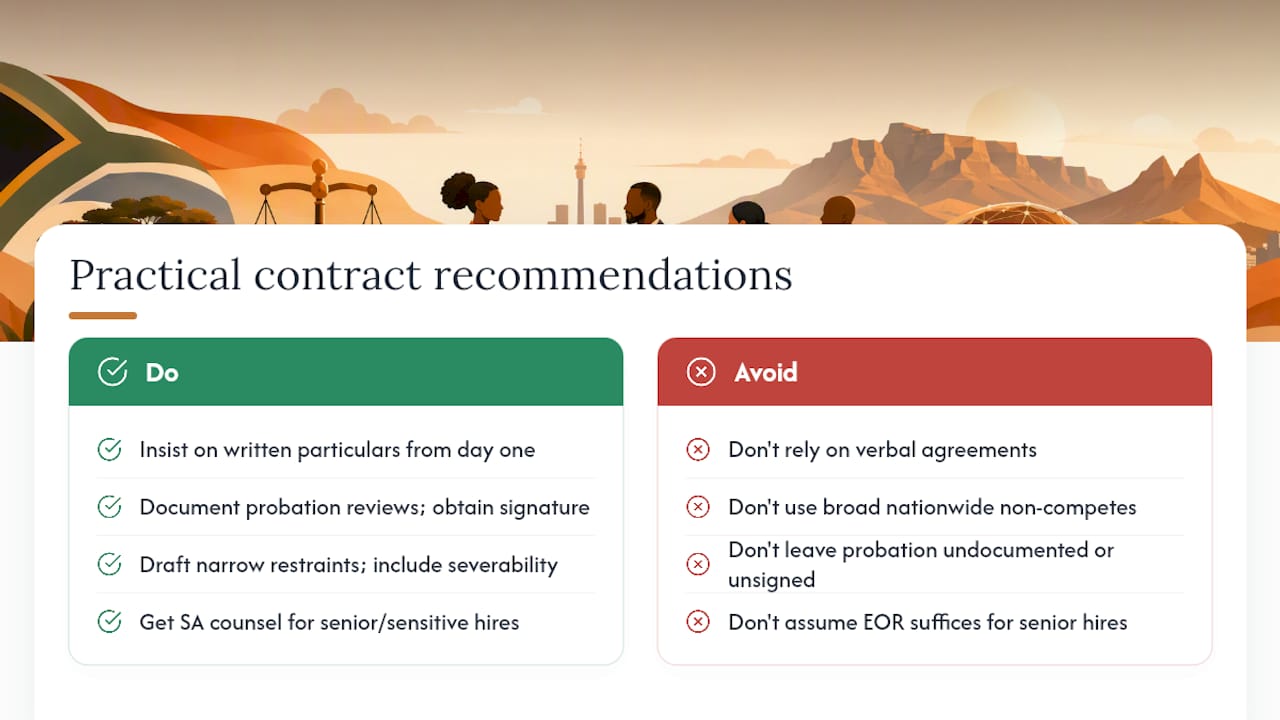
My practical recommendations: insist on written particulars from day one, even for short-term engagements. The BCEA does not give you a grace period, and a verbal agreement is not a defense. Document every probation review in writing, with the employee’s signature on the feedback record. If the employee later disputes the dismissal, that paper trail is the difference between a defensible case and a costly settlement.
On restraints: narrower is almost always better. A 12-month non-solicitation clause tied to specific client relationships the employee actually managed will survive court scrutiny far more reliably than a 24-month nationwide non-compete that a judge will read down or strike entirely. Tie the restraint to a real, defined protectable interest, and include severability so that if one part fails, the rest stands.
When do you need local legal advice versus a compliant EOR contract? If you are hiring a senior executive, a co-founder equivalent, or someone with access to genuinely sensitive trade secrets, get a South African employment attorney to review the restraint and IP clauses specifically. For the majority of professional and technical roles, a well-drafted EOR contract from a licensed local partner covers the statutory requirements and the common-law protections you need.
Ready-made BCEA-compliant contracts with payroll and statutory filings included
Drafting a compliant South African employment contract from scratch, then managing PAYE remittances, UIF contributions, SDL, and COIDA filings on top of your core business, is a significant operational overhead for any international employer.

Expandtosouthafrica removes that overhead entirely. For a flat fee of €350 per employee per month (no setup fees, no FX loading), you get a BCEA-compliant contract signed within 48 hours, ZAR payroll on a defined schedule, and all statutory filings handled: EMP201 PAYE with SARS, UIF, SDL, and COIDA. Employee personal data is processed under POPIA and GDPR with EU data residency. The licensed local partner is the registered employer of record, so your liability exposure is clearly defined from day one.
Visit the EOR services page to request a quote or see the full scope of what is included. If you are currently on another EOR platform, transfers are free.
Sources
- Employment Contract Template — South Africa | mycontracts
- South Africa: Restraints of trade – a useful guide for employers | Bowmans
- Restraint of Trade Agreements in South Africa | MJ Kotze Inc
- Restraint of Trade South Africa – Enforceability Guide