

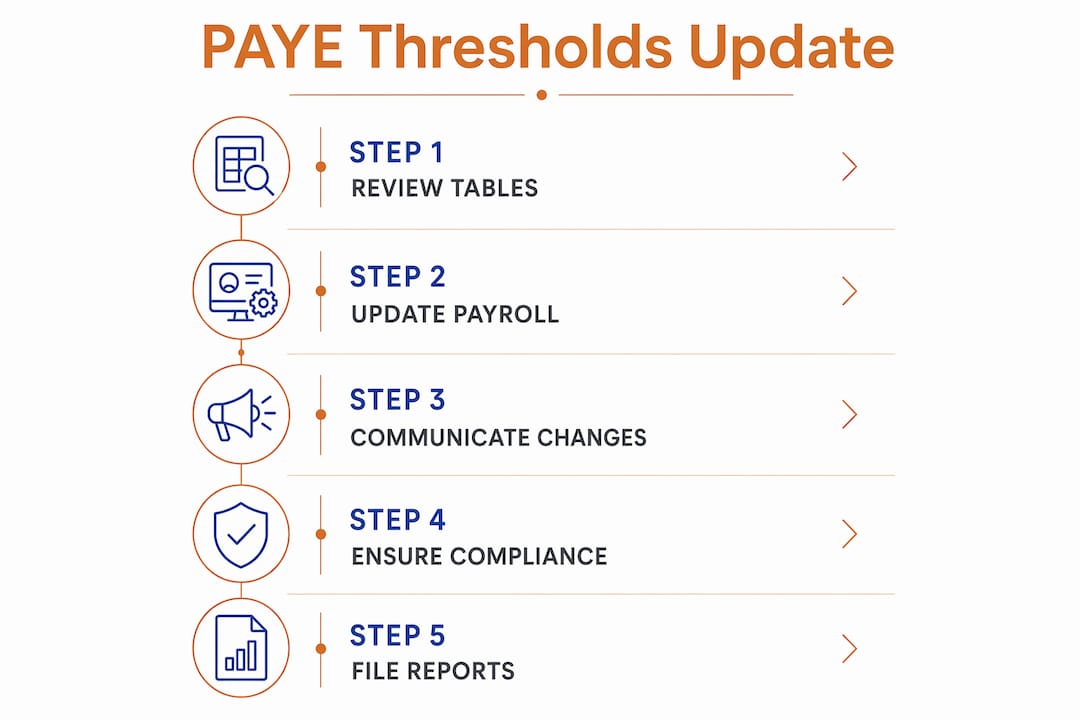
The SARS-prescribed deduction tables for 2026/27 are the authoritative source for monthly PAYE withholding and took effect on 1 March 2026. If your payroll system still runs on 2025/26 figures, every paycheck you process is wrong. Three actions to take before your next payroll run:
- Update payroll tables now. Import the new SARS deduction tables into your payroll software. Do not recalculate from statutory rates manually.
- Align your payroll calendar to the South African tax year. The South African tax year runs 1 March through 28 February. If your company operates on a January–December cycle, you need a parallel calendar for South African employees.
- Confirm allowance and fringe benefit treatment. Travelling allowances, motor fringe benefits, and housing allowances affect taxable remuneration. Misclassifying them now creates reconciliation problems at year-end.
Expandtosouthafrica handles all of this as part of its Employer of Record service: ZAR payroll, EMP201 filings, and full statutory coverage including PAYE, UIF, SDL, and COIDA.
Table of Contents
- Where to find the 2026/27 SARS PAYE deduction tables
- How the deduction tables change your monthly payroll processing
- Which pay items change PAYE withholding
- Common PAYE compliance failures and how to prevent them
- A practical checklist for US HR and finance teams hiring in South Africa
- How Expandtosouthafrica handles PAYE and statutory filings for you
- Key Takeaways
- Why precise PAYE handling matters more than most finance leads realize
- Expandtosouthafrica takes PAYE off your plate from day one
- Useful sources
Where to find the 2026/27 SARS PAYE deduction tables
SARS publishes two documents every employer must have: the Guide for Employers in Respect of Tax Deduction Tables and the Budget Tax Guide 2026. The deduction tables are the operational tool; the budget guide is the statutory source behind them.
Why the tables, not the statutory rates? Statutory rates define the law. The deduction tables translate that law into monthly withholding figures that already incorporate rebates and tax credits. Trying to reconstruct that logic manually from base rates produces incorrect results, particularly for irregular pay and bonuses. SARS instructs employers to use the prescribed tables precisely because the math is pre-built.
The 2026/27 income tax brackets and primary rebate that underpin the deduction tables are:
| Taxable Income (ZAR, annual) | Marginal Rate | Notes |
|---|---|---|
| Below the primary rebate threshold | — | Lowest bracket |
| Second income bracket range | 26% | |
| Above the top income bracket | — | Top rate |
| Primary rebate | R17,820 | Applied to all taxpayers under 65 |
| Tax threshold (under 65) | R95,750 | No PAYE below this annual income |
The primary rebate of R17,820 means employees earning below R95,750 annually owe no income tax and should have zero PAYE withheld. Employees earning just above that threshold will see small but real deductions begin.
Pro Tip: Before importing any SARS deduction table file into your payroll system, check the document header for the effective date and version number. SARS occasionally publishes corrections mid-year. An outdated table imported in error is an audit liability.
How the deduction tables change your monthly payroll processing

Monthly PAYE is calculated by applying the SARS deduction tables to taxable remuneration after permitted deductions, not as a flat percentage of gross pay. Retirement fund contributions and certain approved deductions reduce the taxable base before the table is applied.
Key dates and update windows:
- February: SARS announces the new budget rates. Download updated deduction tables immediately.
- 1 March: New tax year begins. All payroll systems must run on the updated tables from this date.
- March payroll run: The first payroll of the new tax year. Missing the update here creates bracket creep and inaccurate withholding that compounds through the year.
- 28 February: Tax year closes. EMP501 annual reconciliation is due shortly after.
Payroll configuration checklist for employers and EORs:
- Map each employee’s pay period to the correct SARS monthly or weekly table.
- Flag employee age: the secondary rebate applies at age 65, the tertiary rebate at 75.
- Capture medical scheme fee tax credits per employee and apply them to reduce monthly PAYE.
- Record approved retirement fund contributions as pre-tax deductions before applying the table.
- Separate irregular payments (bonuses, commissions) and apply the SARS directive for variable pay.
For international employers managing offshore payroll alignment, the 1 March start date is a recurring operational trap. Build a South Africa-specific payroll calendar and treat it as a separate compliance stream from your home-country cycle.
Which pay items change PAYE withholding
Most cash and near-cash payments to South African employees form part of remuneration for PAYE. The common items that catch international employers off-guard:
- Travelling allowances: 80% is included in remuneration for PAYE purposes unless the employee can demonstrate 80% business use, in which case only 20% is included.
- Motor fringe benefits: The same 80% inclusion rule applies. Employer-provided vehicles require a monthly taxable value calculation.
- Employer-paid medical scheme contributions: Included in remuneration, then offset by the medical scheme fee tax credit.
- Housing allowances: Fully included in remuneration.
- Signing bonuses and variable bonuses: Taxable in the month paid; apply the SARS irregular income directive.
- Subsistence allowances: Partially exempt if within SARS-prescribed daily limits; amounts above those limits are remuneration.
Misclassifying a travelling allowance as a non-taxable reimbursement is one of the most common under-withholding errors SARS identifies during employer audits. The distinction between a reimbursement (actual business expense, receipt-supported) and a travel allowance (fixed monthly amount) determines whether PAYE applies. When in doubt, treat it as remuneration and apply the 80% rule.
Pro Tip: Run a line-by-line remuneration review for every employee before the March payroll. Flag any allowance that is paid as a fixed monthly amount rather than as a reimbursement against actual receipts. Fixed amounts are almost always remuneration.
Common PAYE compliance failures and how to prevent them
Under-withholding, late EMP201 submissions, and incorrect fringe benefit treatment are the three leading causes of SARS penalties for employers. Each is preventable with the right controls.
Common mistakes:
- Applying the wrong deduction table version after a mid-year SARS correction
- Failing to update age/rebate flags when an employee turns 65 or 75
- Treating fixed travel allowances as non-taxable reimbursements
- Omitting employer-paid medical contributions from the remuneration base
- Missing the monthly EMP201 submission deadline, which triggers interest on late payments
SARS imposes understatement penalties and charges interest on underpaid PAYE. Late EMP201 filings attract an additional fixed penalty. Recovery requires a voluntary disclosure or a formal audit process, both of which consume significant finance team time.
Controls that prevent these errors:
- Run a pre-payroll validation comparing the current month’s PAYE total to the prior month. A variance above a set threshold should trigger a manual review.
- Reconcile the monthly PAYE deducted to the payroll journal before submitting EMP201.
- Set a calendar reminder for the EMP201 due date: the 7th of the following month (or the last business day before it).
Pro Tip: Review common payroll compliance mistakes before each new tax year. Many errors are structural, not accidental, and a fresh checklist catches configuration issues before they become penalties.
A practical checklist for US HR and finance teams hiring in South Africa
Prioritize payroll-table updates, employee data verification, and allowance documentation before your first March payroll run. Here is the sequence:
- Download the 2026/27 SARS deduction tables from the SARS website and verify the effective date in the document header.
- Update your payroll system with the new tables before processing the March payroll.
- Verify employee tax status: confirm each employee’s tax number, age, and medical scheme membership.
- Classify all allowances as remuneration or reimbursement, applying the 80% rule to travel and motor fringe.
- Capture retirement fund contributions per employee so the pre-tax deduction reduces the taxable base correctly.
- Set EMP201 filing reminders for the 7th of each month.
- Run a parallel payroll simulation using the new tables before go-live to catch bracket creep or configuration errors.
- Budget for employer statutory costs alongside PAYE: UIF (1% employer contribution on capped remuneration), SDL (1% of leviable amount), and COIDA (rate varies by industry risk class).
Use the employment cost calculator to model total employer cost including PAYE, UIF, SDL, and COIDA for each South African hire before finalizing offer letters.
30/14/7/1-day timeline:
- 30 days out: Download tables, begin payroll system configuration.
- 14 days out: Complete employee data verification and allowance classification.
- 7 days out: Run parallel payroll simulation; resolve discrepancies.
- 1 day out: Final sign-off; confirm EMP201 filing calendar is set.
How Expandtosouthafrica handles PAYE and statutory filings for you
An Employer of Record removes the operational burden entirely. Expandtosouthafrica applies the SARS deduction tables, runs local ZAR payroll, submits EMP201 monthly, and manages PAYE, UIF, SDL, and COIDA filings on your behalf through a licensed local partner.
What the service covers:
- ZAR payroll execution using current SARS deduction tables
- Monthly EMP201 filing and PAYE remittance to SARS
- UIF, SDL, and COIDA registration and contributions
- BCEA-compliant employment contracts signed within 48 hours
- Employee onboarding completed within days
- Annual EMP501 reconciliation
- API integration for payroll automation and data sync
- Data handling under POPIA and GDPR with EU data residency
The flat fee is €350 / $399 / £299 per employee per month, with no setup fees. That pricing covers all statutory filings. You provide employee data and your benefits policy; Expandtosouthafrica handles the rest.
The practical value of an EOR for PAYE is not just filing accuracy. It is the elimination of the configuration risk that comes with every new tax year. When SARS publishes updated deduction tables in February, Expandtosouthafrica updates payroll systems before 1 March, without you needing to track the release, verify the version, or test the import.
Pro Tip: If you are currently managing South African PAYE through a global platform that covers 150 countries, ask them specifically which version of the SARS deduction tables their system uses and when it was last updated. The answer is often revealing.
For a full breakdown of the EOR model and what it means for your hiring structure, the complete EOR guide for South Africa covers entity risk, statutory obligations, and onboarding timelines in detail.
Key Takeaways
The 2026/27 SARS deduction tables, effective 1 March 2026, are the single authoritative source for monthly PAYE withholding, and every international employer with South African staff must update payroll systems before the March payroll run.
| Point | Details |
|---|---|
| Use SARS deduction tables | Import the official 2026/27 tables into payroll software; never reconstruct PAYE from statutory rates manually. |
| Tax year starts 1 March | The South African tax year runs 1 March through 28 February; align your payroll calendar accordingly. |
| Primary rebate is R17,820 | Employees earning below R95,750 annually owe no PAYE; the R17,820 primary rebate is pre-built into the deduction tables. |
| Allowances affect remuneration | Travelling allowances (80% rule), motor fringe, and housing allowances are generally remuneration for PAYE; misclassifying them causes under-withholding. |
| Expandtosouthafrica manages it all | Expandtosouthafrica runs ZAR payroll, files EMP201, and handles PAYE, UIF, SDL, and COIDA for a flat monthly fee with no setup costs. |
Why precise PAYE handling matters more than most finance leads realize
The compliance conversation around PAYE usually focuses on penalties, and that framing undersells the real operational risk. Misapplied PAYE creates a cash-flow problem for employees, not just a liability for employers. When an employee is under-withheld all year and then faces a large tax bill at assessment, the complaint lands in HR’s inbox, not SARS’s. That erodes trust in ways that are hard to quantify but very real to retain.
From a finance perspective, incorrect PAYE also distorts payroll forecasting. If your monthly PAYE figures are wrong, your total employment cost model is wrong, and budget variance explanations become circular. Getting the deduction tables right from 1 March is not a compliance checkbox. It is the foundation of accurate cost reporting for every South African headcount on your books.
Expandtosouthafrica takes PAYE off your plate from day one
South Africa’s payroll compliance requirements are specific, time-sensitive, and updated every March. Expandtosouthafrica is built for exactly this: a single-country Employer of Record that runs ZAR payroll using current SARS deduction tables, files EMP201 monthly, and covers PAYE, UIF, SDL, and COIDA, all for a flat fee of €350 / $399 / £299 per employee per month with no setup costs.

You get BCEA-compliant contracts within 48 hours, full onboarding within days, and a finance team that never has to track a SARS table update again. Use the employment cost calculator to model your total employer cost before making an offer, then visit the EOR services page to see exactly what is covered and request a demo.
Useful sources
- SARS Guide for Employers in Respect of Employees’ Tax (2027) — official employer guide and EMP201 guidance, effective 1 March 2026
- SARS Guide for Employers in Respect of Tax Deduction Tables — worked examples and instructions for applying monthly deduction tables
- SARS Budget Tax Guide 2026 (PDF) — income tax brackets, rebates, and threshold figures for 2026/27
- SARS PAYE-GEN-01-G01 External Guide (PDF) — detailed worked examples for monthly deduction table application
- Expandtosouthafrica payroll services — service scope, ZAR payroll execution, and statutory filing details
- Expandtosouthafrica knowledge base — deeper articles on PAYE, BCEA, and South African labor law