

A competitive remote salary for a South African employee in 2026 generally ranges from a lower multiple of the local average to a considerably higher figure for senior technical talent hired directly by international employers. This is the headline number HR and finance teams need before building a budget.
Two things complicate that figure immediately. First, local-market pay and international remote pay are not the same benchmark, and confusing them is how you lose your best candidate to a competing offer. Second, gross salary is not total cost. Statutory employer contributions, mainly PAYE withholding, UIF, SDL, and COIDA, add materially on top, and none of that touches the ±1 hour overlap with Central European Time that makes South African talent so workable for European teams in the first place.
- Local-market roles: typically 30 to 50% below equivalent international remote pay
- Employer statutory add-ons: roughly 10 to 18% on top of gross salary
- Time zone fit: same working day as most of the EU, no night shifts required
Quick benchmark: A mid-level software developer hired locally averages near Payscale’s reported median of R346,140 a year, while the same skill set hired directly by a European or US company commands considerably more once converted to hard currency.
Key Takeaways
Competitive South African remote pay in 2026 splits sharply between local-market bands and international hard-currency offers, and getting the employment structure right matters as much as the number on the offer letter.
| Point | Details |
|---|---|
| Headline pay bands | Mid-level specialists earn roughly R28,000 to R38,000 monthly locally, senior technical talent tops R90,000+ from international employers. |
| Statutory costs add up | Budget an extra 10 to 18% above gross salary for PAYE, UIF, SDL, and COIDA employer contributions. |
| Currency choice shapes retention | Paying in USD or EUR offers candidates stability but exposes employer costs to rand volatility. |
| CET overlap is a real advantage | The ±1 hour time difference with Central Europe supports same-day collaboration without night shifts. |
| Compliance comes before compensation | Expandtosouthafrica handles BCEA contracts, statutory filings, and ZAR payroll at a flat monthly fee with 48 hour contract turnaround. |
Primary Sources for Salary Benchmarks and Statutory Guidance
- Stats South Africa — national labour market and earnings statistics
- SARS PAYE guidance — employer withholding and EMP201 filing rules
- Payscale software developer data — role-level salary medians
- News24 on international remote hiring — demand trend context
This article is general information, not a substitute for advice from a qualified financial advisor. Consult a qualified financial professional about your own circumstances before acting on anything here.
Table of Contents
- South Africa Salary Benchmarks for Remote Workers by Role and Seniority
- Local Market Rates vs International Remote Pay: What the Numbers Actually Mean
- Payroll and Compliance Essentials for Employers Hiring in South Africa
- How to Build a Total Employer Cost from a Gross Salary Offer
- Why a Specialist EOR Cuts Time and Risk in South African Hiring
- Trends and Forecasts in South African Remote Salary Benchmarks
- How Currency Swings Affect What You’re Actually Paying
- Negotiating Pay for a Remote Role Based in South Africa
- What the Data Actually Tells Employers to Do First
- A Faster, Fixed-Cost Way to Hire in South Africa
- Sources
South Africa Salary Benchmarks for Remote Workers by Role and Seniority
Pay bands vary widely by function, seniority, and who’s writing the check. A junior data analyst hired by a Cape Town startup and a junior data analyst hired remotely by a Berlin fintech are doing similar work for very different money. Below are practical monthly ZAR ranges with rough USD equivalents, built from role-level medians and market roundups covering 2026 remote hiring.
- Software developer / engineer: typical entry-level, mid, and senior monthly salary bands vary widely and can be broadly estimated within local market and international remote pay ranges.
- Cloud / DevOps engineer: entry, mid, and senior roles command competitive salaries generally increasing with seniority and skill specialization.
- Cybersecurity specialist: pays increase with experience and are typically higher than average due to global demand.
- Data scientist / analyst: roles see rising pay bands reflecting experience and skill level, with senior roles earning notably more.
- Product manager: salaries generally reflect growing responsibility and experience, rising with seniority.
- UX/UI designer: compensation varies with skill and portfolio strength, increasing from junior to senior levels.
- Digital marketing manager: typical salary ranges grow with experience and specialization.
- Sales / account executive (B2B): base pay increases with experience and role, with commissions often adding significant additional income.
- Finance / accounting (bookkeeper to financial controller): pay ranges from entry to senior roles tend to increase with qualifications and experience.
- Customer success / operations manager: compensation scales with seniority and responsibility.
Four variables drive most of the spread inside each band. Portfolio strength matters especially for design, product, and engineering roles where a strong GitHub history or shipped-product track record can push a mid-level candidate into senior pay. City premiums add another layer. Indeed’s salary data shows Gauteng and Cape Town running 10 to 20% above smaller-city averages for the same title. And a remote-first premium has emerged as companies compete for candidates who can work asynchronously without hand-holding.
Cybersecurity and senior cloud roles command the strongest international pay when hired by overseas employers, largely because global demand for those skills outstrips supply everywhere, not just in South Africa. OfferZen’s 2026 developer report confirms sustained demand at the senior technical tier, with employers competing hardest for candidates who already have distributed-team experience.

Local Market Rates vs International Remote Pay: What the Numbers Actually Mean
The local-market band reflects what South African companies pay South African employees, constrained by domestic revenue and a local cost of living. The international-remote band reflects what a company earning euros, pounds, or dollars can afford to pay for the same skill, and that gap exists because hard currency buys more in Johannesburg or Durban than it does in London or Amsterdam.
A conservative R18 to $1 exchange rate makes the math concrete:
- Junior role: A local offer of R18,000 a month ($1,000) competes against an international offer of $1,800 to $2,200 for the same entry-level skill set, once a company is paying in USD.
- Mid-level role: Local pay near R38,000 ($2,100) sits well below the $3,500 to $4,500 a European employer might offer a developer with three to five years of experience.
- Senior role: Local senior pay tops out around R95,000 ($5,275), while international employers routinely offer $6,000 to $8,000 for candidates with specialized skills like cloud architecture or security engineering.
If you’re anchoring an offer, benchmark against the international band the moment a role requires skills in global demand, not the local one. Recruiting tactics documented by Hirezar show international employers deliberately pricing offers above local medians while staying well under US or EU salary costs, a strategy that works precisely because it feels generous locally and still saves 40 to 60% for the employer.
Payroll and Compliance Essentials for Employers Hiring in South Africa
Budgeting for a South African hire means budgeting for four statutory line items beyond gross salary, none of them optional. PAYE (Pay As You Earn) withholding must be calculated and remitted monthly via the EMP201 filing process with SARS. UIF (Unemployment Insurance Fund) requires a 1% employer and 1% employee contribution on earnings up to a set ceiling. COIDA (Compensation for Occupational Injuries and Diseases Act) contributions vary by industry risk classification and get billed annually, not monthly.
- PAYE: calculated on the employee’s tax bracket, filed monthly via EMP201
- UIF: 1% employer plus 1% employee, capped at a set earnings ceiling
- SDL: 1% of payroll for qualifying employers
- COIDA: annual assessment based on industry risk category, not a flat rate
Misclassifying a remote worker as an independent contractor when they function as a full employee is one of the fastest ways to trigger a BCEA or LRA dispute, and South African labor law leans toward protecting the worker’s status once the working relationship looks like employment in substance. Payment currency matters operationally too: paying in ZAR through a compliant local payroll avoids FX loading fees that stack up when converting foreign currency piecemeal every month.
Pro Tip: Never assume a “contractor” agreement shields you from employer obligations. If you control hours, tools, and daily tasks, South African courts and the CCMA will likely treat that person as an employee, regardless of what the contract says.
How to Build a Total Employer Cost from a Gross Salary Offer
Setting a competitive offer means working backward from a candidate’s expected take-home pay to a full employer cost figure, not just picking a number that sounds fair.
- Start with the gross monthly salary benchmark for the role and seniority level.
- Add statutory employer items: PAYE is withheld from the employee, but UIF, SDL, and COIDA are genuine employer-side costs.
- Layer in benefits: many international employers now include a home-office stipend, health contribution, or annual leave beyond the BCEA minimum to stay competitive.
- Add recruiting, onboarding, and EOR or payroll administration fees to see the true monthly cost of the hire.
The levers that move competitiveness without blowing the budget are currency choice (paying in USD or EUR feels like a raise without costing more in ZAR terms), a modest signing bonus for candidates weighing multiple offers, a fair probation-period salary that doesn’t undercut the full offer, and a benefits package that goes slightly beyond the statutory BCEA minimum. Use an employment cost calculator to model these scenarios before you extend an offer, not after.
Why a Specialist EOR Cuts Time and Risk in South African Hiring
Hiring compliantly in South Africa means getting BCEA contract terms right, filing PAYE correctly through EMP201, registering for UIF and SDL, and classifying COIDA risk accurately, four separate compliance surfaces most international HR teams have never touched. Expandtosouthafrica structures its service around exactly that gap: BCEA-compliant contracts, ZAR payroll, and statutory filings handled through a licensed local partner, with signed contracts typically ready within 48 hours and full onboarding completed within days.
A single-country specialist EOR handles statutory filings and CCMA-safe dismissal procedures with the same rigor a local law firm would, but at a flat monthly fee instead of hourly legal billing, which matters most when a dismissal or restructuring goes wrong and CCMA timelines start running.
- Flat fee with no setup costs or FX loading on the invoice itself
- Data handled under POPIA and GDPR with EU data residency
- A decision checklist: choose a specialist EOR over entity setup when you’re hiring one to a handful of South African employees and don’t need a standalone legal presence in the country
Trends and Forecasts in South African Remote Salary Benchmarks
Tech hiring inside South Africa has softened, with MyBroadband reporting roughly a 5% drop in local hiring activity through 2025 and into 2026. That softness cuts in favor of international employers: more skilled candidates are actively looking, and local companies have less room to counter a competitive offer denominated in hard currency.
At the same time, demand for senior technical talent hasn’t cooled at all. OfferZen’s 2026 report shows the gap between local and international pay bands widening rather than narrowing, particularly for cloud, security, and senior engineering roles where global shortages persist regardless of any one country’s domestic market conditions.
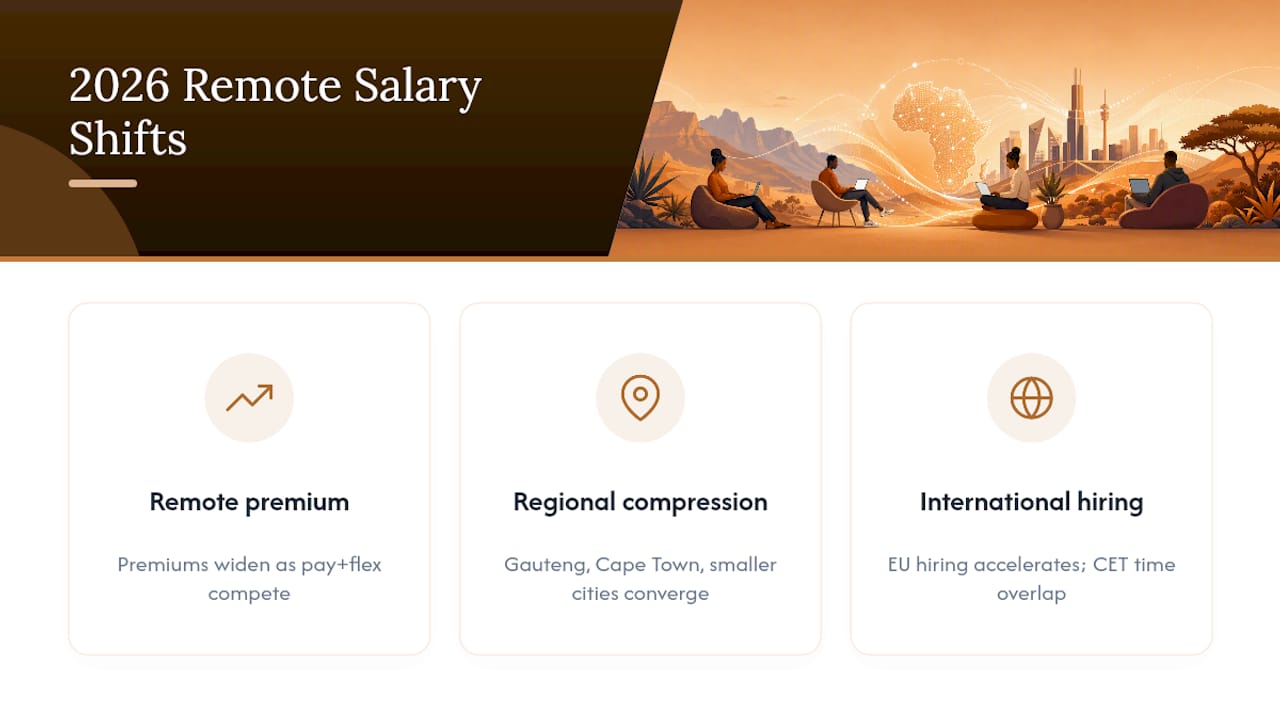
Expect three shifts to keep shaping the picture through the rest of 2026. Remote-first premiums will likely keep expanding as more companies compete purely on flexibility and pay rather than office location. Regional pay compression should continue between Gauteng, Cape Town, and smaller cities as remote work erodes the old “you must live near the office” wage logic. And demand growth documented by News24 suggests international hiring of South African talent will keep accelerating, driven by English proficiency and the CET-friendly time overlap that makes daily standups painless for European teams.
None of this means costs will keep falling for employers. It means the employers who move fastest on strong offers will keep winning the best candidates before local softness reverses.
How Currency Swings Affect What You’re Actually Paying
A ZAR salary that looks generous today can look stingy in six months if the rand strengthens, and vice versa. This matters more for remote hiring than most finance teams initially assume, because the exchange rate you use to benchmark an offer isn’t fixed for the life of the employment relationship.

If you pay in ZAR and the rand strengthens against your home currency, your effective cost per employee rises even though the ZAR figure on the payslip never changes. If you pay in USD or EUR directly, the employee’s real spending power in South Africa can swing significantly with each currency move, which creates its own retention risk if a rand rally suddenly makes their hard-currency salary feel less impressive relative to local peers.
The practical fix is picking one currency model and sticking with it rather than adjusting reactively every quarter. Paying in ZAR through a compliant local payroll insulates your budget from FX swings on the employer side, since your invoice stays denominated in your own currency while the local partner handles conversion. Paying directly in USD or EUR gives the employee currency stability but exposes your effective labor cost to rand volatility. Neither approach eliminates the risk entirely, and building a small buffer, roughly 5 to 8% above your calculated cost, into annual budget planning protects against a sharp currency move mid-year without forcing a renegotiation.
Negotiating Pay for a Remote Role Based in South Africa
Salary negotiation for a South Africa based remote hire runs differently than a domestic negotiation, mostly because the candidate is weighing your offer against both local options and other international employers simultaneously.
Start by being transparent about which band you’re offering from. A candidate who knows upfront that you’re benchmarking against international rates rather than local ones will negotiate in good faith instead of assuming you’re lowballing them. Anchor the first offer close to the middle of your intended range rather than the floor. In a market where OfferZen’s data shows international pay bands pulling ahead of local ones, an opening offer that reads as “local market plus a small premium” often loses the candidate before a counteroffer even happens.
Offer currency flexibility where you can. A candidate choosing between two similar offers will frequently take the one denominated in USD or EUR even at a marginally lower headline number, because currency stability itself has value. Be specific about the non-salary package too: home-office stipend, leave beyond the BCEA minimum, and clear progression timelines often close a negotiation faster than an extra few thousand rand a month. And build in a review point at six or twelve months rather than promising an increase you can’t yet size. Candidates who’ve watched the rand move a lot in short periods respect a scheduled review far more than a vague verbal promise.
What the Data Actually Tells Employers to Do First
Most guidance on South African remote hiring treats salary benchmarking as the whole problem. It isn’t. The bigger risk sitting underneath every pay decision is compliance, and the two are inseparable: an offer that looks generous on paper means nothing if the employment relationship is structured wrong from day one.
The conventional advice tells employers to “just pay competitively” and assumes the payroll mechanics will sort themselves out. They don’t. PAYE, UIF, SDL, and COIDA aren’t back-office details. They are the difference between a clean hire and a CCMA dispute eighteen months later when a “contractor” relationship gets reclassified as employment. I’d argue the sequencing most HR teams use is backward: they benchmark salary first, then figure out compliance. Flip that. Get the employment structure right first, because it constrains what a compliant offer can even look like, then benchmark pay within that structure.
If there’s one thing worth prioritizing above the salary spreadsheet, it’s confirming who legally employs the person before the offer letter goes out. Everything else, including the number on the payslip, is easier to get right once that’s settled.
— Roel
A Faster, Fixed-Cost Way to Hire in South Africa
Building your own compliance stack for a single South African hire rarely makes financial sense, which is exactly the gap Expandtosouthafrica exists to close. Instead of researching BCEA contract clauses, registering for UIF and SDL yourself, or guessing at COIDA classification, you get a licensed local partner handling all of it for a flat fee with no setup costs and no FX loading on the invoice.
Contracts are typically signed within 48 hours, and full onboarding wraps up within days rather than weeks, so the benchmarks in this article translate into an actual hire fast. If you want a role-specific estimate before you commit to a number, run it through the employment cost calculator or review the EOR service details and reach out for a quote tailored to the seniority level you’re hiring.
Sources
- Stats South Africa (labour market statistics)
- SARS – PAYE guidance
- PayScale — Software Developer salary in South Africa (2026)