

A German company can hire a full-time employee in South Africa in three lawful ways: register its own presence there, employ the person directly from abroad and take on South African payroll duties, or employ them through a local Employer of Record (EOR). For most teams hiring one to ten people, the EOR route is the fastest, because it avoids a local entity while keeping the employment fully compliant.
This guide explains each option, what South African law expects of you as the employer, what to budget, and how to handle the common edge cases, such as converting a contractor or ending a contract. Most German firms looking at South Africa are after skilled, German-speaking or English-fluent talent in a time zone within about an hour of Germany.
TL;DR
- You can employ in South Africa through your own registered entity, direct employment, or an Employer of Record. Dentons confirms that using a third-party provider is lawful.
- Signing an employment contract in South Africa can oblige a foreign company to register as an external company with the CIPC, so “no entity” is not the same as “no obligations”.
- Employer costs on top of salary include UIF (1%), SDL (1% where applicable) and Compensation Fund (COIDA) registration. All are due to SARS within seven days of month-end.
- South African labour law protects staff who work in South Africa, whatever law your contract names.
- Our EOR service starts from £299 per month per employee.
Table of Contents
- Your three options, side by side
- Why “no local entity” still needs care
- What South African law expects from the employer
- What to budget beyond salary
- Why South Africa works for German teams
- Step by step: your first South African hire
- Converting a South African contractor to an employee
- Ending the contract
- Perspective
- Hire in South Africa with us
- FAQ
- Sources
Your three options, side by side
The research on South African employment is consistent: a foreign company may register in South Africa, employ the individual directly, or use a third-party service provider. Each carries different work for you.
| Option | What you set up | Who is the legal employer | Best for |
|---|---|---|---|
| Own South African entity | Registration, bank account, payroll, SARS and Compensation Fund accounts | Your South African subsidiary or branch | Teams planning many hires and a lasting local operation |
| Direct employment from Germany | Employer registrations with SARS and others, ZAR payroll, contracts | Your German company | Rarely practical for a single remote hire |
| Employer of Record | A service agreement with the EOR | The EOR’s licensed local partner | First hires, pilots, small teams, fast starts |
The entity route gives you the most control but also the most administration. Direct employment looks simple, yet it makes your German company responsible for South African tax registration, monthly filings and statutory compliance. An EOR places those duties with a local employer, while you direct the daily work.
For a deeper view of how that works, see our explanation of how a legal employer in South Africa operates, and our guide for EU companies hiring in South Africa.
Why “no local entity” still needs care
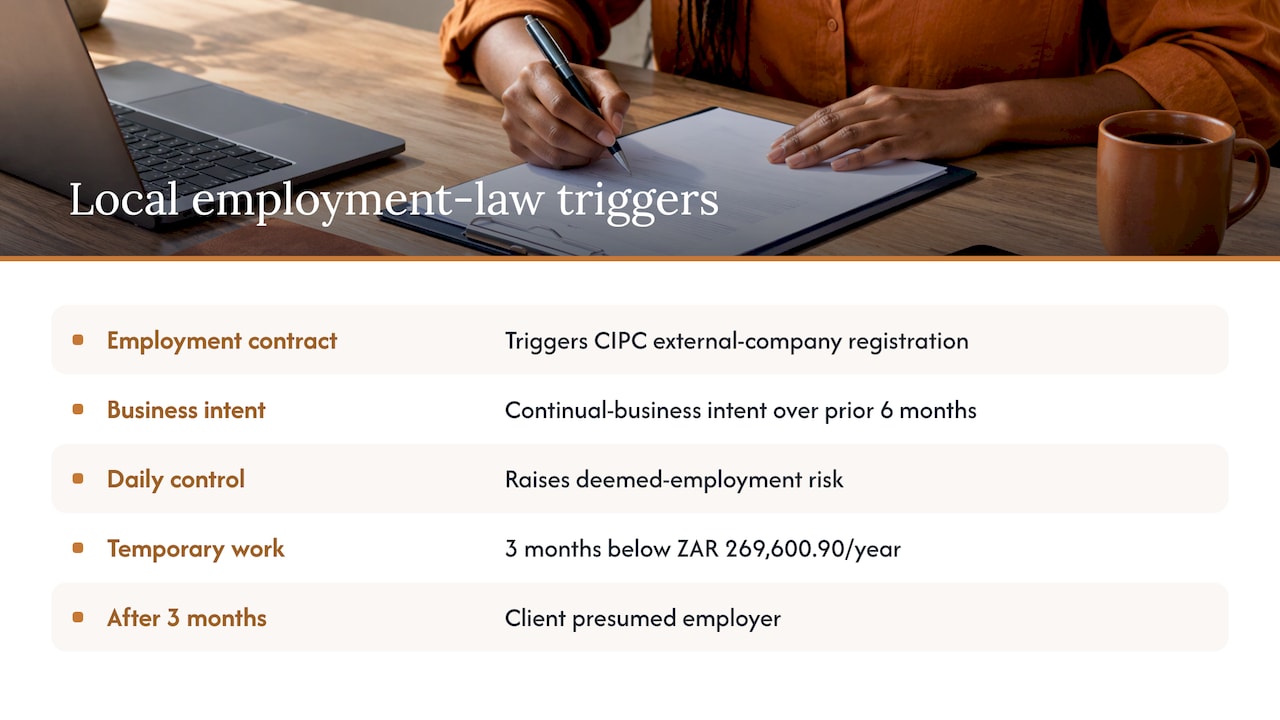
Many German founders assume that hiring one remote person creates no local footprint. South African company law says otherwise. According to the DLA Piper employment guide for South Africa, a foreign company must register as an external company with the CIPC if it enters into an employment contract in South Africa, or if its conduct over the previous six months shows an intention to carry on business continually.
That is a real trigger. It means a contractor-style arrangement, where you simply wire a monthly sum, does not remove the question of how the person is treated under local law. It also explains why companies choose an EOR: the local partner is the contracting employer, so your German company does not sign the employment contract itself.
A second point concerns control. Dentons cautions that the more day-to-day control a client has over third-party personnel, the higher the deemed-employment risk. Section 198A of the Labour Relations Act sets a three-month limit on temporary employment for people earning below ZAR 269,600.90 a year, after which the client is presumed to be the employer. In practice, you should treat the EOR as a permanent employment solution, not a short-term placement mechanism.
What South African law expects from the employer
Whoever is the legal employer must meet a fixed set of obligations. If your EOR provider is the employer, they carry them. If you employ directly, they are yours.
Contracts and conditions
The Basic Conditions of Employment Act (BCEA) requires written particulars of employment. DLA Piper notes these need not be a formal contract, though written agreements are common. The particulars cover the parties, job and workplace, start date, hours, pay and overtime, deductions, leave, and notice. The BCEA text from the Department of Employment and Labour also provides at least 21 consecutive days of annual leave per 12-month cycle.
German employers are used to a detailed Arbeitsvertrag, so the BCEA’s minimums will feel familiar. For clause-level detail, read our guide to essential employment contract clauses in South Africa and the rules on BCEA working hours.
Payroll tax registration and filing
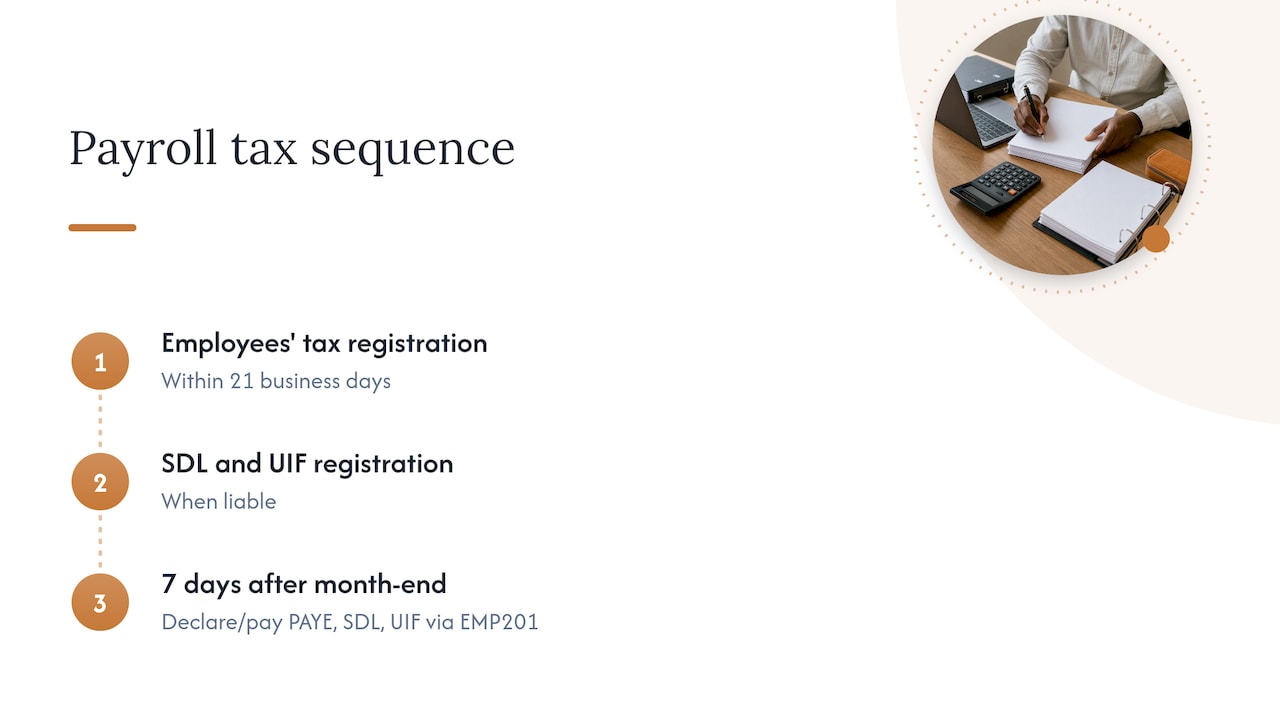
SARS requires employers to register for employees’ tax within 21 business days of becoming an employer, unless none of their employees are liable for normal tax. Employers liable for SDL and UIF must register for those too. Our overview of employer payroll taxes in South Africa walks through the sequence.
Each month, PAYE, SDL and UIF are declared and paid through the EMP201 within seven days after month-end. Missing that rhythm is the most common source of penalties for newcomers, which is why payroll in ZAR is best run locally. See paying employees in ZAR for how this works for foreign teams.
Injury cover and data protection
Employers must register with the Compensation Fund within seven days of appointing an employee. This is the COIDA obligation.
On data, POPIA has applied since 1 July 2020. DLA Piper notes that consent is required for criminal-record checks and applicants should be told about background checks. German firms already work under GDPR, so the principles are familiar, but the details differ. Our guide to background checks in South Africa covers the practical steps.
What to budget beyond salary
Statutory on-costs in South Africa are lighter than the social contributions German employers are used to, but they are not zero.
- UIF: employer and employee each pay 1% of remuneration, up to a monthly contribution threshold, set at R17,712 for the 2026 tax year.
- SDL: 1% of relevant remuneration, applying where the employer expects total remuneration above R500,000 over the next 12 months.
- COIDA: an assessment to the Compensation Fund, based on the employer’s industry classification and payroll.
- Employer of Record fee: from £299 per month per employee on our pricing page.
- Recruitment: if you need us to find the person, talent sourcing is a separate service.
PAYE itself is withheld from the employee’s pay, so it affects net salary rather than your cost. To model a specific salary, use our employment cost calculator or read what a South African employee really costs.
On salary levels, our experience is that skilled roles typically cost 40 to 60% less than comparable roles in the UK or Western Europe. Treat that as a planning range, and confirm it against the real market for your role.
Why South Africa works for German teams
The time zone is the most practical argument. South Africa sits within about an hour of Central European Time, so stand-ups, customer calls and support rotas run in the same working day. For software, finance, customer support and operations roles, that overlap often matters more than the savings.
German-language skills are a real niche. Job boards in Cape Town and Gauteng carry a steady stream of German-speaking customer service and sales roles, which shows an established pool of bilingual staff, particularly in the Western Cape. If you need that profile, our guide to talent sourcing in South Africa explains how foreign employers find and vet candidates.
Step by step: your first South African hire
- Define the role and the budget. Set a gross monthly salary in ZAR and run it through the cost calculator.
- Choose the employment route. For one to a handful of hires, compare an EOR with the entity route on admin time, not only fees.
- Source or confirm the candidate. Run consented background checks, in line with POPIA.
- Issue BCEA-compliant particulars or a contract. Include hours, leave, notice and probation terms.
- Register for payroll taxes. Your legal employer handles SARS registration, UIF, SDL and the Compensation Fund.
- Run monthly payroll. Pay in ZAR and file the EMP201 on time.
- Plan for the end of the relationship. Know the notice periods before you hire.
On notice, see the BCEA notice period rules. For fixed-term arrangements, the three-month rule is worth reading before you draft anything.
Converting a South African contractor to an employee
This is a frequent situation: you already work with a freelancer in Johannesburg or Cape Town and want to formalize the relationship. Handle it as a planned transition.
- Review how the work is really done. Fixed hours, your tools, your management and exclusivity all point towards employment. Dentons’ warning about day-to-day control, mentioned above, applies here too.
- Agree a start date and a clean handover. End the contractor agreement on the day the employment begins, so the two never overlap.
- Issue written particulars before day one. Cover pay, hours, leave, notice and duties.
- Align the pay. Contractor rates normally include the person’s own taxes and leave. Convert to a gross salary and show the person the net result.
- Register the employment. The legal employer must be set up for payroll tax, UIF and the Compensation Fund before the first payslip.
Our team can run this transition under the EOR model. Before you act, speak to a South African employment lawyer or tax adviser about the person’s specific history with you.
Ending the contract
Dismissal in South Africa follows the Labour Relations Act, with fair reason and fair procedure, and disputes go to the CCMA. A German company should not assume its home-country contract terms will override this. A Labour Court decision summarized by the BCRC held that foreign companies could not avoid South African law by contracting with employees employed in South Africa, because that would strip them of its protection.
The German law firm CBBL makes a related point: when the employee physically works in South Africa, South African payroll rules and work-related mandatory contributions generally apply, although other factors may be relevant.
The practical lesson is to document performance, follow the notice rules and take dismissal advice before acting, not after.
Perspective
We work in one country only, and that shapes how we advise German companies. A global platform has to keep one process for 150 countries. We keep one process for South Africa, so contracts, ZAR payroll, EMP201 filings, UIF, SDL and COIDA are things we handle every month, not once a quarter.
Our view is that the biggest risk for a first hire is not the cost. It is an unclear answer to the question of who legally employs your person. We state it plainly: a licensed local partner is the legal employer, you direct the work, and we run the compliance around it. Because that structure is explicit, you can make decisions about dismissal, transfers and conversions without surprises.
We also believe in publishing the numbers. Our fee is flat, with no setup fees and no FX loading, and the cost calculator and API documentation are public. If you are weighing an EOR against the effort of an entity for your first few hires, we think the flat monthly model is the clearest way to start and to scale.
Roel
Hire in South Africa with us
We provide Employer of Record services exclusively for South Africa: BCEA-compliant contracts, ZAR payroll, and PAYE, UIF, SDL and COIDA filings through a licensed local partner. Pricing starts from £299 per month per employee, as published on our pricing page. If you already use another provider, we can discuss a transfer.
If you also need to find the person, our talent sourcing service covers vetted candidates for skilled roles. For the full picture, read our Employer of Record guide for South Africa.
FAQ
Can a German company employ someone in South Africa without a local entity?
Yes, through an Employer of Record or similar third-party provider, which Dentons describes as a lawful option. The provider’s local partner becomes the legal employer. Hiring directly, by contrast, may require you to register as an external company with the CIPC.
How quickly must a direct employer register for payroll taxes?
SARS expects registration for employees’ tax within 21 business days of becoming an employer, unless no employee is liable for normal tax. Registration with the Compensation Fund is due within seven days of appointing an employee. An EOR does these steps on your behalf.
What employer contributions apply on top of salary?
Employers pay UIF at 1% of remuneration up to the monthly threshold, and SDL at 1% where the payroll exceeds R500,000 over the next 12 months. COIDA assessments apply as well. All are filed through SARS and the Compensation Fund on a monthly or periodic basis.
Does German employment law apply to my South African employee?
Not in place of South African law. A Labour Court decision held that foreign companies cannot avoid South African law for people employed in South Africa. Your contract should follow the BCEA and the Labour Relations Act, and you should take local advice on any dismissal.
Is there a time zone problem between Germany and South Africa?
No. South Africa is within about an hour of Central European Time, so teams share nearly the whole working day. That makes live collaboration, support cover and client calls straightforward.
Sources
- Dentons: South Africa Global Employment and Labor Guide
- DLA Piper: Global Expansion Guide, Employment (South Africa)
- Department of Employment and Labour: Basic Conditions of Employment Act
- SARS: Registering for Employees’ Tax
- SARS: Completing the monthly employer declaration (EMP201)
- SARS: Skills Development Levy
- SARS: Guide for Employers in respect of Employees’ Tax, 2026
- Department of Employment and Labour: Compensation Fund obligations of the employer
- CBBL: Verwaltung von Arbeitnehmern in Südafrika
- BCRC: Decided Court Cases