

A Canadian company can hire a full-time employee in South Africa in three ways: open a South African entity, hire the person as a contractor, or use an Employer of Record (EOR) that employs them locally on your behalf. For most small and mid-size teams, the EOR route is the fastest legal option, because it avoids a subsidiary and keeps contracts, payroll and statutory filings in compliance with South African law from day one.
This guide explains why that is, what South African law requires, what each option costs in practice, and how to move from a first conversation to a signed employee in a matter of days.
TL;DR
- Signing a South African employment contract yourself can count as conducting business in the country, which may require your Canadian company to register as an external company with the CIPC.
- An EOR becomes the legal employer in South Africa, while you direct the daily work. You skip the subsidiary and the payroll registrations.
- Statutory obligations include PAYE, UIF, SDL (filed monthly on the EMP201) and Compensation Fund (COIDA) registration, plus BCEA-compliant contracts.
- Our fee is from £299 per employee per month, with no setup fees or FX loading. Statutory contributions are separate from any provider fee.
- South Africa sits six to seven hours ahead of Eastern Canada, so plan for a shared window in your morning and their afternoon.
Table of Contents
- Why Canadian companies hire in South Africa
- The three legal ways to employ someone in South Africa
- Why you should not simply sign an employment contract yourself
- What South African law requires of an employer
- Payroll, tax and statutory contributions
- What it costs: statutory charges versus provider fees
- Step by step: from decision to first day
- Converting contractors and switching providers
- Our perspective
- Hire in South Africa with us
- FAQ
- Sources
Why Canadian companies hire in South Africa
The reasons are practical. South Africa has a deep pool of English-speaking professionals in software engineering, finance, customer support, design and data. In our experience, skilled roles typically cost 40% to 60% less in salary than comparable roles in the UK or Western Europe. That is our own working figure, not a statutory benchmark, and your actual savings depend on the role and seniority. Canadian salaries for senior technical roles are often closer to UK levels than to South African ones, so a similar logic applies.
Time zones matter just as much. South Africa runs on a single zone, UTC+2, all year with no daylight saving. That puts Toronto and Montreal seven hours behind in winter and six hours behind in summer. For Vancouver, it is nine or ten hours. A team in Eastern Canada gets a working overlap from roughly 8:00 to 11:00 a.m. Eastern, which is mid-afternoon to early evening in Johannesburg. It works well for stand-ups, handovers and support rotations, and less well for roles that need live collaboration all day. For European teams the overlap is within about an hour, which is why we position the country that way for UK and EU buyers.

The three legal ways to employ someone in South Africa
Option 1: Set up a South African entity
You register a subsidiary or branch, open a bank account, register for tax and payroll, and employ people directly. This makes sense when you plan a large local team, need a physical office or want a long-term operating base. It also takes the most time and carries fixed administrative costs, such as accounting, filings and local directors or officers, before your first hire is productive.
Option 2: Engage a contractor
It looks simple: the person invoices you, and you pay in Canadian or US dollars. The risk is classification. If the arrangement works like employment (fixed hours, your tools, your management, one client), a South African authority or tribunal may treat the person as an employee, with the employment protections that come with that. Contractors who expect job security, leave and benefits tend to push for conversion sooner or later. If you already have contractors in South Africa, we cover the conversion checklist later in this article.
Option 3: Use an Employer of Record
An EOR is the legal employer of your worker in the country. It issues the contract, runs payroll in rand, files the statutory returns and handles registrations, while you assign and manage the work. Because the person is employed by a local entity, you do not need your own South African entity to hire them. Our EOR services in South Africa are built around this model, and our complete guide to Employer of Record in South Africa goes deeper on how the arrangement is structured.
Why you should not simply sign an employment contract yourself
It is tempting to draft a contract, wire a salary and call it done. The problem is that South Africa’s Companies and Intellectual Property Commission (CIPC) says a foreign company must register as an external company if it conducts, or intends to conduct, business in South Africa, and it lists entering into contracts of employment among the activities it regards as conducting business (CIPC, foreign company registration).
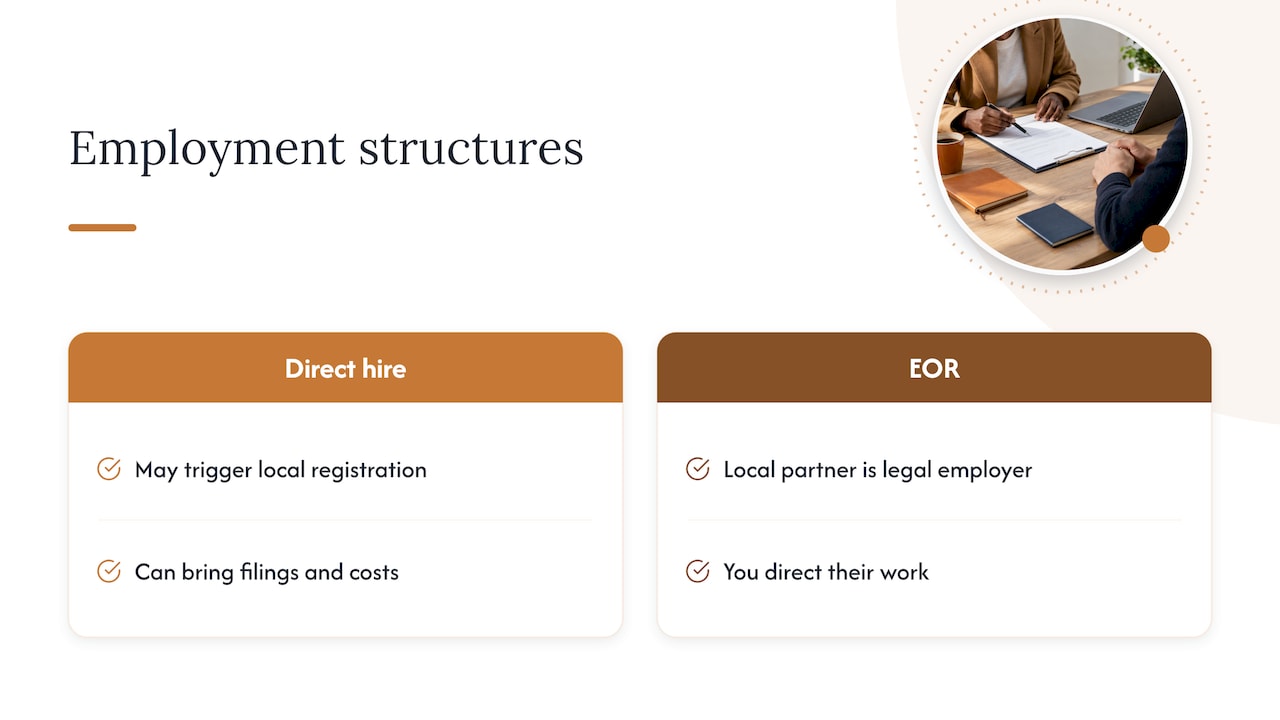
In practical terms, a direct hire can pull your Canadian company into local registration, and registration brings its own filings and costs. If you are checking what a registration would involve, you will typically need certified copies of your corporate documents. Services that produce certified company registration copies can help with that step if you do go down the entity route.
The employer identity also drives your tax position. Who legally employs the worker affects tax, labour and permanent establishment exposure, so it should be a deliberate choice rather than a by-product of how you paid the first invoice. Ask your Canadian tax adviser about the permanent establishment question for your specific facts. An EOR structure places legal employment with the local employer, and we disclose openly who that is: our licensed local partner is the legal employer of your people, and you direct their work.
What South African law requires of an employer
Whether you hire through an EOR or your own entity, the same rules apply to the employment relationship. This is the short version that matters to a foreign founder.
Contracts and the BCEA
The Basic Conditions of Employment Act (BCEA) is the core statute. It requires written particulars such as hours of work, wage rates, leave entitlements and notice periods, and it sets procedural requirements for termination (BCEA, Department of Employment and Labour). Our guide to essential employment contract clauses for South Africa lists what a compliant contract should contain, and Canadian templates should not be reused as they are.
If you are considering a fixed-term arrangement to test the relationship, read our explanation of the three-month rule for fixed-term contracts first. Fixed terms are more restricted than many foreign employers expect.
Working hours
The BCEA sets ordinary working hours at a maximum of 45 hours per week: nine hours a day for employees working five days or fewer, or eight hours a day for those working more than five days (BCEA). This matters for Canadian teams that expect someone to cover late North American hours. Overtime and scheduling have to fit within the statute, so build that into the role design. Our page on BCEA working hours shows how to reflect this in the contract and payroll.
Notice and termination
Dismissal in South Africa follows procedural fairness rules, and the Labour Relations Act and the CCMA (the dispute resolution body) are involved when a dismissal is contested. This is where the at-will habits common in North America cause the most trouble. Notice periods under the BCEA step up with length of service, and our notice period guide sets out the one-, two- and four-week rules. Build the termination process, with warnings and documentation, before you need it.
Payroll, tax and statutory contributions
This is the part Canadian founders underestimate, because the filings are many and the deadlines are monthly.
| Obligation | What it is | Timing |
|---|---|---|
| PAYE | Employees’ tax withheld from pay and paid to SARS | Monthly |
| UIF | Unemployment insurance, 1% from employer and 1% from employee, subject to a threshold | Monthly |
| SDL | Skills Development Levy, a compulsory employer levy | Monthly |
| COIDA | Registration with the Compensation Fund for work injury cover | Within seven days of first employee |
| EMP501 | Reconciliation declarations | Interim (1 March to 31 August) and annual |
The South African Revenue Service (SARS) requires employers to withhold employees’ tax from remuneration and pay it monthly, with PAYE, SDL and UIF amounts remitted using the Monthly Employer Declaration (EMP201) (SARS employer guide). Reconciliations on the EMP501 follow for the interim period (1 March to 31 August) and for the annual period ending in February (SARS, employer declarations).
Registration has its own clock. SARS’s current guide says an employer must generally register for employees’ tax within 21 business days after becoming an employer, and employers liable for SDL or UIF must also register through the applicable process (SARS guide for employers, 2027 tax year). The same guide states that employer and employee each contribute 1% of remuneration to UIF, subject to the statutory threshold. Our pages on UIF contributions and the R17,712 cap, SDL registration and employer payroll taxes walk through each filing. For the PAYE bands, see South Africa PAYE thresholds.
The Compensation Fund guidance says an employer should register within seven days after employing its first employee (Compensation Fund service book).
Payments are made in rand, and the EMP201 is due by the 7th of the following month, as we explain in paying employees in ZAR. Fiatmap has a useful overview of corporate tax in South Africa if you are comparing the local tax environment with Canada’s. Note that employer withholding sits separate from corporate tax, and your adviser should confirm how the two interact for your structure.
If you would rather not run any of this yourself, our payroll services in South Africa page explains what we file on your behalf.
What it costs: statutory charges versus provider fees
It helps to separate the three buckets of cost you will see.
- Salary and benefits. What you agree with the employee, in rand. Your salary budget is the largest line.
- Statutory employer charges. Employer UIF at 1% of remuneration (up to the threshold), SDL, and COIDA contributions. These are set by law and are not provider margin. Because they are statutory, they apply whichever structure you use.
- Provider fee. What the EOR charges for employing, running payroll and handling compliance.
Our fee is from £299 per employee per month, published as a flat fee, which also appears as $399 or €350 depending on currency. There are no setup fees and no FX loading. You can see the current terms on our pricing page, and our public employment cost calculator shows the full employer cost for a given salary.
A few budgeting points for a Canadian finance lead:
- Convert your salary budget at a realistic rand exchange rate and leave room for movement, because the rand can swing.
- Ask any provider whether it adds an FX margin on funding payroll. We do not.
- Treat recruitment as a separate decision. If you need us to find the person, our talent sourcing fee is bundled into total employer cost, and the page shows how it is calculated.
Step by step: from decision to first day
- Define the role and salary range in rand. Check the range against local market data, not your Canadian band.
- Choose the structure. Entity, contractor or EOR. For a first hire or a small team, we recommend EOR.
- Source the candidate. Use your own network or a sourcing service. Our guide to talent sourcing for foreign employers and a roundup of tech recruiters for US employers are good places to compare approaches, and the principles apply to Canadian employers as well.
- Sign the service agreement and the employment contract. With us, contracts are signed within 48 hours, and onboarding follows within days.
- Register and onboard. Your EOR handles employer registrations and the employee’s payroll setup. If you run your own entity, you do this yourself, and the SARS 21-business-day registration window applies.
- Run the first payroll cycle. Check payslips, leave balances and your reporting integration. If you want to connect payroll data to your HR system, see our note on HRIS integration.
- Set up performance and review routines early. Documented expectations and feedback make any later process, including a fair dismissal, far simpler.
Converting contractors and switching providers
If you already work with South African contractors, check four things before converting them.
- How the relationship actually works. Hours, tools and supervision say more than the contract title.
- What the person is owed on transition. Agree how tenure, leave and notice are treated, and put it in writing.
- Tax registrations. The contractor may be registered as an individual taxpayer. Payroll will change how tax is collected, so SARS records and PAYE need to line up.
- Timing. Plan the switch for the start of a pay cycle so there is no gap or overlap in payment.
If you are moving from another EOR, ask the outgoing provider for the contract, leave balances, tax and UIF records and any open disputes, and plan the handover so pay is not interrupted. We offer free transfers from other EOR providers to keep this simple.
Our perspective
Most Canadian founders who contact us have the same worry: that hiring one person in South Africa means building a legal presence they do not want. It does not have to.
We run one country only. That means we know the SARS filing calendar, the BCEA’s notice and hours rules and the CCMA process in detail, rather than as one line in a 150-country matrix. When something changes locally, we see it as it happens.
We also think you should know exactly who employs your people. Our licensed local partner is the legal employer, we run the platform and the process, and you direct the work. Honest disclosure of that structure, a flat fee without setup or FX charges, and clear guidance on fair dismissal are what we think a good EOR relationship rests on.
If you are weighing a first hire, start with the employment cost and the contract, not the tool. The rest follows.
Roel
Hire in South Africa with us
We employ your South African staff through our licensed local partner, with BCEA-compliant contracts, ZAR payroll and all PAYE, UIF, SDL and COIDA filings handled for you. The fee is from £299 per employee per month with no setup fees, and you can model the full employer cost with our public calculator before committing.

See the details and current terms on our Employer of Record pricing page, or start at Expand to South Africa to talk through your first hire.
FAQ
Can a Canadian company hire in South Africa without a local entity?
Yes, through an Employer of Record that employs the person locally. Hiring directly can count as conducting business in South Africa, which the CIPC says may require external company registration. An EOR avoids that by acting as the legal employer.
Is it safer to treat a South African worker as a contractor?
Only if the relationship genuinely works like a contract engagement. If the person works set hours under your management and mainly for you, it looks like employment, and South African employment protections can apply. An employed structure through an EOR removes the classification question.
What is the time difference between Canada and South Africa?
South Africa is on UTC+2 all year. Eastern Canada is six hours behind in summer and seven in winter, so the overlap is your morning and their afternoon. Western Canada has a narrower window, so plan asynchronous work for those teams.
How long does it take to hire someone through an EOR?
With us, contracts are signed within 48 hours of agreement, and onboarding follows within days. The main variable is the candidate’s notice period with their current employer, which is usually set by their existing contract and the BCEA notice rules.
What does South African employer tax cover?
Employers withhold PAYE from pay, contribute 1% of remuneration to UIF (the employee pays 1% too, up to a threshold), pay the Skills Development Levy, and register with the Compensation Fund. PAYE, UIF and SDL are declared monthly on the EMP201.
Sources
- CIPC: foreign company registration
- Basic Conditions of Employment Act, Department of Employment and Labour
- SARS employer guide, PAYE-GEN-01-G20
- SARS: completing and submitting employer declarations
- SARS guide for employers, 2027 tax year
- Compensation Fund service book
- Fiatmap: taxes in South Africa
- Certified company registration copies