

If you are a founder or finance lead asking about salary savings in South Africa, the short answer is this: for skilled roles, base salaries typically run 40-60% below comparable UK, EU or US levels. That gap is real, but it is a starting figure, not your final one. Statutory employer contributions, benefits, and the cost of employing people legally without a local entity all sit on top. This guide shows you how to turn the headline number into a budget you can defend.
One note on the search itself. Much of what ranks for this phrase is about household saving in South Africa, meaning how individuals put money aside from their pay. We cover that briefly, because it affects how you design pay and benefits for local staff. The main focus is the employer’s question: what do you actually save?
TL;DR
- Skilled roles in South Africa typically cost 40-60% less in salary than the same role in the UK, EU or US. This is our working range, and your result depends on the role and seniority.
- Salary is only part of employer cost. Budget for UIF, SDL, COIDA, benefits, and a compliant employment structure.
- Our Employer of Record service is a flat $399 per employee per month (£299 or €350 in other currencies), with no setup fees or FX loading.
- South African households save very little, so retirement and medical benefits carry real weight in offers and retention.
- The ±1 hour overlap with Central European Time makes the savings usable for real-time teams.
Table of Contents
- Where the 40-60% salary difference comes from
- A worked example: from salary saving to total saving
- What the flat fee replaces
- The cost lines that reduce your saving
- Why benefits matter more than they appear
- Practical habits you can encourage in local staff
- Making the savings usable: time zone, talent and compliance
- Perspective
- Get your own savings figure
- FAQ
- Sources
Where the 40-60% salary difference comes from
The saving is not a discount on talent. It comes from a different local pay market. Salaries in South Africa are set in rand against local living costs, and a skilled professional there is paid on that scale. When a company in London, Berlin or New York hires into that market, its payroll budget buys more.
Two cautions keep the number honest:
- Converted salaries are not the whole story. A straight currency conversion of a UK salary overstates or understates what a local role needs to pay. Purchasing power matters. Our own breakdown of South Africa versus UK salaries explains why adjusting for purchasing power parity gives a fairer comparison than the exchange rate alone.
- Seniority narrows the gap. Scarce skills, such as senior engineers with cloud or data experience, are in demand from international employers too. Expect the saving on those roles to sit toward the lower end of the range, and on mid-level and support-heavy roles toward the higher end.
The practical conclusion: treat 40-60% as the planning range for skilled roles, then validate it for your specific job title before you commit to a budget.
A worked example: from salary saving to total saving
Here is an illustration, not a quote. Suppose a role costs $100,000 in base salary in your home market.
| Line | Low-saving case (40%) | High-saving case (60%) |
|---|---|---|
| Home-market base salary | $100,000 | $100,000 |
| Equivalent South African base salary | $60,000 | $40,000 |
| Gross salary saving | $40,000 | $60,000 |
| Employer of Record fee ($399 × 12) | $4,788 | $4,788 |
| Saving after the EOR fee, before local on-costs | $35,212 | $55,212 |
The on-costs come next. In South Africa, the employer side includes UIF and SDL contributions and COIDA, the work injury and disease scheme, plus any pension, medical or insurance benefits you offer. Our guide to what an employee really costs in South Africa lays out the components, and our employment cost calculator lets you run your own figures. Compare the same on-cost items at home, because your home-market salary figure also carries employer taxes and benefits that the table above leaves out. In most cases the comparison still favors South Africa clearly, but you should see the numbers rather than take our word for it.
What the flat fee replaces
There are two ways to employ someone in South Africa legally: set up a local entity, or use an Employer of Record. A local entity means incorporation, registration with the tax authority, payroll software, a local accountant, and ongoing filings. For one or two hires, that overhead can eat a large share of the saving.
With our model, a licensed local partner is the legal employer. It handles:
- BCEA-compliant employment contracts
- Payroll in rand
- PAYE, including the monthly EMP201 return to SARS
- UIF, SDL and COIDA filings
You direct the day-to-day work, and we are open about who legally employs your people. The fee is a flat $399 per employee per month (£299 or €350), with no setup fee and no FX loading. You can see current terms on our Employer of Record pricing page.
If you want to understand the payroll side first, our pages on payroll taxes for employers and paying employees in ZAR cover the registration and monthly deadlines in detail.
Why a single-country provider changes the math
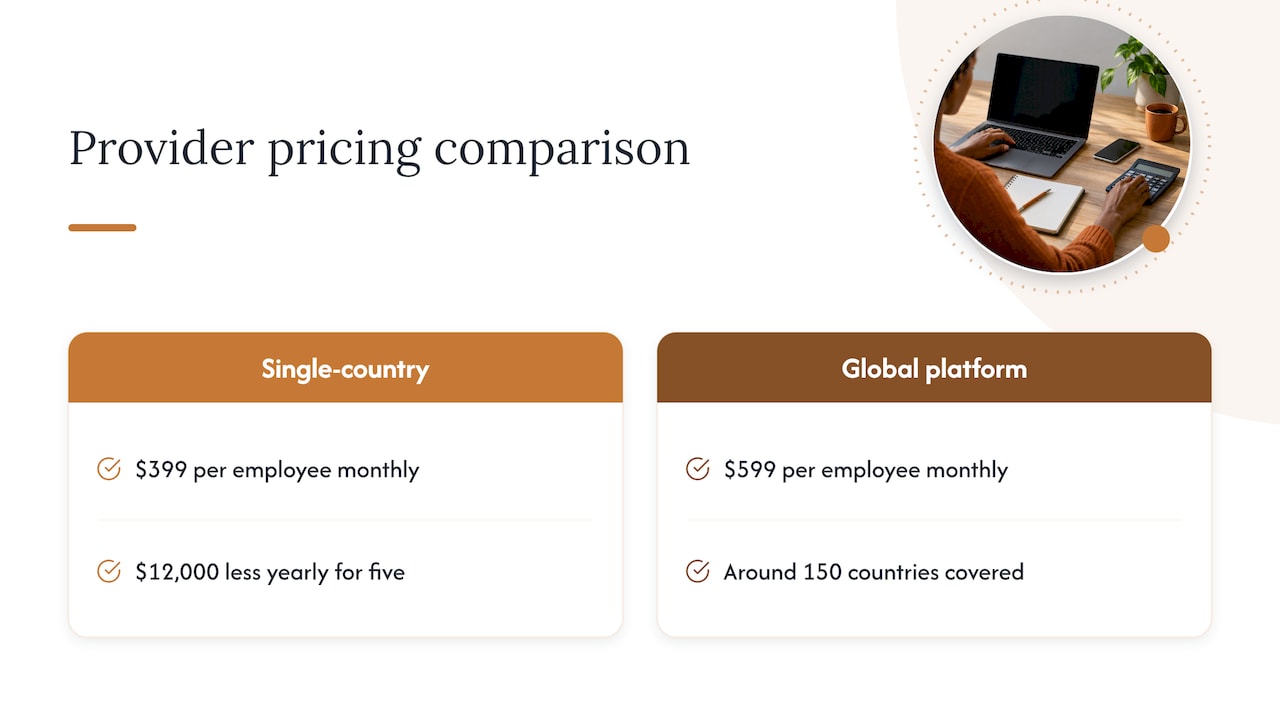
Global platforms cover around 150 countries and, in our experience of their published pricing, charge $400 to $599 per employee per month. That is a fair price for breadth. If you only hire in South Africa, you are paying for coverage you do not use. A single-country provider can price lower and concentrate its attention on one set of rules: the BCEA, the Labour Relations Act, COIDA and SARS thresholds.
Over a year, the difference on one employee is modest. Over a team of five, the gap between $399 and $599 a month is $12,000 a year. That figure is simple multiplication on the pricing ranges above, and it is worth including in your comparison.
The cost lines that reduce your saving
A credible savings estimate names what it subtracts. These are the items to model.
- Statutory employer contributions. UIF, SDL and COIDA apply on top of salary. Rates and caps change, so use the current figures from SARS and the Department of Employment and Labour when you build the budget.
- PAYE thresholds. These determine the take-home pay your employee sees for a given gross, which affects the gross figure you need to offer. See our note on South Africa PAYE thresholds for 2026.
- Bonuses. A thirteenth-month bonus is common in South African employment. Bonus tax is calculated differently from regular pay, and mismatches in payment references cause problems. Our guide on bonus tax for employers explains how.
- Benefits. Retirement, medical aid and risk cover. More on this below, because it is where many foreign employers underbudget.
- Perks with tax consequences. A company car, for example, creates a taxable fringe benefit. Our page on company car tax covers the calculation.
- Exit costs. If a role ends for operational reasons, severance applies at one week’s pay per completed year of service. Use our severance calculator guide when you model risk.
Why benefits matter more than they appear
This is where the household-saving question becomes useful to an employer. South Africans, on average, save very little. Nedbank’s economists report that the household saving ratio fell from -1.3% to -1.6% in the second quarter of 2026, its worst level since the third quarter of 2014. A negative ratio means households are financing part of their spending by drawing down savings or borrowing.
Debt pressure points the same way. A Daily Maverick report from August 2026 notes that, for some debt-counselling clients, repayments take up to 64% of take-home pay.
What does that mean for you as an employer?
- Employer-provided savings are valued. Old Mutual’s 2024 workplace benefits research found that 73% of employees rank factors other than salary as their top priority when considering a new employer. Retirement savings, medical aid and mental health benefits were the most valued core benefits.
- Retirement funds are tax-efficient for the employee. Sanlam’s member guide describes retirement funds as a cost-effective way to save, because contributions can reduce taxable income and group insurance is generally cheaper than individual policies.
- Benefits can carry tax reporting duties. Under the Seventh Schedule to the Income Tax Act, the employer must determine and report the cash equivalent of taxable fringe benefits, such as medical aid contributions, on the employee’s tax certificate. Your Employer of Record handles this reporting.
The practical point: a package built around a competitive salary plus a retirement and medical contribution often retains people better than the same money paid as cash alone. Build that into your cost model from the first offer rather than adding it after a candidate asks. Our overview of hiring and benefits in South Africa shows how international employers typically structure this.
Practical habits you can encourage in local staff
You are not responsible for your employees’ personal finances, but a few supportive practices cost little and help retention.
- Offer retirement fund membership from day one. Regular, automatic deductions work better than leaving saving to discipline. Research from a University of Cape Town study points to insufficient income and weak spending discipline as factors that inhibit saving, and automatic deductions address the second.
- Explain tax-free savings accounts. South African individuals can earn tax-free interest in these accounts, with contributions capped at R46,000 per tax year and R500,000 over a lifetime. Exceeding the annual limit incurs a penalty, so share the cap rather than encouraging unlimited deposits.
- Pay on time, every month. Predictable pay dates make personal budgeting easier. Our payroll process pays in rand, so your team sees no currency conversion or foreign transfer delays.
- Start small. Paymenow data cited by Daily Maverick suggests that a regular deposit of around R300 a month can reduce the chance that an emergency becomes another loan.
These are small touches, but they signal that you understand the local context, and that matters when you are a foreign employer competing for strong candidates.
Making the savings usable: time zone, talent and compliance
A salary saving is only worth having if the person delivers. Three factors decide that.
Time zone. South Africa sits within about an hour of Central European Time, so European teams get a full working-day overlap. UK teams overlap almost entirely, and US East Coast teams share the morning. Daily standups and live collaboration work without anyone working at night.
Talent. Finding the right person is the harder step for most first-time hires. Our talent sourcing service is built for skilled roles, and our guide to talent sourcing in South Africa explains the process for foreign employers.
Compliance. Savings disappear quickly after a labor dispute. South African employment law, including the BCEA and the LRA, gives employees strong protection against unfair dismissal, and disputes go to the CCMA. Put proper terms in writing at the start. Our pages on essential contract clauses, working hours under the BCEA and notice periods cover the points most often missed. If you are in the US, our overview of three routes for US companies hiring in South Africa compares your options side by side.
Perspective
We built Expand to South Africa around one belief: the salary saving is the reason companies look at South Africa, but compliance is the reason they stay.
We have seen the same pattern many times. A founder is drawn by the 40-60% difference, hires a contractor, and later discovers that the arrangement carries risk around worker classification, statutory filings and dismissal. The saving was real, but the exposure ate into it.
That is why we do one country and nothing else. A licensed local partner employs your people under BCEA-compliant contracts, runs rand payroll, and files PAYE, UIF, SDL and COIDA. You pay a flat fee with no setup charge and no FX loading. You know exactly who the legal employer is, because we tell you.
If you are comparing providers, compare the whole cost: fee, on-costs, benefits and exit risk. We are comfortable with that comparison, and our calculator and public API documentation are open so you can check our numbers yourself.
Roel
Get your own savings figure
A general range helps you decide whether to look further. A real decision needs your role, your salary band and your benefits plan. We offer Employer of Record service at $399 per employee per month (from £299 in the UK), with signed contracts within 48 hours and onboarding within days. If you already use another provider, we handle transfers at no charge.
You can review the full terms on our Employer of Record pricing page, read the complete guide to Employer of Record in South Africa, or start from our home page.
FAQ
How much can I save on salaries by hiring in South Africa?
For skilled roles, the typical range is 40-60% on base salary compared with UK, EU or US levels. The exact figure depends on the role, seniority and how scarce the skill is. Subtract the Employer of Record fee, statutory contributions and benefits to reach a net figure.
Do I need a South African company to hire an employee there?
No. An Employer of Record lets you hire full-time staff through a licensed local partner that acts as the legal employer. It issues the contract, runs payroll and files with SARS, so you do not need to incorporate a subsidiary.
Is the salary saving the same as the total cost saving?
No. Total savings are lower than the salary gap, because you also pay UIF, SDL, COIDA, benefits and the EOR fee. They are usually still substantial, and our employment cost guide shows each line so you can model your own case.
Why does South Africa’s low household saving rate matter to an employer?
With household saving at -1.6% in the second quarter of 2026, according to Nedbank economists, employees often value employer retirement and medical contributions highly. Including them in the offer can improve acceptance and retention.
Sources
- Personal finances September 2026, Nedbank
- Save a little money each month to avoid getting yet more loans, Daily Maverick
- Old Mutual Corporate Employee Benefits Brochure
- Sanlam Easy Retirement Plan Member Guide
- SARS guide for employers on fringe benefits
- Savings culture in South Africa: A safety net or an empty promise, University of Cape Town
- Tax-free Savings Account, Discovery Bank