

For most foreign companies hiring one to ten people in South Africa, an Employer of Record (EOR) is the faster and cheaper route. A local entity (a South African Pty Ltd) becomes the better choice once you have a larger team, a physical office, or a long-term plan that justifies the fixed administrative load. Neither route removes permanent establishment (PE) risk on its own, and that point matters more than most comparison pages admit.
This guide compares both options on the criteria a founder, HR lead or finance decision-maker actually weighs: time to first hire, cost, compliance duties, control, exit and tax exposure. It uses current South African rules throughout.
TL;DR
- Use an EOR when you want to employ a small team in South Africa quickly, without a subsidiary, CIPC filings or separate payroll registrations.
- Use a local entity when you expect a sizable team, need your own premises, contracts or bank accounts in the country, or want full long-term control.
- Both routes carry compliance work. A subsidiary puts it on you; an EOR moves the filings to the provider, but you still need to verify that PAYE, UIF, SDL and COIDA are handled properly.
- PE risk depends on substance, not paperwork. What your employee does, and with what authority, matters more than who the employer is on the contract.
- Switching is normal. Many companies start with an EOR and open an entity later, once headcount and revenue justify it.
Table of Contents
- What each model actually means
- Speed to first hire
- Cost: what you pay in each model
- Compliance: who carries what
- Control and flexibility
- Permanent establishment: the risk neither model removes
- Which model fits which company
- Perspective: why we focus on one country
- How our EOR service handles the entity-free route
- A short decision checklist
- FAQ
- Sources
What each model actually means
Employer of Record
An EOR is the legal employer of your staff in South Africa. It issues the employment contract, runs payroll in rand, withholds and pays tax, and files the statutory returns. You direct the daily work: tasks, priorities, performance. The employee works for you in every practical sense, but the legal employment relationship sits with the EOR’s licensed local partner.

At Expand to South Africa, EOR services work exactly this way, and we tell clients plainly who the legal employer is. That disclosure matters, because it determines who is on the other side of a labour dispute.
Local entity
A local entity is a South African company, usually a private company (Pty Ltd), that you own and control. It registers with the Companies and Intellectual Property Commission (CIPC), then registers with SARS and the Department of Employment and Labour as an employer. You are the legal employer, so every contract, payslip, filing and dismissal is yours.
Speed to first hire
An EOR is the clear winner on speed. With us, signed contracts follow within 48 hours and full onboarding within days. There is no company name reservation, no director paperwork, no waiting for tax registrations.
A subsidiary involves a chain of steps before anyone can start work legally:
- Register the company with CIPC.
- Open a South African business bank account, which usually requires documentation on directors and beneficial owners.
- Register as an employer with SARS. The law gives you 21 business days after becoming an employer to do this, so it must happen as soon as the first person is hired.
- Register with the Unemployment Insurance Fund (UIF) and, if payroll exceeds the threshold, for the Skills Development Levy (SDL).
- Register with the Compensation Fund under COIDA, within 7 days of appointing your first employee.
- Set up payroll software and contract templates that comply with the Basic Conditions of Employment Act (BCEA).
None of these steps is exotic, but each has its own portal, forms and deadlines. For a first remote hire, that overhead often exceeds the value of the role in its first months.
Cost: what you pay in each model
EOR cost
An EOR charges a recurring fee on top of salary and statutory employer costs. Our fee is flat: from £299 per employee per month (€350 or $399 in other currencies), with no setup fees and no FX loading. The full price is on our pricing page. The fee covers contracts, ZAR payroll and statutory filings. Salary, employer UIF and SDL, and COIDA assessments are separate employment costs, which our public calculator shows before you commit.
The usual complaint, “why is EOR so expensive?”, is mostly a question of scope. Platforms covering around 150 countries price in that breadth. A single-country provider carries less overhead per market, which is why a flat fee is possible.
Entity cost
The CIPC registration fee itself is modest. The cost is in what follows:
- Annual returns. Every company must file with CIPC each year on its registration anniversary, and the fee varies with turnover, from R100 to R4,000. Failure to file brings penalties and potential deregistration.
- Accounting and payroll. You need a local accountant or bookkeeper, plus monthly payroll processing, the EMP201 declarations and the annual reconciliation.
- Governance. Directors, a registered office address, and beneficial ownership records.
- Management time. Someone in your finance or HR team has to learn South African rules, or you pay a professional to do it.
We will not quote you a single entity figure, because it depends on your accountant, your payroll size and your structure. The honest approach is to price three lines: setup, annual compliance, and the internal hours you will spend. Then compare the total with the EOR fee multiplied by headcount.
A worked break-even view
An EOR fee scales linearly with headcount. Entity costs are mostly fixed. So there is a crossover point, and it depends on your quote for local accounting and company secretarial work. Take your annual entity running costs, divide by twelve, then divide by the monthly EOR fee. The result is roughly how many employees it takes before the entity’s fixed costs are spread thinner than the EOR fee. Below that number, the EOR is cheaper. Above it, the entity may be, provided you value the management time you will spend running it.
The salary side is where the real savings sit. For skilled roles, we typically see 40 to 60% lower salary cost than comparable UK or EU hires, and that holds under either model. The EOR-versus-entity choice only decides the overhead around it.
Compliance: who carries what
South African employment compliance has several moving parts that do not talk to each other automatically.
| Obligation | Local entity | EOR |
|---|---|---|
| CIPC annual returns | You | Not applicable to you |
| PAYE, UIF, SDL monthly filing (EMP201) | You | Provider |
| COIDA registration and assessment | You | Provider |
| BCEA-compliant contracts | You | Provider |
| Dismissal procedure and CCMA exposure | You | Provider’s partner, with your input |
| Day-to-day management and performance | You | You |
The monthly statutory filings
Employers must deduct PAYE and pay UIF and SDL, and remit them by the 7th day of the following month through the EMP201 declaration. UIF is 1% from the employee and 1% from the employer. SDL applies once annual payroll exceeds R500,000. Employers are personally liable for shortfalls. Our guide to employer payroll taxes in South Africa walks through the registration sequence.
COIDA is separate
COIDA registration is not bundled with tax registration. You must register with the Compensation Fund, you are classified under an industrial tariff, and the employer alone pays the assessment, with no deduction from the employee. It is the filing foreign employers forget most often.
Contracts, hours and notice
The BCEA caps ordinary hours at 45 per week and sets notice periods of one week (up to six months of service), two weeks (up to one year) and four weeks (over one year). Operational dismissals carry severance of one week per completed year of service. See our pages on BCEA working hours, notice periods and employment contract clauses for the contract detail.
Control and flexibility
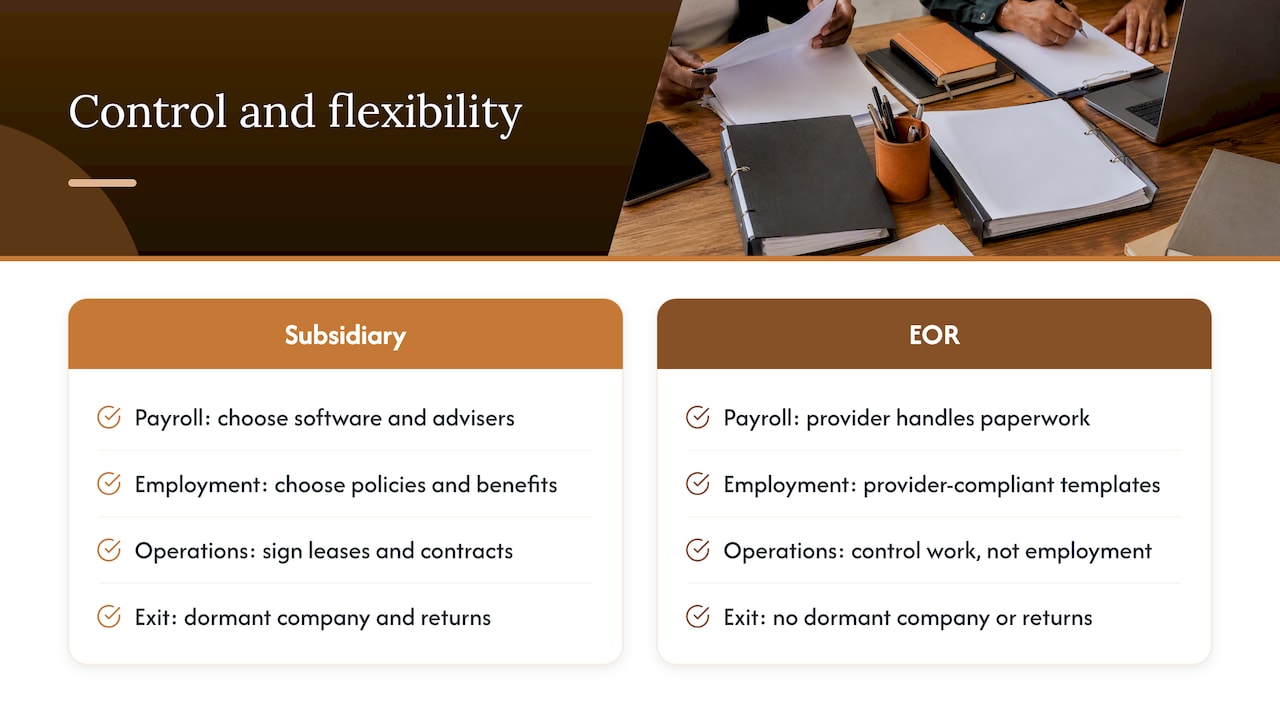
A subsidiary gives you the most control. You choose payroll software, benefit design, policies and advisers. You can sign leases, contract with local customers and open bank accounts. For a business planning a real South African operation, that autonomy is the main reason to incorporate.
An EOR gives you control over the work but not over the legal employment framework. Benefits and contract terms follow the provider’s compliant templates, though you can agree role-specific terms such as salary, title and reasonable restrictive covenants where lawful. For a distributed engineering or support team, that trade is usually fine. The employee reports to you; the provider handles the paperwork.
An EOR also makes exit simpler. If a pilot hire does not work out or you pause the market, you are not left with a dormant company and its annual returns. Dismissals still need a fair procedure, since South African labour law protects employees through the Labour Relations Act and the CCMA, so ask any provider how it handles them. We give CCMA-safe dismissal guidance as part of the service.
Permanent establishment: the risk neither model removes
Providers often advertise that an EOR eliminates PE risk. That is a simplification. Tax commentary on EOR arrangements points out that the EOR model is a contractual arrangement, not a legal shield, and tax authorities look at substance. If your South African employee habitually concludes contracts in your company’s name, or runs essential operations from a fixed place such as a home office, a PE may arise whichever structure you use.
Practical consequences:
- Keep contract-signing authority with people outside South Africa, unless you have taken tax advice.
- Be careful with senior sales or country-manager roles. Authority and function matter more than the label on the contract.
- Avoid renting offices or paying for premises in your own name while using an EOR.
- Get cross-border tax advice from your own adviser before the first hire, particularly for US, UK or EU companies with a double tax agreement to consider.
A legal practitioners’ report on Employers of Record frames the choice as speed versus control, and says a subsidiary is the gold standard for long-term control. It also stresses that you must check the EOR handles local obligations like COIDA and SARS filings, because neglected ones can fall back on you. We agree with both points. Our page on employer of record risks for US companies covers this in more depth.
Which model fits which company
Choose an EOR if
- You are hiring your first one to ten people in South Africa.
- You want to test the market before committing capital.
- You have no finance or HR staff who know South African law.
- You are converting contractors into employees and want a clean, compliant contract. Our guide for US companies compares the three routes available.
Choose a local entity if
- You need a physical office, local customers or local contracts in your company’s name.
- You are building a team where the fixed cost of running an entity is lower than the sum of EOR fees.
- You need full control over benefits, policies and payroll systems.
- You have in-house or retained South African accountants and an employment lawyer.
Start with an EOR, then convert
This is the most common path. Hire through an EOR to start fast and learn the market. When headcount and revenue justify it, open an entity and transfer employees. South African employment transfers are normally handled by agreement and consultation, so plan the move with the provider and your lawyer rather than treating it as a surprise.
Perspective: why we focus on one country
We built Expand to South Africa because we saw the same pattern repeatedly. A European or US founder finds a strong developer, designer or support lead in Cape Town or Johannesburg, then spends weeks comparing generic global platforms and local accountants. The global platforms cover everything and know South African detail unevenly. The local accountants know the detail but have never worked with a foreign payroll cycle.
Our view is that one country done properly beats 150 done adequately. That means a flat fee you can budget against, a licensed local partner running BCEA-compliant contracts and ZAR payroll, filings for PAYE, UIF, SDL and COIDA handled in one place, and a time zone within an hour of CET for real-time collaboration.
We also think EOR is not always the final answer. If you are heading toward a large South African operation, say so early, and we will help you plan the transition rather than lock you in. We offer free transfers from other EOR providers for companies that want to switch, and we disclose who legally employs your people. You should not have to guess.
— Roel
How our EOR service handles the entity-free route
If you decide the EOR route fits, here is what you get from us:
- A flat fee from £299 per employee per month, with no setup fees and no FX loading. See the full pricing.
- BCEA-compliant contracts, ZAR payroll, and PAYE, UIF, SDL and COIDA filings through our licensed local partner.
- Data handled under POPIA and GDPR, with EU data residency.
- An employment cost calculator and an open API with public docs and sandbox keys, for teams that want to automate hiring.
- Talent sourcing if you need help finding the person first.
If you want the broader picture first, read our complete guide to Employer of Record in South Africa.
A short decision checklist
- Count the hires you expect in the next 24 months.
- Ask a South African accountant to quote entity setup, annual compliance and payroll.
- Multiply the EOR fee by your expected headcount and compare totals.
- List what employees will do in South Africa, and whether any role signs contracts or uses a dedicated office.
- Get tax advice on PE exposure in your home country.
- Verify whatever provider you choose on COIDA, SARS filings and dismissal handling.
FAQ
Is an EOR cheaper than a local entity in South Africa?
For small teams, usually yes, because you avoid setup, annual CIPC returns, local accounting and the management time of running a company. As headcount grows, the entity’s fixed costs are spread across more people and the gap narrows. Get a written entity quote and compare it with the EOR fee multiplied by your planned headcount.
Does using an EOR remove permanent establishment risk?
No. Tax authorities assess substance, such as where work happens and whether the employee can bind your company, not only the contract. An EOR simplifies employment compliance, but it does not guarantee that no PE arises. Speak to a cross-border tax adviser if your South African hire has sales authority or senior decision-making power.
Can I move from an EOR to my own entity later?
Yes, and many companies do. You open the entity, register it with CIPC, SARS, UIF and the Compensation Fund, then transfer employees by agreement. Plan the timing with your provider and an employment lawyer so continuity of service and notice rights are handled properly.
What filings does a South African employer need monthly?
PAYE, UIF and SDL (if payroll exceeds R500,000 a year) go through the monthly EMP201 declaration, due by the 7th of the following month. COIDA is registered separately with the Compensation Fund and assessed annually by industrial tariff. An EOR handles these for you; with an entity, they are yours.
Sources
- Registering for Employees’ Tax (PAYE), SARS
- Pay-As-You-Earn, SARS
- Compensation Fund obligations of the employer, Department of Employment and Labour
- Basic Conditions of Employment Act regulations, South African Government
- CIPC services and annual return fees, Amla Auditors
- Permanent establishment and Employer of Record, Tolley’s Global Mobility
- Employers of Record report, WSG