

For international teams hiring in South Africa, a single-country Employer of Record with published flat-fee pricing typically delivers the lowest Total Cost of Ownership. For multi-country hiring, the picture is more complex. The market-average EOR service fee sits at approximately $549 per employee per month, but hidden items — FX spreads, deposits, benefits markups, and per-event charges — commonly inflate that figure by 15–30% in year one. Published pricing is a starting point, not a final invoice.
Top picks by buyer job:
- Single-country South Africa hires: Expandtosouthafrica — flat $399/month per employee, no setup fees, no FX loading, statutory filings included.
- Mid-tier global coverage: Multiplier or RemoFirst — headline fees from $199–$400/month, though TCO checks are essential before signing.
- Enterprise multi-country: Deel or Remote — published fees from $599/month with broad integrations and compliance support.
- Integrated payroll and HR: Papaya Global — enterprise-grade features with combined payroll and EOR capabilities.
Your immediate next step: model one hire fully loaded using the checklist below, then request itemized quotes that explicitly state FX rate basis, deposit terms, and offboarding fees before comparing any two providers.
Table of Contents
- EOR Pricing Comparison: Leading Providers at a Glance
- What actually drives your EOR cost?
- Which EOR pricing model fits your team?
- How to calculate Total Cost of Ownership for an EOR hire
- How to compare EOR providers: procurement checklist and red flags
- Country benchmarks and a South Africa worked example
- How this comparison was built: assumptions and methodology
- Key Takeaways
- When to choose a single-country specialist over a global EOR platform
- Transparent South Africa EOR pricing, without the hidden costs
- Authoritative sources and statutory references
EOR Pricing Comparison: Leading Providers at a Glance
No two EOR invoices look alike. The table below normalizes the key procurement dimensions across eight providers so you can run an apples-to-apples comparison. Published EOR fees range from $199 to $599 per employee per month, but what that fee actually covers varies dramatically by provider.
| Provider | Pricing model | Starting fee (PEPM) | Country coverage | Included services | Setup fees | FX handling | Contract minimums | Compliance coverage | API / integrations | Talent sourcing | Data residency |
|---|---|---|---|---|---|---|---|---|---|---|---|
| Expand to South Africa | Flat fee | $399 / €350 | South Africa only | BCEA contracts, ZAR payroll, PAYE, UIF, SDL, COIDA | None | No FX loading | Monthly; free transfers | Full statutory + CCMA-safe dismissal guidance | Open REST API, public docs, sandbox keys | Vetted talent sourcing included | POPIA + GDPR; EU data residency |
| Deel | Flat fee (PEPM) | $599 | 150+ countries | Payroll, compliance, contracts, benefits, equity support | Not disclosed | Proprietary rate; spread not published | Annual commitment for best rate | Broad global compliance | 500+ integrations, HRIS | Available as add-on | Varies by region |
| Remote | Flat fee (PEPM) | $599 | — | Payroll, compliance, benefits, contractor management | Not disclosed | Not disclosed; ~5-day pre-funding | Annual commitment | Enterprise compliance + mobility | Broad integrations | Limited | Varies |
| Multiplier | Flat fee (PEPM) | $400 | 150+ countries (APAC focus) | Payroll, compliance, benefits | Not disclosed | Proprietary; not disclosed | Not disclosed | Multi-country compliance | Integrations available | Available | Varies |
| RemoFirst | Flat fee (PEPM) | $199 | — | Payroll, compliance, benefits (scope varies) | Not disclosed | Not disclosed | Not disclosed | Standard compliance | Available | Limited | Varies |
| Papaya Global | Flat fee (PEPM) | — | — | Payroll, HR, benefits, compliance | Not disclosed | Proprietary banking partner rate | Enterprise terms | Enterprise-grade | Broad HR/payroll integrations | Limited | Varies |
| Global Squirrels | Custom / regional | Custom quote | Selected markets | Payroll, compliance, regional HR | Not disclosed | Not disclosed | Varies by engagement | Regional specialist compliance | Limited | Available | Varies |
| Columbus (Hire with Columbus) | Consultative / custom | Custom quote | Supported markets | Payroll, hiring, compliance | Not disclosed | Not disclosed | Varies by engagement | Consultative compliance | Limited | Available | Varies |
Key observations from the table:
- Expandtosouthafrica is the only provider in this comparison that publishes a zero-setup-fee, zero-FX-loading flat fee with full statutory coverage for South Africa. That transparency is rare.
- Deel and Remote both publish $599/month as their annual-commitment price; monthly billing has historically run higher.
- RemoFirst’s $199 headline is the lowest published entry point, but what is bundled matters more than the number. Verify benefits administration, immigration, and termination scope before treating it as a like-for-like comparison.
- Global Squirrels and Columbus do not publish list pricing. For procurement purposes, treat custom-quote providers as requiring a full RFP before any cost modeling.
- No provider in this comparison publicly discloses its FX spread as a percentage. That single omission can represent $500–$3,000 per year on a $100,000 salary.
Pro Tip: If a vendor quote is within 10–15% of a country-tier benchmark on a comparable scope, pricing is market-aligned. A gap greater than 15% usually signals differences in benefits markup or FX that need probing before you sign.
What actually drives your EOR cost?
Understanding the cost drivers separates the negotiable from the non-negotiable. Every EOR invoice contains two distinct layers: statutory costs set by law and provider-controlled costs that are, at least partially, negotiable.
Statutory cost drivers (non-negotiable)
These are set by the employment laws of the country where your employee works. No EOR provider can waive them, and any quote that omits them is incomplete.
- Gross salary: The base from which all statutory calculations flow.
- Employer social contributions: Country-specific rates for pension, health, unemployment, and similar programs. In Germany, for example, employer contributions run approximately 20.45% of gross salary.
- Mandatory bonuses: 13th or 14th-month pay where legally required (common across Latin America, parts of Europe, and some African markets).
- Statutory severance: Jurisdiction-dependent; in some markets it accrues from day one of employment.
Provider-controlled cost drivers (negotiable)
These are where your TCO analysis and negotiation should focus.
- Headline service fee: The published PEPM figure. The only fully negotiable line item.
- Benefits markup: Providers often charge a percentage above the actual cost of health and other benefits. This markup is rarely disclosed upfront.
- FX spread: The difference between the mid-market exchange rate and the rate at which the provider converts your payment into local currency. Even a 2% spread on a $100,000 salary costs $2,000 per year.
- Deposit or prepayment: Some providers require one to three months of full employment cost per employee as a refundable deposit. For a small team, this can lock up tens of thousands of dollars in working capital.
- Setup and onboarding fees: Average setup fees have fallen from approximately $283 to $124 since 2024, but they still vary by provider and are often not disclosed on pricing pages.
- Offboarding and termination fees: Typically $150–$400 per employee, with statutory severance additional in regulated markets.
- Per-event charges: Payroll frequency changes, compliance audits, custom reporting, and immigration support are commonly billed separately.
A single 2% FX spread or a two-month deposit on a $5,000/month employee adds materially to your first-year cash position. Model both before comparing headline fees.
Which EOR pricing model fits your team?
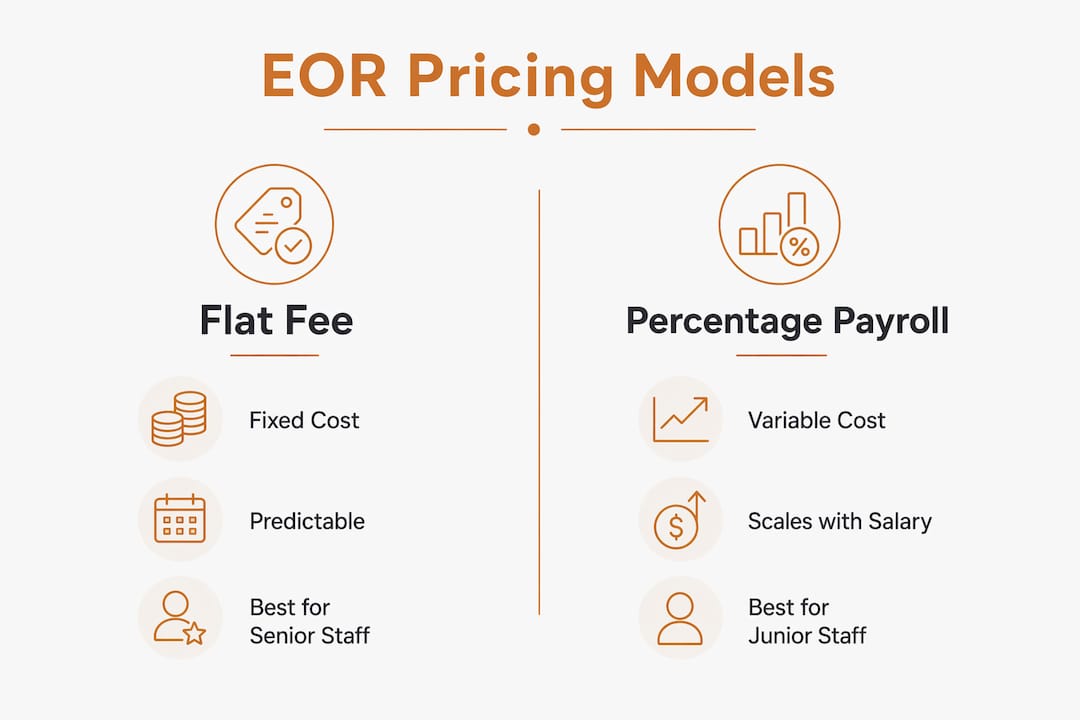
Three primary pricing models dominate the market: flat fee per employee, percentage of payroll, and hybrid structures. Each suits a different buyer profile.
Flat fee per employee (PEPM)
A fixed monthly charge regardless of salary. Budgeting is straightforward, and the cost per employee is predictable. This model strongly favors senior-heavy teams because the fee does not scale with salary. Deel ($599/month) and Remote ($599/month on annual commitment) both use this structure.

Best for: Predictable-budget buyers, senior engineers, finance teams that need fixed monthly accruals.
Percentage of payroll
A fee calculated as a percentage of total monthly salary. Costs scale directly with payroll spend, which can be advantageous for junior-heavy teams on lower salaries but expensive when senior hires are involved.

Best for: Junior-heavy teams in lower-cost markets where the percentage produces a lower absolute fee than a flat PEPM.
Hybrid and enterprise custom
A reduced flat base fee combined with a percentage of payroll, typically offered to enterprise clients with large, multi-jurisdiction teams. Pricing is almost always quote-based.
Best for: Large organizations with mixed headcount across multiple countries that can negotiate volume tiers.
Break-even example: flat fee vs. percentage
Consider a software engineer earning $5,000/month. At a flat fee of $599/month, the EOR service cost is $599 regardless of salary. At a 10% percentage model, the fee is $500/month. The flat fee is slightly higher here. But for a senior architect earning $8,000/month, the percentage model produces $800/month versus the same $599 flat fee. Flat fees win for higher-salary hires, and the break-even point typically sits somewhere between $5,000 and $6,000/month depending on the percentage rate.
Expandtosouthafrica’s flat $399/month fee sits below the market median of $599/month and below the break-even point for most South African salary bands, making it cost-effective for both junior and senior hires in that market.
How to calculate Total Cost of Ownership for an EOR hire
The headline service fee is the number sales teams lead with. The items that actually move your first-year cash position are the ones no provider in the WhichPayroll benchmark sample publishes as a figure.
| Hidden cost item | Typical range | Dollar impact on $60,000/year salary |
|---|---|---|
| FX spread | 0.5%–3% of payroll | — |
| Refundable deposit | 1–3 months of total employment cost | $5,000 upfront (opportunity cost) |
| Benefits markup | 5%–15% above actual benefit cost | Varies by benefits scope |
| Setup / onboarding fee | $0–$2,000 | $0–$2,000 year one only |
| Offboarding / termination fee | $150–$400 per employee | $150–$400 at exit |
| Per-event charges | $150–$400 per employee | Depends on frequency |
Statistic: No provider in the WhichPayroll 2026 benchmark publishes its FX spread as a percentage. The market band sits at 0.5%–3% over mid-market. On a $100,000 salary, a 2% mid-point spread costs $2,000 per year — larger than the fee gap between most providers’ headline prices.
Step-by-step first-year TCO calculation
Using a reference salary of $60,000/year ($5,000/month) and the WhichPayroll median fee:
- Gross salary: $60,000
- Employer statutory contributions (country-dependent; use your target country’s rate): variable
- EOR service fee ($599/month × 12): $7,188
- FX spread (2% mid-point on $60,000): $1,200
- Setup fee (amortized over year one): $124 average
- Offboarding reserve (prorated): $150–$400
- Estimated year-one total (excluding statutory): $68,662–$68,912 before employer social contributions
For a South Africa hire through Expandtosouthafrica at $399/month, the service fee line drops significantly, with zero setup fees and zero FX loading, reducing the year-one total notably on the service fee alone before accounting for FX savings.
Pro Tip: To test a provider’s FX spread, request a sample funding instruction and compare the stated rate against the mid-market rate at the same timestamp using a source like the European Central Bank or XE.com. A provider unwilling to show you the rate basis before signing is a red flag.
How to compare EOR providers: procurement checklist and red flags
Running a structured evaluation protects your organization from the most common procurement mistakes in this category. Buyers who focus only on the published service fee routinely underestimate first-year cost by 15–30%.
Step-by-step evaluation checklist
- Normalize the salary reference. Use the same gross monthly salary across all provider quotes. Providers sometimes quote on different salary assumptions, making direct comparison impossible.
- Require statutory line-by-line breakdowns. Ask each provider to itemize employer social contributions, mandatory bonuses, and benefits separately from their service fee.
- Request the FX policy in writing. Ask for the rate basis (mid-market, proprietary, banking partner), whether the rate is shown before payment, and the pre-funding lead time.
- Confirm deposit terms. Ask whether a deposit is required, the amount (in months of total employment cost), whether it is refundable, and when it is returned.
- Request the offboarding fee schedule. Get the per-employee termination fee in writing, separate from any statutory severance obligations.
- Ask for a sample invoice. A real invoice from a comparable engagement reveals per-event charges and line items that never appear on pricing pages.
Contract clause checklist
- Auto-renewal caps: Does the contract cap annual fee increases on renewal? Renewal cap clauses are now more widely standardized, but not universal.
- Termination fees: What is the cost to exit the contract early? Is there a notice period, and what happens to the deposit?
- Liability cap: What is the provider’s maximum liability for compliance failures? This matters most in regulated markets.
- Statutory remittance receipts: Does the contract guarantee you receive proof of PAYE, social contribution, and benefits payments? Without this, you cannot verify compliance.
- Data residency clauses: Where is employee data stored, and under which privacy framework? For EU-based employers, GDPR alignment is non-negotiable.
- Audit rights: Can you request a compliance audit or review statutory filings? This is a key differentiator between specialist and commodity providers.
Negotiation levers (where to focus)
Statutory employer costs are set by law and cannot be negotiated. Concentrate your effort on:
- Service fee discounts for annual prepayment or multi-employee volume.
- Deposit waivers in exchange for annual prepayment commitments.
- Capped FX margin written into the contract as a maximum percentage over mid-market.
- Offboarding fee caps to limit exit cost exposure.
Red flags to walk away from
- “All-in” quotes with no statutory breakdown.
- Indefinite or non-refundable deposits.
- No FX rate basis disclosed before signing.
- No statutory remittance documentation in the contract.
- High per-event fees for routine payroll changes.
For a deeper look at PEO administrative fee transparency and what contract terms to prioritize, the Inclusive PEO guide covers the key components in detail.
Country benchmarks and a South Africa worked example
EOR costs vary significantly by region. Base fees in Southeast Asia start as low as $199/month, while the United States runs $599/month or higher before ACA, 401(k), and multi-state obligations are added. Eastern Europe sits at $599/month for global platforms, with regional specialists using custom pricing.
| Region | Base EOR fee range (PEPM) | Key statutory cost driver | Notes |
|---|---|---|---|
| Southeast Asia | $199–$400 | Varies sharply by country | Widest compliance variation in the market |
| Latin America | $399–$699 | Mandatory bonuses (13th/14th month) | Statutory bonuses materially inflate total cost |
| Eastern Europe | $599 (global platforms) | Employer social contributions | Regional specialists may offer custom rates |
| United States | $599+ | ACA, 401(k), multi-state payroll | Total cost rises above base fee |
| South Africa | $399 (Expandtosouthafrica) | PAYE, UIF (1%), SDL (1%), COIDA | Statutory burden lower than EU/US equivalents |
South Africa worked example
Using a mid-level software developer earning ZAR 45,000/month (approximately $2,500/month at current rates):
- Gross salary: ZAR 45,000/month
- UIF (employer contribution): 1% of gross = ZAR 450/month
- SDL: 1% of gross = ZAR 450/month
- COIDA: Variable; assessed annually based on industry risk rating
- PAYE remittance: Withheld from employee gross and remitted to SARS via EMP201
- Expandtosouthafrica flat fee: $399/month (€350; no FX loading, no setup fee)
- Estimated fully-loaded monthly cost: Gross salary + statutory contributions + $399 EOR fee
South Africa’s statutory employer burden is notably lower than equivalent contributions in Germany (20.45%), France, or the United Kingdom. Combined with salary savings of 40–60% versus UK and EU equivalents for skilled roles, the fully-loaded cost of a South African hire through Expandtosouthafrica is materially lower than hiring the same profile in Western Europe.
Procurement anchor: If a received quote for South Africa EOR services is more than 15% above the Expandtosouthafrica benchmark on a comparable scope, probe the difference. It almost certainly sits in benefits markup, FX loading, or deposit terms.
How this comparison was built: assumptions and methodology
Transparency on methodology lets you recalculate for your own scenario. Here are the assumptions behind the benchmarks and examples in this article.
- Reference salary: $5,000/month ($60,000/year) used for the TCO step-by-step example; ZAR 45,000/month used for the South Africa worked example.
- Service fee benchmark: Market-average and median figures drawn from the Compareor benchmark (1,200+ quotes) and the WhichPayroll 2026 benchmark (17 providers, observed May 2026).
- FX treatment: Mid-market rate used as the baseline; FX spread modeled at 2% (mid-point of the 0.5%–3% market band) for the TCO calculation.
- Setup fee amortization: Average setup fee of $124 (Compareor 2026 figure) amortized across year one only; not included in steady-state year-two cost.
- Benefits markup: Not modeled in the step-by-step example due to high variance; flagged as a required line item in your own RFP.
- Statutory contributions: Country-specific rates cited from published statutory sources; South Africa rates (UIF 1%, SDL 1%, PAYE via SARS EMP201) reflect current SARS and Department of Labour schedules.
- Data scope: Published pricing captured from provider pricing pages and the WhichPayroll benchmark (May 2026). Three of 17 providers in the WhichPayroll sample do not publish pricing; their fees are not estimated here.
- Expandtosouthafrica pricing: Published flat fee of $399/month per employee, confirmed on the publisher’s pricing page. No setup fees, no FX loading.
How to recalculate for your scenario
Change three inputs and the model adjusts:
- Your gross monthly salary (replaces the $5,000 reference): recalculate statutory contributions at your target country’s employer rate, then add the provider’s service fee.
- Your provider’s FX spread (replace the 2% assumption with the rate basis from your funding instruction): multiply by annual payroll to get the annual FX cost.
- Your headcount (multiply the per-employee total by number of employees): volume tiers may reduce the service fee at three or more employees with some providers.
The biggest variance between scenarios comes from statutory employer contributions (country-dependent and non-negotiable) and benefits markup (provider-dependent and negotiable). Those two lines deserve the most scrutiny in any RFP response.
Use the Expandtosouthafrica employment cost calculator to run a South Africa-specific fully-loaded estimate with your own salary inputs.
Key Takeaways
The most important finding in any EOR pricing comparison is that the published service fee rarely reflects first-year cost. Hidden items — FX spreads, deposits, benefits markups, and per-event charges — commonly add 15–30% to what the pricing page shows.
| Point | Details |
|---|---|
| TCO beats headline fee | Hidden costs add 15–30% to year-one cost; model FX spread, deposit, and offboarding fees before comparing providers. |
| Flat fees favor senior hires | Flat PEPM pricing wins over percentage-of-payroll for employees earning above approximately $5,000–$6,000/month. |
| FX spread is the silent cost | No provider in the 2026 WhichPayroll benchmark publishes its FX spread; a 2% spread on $100,000 salary costs $2,000/year. |
| Negotiate the right lines | Focus negotiation on service fee, deposit terms, and FX margin cap; statutory employer contributions cannot be reduced. |
| Expandtosouthafrica for South Africa | At $399/month with no setup fees and no FX loading, Expandtosouthafrica is the transparent flat-fee option for single-country South Africa hires. |
When to choose a single-country specialist over a global EOR platform
The conventional wisdom in this market is that bigger coverage equals better value. After working through the numbers, that framing misses the point for most buyers.
Global EOR platforms are built for breadth. They serve organizations that need to hire in fifteen countries simultaneously, want a single vendor relationship, and have the procurement resources to manage complex enterprise contracts. For those buyers, Deel, Remote, or Papaya Global are rational choices. The integration ecosystems are mature, the compliance infrastructure is real, and the pricing, while higher, reflects genuine multi-jurisdiction capability.
But the majority of international companies hiring in South Africa are not doing so as part of a fifteen-country expansion. They are hiring one, three, or ten South African employees because the talent is excellent, the time zone overlap with Europe is workable (within roughly one hour of CET), and the salary arbitrage is real. For that buyer, a global platform’s $599/month fee, opaque FX handling, and potential deposit requirement represent unnecessary cost and complexity.
A single-country specialist like Expandtosouthafrica offers something a global platform structurally cannot: deep local legal alignment, CCMA-safe dismissal guidance, direct relationships with SARS and the Department of Labour, and a pricing model that does not penalize you for not needing 149 other countries. The trade-off is obvious: if your hiring needs expand beyond South Africa, you will need a second vendor relationship. That is a real limitation worth acknowledging.
The buyer profiles best served by a single-country specialist are small to mid-size international companies hiring one or more South African employees, prioritizing compliance transparency, minimal working-capital lock-up, and a flat, predictable monthly cost. If that describes your situation, the global platform’s breadth is not a feature you are paying for. It is overhead.
Transparent South Africa EOR pricing, without the hidden costs
Most of the pain points in this article — opaque FX spreads, undisclosed deposits, benefits markups, and per-event termination fees — are structural features of global EOR platforms, not bugs. They exist because multi-jurisdiction complexity genuinely requires margin to manage. Expandtosouthafrica is built differently: one country, one flat fee, nothing hidden.
The published fee is $399 per employee per month (€350 / £299). It covers BCEA-compliant employment contracts, ZAR payroll, PAYE remittance via EMP201, UIF, SDL, and COIDA filings, CCMA-safe dismissal guidance, and an open REST API with public documentation. There are no setup fees, no FX loading, and no deposit requirements. Statutory pass-throughs (UIF, SDL, COIDA) are itemized transparently on every invoice. Data is handled under POPIA and GDPR with EU data residency.
If you are modeling a South Africa hire, use the employment cost calculator to build a fully-loaded estimate with your own salary inputs. For a tailored quote or to review the full scope of EOR services in South Africa, the team can turn around a signed contract within 48 hours of agreement.
Authoritative sources and statutory references
Use these sources when validating benchmark figures during your RFP process or when requesting itemized quotes from providers.
- Compareor EOR Cost Benchmark 2026: Built from 1,200+ quotes; supplies market-average service fee ($549/month), setup fee trends, and FX spread compression data. Attach to RFPs as a pricing anchor.
- WhichPayroll EOR Cost Benchmark 2026: 17-provider sample with published fees, FX disclosure status, and pre-funding lead times observed May 2026. The most granular published benchmark for procurement use.
- WhichPayroll EOR Cost Calculator Guide: Covers TCO methodology, negotiation levers, and the 15–30% hidden-cost uplift finding. Use when building your own TCO model.
- WhichPayroll EOR Pricing Models: Explains flat PEPM, percentage-of-payroll, and hybrid structures with break-even guidance.
- WhichPayroll EOR Fee Comparison Tool: Country-by-country published list prices for major providers, captured May 2026. Useful for verifying provider-quoted fees against published rates.
- Wisemonk EOR Pricing Guide 2026: Covers regional fee ranges and the importance of checking inclusion lists beyond the headline number.
- eorHQ Pricing Reference: Onboarding and offboarding fee ranges ($0–$2,000 and $150–$400 respectively) and per-event charge benchmarks.
- Alcor EOR Cost Guide 2026: Six-component cost breakdown and regional fee ranges; useful for cross-referencing statutory contribution rates by region.
- Inclusive PEO: PEO Administrative Fees Explained: Covers fee transparency and contract term best practices; useful for procurement teams evaluating administrative fee structures.
- Expandtosouthafrica Employment Cost Calculator: Interactive tool for modeling fully-loaded South African employment costs with your own salary inputs. Country-specific statutory rates (PAYE, UIF, SDL, COIDA) are built in.
- SARS EMP201 and Department of Labour: Primary statutory sources for South African PAYE, UIF, SDL, and COIDA rates. Attach to RFPs when requesting statutory line-by-line breakdowns from South Africa EOR providers.
This article provides general information for procurement and planning purposes. Statutory rates, provider pricing, and contract terms change. Confirm current figures with the relevant primary source or a qualified employment law professional before making hiring decisions.