

Moonlighting is not automatically illegal in South Africa. Employees may take on outside work, but the common-law duty of good faith requires disclosing anything that could create a conflict of interest, and employers can lawfully restrict or prohibit outside work through contracts and policies. Undisclosed moonlighting, particularly when it involves dishonesty or a competing business, can justify dismissal.
TL;DR:
- Disclosing outside work is essential when moonlighting creates a potential conflict of interest, especially with competitors or clients, to avoid breach of good faith.
- Employers can enforce restrictions or bans through clear contracts and policies, but must apply them consistently to withstand legal scrutiny.
- Concealing a side business, even if unrelated to the primary job, can justify dismissal if it involves dishonesty or poses a risk to the employer’s business interests.
- Working in unrelated fields during off-hours generally faces a lower risk, but failure to disclose work with a competitor can lead to immediate dismissal.
- Public-sector employees face stricter rules, requiring formal approval and accounting for criminal liabilities under specific regulations.
Table of Contents
- Is Moonlighting Legal in South Africa?
- What Bakenrug Meat Actually Decided About Disclosure
- When Does Moonlighting Cross Into Misconduct?
- Building a Moonlighting Policy That Actually Holds Up
- Why Public Servants Face a Much Stricter Standard
- A Quick Checklist for Employees and Employers
- What Rights Do Employees Have When Accused of Improper Moonlighting?
- Does It Matter If the Second Job Is With a Competitor?
- A Compliance Note From Expand to South Africa
- Let Expandtosouthafrica Handle the Compliance Side of Hiring in South Africa
- Sources
- FAQ
Is Moonlighting Legal in South Africa?
No statute bans private-sector employees from holding a second job. Moonlighting South Africa law rests almost entirely on common law, not a specific act of Parliament, which surprises a lot of employees who assume there must be a rule against it somewhere.
What actually governs the situation is the duty of good faith, an implied term in every employment contract that requires employees to act honestly and avoid conflicts with their employer’s interests. Courts and the Commission for Conciliation, Mediation and Arbitration apply this principle case by case, weighing disclosure, dishonesty, and actual harm rather than a blanket prohibition.
A few statutory and structural points still matter:
- The Basic Conditions of Employment Act caps ordinary working hours and overtime, and combined hours across two jobs can push a worker past those limits even if neither employer intends it.
- Employment contracts frequently include express clauses banning or restricting outside work, and these clauses are generally enforceable.
- Company policies fill the gaps the contract leaves open, covering disclosure timing, approval steps, and sanctions.
- Public-sector employees face a separate, stricter statutory regime, covered later in this piece.
What Bakenrug Meat Actually Decided About Disclosure
The Labour Appeal Court’s ruling in Bakenrug Meat (Joostenberg Meat) is the single most cited case on moonlighting South Africa law, and for good reason: it drew a firm line around disclosure that lower tribunals now apply routinely.
The LAC confirmed that an employee acts in bad faith the moment a potential conflict of interest exists, even without proof of actual competition or harm. Concealing a side business, on its own, was enough to justify dismissal, because the failure to disclose was itself the breach, not whatever the side business happened to do.
Courts generally test three things when a moonlighting dispute reaches the Labour Appeal Court, the Labour Court, or the CCMA:
- Material non-disclosure: did the employee hide something a reasonable employer would want to know?
- Conflict risk: could the outside work realistically compete with or undermine the employer, even indirectly?
- Dishonesty: did the employee actively lie, falsify records, or conceal income to avoid detection?
A recurring pattern in these cases: mere weekend or after-hours work in an unrelated field tends to survive scrutiny. What tips a case toward dismissal is concealment plus proof the employer’s business or trust was actually put at risk.
The Labour Court and CCMA don’t always land in the same place on borderline facts, which is exactly why documentation and consistent policy application matter so much for employers building a defensible position.
When Does Moonlighting Cross Into Misconduct?
Employers rarely win a moonlighting dismissal on the side job alone. What tribunals actually look for is evidence tied to one of these triggers:
- Conflict of interest, where the second job involves a competitor, supplier, or client of the primary employer.
- Performance decline, where fatigue or divided attention measurably affects output, attendance, or quality.
- Misuse of employer resources, such as using company laptops, vehicles, or working hours to run the side business.
- Confidential information exposure, where trade secrets, client lists, or pricing data could leak to a competing venture.
- Dishonest concealment, including forged leave forms, falsified timesheets, or hidden income streams.
Perceived risk is not the same as demonstrable harm, and that gap decides most cases. An employer suspecting a conflict must show more than discomfort; tribunals expect concrete evidence, whether that’s a client complaint, a documented performance drop, or proof the employee actively hid the arrangement.
Proportionality and consistency carry real weight too. A written warning for one employee and instant dismissal for another, on comparable facts, invites an unfair-dismissal finding regardless of how strong the underlying misconduct looks.
Pro Tip: Before drafting a disciplinary charge, ask whether you could prove the harm to a neutral third party using documents alone, not just suspicion. If the answer is no, the case likely needs more evidence, not a faster hearing.
Building a Moonlighting Policy That Actually Holds Up
A policy that only says “no moonlighting without permission” won’t survive a CCMA challenge. It needs specifics.
At minimum, your written policy should:
- Define moonlighting clearly, including part-time work, freelancing, and unpaid directorships.
- Require disclosure within a set timeframe, ideally at hiring and annually thereafter.
- Describe a simple approval process rather than a blanket ban, since courts favor proportionate responses over absolute restrictions.
- State sanctions explicitly, tied to the severity of non-disclosure or actual conflict.
- Include worked examples so employees understand where the line sits.
Enforcement is where most employers stumble. The Labour Court’s decision in Martin & East v Bulbring NO shows how inconsistent application of a moonlighting rule turned an otherwise defensible policy into an unfair dismissal. Train managers on the policy, keep signed annual declarations on file, and escalate exceptions through one consistent channel rather than ad hoc manager discretion. Selective enforcement is the fastest way to lose a case you should have won. Clear employment contract clauses covering outside work make this entire process far easier to defend later.
Pro Tip: Keep every disclosure form, approval email, and warning letter in one personnel file. Tribunals weigh paper trails heavily, and a missing document often matters more than a weak argument.
Why Public Servants Face a Much Stricter Standard
Public-sector employees operate under a tougher regime than the private sector. The Public Service Regulations and the Prevention and Combating of Corrupt Activities Act (PRECCA) restrict outside remunerative work and, in cases involving state contracts, carry criminal exposure that private employees never face.
- Officials generally need prior written permission before taking on outside remunerative work.
- Disclosure deadlines are formal and administratively enforced, not left to manager discretion.
- Non-compliance can trigger disciplinary action, and in serious cases, criminal liability under PRECCA.
- Departments should route approval requests through a designated ethics or HR officer, not a direct supervisor.
A Quick Checklist for Employees and Employers
For employees, the safest path is proactive disclosure rather than waiting to be asked.
- Disclose the outside work in writing, naming the employer or client and describing the general nature of the work.
- Confirm the hours don’t overlap with your primary job and won’t push you past BCEA limits.
- Offer mitigation upfront, such as agreeing not to work during office hours or on employer equipment.
- Keep copies of every disclosure and approval for your own records.
For employers, the checklist runs in parallel:
- Ask specific questions: who is the outside employer, what does the role involve, and could it touch a competitor or client?
- Assess conflict risk against real facts, not assumptions about the employee’s honesty.
- Consider temporary or conditional approval instead of an outright refusal.
- Match any sanction to the actual harm shown, not the worst-case scenario.
Pro Tip: A one-page disclosure form beats a lengthy policy document nobody reads. Ask for the outside employer’s name, role, hours, and any client overlap, then file it alongside the signed contract.
What Rights Do Employees Have When Accused of Improper Moonlighting?
An accusation of improper moonlighting doesn’t strip an employee of standard fair-process protections. The employer still has to follow a proper disciplinary procedure, including written notice of the charge, a chance to respond, and representation at the hearing.
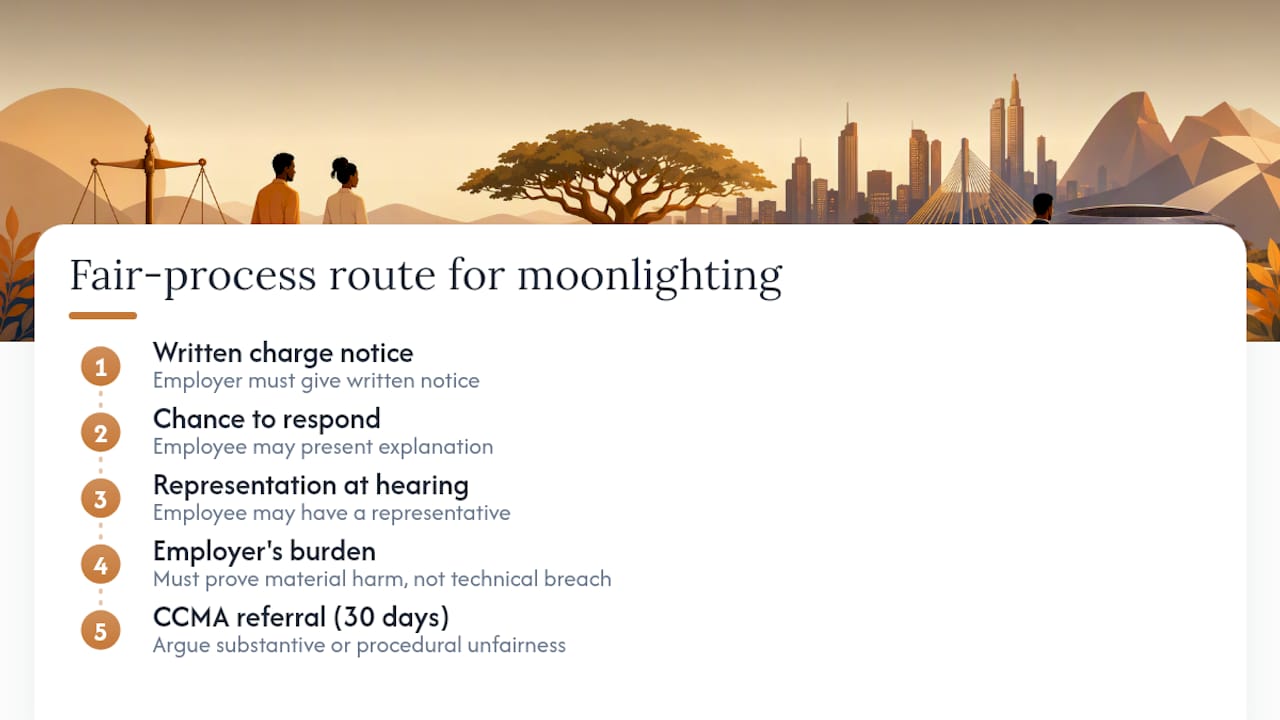
The burden of proof sits with the employer, not the employee. Tribunals expect employers to show the disclosure failure was material and, ideally, connected to actual or realistic harm, not just a technical breach of a vague policy clause. An employee who disclosed the outside work, even informally, has a far stronger position than one who concealed it entirely.
If dismissed, an employee can refer the matter to the CCMA within 30 days, arguing either that the dismissal was substantively unfair (the conduct didn’t warrant dismissal) or procedurally unfair (the process was flawed). Inconsistent enforcement, discussed earlier through the Martin & East judgment, remains one of the strongest grounds for reinstatement. Employees should also request the specific policy or contract clause relied upon, since a dismissal based on an unwritten or unevenly applied rule is far easier to challenge. Understanding CCMA unfair dismissal timelines and evidence standards matters here, because missing the referral window closes the door regardless of how strong the underlying case is.
Does It Matter If the Second Job Is With a Competitor?
Yes, and the distinction shapes the entire legal analysis. Moonlighting for a direct competitor is treated far more seriously than taking on unrelated work, because the conflict of interest is inherent rather than hypothetical.
When the second job sits with a competitor, courts assume a heightened risk: exposure to trade secrets, client relationships, and pricing strategy, even if the employee never intended to misuse any of it. The Bakenrug reasoning applies with full force here, since the potential for conflict alone can justify dismissal, without proof that confidential information actually changed hands.
Unrelated-sector moonlighting sits on much safer ground. An accountant driving for a delivery platform on weekends, or a warehouse worker tutoring students in the evenings, faces a dramatically lower bar. These arrangements rarely touch the employer’s business interests, and tribunals tend to require actual evidence of harm, such as fatigue-driven performance issues, before treating the situation as misconduct.
The practical takeaway: disclosure obligations exist either way, but the consequences of non-disclosure scale with proximity to the employer’s market. An employee moonlighting in an unrelated field who forgets to disclose faces a much smaller risk than one who conceals work for a direct rival.
A Compliance Note From Expand to South Africa
Balancing an employee’s right to extra income against an employer’s need for trust isn’t a legal abstraction, it’s a daily HR decision. Roel has spent years advising international companies on South African labour compliance, and the pattern is consistent: clear policy beats reactive discipline every time. The service includes building BCEA, LRA, and COIDA compliance, including PAYE filings and CCMA-safe dismissal guidance, into every contract managed.
— Roel
Let Expandtosouthafrica Handle the Compliance Side of Hiring in South Africa
If you’re hiring in South Africa without a local entity, moonlighting disputes are just one of many compliance risks you’re exposed to without a compliant contract and consistent HR process in place. This service acts as an alternative to setting up a South African subsidiary by delivering BCEA-compliant contracts, ZAR payroll, and statutory filings (PAYE, UIF, SDL, and COIDA) through a licensed local partner, aiming to ensure outside-work clauses and disciplinary policies hold up if a dispute ever reaches the CCMA.

Our Employer of Record services in South Africa start from £299 per month per employee, with no setup fees or currency loading, and signed contracts land within 48 hours. If you also need help sourcing vetted South African talent, our talent sourcing service handles that too. Check current employer of record pricing and get a compliant contract with proper conflict-of-interest and disclosure clauses drafted in from day one.
This article is general information, not a substitute for advice from a qualified lawyer. Consult a qualified legal professional about your own circumstances before acting on anything here.
Sources
- Cliffe Dekker Hofmeyr: Moonlighting — scope of the duty of good faith
- Martin & East (Pty) Ltd v Bulbring NO — SAFLII
FAQ
Is Moonlighting Legal in South Africa?
Yes. There’s no statute banning private-sector moonlighting, but employees must disclose outside work that could create a conflict of interest, and employers can restrict it through contracts or policy.
What Is Moonlighting and Why Do Some Consider It Illegal?
Moonlighting means holding a second job or business alongside primary employment. It’s not automatically illegal, but undisclosed moonlighting can breach the common-law duty of good faith and justify dismissal, which leads many to assume it’s outright banned.
Is It Legal to Work More Than 12 Hours a Day in South Africa?
The Basic Conditions of Employment Act caps ordinary hours and overtime, and combined hours from two jobs can breach those statutory limits even if each employer stays compliant on paper.
Can an Employer Stop You From Moonlighting?
Yes, employers can lawfully prohibit or restrict outside work through an employment contract or company policy, provided the rule is applied consistently across all employees.
What Happens If an Employee Doesn’t Disclose a Side Business?
Concealing a side business can constitute a breach of the duty of good faith on its own, as confirmed in the Bakenrug Meat Labour Appeal Court decision, and may justify dismissal even without proof of direct competition.