

South Africa has no dedicated remote-work statute. Your remote work policy in South Africa still runs through the BCEA, the LRA, the OHS Act, and POPIA. Whether remote-work terms sit in the employment contract or in a standalone policy determines how easily you can change them later, and it should shape every clause you draft. Your top three priorities: a documented OHS risk assessment, POPIA-aligned security controls, and unambiguous written terms on hours and availability.
TL;DR:
- Remote work arrangements in South Africa are governed by multiple statutes, including the BCEA, LRA, OHS Act, and POPIA, each imposing different obligations.
- Drafting remote work terms into employment contracts limits flexibility, while policies allow more discretion but require fair consultation and notice.
- Employers must conduct risk assessments, enforce POPIA security controls, and maintain detailed records for home-office health and safety compliance.
- Data security policies should mandate VPN use, encrypted storage, and incident response procedures to meet POPIA standards.
- Cross-border remote work triggers tax residency, visa, and social security considerations, requiring early legal and tax vetting before onboarding employees abroad.
Table of Contents
- What Legal Framework Governs Remote Work in South Africa?
- Should Remote Work Sit in the Contract or the Policy?
- What Are Your OHS Obligations for Home Workspaces?
- How Do You Meet POPIA Requirements for Remote Employees?
- What Tax and Immigration Risks Apply to Cross-Border Remote Work?
- What Should Your Remote Work Policy Checklist Include?
- How Do You Roll Out and Monitor the Policy?
- What HR Leaders Get Wrong About Remote Work Policy
- A Practical Execution Route for Compliant South African Employment
- Key Statutes and Official Guidance to Bookmark
- Sources
- FAQ
What Legal Framework Governs Remote Work in South Africa?
No single act regulates telecommuting. Instead, four statutes stack together, and each one controls a different piece of the arrangement.
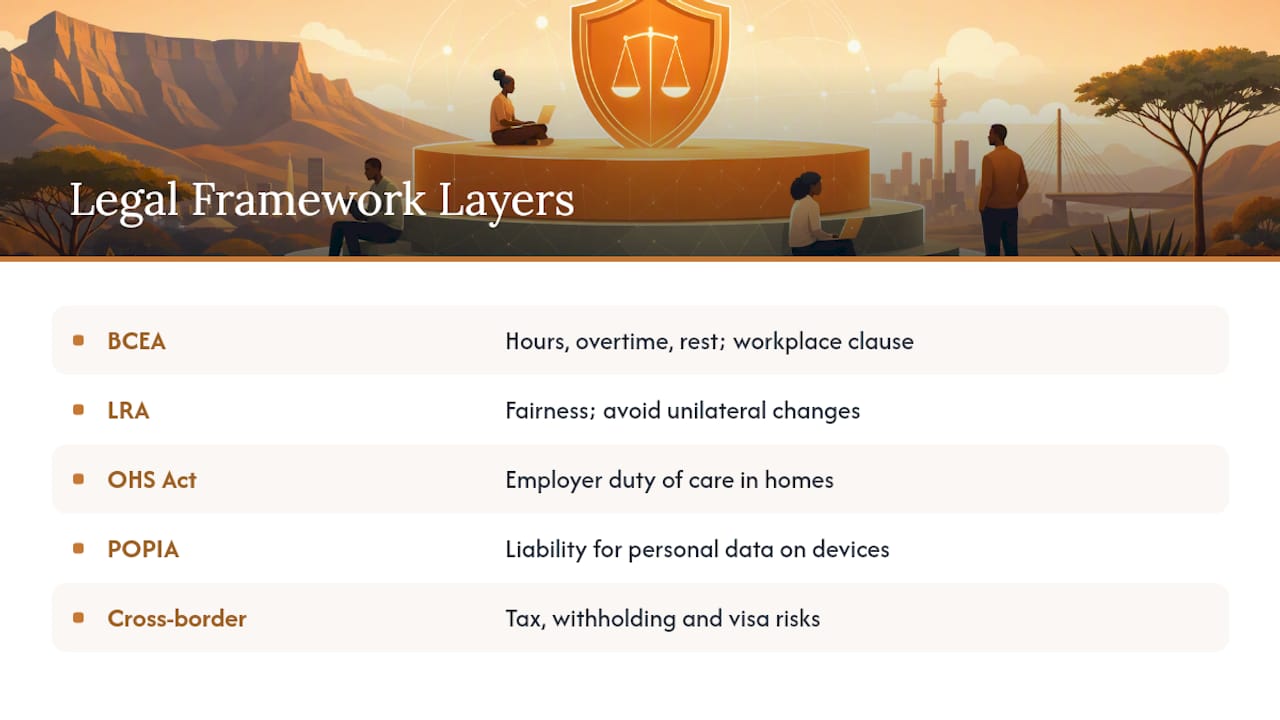
The Basic Conditions of Employment Act (BCEA) still applies in full to remote employees. It governs ordinary hours, overtime, rest periods, and the written particulars of employment, including a statement of where the employee actually works. If your contract clauses don’t reflect the real place of work, you’re already out of step with the BCEA’s requirements.
The Labour Relations Act (LRA) governs fairness. Change a remote arrangement unilaterally and you risk an unfair-labour-practice claim, particularly where the employee reasonably relied on the arrangement continuing. Consultation isn’t optional when you’re pulling someone back to the office after two years of working from a spare room.
The Occupational Health and Safety Act extends the employer’s duty of care into private homes, even though nobody expects you to inspect a spare bedroom the way you would inspect a warehouse floor. “Reasonably practicable” is the working standard, and it shows up constantly in OHS guidance for the digital economy.
POPIA puts the employer on the hook for personal data that travels over home Wi-Fi and sits on personal laptops. That’s an expanded attack surface you didn’t have when everyone worked from one building.
Cross-border remote arrangements add a fifth layer: tax residency triggers, withholding exposure, and Remote Work Visa conditions. Flag these early and route them to specialist advice rather than guessing.
Because there is no standalone remote-work statute, employers are left to fit remote arrangements into laws written for a fixed workplace. That’s the core compliance challenge, and it’s why the next decision, contract or policy, matters so much.
Should Remote Work Sit in the Contract or the Policy?
This single drafting decision determines how much flexibility you retain. If remote work is written into the employment contract as a term, you generally cannot remove it without the employee’s agreement. Attempt it unilaterally and you’re exposed to an unfair-labour-practice claim under the LRA. If it exists only inside a workplace policy, you have more discretion to adjust it, but you still have to act fairly and follow a reasonable process, according to CMS’s expert guide to remote working.
Follow this sequence when introducing or changing remote-work arrangements:
- Consult before you decide. Tell affected employees what’s changing and why, and genuinely listen to objections before finalizing anything.
- Give real notice. A week’s warning for a permanent change to someone’s working life invites disputes; a reasonable notice period is safer practice.
- Use trial periods. A three-to-six-month pilot for new remote arrangements lets both sides test it without locking in a permanent contractual right too early.
- Draft precise clauses. Cover the variation procedure, the defined place of work, hybrid-schedule days, KPIs, and availability windows explicitly.
- Check for a union. Where a recognized union or collective agreement covers the role, consult through those structures before changing anything, even informally.
Legal experts note that implementation detail, how you communicate a change, whether employees actually consented, and whether you ran a trial, often decides the outcome of a dispute more than the wording of the policy itself.
What Are Your OHS Obligations for Home Workspaces?
Your OHS duty doesn’t stop at the office door. It extends to any location where work happens, home offices included, though “reasonably practicable” sets a realistic ceiling on what you’re expected to control.
Government guidance recommends a hierarchy of controls: eliminate the hazard first, then substitute, engineer, apply administrative controls, and use protective equipment only as a last resort. In practice, most employers rely on employee self-assessment forms and the occasional photo rather than full home inspections, a lighter-touch method that still produces an auditable record, according to NIOH guidance on working from home.
Your checklist should cover, inspired by best practice guidance on how to conduct an HR compliance health check: adequate lighting and ventilation at the workstation, safe electrical setups, no overloaded extension cords or exposed wiring, clear walkways free of trip hazards, a chair and desk height that support proper posture, and a dedicated, distraction-limited work area where feasible.
- Adequate lighting and ventilation at the workstation
- Safe electrical setups, no overloaded extension cords or exposed wiring
- Clear walkways free of trip hazards
- A chair and desk height that support proper posture
- A dedicated, distraction-limited work area where feasible
Review these assessments at least every 24 months, and retain the records; some exposure-related documentation carries a 40-year retention expectation under OHS guidance for the digital economy. Any home-office incident, a fall, a repetitive strain injury, still needs to be reported and investigated the same way an office incident would be.
Pro Tip: Build the self-assessment form into onboarding for every remote hire, not just as an afterthought during an audit. A signed form from day one is worth far more in a dispute than a hurried one written after an incident.
How Do You Meet POPIA Requirements for Remote Employees?
POPIA doesn’t relax its standards because an employee is working from a kitchen table instead of a server-room-adjacent office. You remain accountable for how personal data is processed, stored, and transmitted, regardless of where the device sits.
Home routers, shared family devices, and personal laptops all widen the exposure your policy has to close. Practitioner guidance consistently flags weak home-network security as one of the most common gaps in employer remote-work policies, one that shows up repeatedly in remote work compliance reviews.
Mandate these controls in the policy, not just in an IT handbook nobody reads:
- A company-approved VPN for all access to internal systems
- Mobile device management (MDM) or an equivalent endpoint policy on any device touching company data
- Encrypted storage for client and employee data, with no unencrypted local copies
- Clear rules limiting how much data can be copied onto personal devices at all
- Documented incident-response timelines so a lost laptop or phished credential gets reported within hours, not weeks
Pair the controls with mandatory security training and a signed acceptable-use agreement. Keep both on file. When a regulator or a court asks how you evidenced compliance, “we trained people and can show the sign-off” beats “we assumed everyone knew.”
What Tax and Immigration Risks Apply to Cross-Border Remote Work?
Cross-border remote work creates exposure most HR teams don’t budget for until it becomes a problem.
Foreign nationals working remotely from South Africa for an overseas employer generally need the Remote Work Visa, which sets minimum earnings requirements and documentation requirements. The Department of Home Affairs’ Remote Work visa requirements also flag tax-registration considerations tied to how long someone stays.
Presence in the country for more than 183 days in a 12-month period is a common tax-residency trigger, and it can create employer withholding obligations depending on the applicable double-tax agreement. This is where “just let them work from Cape Town for a season” quietly turns into a corporate tax filing.
Before approving any cross-border remote arrangement, work through:
- Tax sign-off confirming residency status and withholding exposure for both employer and employee
- Immigration sign-off confirming visa eligibility and any restrictions on local employment activity
- Duration caps written into the approval, not left open-ended
- UIF and COIDA territorial checks, since South Africa’s social-security contributions have jurisdictional limits that don’t automatically follow the employee abroad
- Payroll flags so finance knows the arrangement exists before the first payslip goes out
Specialist tax and immigration advice earns its cost here. A salary benchmarking review can also help you scope compensation fairly if the arrangement involves relocating talent rather than simply permitting remote work from an existing base.
What Should Your Remote Work Policy Checklist Include?
A workable policy reads like an operational manual, not a legal essay. Run through these headings when drafting or updating yours:
- Scope and eligibility. Define which roles qualify and who approves applications; keep eligibility separate from the approval process so operational and tax risk get assessed independently.
- Place of work. State it precisely; this feeds directly into your BCEA written particulars.
- Hours and availability. Set core hours, response-time expectations, and how overtime gets authorized and paid.
- Equipment and reimbursements. List what the company provides, what gets reimbursed, and the cap.
- OHS compliance. Reference the self-assessment process and review cadence.
- Data security. Cross-reference your POPIA controls rather than duplicating them.
- Performance and KPIs. Tie output measures to the role, not to hours logged.
- Trial and review periods. Set a fixed review date, not an indefinite arrangement.
- Variation procedure. Spell out how and when the arrangement can change, and with what notice.
- Insurance and liability. Clarify what’s covered if equipment is damaged or stolen at home.
- Recordkeeping. Note retention periods for OHS, security, and approval records.
- Disputes. Set out the escalation path if an employee disagrees with a decision or a change.
For each heading, decide early whether it needs contractual permanence or policy-based flexibility. If retention of a specific arrangement matters for a hard-to-replace hire, write it into the contract. If you need room to adjust as the business evolves, keep it in policy with clear consultation triggers.
Pro Tip: Escalate to legal or tax counsel the moment a clause touches cross-border pay, union coverage, or permanent contractual entitlement. Those three areas produce the most expensive mistakes.
How Do You Roll Out and Monitor the Policy?
Run a pilot with a small group before rolling the policy out company-wide, and train managers specifically on how to apply it consistently, not just circulate the document.
Keep records of hours and availability, since that’s legitimate BCEA-related documentation. Avoid intrusive surveillance tools that log keystrokes or screen activity without clear justification; that creates its own POPIA and trust problems.
- Retain approval records and risk assessments for the periods set out in your OHS section
- Log incidents and how they were resolved
- Review the policy annually, or sooner if a role, law, or business risk changes materially
- Treat a spike in disputes or missed KPIs as a trigger for early review, not year-end
What HR Leaders Get Wrong About Remote Work Policy
Most employers treat their remote-work policy as a one-time document instead of a living risk framework, and that’s the mistake that shows up in disputes years later. The policy you write on day one rarely survives a role change, a tax-residency trigger, or a manager who quietly stops enforcing the hours clause.
A contractual remote-work term makes sense when you’re retaining a hard-to-replace employee and permanence matters more than flexibility. For everyone else, policy-based arrangements with real consultation triggers give you room to adapt without inviting a fairness dispute. Good recordkeeping and basic OHS and POPIA controls aren’t paperwork for its own sake; they’re what stands between you and an expensive claim when something eventually goes wrong. Any cross-border element deserves a tax and immigration pre-check before you approve it, not after someone’s already relocated.
— Roel
A Practical Execution Route for Compliant South African Employment
Writing the policy is one job. Running BCEA-compliant contracts, ZAR payroll, and the monthly PAYE, UIF, SDL, and COIDA filings that keep it compliant is another, and it’s the part that consumes HR time month after month. Our service is designed to handle local contracts, payroll, and statutory filings through a licensed local partner, with data handling that complies with relevant data protection laws, offered for a flat monthly fee per employee with no setup costs.

If you’re hiring in South Africa without a local entity, or you’ve inherited a patchwork of remote arrangements that were never properly documented, a compliance-focused EOR setup removes the filing and payroll risk from your plate entirely. It’s worth understanding the risks of getting Employer of Record wrong before you choose a provider, since not every EOR discloses who actually employs your people. Request a compliance review of your current remote-work setup, or a consultation on hiring your first South African employee.
Key Statutes and Official Guidance to Bookmark
- BCEA official text for working-hours and written-particulars requirements
- OHS digital-economy guidance for risk-assessment templates
- DHA Remote Work visa notice for cross-border eligibility
- CMS expert guide to remote working for contract-versus-policy analysis
- Expandtosouthafrica’s knowledge hub for ongoing compliance updates
Sources
- University of the Western Cape research item — remote work regulation summary
- What every employer and employee should know for the digital economy (Department of Labour guidance)
- CMS expert guide to remote working — South Africa
- Department of Home Affairs — Remote Work visitor visa requirements (9 Oct 2024)
FAQ
Can You Work Remotely in South Africa?
Yes, remote work is legal and governed by the same BCEA and LRA protections that apply to any employee, with no separate remote-work statute required.
Can I Work Remotely for a US Company From South Africa?
Yes, but tax residency rules apply after extended presence, typically triggered around 183 days, and the arrangement should be reviewed for withholding and permanent-establishment risk before it becomes long-term.
What Are the New Rules for Foreign Workers in South Africa?
Foreign nationals working remotely from South Africa for a foreign employer generally need a Remote Work Visa, which sets minimum earnings requirements and documentation requirements.
How Many Hours Are You Legally Allowed to Work in a Week in South Africa?
The BCEA caps ordinary working time, and that limit applies to remote employees exactly as it applies to office-based staff.
Do I Need a Separate Contract for Remote Employees in South Africa?
Not necessarily a separate contract, but your existing contract or a supporting policy should clearly state the place of work, hours, and equipment terms, and Expandtosouthafrica’s BCEA-compliant contracts build these clauses in from the start.