

When you hire someone in South Africa through an Employer of Record (EOR), the EOR is the employee’s legal employer. It signs the contract, runs payroll in rand, files the taxes and answers to South African labour law. You direct the daily work. That split is simple on paper, but South African courts look at the real relationship, not only the paperwork, so you need to understand where the line sits.
This guide explains who legally employs your people, what the EOR carries, what stays with you, and how an EOR differs from a contractor, a PEO or your own subsidiary.
TL;DR
- Under a standard EOR model, the EOR is the sole legal employer. It holds the employment contract, runs ZAR payroll and files PAYE, UIF, SDL and COIDA.
- You manage the work, not the employment. Day-to-day control is where a foreign client can drift into co-employer territory.
- South African courts apply substance over form, so a service agreement alone does not shift all risk away from you.
- An EOR suits companies with no South African entity. A contractor arrangement is cheaper to start but carries misclassification risk.
- Our flat fee is £299 per employee per month, with no setup fee, and we tell you in writing who the legal employer is.
Table of Contents
- What an EOR is in South Africa
- Who is the legal employer, exactly?
- What the EOR handles
- What stays with you
- The co-employer risk you should know about
- EOR vs contractor, PEO and your own entity
- What it costs
- Our perspective
- Hiring through us
- Checklist before you sign with any EOR
- FAQ
- Sources
What an EOR is in South Africa
An EOR is a third party that employs workers locally for a foreign company that has no South African presence. According to Cliffe Dekker Hofmeyr’s 2024 analysis, the EOR normally becomes the worker’s legal employer and takes on the domestic employment functions, including payroll, employee taxes, benefits and employment-law obligations.
Mechanically, Bowmans describes the EOR employing the individual directly and assigning that person’s services to the foreign company for a fee. The employee has one contract, with one employer. It is not a shared employment model, and the person does not sit on two contracts.
The practical result: you get a full-time team member in Johannesburg, Cape Town or Durban without registering a company, opening a bank account or registering with SARS yourself. Our own EOR services follow this model through a licensed local partner.
Who is the legal employer, exactly?
Three parties are involved, and each has a distinct role.
| Party | Role | Holds |
|---|---|---|
| EOR (licensed local entity) | Legal employer | Employment contract, payroll, statutory registrations, disciplinary and dismissal process |
| Your company | Client and day-to-day manager | Work direction, tools, performance goals, service agreement with the EOR |
| Employee | Employee of the EOR | Rights under South African labour law, assigned to your business |
The name on the contract matters. The Basic Conditions of Employment Act (BCEA) requires the employer to give the employee written particulars when employment starts. Those include the employer’s full name and address, the role, workplace, start date, hours, remuneration, deductions, leave and notice terms. If the contract names an entity you cannot identify, or names your foreign company when you expected an EOR, stop and ask why.
We publish a checklist for this: 6 checks to confirm the legal employer for US, UK and EU companies. It covers the entity name, its registrations and who signs.
What the EOR handles
The EOR’s legal-employer role has real content. In South Africa, it covers the following.
- Contracts. BCEA-compliant employment contracts with the required written particulars. See our notes on essential contract clauses.
- Payroll in rand. Net pay, payslips and deductions. Payslip content is regulated, as we explain in our guide to BCEA payslip rules.
- PAYE. SARS states that an employer who pays or becomes liable to pay remuneration must deduct employees’ tax and pay it to SARS monthly. The EOR does this under its own registration.
- UIF. The same SARS guide states that the employer and employee each contribute 1% of remuneration to the Unemployment Insurance Fund, which is 2% in total. The monthly ceiling is covered in our UIF contributions guide.
- SDL and COIDA. The Skills Development Levy and workplace injury cover are registered and paid by the employer of record.
- Filing rhythm. Monthly EMP201 returns and the annual reconciliation. Our payroll tax overview walks through the registration steps, and the EMP501 guide covers the reconciliation.
If you want the mechanics of paying people in rand from abroad, read paying employees in ZAR.
What stays with you
An EOR does not remove your management role. You remain responsible for:
- Defining the job. Role, goals, working hours within the contract, and the tools the person needs.
- Managing performance. You give feedback and flag problems early. The EOR runs any formal process, but it needs your documented evidence.
- Budgeting the total cost. Salary, employer UIF, SDL, COIDA, benefits and the EOR fee.
- Keeping the relationship honest. Do not treat the employee as though they work for your company in all but name on the paperwork, without telling the EOR.
Hours are a good example. The BCEA sets limits on ordinary working hours, overtime and rest for employees below the earnings threshold. Your managers set the schedule, so they need to know the rules. We summarise them in BCEA working hours for employers.
The co-employer risk you should know about
This is the part many sales pages skip. Two South African law firms have written about it plainly.
Cliffe Dekker Hofmeyr’s view is that an EOR is a practical way to hire without an entity, but the foreign client may be found to be a co-employer and exposed to adverse claims. If that happens, the Labour Relations Act’s temporary-employment-service provisions may apply, and workers may be deemed employees of the client.
Bowmans reports that South African courts take a substance-over-form approach. Both the EOR and the foreign client may be treated as employers despite the service agreement. A contract that allocates risk to the EOR does not stop authorities or courts from looking at how the relationship works.
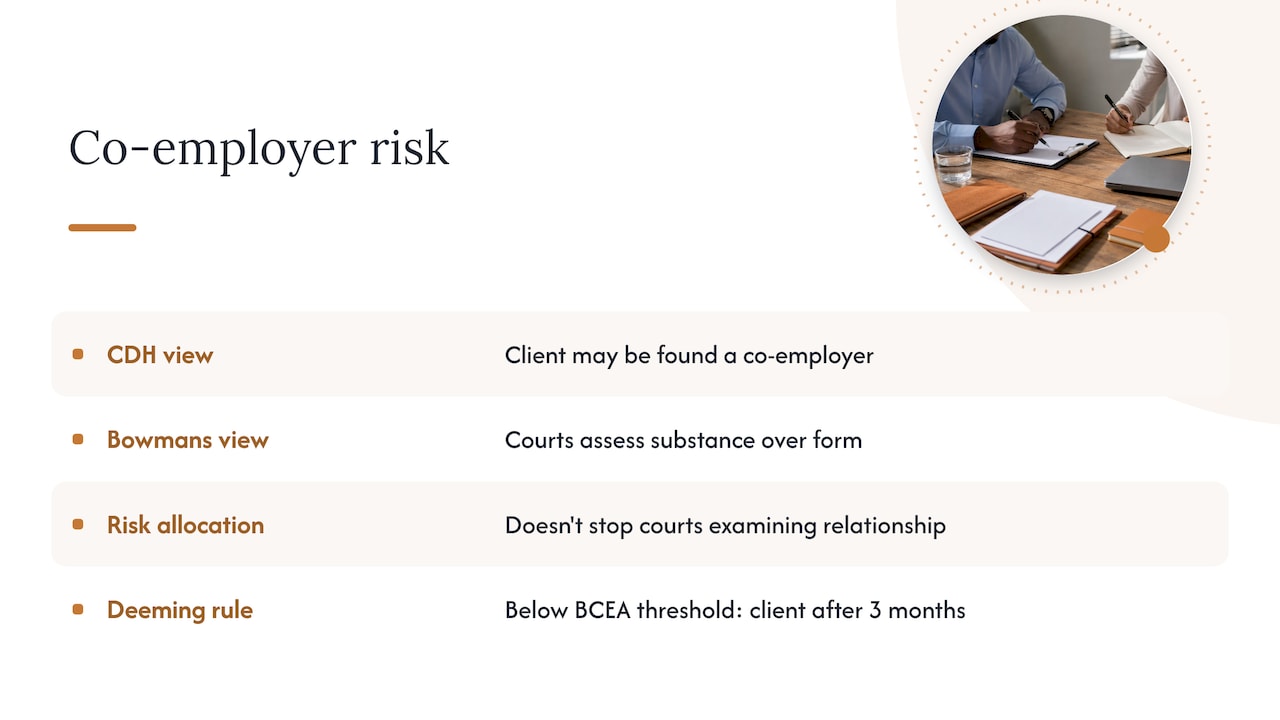
The deeming rule has a specific shape. The South African Government has stated that after three months a worker placed by a labour broker becomes the client’s employee, and that the protection applies to workers earning below the BCEA threshold. A well-built EOR structure is not a labour broker placing temporary staff, but you should have a lawyer or your provider confirm why the provision does not apply to your arrangement.
How to lower the risk
- Keep the employment decisions (hiring terms, discipline, dismissal, pay changes) flowing through the EOR.
- Document the EOR as the contracting employer in all onboarding material, email signatures and org charts.
- Avoid giving the employee a company-branded employment contract or a parallel offer letter.
- Ask your provider to explain the dismissal process before you need it. Dismissals in South Africa must be substantively and procedurally fair, and disputes go to the CCMA.
- Read our overview of EOR risks for US companies.
EOR vs contractor, PEO and your own entity
The three alternatives answer different needs.
| Option | Legal employer | You need a SA entity? | Main trade-off |
|---|---|---|---|
| EOR | The EOR | No | Monthly fee per employee; you give up some control over employment administration |
| Independent contractor | The contractor is self-employed | No | Misclassification risk if the person is in fact an employee |
| PEO (co-employment) | Shared with you | Usually yes | Requires your own local employer registration |
| Own subsidiary | Your subsidiary | Yes | Setup time, registered office, accounting, ongoing compliance |
Contractor
South African law starts from a presumption. For people earning at or below the threshold (currently R269,600.90 a year, according to a local law firm), the Labour Relations Act and the BCEA presume the person is an employee if any one of the listed factors is present. These include working under your direction and being economically dependent on you. Above the threshold, the same factors still guide a court. A full-time, single-client person working your hours is a risky contractor. Converting them is a common reason for using an EOR.
PEO
A PEO shares employment responsibilities with you, which generally assumes you are already an employer locally. Without a South African entity, that is rarely the starting point for a foreign company. An EOR is the sole legal employer instead.
Your own entity
A subsidiary gives you full control, and at larger headcount it can be the better choice. For a first hire or a team of a few people, the setup, accounting and filing overhead is usually out of proportion. You can also begin with an EOR and later transfer staff to your own entity.
What it costs
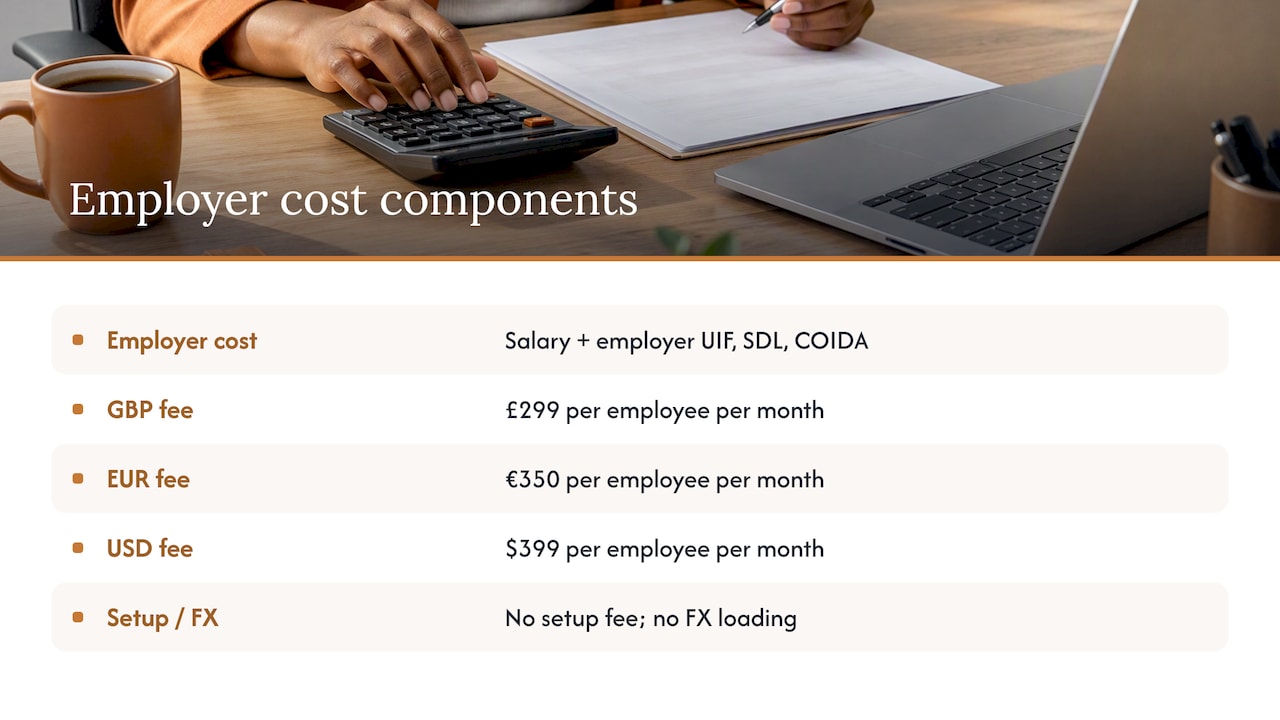
The EOR fee is only part of the picture. Employer costs sit on top of salary: employer UIF, SDL and COIDA. Our flat fee is £299 per employee per month (€350 or $399 in the other currencies we quote), with no setup fee and no FX loading. See the pricing page for the current terms. Our calculator on the site shows the total cost for a given salary.
For skilled roles, salaries in South Africa are typically 40 to 60% lower than in the UK or EU. The time zone is also helpful: South Africa is within about one hour of Central European Time, so overlap with European teams is nearly complete. US teams share the morning.
If you need help finding the person, our talent sourcing service is priced separately and is bundled into the total employer cost.
Our perspective
We do one country. That choice shapes how we think about the legal-employer question.
First, you should know who employs your people. Our contracts are issued through a licensed local partner, and we state that in plain terms before you sign. Some providers blur this. We would rather you read it on day one than discover it in a dispute.
Second, the co-employer risk is real, and it is managed through behavior, not slogans. We coach clients on keeping hiring terms, discipline and dismissal inside the EOR process. When a CCMA matter looks likely, we want the file to show a fair process from the start.
Third, price should be legible. A flat fee and a clear statement of statutory costs is easier for a finance lead to approve than a quote that changes by country and currency.
Fourth, an EOR is not a permanent answer for every company. If you reach a headcount where your own entity makes sense, we will help you move people across. Free transfers from other EOR providers into our model are also part of how we work.
— Roel
Hiring through us
We run employment in South Africa through a licensed local partner: BCEA-compliant contracts, ZAR payroll, and PAYE, UIF, SDL and COIDA filings. Contracts are signed within 48 hours, and onboarding follows within days. Data is handled under POPIA and GDPR with EU data residency.
If you want to see the cost for your first hire, start with our pricing page or read the complete EOR guide. US companies can also review the three hiring routes.
Checklist before you sign with any EOR
- Ask for the legal name, registration number and address of the employing entity.
- Ask which SARS registrations it holds for PAYE, UIF, SDL and COIDA.
- Request a sample employment contract and check it against the BCEA written-particulars list.
- Ask how dismissals and CCMA disputes are handled, and who pays for them.
- Confirm where employee data is stored and how POPIA is handled. See our POPIA guide for foreign employers.
- Check what the exit terms are if you move to your own entity or another provider.
FAQ
Is the EOR or my company the legal employer in South Africa?
In the standard EOR model, the EOR is the legal employer and holds the contract. Your company directs the work. Courts look at the substance of the relationship, so a foreign client that behaves like the employer can still be treated as a co-employer.
Does using an EOR mean I avoid South African labour law?
No. The employee has the same statutory rights as any South African employee, including BCEA protections and unfair-dismissal protection under the Labour Relations Act. The EOR carries the administration, but you are bound by how the relationship works in practice.
Can I use a contractor instead?
You can, but a full-time person working under your direction is likely to be treated as an employee. The presumption of employment applies to people earning at or below the statutory threshold. If the classification is wrong, the cost of correcting it falls on you.
Do I need a South African company to hire one person?
Not if you use an EOR. The EOR employs the person locally and assigns their services to you. If your headcount grows, you can later move staff into your own entity.
What does an EOR in South Africa cost with us?
Our fee is £299 per employee per month, with no setup fees and no FX loading. Salary, employer statutory contributions and any benefits are additional. Check the pricing page for current terms.
Sources
- Cliffe Dekker Hofmeyr: Employers of record and their place in South Africa
- Bowmans: Engaging workers via employers of record
- SARS: Guide for Employers in respect of Employees’ Tax
- Basic Conditions of Employment Act 75 of 1997 (written particulars)
- South African Government: Labour welcomes Constitutional Court ruling on labour brokers
- Employee or independent contractor? (MJK Inc)