

Yes, you can hire full-time employees in South Africa without forming a local company, but not by simply signing them yourself. The compliant route is an Employer of Record (EOR): a licensed local employer that holds the employment contract, runs rand payroll and files the statutory returns, while you direct the day-to-day work. The alternative, employing directly, pulls your foreign company into South African company registration. This guide explains why, what each route costs and how to get a first hire started.
TL;DR
- A South African employment contract counts as conducting business there, so direct employment can require you to register as an external company with the CIPC.
- An EOR lets you employ people full time without an entity: the EOR is the legal employer, and you manage the work.
- Statutory employer costs include UIF (1%, capped), SDL (1%) and COIDA (an industry tariff), on top of salary and any EOR fee.
- Contractors can be engaged directly only when the relationship is genuinely independent. Courts look at substance, not labels.
- Our flat EOR fee starts at £299 per employee per month, with contracts signed within 48 hours.
Table of Contents
- Why a foreign company cannot just hire someone directly
- Your three routes, compared
- How an EOR works, step by step
- What hiring in South Africa costs
- When contractors are safe, and when they are not
- When you do need your own entity
- Why South Africa works for remote teams
- Our perspective
- Start your first South African hire
- FAQ
- Sources
Why a foreign company cannot just hire someone directly
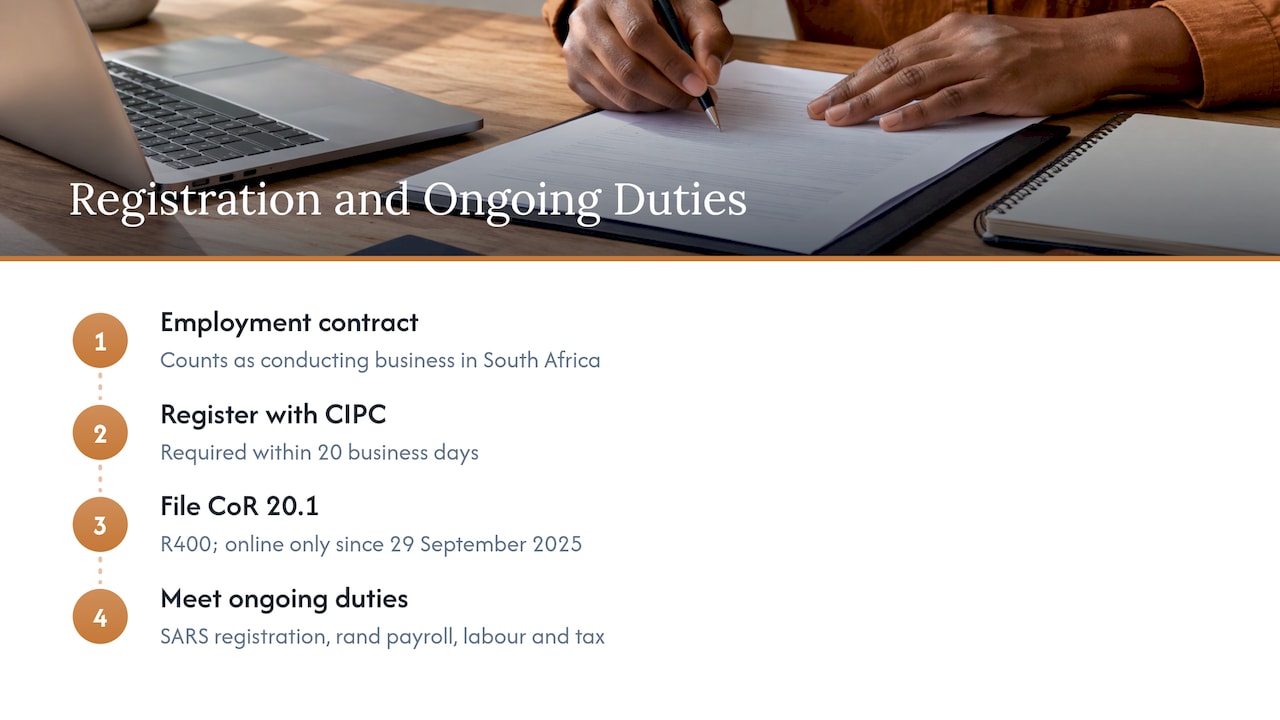
South African company law treats entering into contracts of employment as one of the activities that count as conducting business in the country. Under section 23 of the Companies Act 71 of 2008, a foreign company that does so must register with the CIPC within 20 business days, according to the CIPC’s external company registration guidance.
The exemptions in the Act are narrower than many founders assume. A South African law firm’s external company checker notes that the carve-outs in section 23(2A), such as holding a bank account or dealing with securities, apply to a different limb of the section and not to the employment trigger. In practice, one South African employment contract is enough to require registration.
Registration is a form (CoR 20.1, with an R400 fee, filed online only since 29 September 2025), but it is not the hard part. An external company then carries ongoing obligations: it must be registered as an employer with SARS, run payroll in rand and keep up with labour-law and tax compliance as a South African presence. Many companies want to test the market with one or two hires before taking that on.
Your three routes, compared
There are three realistic ways to put someone to work for you in South Africa.
| Route | Who is the legal employer | Local entity needed | Best for |
|---|---|---|---|
| Employer of Record | The EOR’s South African entity | No | First hires, small teams, market testing |
| Independent contractor | Nobody (the person is self-employed) | No | Genuine project-based or independent work |
| Own South African entity or external company registration | You | Yes | Larger teams, local operations, long-term presence |
Route 1: Employer of Record
An EOR employs the worker on your behalf under South African law. You choose the person and agree the terms. The EOR issues a compliant contract, onboards the employee with tax and UIF details, runs monthly payroll and handles statutory filings. You manage the work. We cover how this works in more detail in our complete guide to Employer of Record in South Africa.
Route 2: Independent contractor
Hiring a self-employed professional to deliver a defined outcome is legitimate. It becomes risky when the person works fixed hours under your supervision, uses your tools, works only for you and does so indefinitely. South African law looks at the reality of the relationship rather than the contract wording; a South African law firm’s overview lists control over working hours, integration into the business, economic dependence, supervision, exclusivity and ongoing work as indicators of employment. If those describe your arrangement, you are effectively employing someone, and the contractor label will not protect you.
Route 3: Your own entity
Incorporating a subsidiary or registering an external company gives you full control and makes sense once you have a team and a long-term plan. It also means you own every compliance duty, from payroll registration to dismissal procedure.
How an EOR works, step by step
The sequence is similar across providers. Here is how it runs with us.
- Agree the hire. You identify the candidate, or ask us to source one, and settle salary, title, start date and working arrangements.
- Sign the service agreement. This sets out the EOR relationship and the flat monthly fee.
- Contract issued. The licensed local partner issues a BCEA-compliant employment contract. Section 29 of the BCEA requires written particulars at the start of employment, including the employer’s name and address, duties, hours, wage and calculation method, leave, deductions and notice. The official checklist lists each item. Our guide to essential employment contract clauses covers what to add beyond the minimum.
- Onboarding. The employee provides tax details and is registered for UIF.
- Monthly payroll. PAYE is deducted, and UIF, SDL and COIDA are handled. Read more on our payroll services page.
- Day-to-day management. You assign work, set goals and run performance conversations as you would for any remote team member.
- Ongoing compliance. Monthly EMP201 submissions, reconciliations, tax certificates and statutory leave administration are handled for you.
We sign contracts within 48 hours, and full onboarding takes days, not months. If you are moving fast, our page on hiring in South Africa with contracts in 48 hours walks through the timeline.
What hiring in South Africa costs
Budget for three layers: salary, statutory employer contributions and the EOR fee.
Statutory contributions
The figures below come from SARS’s employer guide for the 2025/26 tax year, so check the current guide for updates before you budget.
- UIF: 1% from the employee and 1% from the employer, on remuneration capped at R17,712 per month. That means a maximum of R177.12 from each side, or R354.24 combined, as stated in the SARS employer guide.
- SDL: 1% of the leviable amount, payable monthly. Employers who reasonably expect their total leviable amount over the next 12 months not to exceed R500,000 need not register, per the same guide.
- COIDA: an annual assessment based on total earnings and an industry tariff, so the rate depends on how risky your sector is. An office-based software team sits at the low end of the range.
- PAYE: deducted from the employee’s pay, not an extra employer cost, but it must be calculated and paid correctly. See our overview of employer payroll taxes in South Africa and the current PAYE thresholds.
Filing deadlines
Employers must apply to register for employees’ tax with SARS within 21 business days of becoming an employer, according to the same SARS guide. Employees’ tax, SDL and UIF must be paid within seven days after the end of the month in which they were deducted or became due, with a monthly EMP201 declaration submitted alongside payment. Missing these dates is where do-it-yourself setups tend to slip. Our guide to paying employees in ZAR explains the monthly rhythm.
The EOR fee
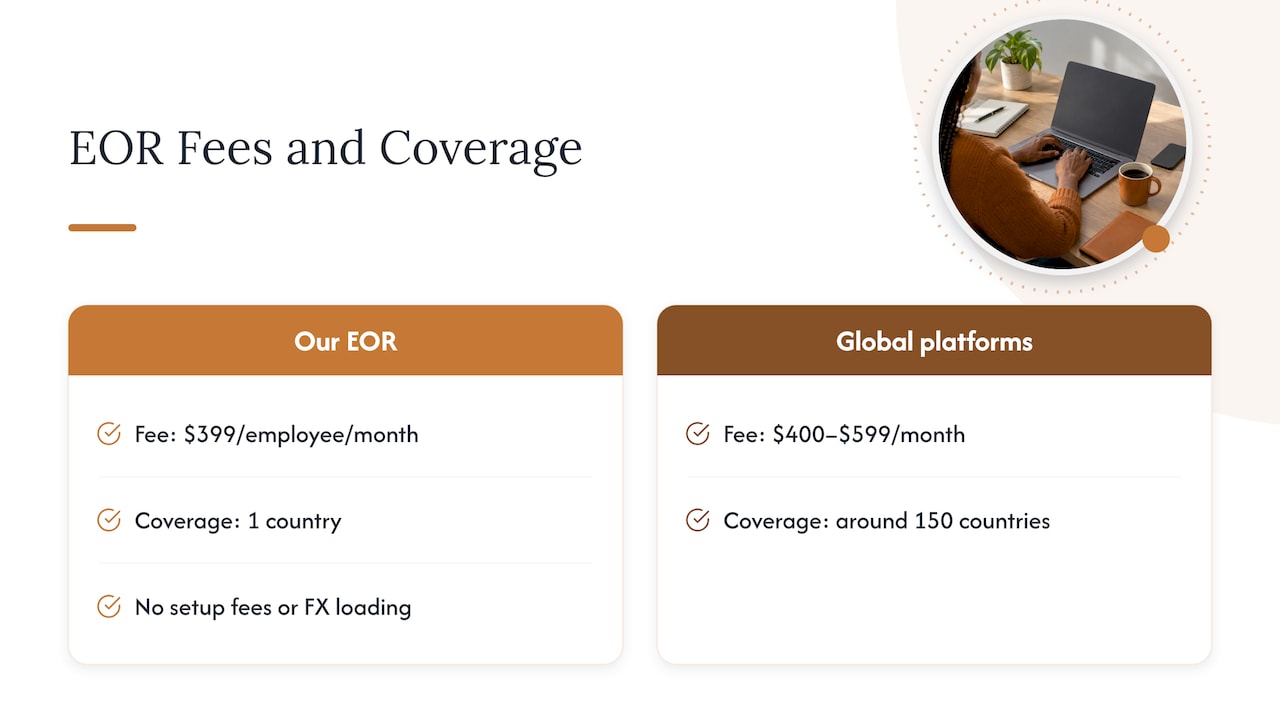
Our Employer of Record service is priced from £299 per employee per month (the flat fee is also published as $399 or €350), with no setup fees and no FX loading. Full details are on our pricing page. Global multi-country platforms typically charge $400 to $599 per month because they cover around 150 countries; we cover one.
A worked example
Take a mid-level developer on a salary of R50,000 per month, well above the UIF ceiling:
| Item | Monthly amount |
|---|---|
| Gross salary | R50,000 |
| Employer UIF (1%, capped) | R177.12 |
| Employer SDL (1% of leviable pay, once registered) | R500 |
| COIDA | Annual assessment by industry tariff |
| EOR fee | From £299 |
The salary figure is illustrative, not a quote. Our public employment cost calculator lets you model your own numbers. For skilled roles, we typically see salary savings of 40 to 60% compared with UK and EU equivalents, which is why many teams hire here in the first place.
When contractors are safe, and when they are not
You can engage a South African contractor directly when the person runs their own business, controls how and when the work is done, serves other clients and is paid for a deliverable. A short, defined project with a freelance designer is a typical fit.
A full-time developer who sits in your stand-ups, works your hours and has no other clients is not. Treating that person as a contractor exposes you to back-claims for tax contributions, leave and overtime, and to unfair-dismissal claims if you end the relationship. If you are converting an existing contractor, the transition is a standard EOR use case, and we can start from the facts of the current arrangement.
When you do need your own entity
An EOR is not meant to be permanent for every company. Consider your own South African presence when:
- you are building a larger team and want direct control of employment terms and benefits;
- you plan to operate from local premises or run local sales and customer contracts;
- your hiring will continue for years and the fixed cost of an entity is lower than per-employee fees;
- investors, clients or regulators require a local legal presence.
Starting with an EOR does not close that door. Many companies use the EOR to prove the market, then transfer the team into their own entity later. Our guide to remote hiring in South Africa covers the scaling path.
Why South Africa works for remote teams
South Africa sits within about one hour of Central European Time, so European teams get a full working day of overlap, and UK teams have near-complete overlap. US teams get a morning overlap with the South African afternoon. English is the language of business, and there is a deep pool of developers, finance professionals, designers and customer-support talent. If you need help finding candidates, our talent sourcing service and guide to sourcing talent in South Africa explain the process, and US employers can compare options in our list of the best South Africa tech recruiters.
If you are based in Europe or Canada, we have country-specific guides for EU companies, Dutch companies and Canadian companies. For the US perspective, read our page on US company hiring in South Africa.
Our perspective
We built Expand to South Africa around one belief: a company that hires in one country should get an expert in that country, not a generalist that treats it as one line in a catalogue of 150.
Most of the questions we hear are not about price. They are about who legally employs the person, what happens if it does not work out, and whether the payroll filings are right. So we say plainly that our licensed local partner is the legal employer, and that you direct the work. We give you a flat fee, no setup charge and no FX loading, so the cost on month twelve is the cost you expected on day one.
We also think compliance should be something you can see. Our employment cost calculator is public, and our API has open documentation and sandbox keys, so your engineers can automate hiring and payroll data without a sales call. If you already have an EOR provider, we transfer your team at no charge.
Dismissal is where many foreign employers get hurt, because South African labour law requires fair procedure. We guide you through CCMA-safe offboarding so you are not improvising when it matters.
Roel
Start your first South African hire
If you are ready to employ someone in South Africa without a local company, we can issue a compliant contract within 48 hours and run payroll from the first month. Our EOR service starts from £299 per employee per month, with no setup fees. See the details on our EOR services page or go straight to pricing.
FAQ
Is it legal to hire someone in South Africa without a local entity?
Yes, if the person is employed by a licensed local employer such as an EOR, or is a genuine independent contractor. Employing them yourself, without registration, is the problem: a South African employment contract counts as conducting business under the Companies Act, which triggers external company registration with the CIPC.
How long does it take to hire through an EOR?
With us, contracts are signed within 48 hours of agreeing terms, and onboarding takes days. Setting up your own entity and registering as an employer takes considerably longer, because registrations with the CIPC and SARS must be completed before the first payroll.
Who is the legal employer under an EOR?
The EOR’s South African partner entity is the legal employer and holds the employment contract. You direct the employee’s daily work, and the partner handles payroll, tax filings and statutory compliance. We state this openly so there are no surprises about legal responsibilities.
Can I pay a South African employee in dollars or euros directly?
South African employees are paid in rand through local payroll, with PAYE, UIF and SDL handled in the same cycle. With us, you pay one invoice in your currency, with no FX loading, and we manage the ZAR payroll.
What happens if I want to end the employment?
South African law requires notice and a fair procedure. We guide you through the BCEA notice rules and CCMA-safe steps, so the termination follows the law. Our notice period guide sets out the statutory minimums.
Sources
- CIPC: External Company Registration guidance
- Do You Need to Register an External Company? SA Checker
- BCEA compulsory employment details checklist
- SARS PAYE guide for employers
- Employment Law in South Africa for Foreign Companies