

An Employer of Record (EOR) in South Africa costs between roughly $199 and $699 per employee per month in platform fees, depending on whether you use a global platform or a specialist. On top of that you pay the employee’s salary and a statutory employer load that is unusually low, often 2-4% of pay. Our own flat fee is $399 per employee per month, with no setup fees and no FX loading. The rest of this guide shows how the total is built, where the extras hide, and how to model it before you sign.
TL;DR
- Platform fees: published ranges for South Africa run from about $199 to $699 per employee per month. Global platforms sit at the top of that range, specialists lower.
- Our price: €350 / $399 / £299 per employee per month, flat, with no setup fees and no FX loading.
- Statutory load: UIF, SDL and COIDA together are small, so salary remains by far the largest line in your cost.
- Watch the extras: CCMA representation, background checks, equipment and benefits administration are often billed outside the headline fee.
- Savings: for skilled roles, salaries are typically 40-60% below UK and EU levels, and South Africa sits within ±1 hour of CET.
Table of Contents
- What an EOR actually charges for
- Platform fees: what the market charges
- The statutory employer load in South Africa
- A worked monthly example
- Hidden costs to ask about before you sign
- Where the real risk, and the real cost, sits
- Salary savings and time zone: the other side of the cost equation
- Our perspective: what we think a fair price looks like
- How to compare EOR quotes in five steps
- What we offer, and what it costs
- FAQ
- Sources
What an EOR actually charges for
An Employer of Record becomes the legal employer of your worker in South Africa. It issues the contract, runs payroll in rand, files the statutory returns and carries the employment-law exposure, while you direct the daily work. The alternative is a local subsidiary, which the Platformics blog puts at 2-6 months to establish and ZAR 50,000-100,000 a year to maintain. That comparison is why most first hires abroad go through an EOR.
The monthly bill has four parts:
- Gross salary (and any agreed allowances or bonuses).
- Statutory employer contributions (UIF, SDL, COIDA).
- The EOR platform fee, normally flat per employee.
- Optional or variable items: benefits, equipment, recruitment, legal support.
Only the third is negotiable between providers in a meaningful way. The others are set by law or by the market for the role. If you want the full legal mechanics, our complete guide to Employer of Record in South Africa covers them in depth.
Platform fees: what the market charges
Published fees vary widely, and the spread is mostly explained by how many countries a provider covers and how much it bundles.
| Provider type | Typical fee per employee per month | Source |
|---|---|---|
| Large global platforms (150+ countries) | About $599-$699 | HiveDesk |
| Mid-priced global platforms | Around $400 | Dupple |
| Low-cost or regional providers | From $199 | Dupple |
| Our South Africa-only service | $399 flat (€350 / £299) | Our pricing page |
Treat any single figure as a starting point. Fees change, and comparison sites update them at different speeds. Check the provider’s own pricing page on the day you decide.
One point matters more than the headline number: a $599 fee is rarely a $599 bill. An independent review notes that the headline price of a large global platform grows through FX markups of 1 to 3 percent per payroll cycle, statutory benefit fees and off-cycle payroll charges. For a small team the effective cost can land between $750 and $900 per employee per month, according to that review.
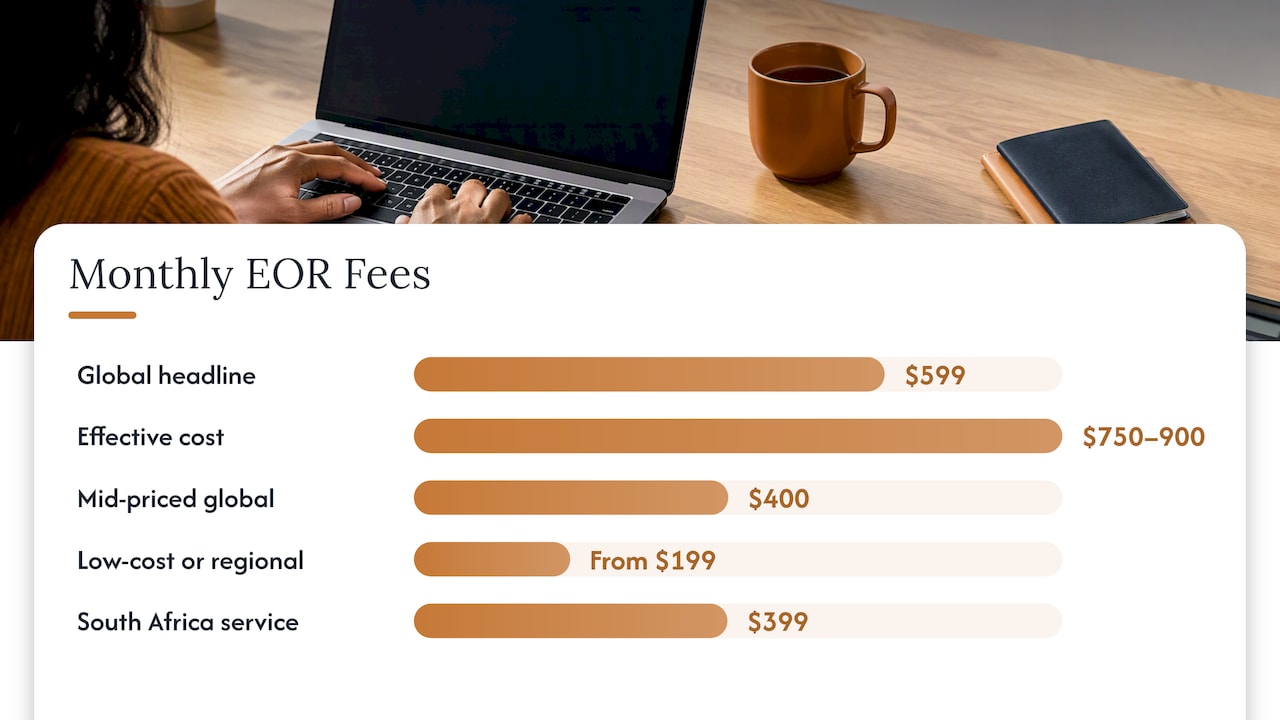
This is the reason we price the way we do. We cover one country, so there is no 150-country platform to fund, and we do not add a currency margin to your payroll or charge to get started. Our EOR pricing comparison shows how to model any provider’s true cost side by side.
The statutory employer load in South Africa
South Africa’s payroll-related employer costs are light compared with continental Europe. For the 2026/27 assessment year, which ends on 28 February 2027, the employer contributions are, per SARS guidance:
- UIF (Unemployment Insurance Fund): 1% of remuneration, applied up to a ceiling of R17,712 per month. Our UIF contributions guide explains the cap and the EMP201 versus uFiling distinction.
- SDL (Skills Development Levy): 1% of total payroll, payable only by employers whose annual remuneration exceeds R500,000.
- COIDA (workplace injury cover): varies by industry, typically in a band of about 0.11% to 8.26%, calculated on earnings up to a cap of R668,000 per year.
Employees contribute their own 1% to UIF and pay PAYE on their salary. The employer withholds and remits these through the monthly EMP201 return. Our guide to employer payroll taxes and the 21-day registration window and the page on PAYE thresholds cover that side.
Taken together, the statutory load is often only 2-4% on top of salary, according to Platformics. If you want wider context on how South Africa taxes companies and payroll, this corporate tax overview from Fiatmap is a useful reference alongside the SARS pages.
A worked monthly example
Say you hire a senior developer in Johannesburg on a gross salary of R60,000 per month. The figures below are illustrative. The COIDA rate is an assumption, since the real rate depends on your industry classification.
| Line | Basis | Monthly amount |
|---|---|---|
| Gross salary | Agreed | R60,000.00 |
| UIF (employer) | 1%, capped at R17,712 of pay | R177.12 |
| SDL | 1% of R60,000 (assuming payroll above R500,000 a year) | R600.00 |
| COIDA | Assumed 1% on R60,000 (rate varies by industry) | R600.00 |
| Statutory load | R1,377.12 (about 2.3%) | |
| EOR platform fee | Flat | $399 (billed separately) |
The statutory load is R1,377.12, or 2.3% of salary. The fee is a fixed amount in your own currency. Your total monthly cost is therefore salary plus about 2.3% plus the flat fee. To run your own role, use our employment cost calculator, which is public and needs no sign-up.
The arithmetic also shows why a flat fee suits South Africa. When statutory costs are low, a percentage-of-salary fee would add little value at the top end, and a high flat fee becomes the single biggest cost after salary. That is why the fee deserves scrutiny.
Hidden costs to ask about before you sign
The low statutory load can be misleading. Headline EOR fees often exclude operational costs such as CCMA representation, background checks, equipment procurement and specialized benefits management (medical aid, pension). Ask every provider, us included, to put the following in writing:
- FX treatment. Is salary converted at the mid-market rate, or with a margin? What is the margin per cycle?
- Setup or onboarding fees. We charge none. Some providers charge a one-off amount per hire.
- Off-cycle payroll. Corrections and bonuses may carry a separate charge.
- Dismissal support. Who represents you at the CCMA, and at what cost? This matters more than most buyers expect.
- Benefits. Medical aid and retirement contributions are optional by statute but common in the market for skilled roles. Confirm who administers them and what that costs.
- Exit terms. Notice periods, minimum terms and fees for moving your team to another provider.
The point of the exercise is to compare total invoices, not headline fees. A provider with a $299 fee and several add-ons can cost more than a flat-fee provider at $399.
Where the real risk, and the real cost, sits
The statutory percentages are not where South African employment gets expensive. Termination is. Under the Labour Relations Act (LRA), a dismissal must be substantively and procedurally fair, and a disputed dismissal goes to the CCMA. Experts quoted by Platformics point to non-compliant terminations and SARS filing errors as the costs that quietly become prohibitive when handled in-house.
Two practical consequences for budgeting:
- Hire with the contract right. A Basic Conditions of Employment Act (BCEA) compliant contract sets notice, leave, working hours and probation correctly from day one. Errors here are expensive to correct later.
- Plan exits before they happen. Ask how your provider handles performance management, consultation and documentation. We give CCMA-safe dismissal guidance as part of the service, so a difficult conversation does not turn into a surprise legal bill. For the wider picture, read our overview of Employer of Record risks for U.S. companies.
Salary savings and time zone: the other side of the cost equation
Fees only matter relative to what you save. For skilled roles such as software development, finance and customer support, we typically see salaries 40-60% below comparable UK and EU levels. That is a pattern across the roles we see, not a guarantee for every hire, so benchmark the specific role. A South African tech hiring report addresses CTOs facing high senior developer salaries and tight budgets, which is the situation many of our clients describe.
South Africa also runs within ±1 hour of Central European Time, so a Johannesburg or Cape Town hire overlaps with a European workday almost completely. For US teams the overlap is shorter, usually the US morning, so plan meeting windows accordingly. If you are a US company, our guide to hiring in South Africa from the US compares the three routes available. For support roles specifically, see hiring customer support in South Africa.
Our perspective: what we think a fair price looks like
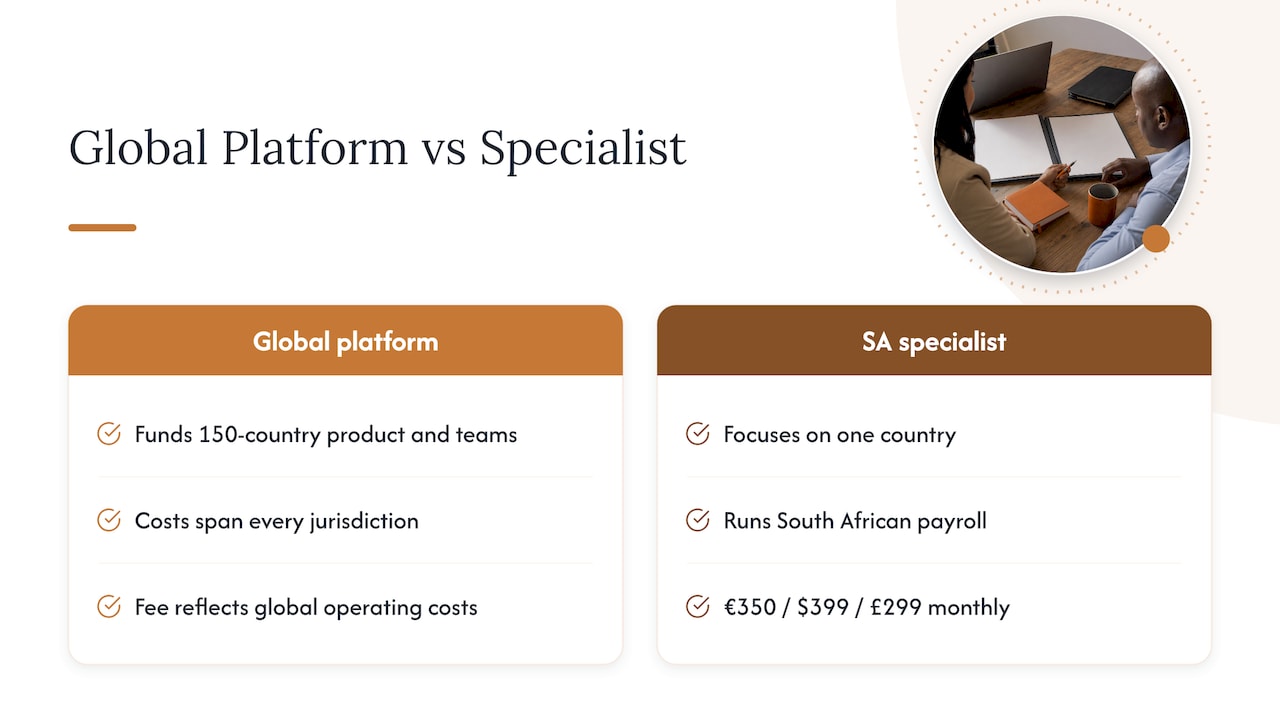
We built this company around one country because we think the economics of a 150-country platform and a South African hire do not line up. A global provider must fund a product, legal teams and support across every jurisdiction, and that cost lands in the per-employee fee. South Africa’s statutory structure is simple enough that a specialist can run it properly for less.
We also think pricing should be readable in one sentence: €350, $399 or £299 per employee per month, no setup fee, no FX loading. If a quote needs a spreadsheet to decode, it is hard to trust.
The second thing we insist on is honesty about who employs your people. The legal employer is a licensed local partner, not us and not you. That partner issues BCEA-compliant contracts, runs ZAR payroll, and files PAYE, UIF, SDL and COIDA with SARS and the relevant funds. You should know this before you sign, and you should be able to see it in the agreement. Data is handled under POPIA and GDPR with EU data residency.
Third, we think the cost of leaving matters as much as the cost of joining. We transfer teams from other EOR providers for free, and we publish an open API with public docs and sandbox keys so your engineers can test the integration before you commit.
— Roel
How to compare EOR quotes in five steps
- Define the role and salary. Use market data for the specific job and city rather than a country average.
- Request a full 12-month cost. Include fees, FX margin, setup, benefits administration and any minimum term.
- Ask who the legal employer is. Confirm in the agreement that a licensed local entity employs your people.
- Test the exit. Ask for the dismissal process, CCMA support terms and transfer terms in writing.
- Check the tooling. If you automate hiring, confirm API access, documentation and sandbox availability before the contract is signed.
If you are switching provider or converting a contractor, add one more check: how the move affects the employee’s continuity of service and leave balances. Our payroll services page explains how we handle the payroll side of a transfer.
What we offer, and what it costs
Our Employer of Record service costs €350, $399 or £299 per employee per month, covering contracts, ZAR payroll, statutory filings and compliance guidance. Contracts are signed within 48 hours and onboarding completes within days. If you also need candidates, talent sourcing is available for skilled roles, with its fee bundled into the total employer cost. See current pricing, or start from our EOR services overview.
FAQ
How much does an EOR cost in South Africa?
Platform fees typically run from about $199 to $699 per employee per month, with global platforms at the top of the range. Our flat fee is $399 per employee per month, with no setup fees or FX loading. You also pay the salary and a statutory employer load that is often 2-4% of pay.
Is the EOR fee the whole cost of hiring?
No. The fee sits on top of gross salary and employer contributions to UIF, SDL and COIDA. Extras such as CCMA representation, background checks, equipment and benefits administration may be billed separately by some providers, so ask for a full 12-month cost.
What employer contributions apply in South Africa?
For 2026/27, UIF is 1% of remuneration up to R17,712 a month, SDL is 1% of payroll for employers above R500,000 in annual remuneration, and COIDA varies by industry on earnings up to R668,000 a year. These are paid through SARS and the relevant funds.
Is an EOR cheaper than setting up a South African entity?
For one to a few hires, usually yes. A local entity can take 2-6 months to set up and carries ongoing running costs, while an EOR can onboard an employee in days. Past a certain team size the comparison changes, so model both before deciding.
Sources
- HiveDesk: Employer of Record (EOR) in South Africa: 2026 Guide
- Platformics: Reducing Overheads With Employer Of Record Services
- SARS: 2026 Tax Guide
- Dupple: Best EOR Services in 2026
- WhichPayroll: Deel alternatives review
- Strategic hiring in a budget-constrained environment: South African talent revealed