

If you’re evaluating Atlas HXM alternatives, the shortlist that consistently holds up across pricing, entity model, and operational depth includes Deel, Remote, Rippling, Oyster, Multiplier, Skuad (now Payoneer Workforce Management), Omnipresent, Rivermate, and Expandtosouthafrica for South Africa-specific hiring. Each earns its place for a distinct reason.
The single most important filter before comparing any of these providers: does the vendor own legal entities in your target countries, or does it operate through local partners? That question alone narrows the field for regulated industries. After that, all-in year-one cost — not the headline monthly fee — is the only number that gives you a real apples-to-apples comparison.
Here is the quick-reference shortlist:
- Deel — best for companies managing a mix of full-time employees and contractors across many countries
- Remote — best for compliance-first buyers who require fully owned entities and a mature integration stack
- Rippling — best for US-headquartered teams that want EOR bundled into a unified HR, IT, and payroll platform
- Oyster — best for mid-market companies prioritizing benefits localization and a clean self-serve experience
- Multiplier — best for value-focused buyers hiring across Asia-Pacific and emerging markets
- Skuad / Payoneer Workforce Management — best for contractor-heavy teams needing a cost-efficient global workforce platform
- Omnipresent — best for European-headquartered companies seeking dedicated account management and owned-entity coverage
- Rivermate — best for smaller teams needing a flexible, lower-cost EOR with responsive support
- Payoneer — best for cross-border contractor payments where full EOR employment is not required
- Expandtosouthafrica — best for companies hiring full-time employees in South Africa requiring BCEA-compliant employment, ZAR payroll, and transparent flat-fee pricing with no FX loading
Table of Contents
- How do the top Atlas EOR alternatives compare side by side?
- How do you choose the right Atlas EOR alternative for your hiring map?
- What does each shortlisted EOR provider actually offer?
- How were these alternatives selected?
- When does a South Africa specialist make more sense than a global platform?
- Key Takeaways
- The case for starting with one market and one specialist
- South Africa hiring without the global platform markup
- Useful sources for procurement preparation
How do the top Atlas EOR alternatives compare side by side?
Atlas HXM publishes a starting rate at a premium level per employee per month and claims 100% owned entities across many countries, positioning it at the premium end of the market on both price and structural compliance. The alternatives below cover the full spectrum from owned-entity global platforms to specialist single-country providers.

| Provider | Best for / ideal buyer | Pricing model | Geographic coverage | Employment model | Payroll & benefits | Onboarding SLA | Integrations / API | Support |
|---|---|---|---|---|---|---|---|---|
| Atlas HXM | Regulated enterprises needing owned-entity breadth | Premium rate per employee | Numerous countries | 100% owned entities | Full payroll, statutory benefits | Not publicly stated | HRIS connectors; API available | Dedicated CSM |
| Deel | Mixed employee + contractor global teams | Higher-mid tier rate per employee; contractor fees apply | Many countries | Owned entity + partner hybrid | Full payroll, benefits, contractor payments | Days | Strong HRIS integrations; public API | — |
| Remote | Compliance-first buyers, owned-entity required | Higher-mid tier rate per employee | More limited country count | 100% owned entities | Full payroll, localized benefits | Days | Strong integrations; Slack, Greenhouse, BambooHR | Dedicated CSM |
| Rippling | US-HQ teams wanting unified HR + IT + EOR | Custom pricing | 50+ countries (EOR) | Owned entity + partner | Payroll, benefits, device management | Days | Native HR/IT/payroll stack; open API | Tiered support |
| Oyster | Mid-market; benefits localization focus | Mid-range rate per employee | Many countries | Owned entity + partner | Full payroll, localized benefits | Days | BambooHR, Workday, Greenhouse | Dedicated CSM |
| Multiplier | Value-focused; Asia-Pacific and emerging markets | Lower-mid tier rate per employee | Many countries | Owned entity + partner | Full payroll, benefits, equity | Days | Slack, Xero, QuickBooks; API | CSM; legal support |
| Skuad / Payoneer WFM | Contractor-heavy teams; cost efficiency | Custom pricing, competitive for contractors | Many countries | Partner-led model | Payroll, contractor payments | Days | Integrations available | Support team |
| Omnipresent | European HQ; dedicated account management | Custom pricing | 160+ countries | Owned entity + partner | Full payroll, benefits | Days | HRIS integrations | Dedicated CSM |
| Rivermate | Small teams; flexible, lower-cost EOR | Lower-range rate per employee | Many countries | Partner-led model | Full payroll, benefits | Days | API available | Responsive support |
| Payoneer | Contractor payments; no full EOR needed | Transaction-based | Global | Payments platform | Cross-border payments | Immediate | API; marketplace integrations | Standard support |
| Expandtosouthafrica | South Africa full-time hires; flat-fee certainty | Fixed flat rate per employee | South Africa only | Licensed local partner | ZAR payroll, PAYE, UIF, SDL, COIDA | Signed contract within 48 hours; onboarding within days | Open REST API; public docs + sandbox | Dedicated support; CCMA guidance |
Pricing caveats and all-in year-one cost
The headline monthly fee is rarely the final number. Procurement should model setup fees, security deposits, and termination fees along with the base rate to get a true year-one comparison. A provider charging $499/month with a $1,000 setup fee and a one-month security deposit per employee costs materially more in year one than the sticker price suggests, particularly at 5–10 hires.
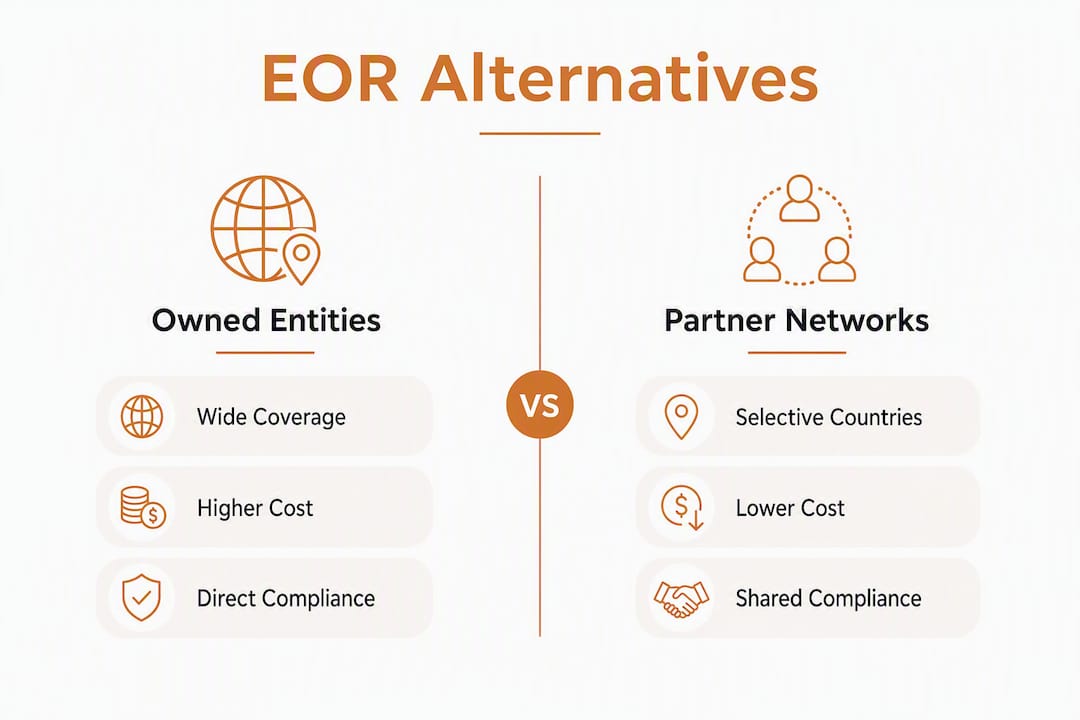
For a 10-employee deployment, the difference between a negotiated rate and a list-price contract can exceed $20,000 annually. FX loading — where a provider converts your USD payment to local currency at a marked-up rate — is a further hidden cost that rarely appears in published pricing pages.
Three quick filters for procurement:
- South Africa-specific hiring? — Expandtosouthafrica’s flat $399/month with no setup fees and no FX loading is the most cost-predictable option in that market.
How do you choose the right Atlas EOR alternative for your hiring map?
The dominant decision filter is entity model first, then all-in year-one cost, then integration fit. Get those three in the right order and the shortlist writes itself.

Legal and compliance teams at regulated companies often treat owned-entity status as a binary requirement, which immediately narrows the field to providers like Remote, Atlas HXM, and Deel’s owned-entity markets. Once you’ve confirmed entity model, build the cost model before you talk to sales.
Due-diligence questions to ask every vendor
- Does the provider own legal entities in each of my target countries, or does it use local partners? Who bears liability in a dispute?
- How is payroll funded and on what timeline? Does the provider hold a float, and what happens if you miss a funding deadline?
- Which statutory benefits (pension, health, severance accrual) are included in the base fee, and which are billed separately?
- What are the exact termination and exit terms? Is there a notice period, a termination fee, or a minimum contract length?
- What is the SLA for onboarding a new employee from signed contract to first payroll?
- Where is employee data stored, and under which data protection framework (GDPR, POPIA, CCPA)?
- Which HRIS systems does the platform integrate with natively, and is there a public API with sandbox access?
- Can you provide a reference from a client in my industry who has gone through an employee transfer or termination in my target country?
Red flags to watch
- Setup or termination fees buried in the contract but absent from the pricing page
- Evasive answers about whether the provider owns the local legal entity
- No published SLA for onboarding or payroll processing
- FX conversion rates that are not disclosed or are marked up above mid-market
- No documented process for handling labor law changes mid-contract
Building an all-in year-one cost for 10 employees
Use this structure to compare any two providers on equal terms:
- Base fee: Monthly per-employee rate × 12 × 10 employees
- Setup fees: One-time per-employee or per-country setup charges
- Security deposit: Typically one to two months of employer cost, held per employee
- Statutory employer costs: Employer-side contributions (pension, health, social security) — confirm whether these are included in the base fee or billed on top
- Termination reserve: Estimated cost of one termination per year (notice pay, severance accrual, legal fees)
- FX loading: If you pay in USD but the provider converts to local currency, model the markup
At $499/month base with a $1,000 setup fee and a one-month deposit per employee, year-one cost for 10 employees is approximately $61,880 before statutory costs. At $399/month flat with no setup fees and no FX loading, year-one cost for the same 10 employees is $47,880 — a difference that compounds as headcount grows.
Pro Tip: Ask every vendor for a volume pricing schedule in writing before you sign. Teams with 20 or more employees regularly secure 25–40% off published list prices. Request annual caps on rate increases as a separate negotiation point — most providers will agree to a 5–10% annual ceiling if asked directly.
What does each shortlisted EOR provider actually offer?
Atlas HXM
Atlas HXM operates 100% owned entities across 160+ countries and publishes a starting rate of around $500 per employee per month. Its structural advantage is genuine: because it owns the legal entities, it bears direct employer liability rather than passing it through a local partner. That matters for regulated industries where intermediary liability is a compliance concern. The caveat is price — Atlas sits at the premium end of the market, and its platform integrations, while functional, are not as mature as Remote or Rippling for HRIS-heavy buyers.
Deel
Deel covers 150+ countries with a mix of owned entities and local partners, charges around $599/month for EOR employment, and $49/month for contractor management. Its contractor-to-employee conversion workflow is one of the most developed in the market, which makes it the natural choice for companies that started with contractors and are formalizing employment. Integration depth is strong, with 50+ native HRIS connectors and a public API. The caveat: the partner-model markets introduce variability in local compliance quality that owned-entity-only buyers should scrutinize.
Remote
Remote publishes $599/month per employee and operates 100% owned entities across 85+ countries. The narrower country count compared to Atlas is a real constraint for companies with hiring maps spanning Africa, the Middle East, or Southeast Asia. Where Remote leads is platform maturity: its HRIS integrations, onboarding workflows, and API documentation are consistently rated among the strongest in the category. For compliance-first buyers who need owned-entity certainty and a polished platform, Remote is the most direct Atlas alternative.
Rippling
Rippling bundles EOR with HR, IT, and payroll in a single platform, which is a meaningful operational advantage for US-headquartered companies that want to manage devices, access provisioning, and international payroll from one system. EOR coverage spans 50+ countries, which is narrower than Atlas or Remote, and pricing is custom. The integration story is Rippling’s clearest differentiator: if your team already uses Rippling domestically, extending it internationally is far less disruptive than onboarding a separate EOR platform. For Rippling alternatives focused on South Africa, the country-specific statutory depth is limited compared to a specialist provider.
Oyster
Oyster covers 180+ countries and publishes pricing around $499/month per employee. Its benefits localization engine — which maps local statutory minimums and market norms by country — is a genuine differentiator for mid-market companies that want to offer competitive packages without building local HR expertise. The platform is self-serve friendly, which suits leaner HR teams. The caveat is that Oyster uses a mix of owned entities and local partners, so compliance-first buyers should confirm entity ownership country by country.
Multiplier
Multiplier publishes pricing around $400/month per employee, making it one of the more accessible entry points in the owned-entity-plus-partner tier. Its Asia-Pacific coverage is particularly strong, and it handles equity and stock option administration alongside standard payroll and benefits. For companies building teams across India, Singapore, or Southeast Asia, Multiplier’s regional depth is a practical advantage. The platform’s integration ecosystem is growing but not yet at the depth of Remote or Rippling.
Skuad / Payoneer Workforce Management
Skuad rebranded to Payoneer Workforce Management and covers 160+ countries through a partner-led model. Its pricing is competitive, particularly for contractor-heavy use cases where agent-of-record platforms can cost $30–$150 per contractor per month — well below full EOR rates. The trade-off is that the partner model introduces more variability in local compliance quality. For companies that need cost efficiency over owned-entity certainty, Skuad/Payoneer WFM is worth modeling.
Omnipresent
Omnipresent covers 160+ countries with a mix of owned entities and partners, and its strongest differentiator is dedicated account management. European-headquartered companies in particular tend to value Omnipresent’s hands-on CSM model and its GDPR-aligned data handling. Pricing is custom and not publicly listed, which means you’ll need a direct conversation to build a cost model. The onboarding experience is consistently rated positively in user reviews on Gartner Peer Insights.
Rivermate
Rivermate operates across 150+ countries through a partner network and publishes pricing in the $299–$499/month range, positioning it as a lower-cost alternative for smaller teams. Its support responsiveness is a recurring positive in user feedback, and its API is available for teams that want to automate employment workflows. The partner-led model means entity ownership varies by country, so due diligence on specific markets is necessary.
Payoneer
Payoneer is not a full EOR provider. It is a cross-border payments platform that handles contractor and freelancer payments in 200+ currencies. For companies that need to pay international contractors without formalizing employment, Payoneer is cost-effective and widely trusted. The moment you need to employ someone full-time with statutory benefits, social contributions, and a compliant employment contract, Payoneer is not the right tool.
Expandtosouthafrica
Expandtosouthafrica does one country and does it properly. For companies hiring full-time employees in South Africa, the platform delivers:
- BCEA-compliant employment contracts signed within 48 hours
- ZAR payroll with full statutory filings: PAYE (EMP201 with SARS), UIF, SDL, and COIDA
- POPIA and GDPR-compliant data handling with EU data residency
- CCMA-safe dismissal guidance for compliant offboarding
- Free transfers from other EOR providers
- Vetted talent sourcing in South Africa bundled into the employer cost
- A public employment cost calculator and open REST API with sandbox keys
- Flat fee of $399/month per employee with no setup fees and no FX loading
The single-country focus means every compliance update, every SARS threshold change, and every LRA amendment is handled by a team whose entire operational context is South Africa. That depth is not replicable by a 160-country platform managing statutory updates across dozens of jurisdictions simultaneously.
How were these alternatives selected?
The shortlist was built on four primary filters: geographic coverage and country count, employment model (owned entity vs. partner vs. hybrid), pricing transparency (published rates, visible fee structures, disclosed setup and termination terms), and platform capabilities (HRIS integrations, API maturity, onboarding SLAs). South Africa relevance was a fifth filter applied specifically to assess which providers handle BCEA, LRA, PAYE, UIF, SDL, and COIDA correctly.
Data sources used
- Analyst and review platforms: — Gartner Peer Insights for verified user reviews comparing Atlas HXM to alternatives; G2 and Capterra for user-rated scores on Skuad and other providers
| Source type | What it provides | Limitation |
|---|---|---|
| Gartner Peer Insights | Verified user reviews; procurement comparison signals | Reviews reflect past experience; pricing may have changed |
| eorHQ comparison guides | Entity model data; published pricing; coverage maps | Vendor-reported data; verify directly with providers |
| Compareor benchmark | Market pricing ranges; negotiation norms | Aggregated; individual quotes will vary |
| Vendor pricing pages | Published list prices | Often exclude setup, deposit, and termination fees |
| SARS / BCEA / LRA | Statutory filing requirements for South Africa | Rates and thresholds change annually; confirm current figures |
Important limitation: EOR pricing is negotiable, and published rates are starting points. Always request a written quote that itemizes setup fees, security deposits, statutory employer costs, and termination terms before signing. Country-specific statutory costs (employer-side pension, health, and social contributions) vary significantly and are frequently excluded from headline pricing.
When does a South Africa specialist make more sense than a global platform?
Choose a South Africa specialist when your hiring map includes permanent full-time employees in South Africa and you need local statutory certainty, cost predictability, and CCMA-compliant offboarding support. A global platform covering 160 countries manages South Africa as one of many markets; a specialist manages it as the only market.
The practical difference shows up in three areas. First, statutory filing accuracy: PAYE submissions via EMP201 to SARS, UIF contributions, SDL levies, and COIDA registration are handled by a team whose entire compliance focus is South African labor law. Second, dismissal and offboarding: the CCMA (Commission for Conciliation, Mediation and Arbitration) has specific procedural requirements for fair dismissal under the LRA. A global platform’s generic offboarding workflow may not account for those requirements. Third, switching EOR providers carries compliance complexity — transfers require legal, tax, and payroll coordination, and risks include severance and local re-employment implications. A specialist with a documented transfer playbook tailored to South African labor courts handles this more cleanly than a generalist platform.
On cost, the comparison is direct. Global EOR platforms typically publish rates of $400–$699 per employee per month before setup fees, deposits, and FX loading. Expandtosouthafrica charges a flat $399/month per employee with no setup fees and no FX loading. For a team of five South African employees over 12 months, that is $23,940 at the flat rate versus $24,000–$41,940 at global platform list prices — and the gap widens once you add setup fees and currency conversion markups that global platforms routinely apply to ZAR payroll.
Onboarding timeline: signed contracts within 48 hours, full onboarding within days. For companies that need a South African employee active before the end of a sprint cycle, that timeline is operationally meaningful. The complete South Africa EOR guide covers statutory rates, cost benchmarks, and compliance requirements in detail for buyers who want to validate the numbers independently.
Key Takeaways
The most effective approach to selecting an Atlas EOR alternative is to filter first on employment model, then build a full year-one cost model before comparing headline fees.
| Point | Details |
|---|---|
| Entity model is the first filter | Regulated buyers should confirm owned-entity vs. partner status before comparing any other dimension. |
| Build all-in year-one cost | Add setup fees, security deposits, FX loading, and termination reserves to the base monthly fee for a true comparison. |
| Negotiate volume discounts | Teams with 20+ employees regularly secure 25–40% off published list prices; always request a written volume schedule. |
| Plan your exit before you sign | Confirm transfer protocols and termination terms upfront; switching EOR providers carries compliance risk, especially in South Africa. |
| Expandtosouthafrica for South Africa hires | Flat $399/month per employee, no setup fees, no FX loading, BCEA-compliant contracts, and CCMA-safe offboarding in one specialist platform. |
The case for starting with one market and one specialist
Most procurement processes for EOR services default to the biggest platform with the longest country list. That instinct makes sense for companies hiring across 10 or 15 markets simultaneously. For companies adding South Africa as a single market, it often produces the wrong outcome: a global platform contract with pricing, support, and compliance depth calibrated for volume buyers, not for a team of 3–10 South African employees.
My recommendation depends on your hiring map. For 1–5 hires in a single market, a specialist EOR almost always delivers better cost predictability and local compliance depth than a global platform. For 10–50 hires across multiple countries, a global platform with owned-entity coverage and strong HRIS integrations is the right infrastructure. For 50+ hires, the breakeven calculation for setting up a local entity is worth running — EOR is typically most cost-effective up to 15–25 employees per country before entity formation becomes cheaper.
The probe question worth including in every vendor RFP: “Show me the exact statutory filings you handle in [target country], the timeline for each, and the name of the legal entity that employs my people.” Evasive answers to that question are a reliable signal of a partner-model provider presenting itself as an owned-entity platform.
For a practical pilot, start with one market and one provider. A single-market pilot with a specialist EOR gives you a clean compliance baseline, a real cost model, and a reference point for negotiating a broader global platform contract if your hiring map expands.
South Africa hiring without the global platform markup
If South Africa is on your hiring map, Expandtosouthafrica delivers full-time employment at a flat $399 per employee per month — no setup fees, no FX loading, no ambiguity about who legally employs your people. BCEA-compliant contracts are signed within 48 hours. ZAR payroll, PAYE, UIF, SDL, and COIDA filings are handled by a licensed local partner whose entire operational focus is South African employment law. CCMA-safe dismissal guidance is included, and transfers from other EOR providers are free.
Global platforms charge $400–$699/month for 150 countries and manage South Africa as one line item among many. Expandtosouthafrica manages it as the only line item. If you’re hiring one to fifty South African employees and want cost certainty, statutory accuracy, and a team that knows the CCMA by name, explore South Africa EOR services and request a quote directly.
Useful sources for procurement preparation
- Gartner Peer Insights: Atlas HXM Alternatives — Verified user reviews comparing Atlas HXM to alternatives; useful for procurement teams that need third-party validation of vendor claims.
- eorHQ: EOR Cost Guide — Detailed breakdown of all-in year-one cost components including setup fees, deposits, and termination costs; the most practical pricing reference in the research pool.
- eorHQ: Compare EOR Providers — Side-by-side provider catalog with entity model data, coverage maps, and transfer protocol guidance.
- Compareor: Average EOR Cost 2026 Benchmark — Market pricing ranges and volume discount norms; use this to calibrate your negotiation position before vendor conversations.
- eorHQ: Using EOR to Test New Markets — Explains the owned-entity vs. partner model distinction and when EOR is the right structure versus entity formation.
- Wisemonk: EOR Alternatives Compared — Covers the full spectrum of hiring models (EOR, PEO, AOR, own entity, staffing) with breakeven headcount guidance.
- Expandtosouthafrica: EOR Pricing Comparison — Step-by-step model for calculating all-in year-one cost and comparing EOR fees; includes South Africa-specific statutory cost examples.
- Expandtosouthafrica: South Africa EOR Complete Guide — In-depth reference for BCEA, LRA, PAYE, UIF, SDL, and COIDA requirements; the primary source for South Africa statutory compliance detail.
Recommended
- EOR Pricing Comparison: Model the True Cost Before You Sign | Expand to South Africa
- Deel vs Remote for HR Teams: Which to Pick in 2026 | Expand to South Africa
- Best Deel Alternatives for Hiring in South Africa (2026) | Expand to South Africa
- Best Rippling Alternatives for South Africa Hiring | Expand to South Africa