

The six valid alternatives to global PEO services are: a locally owned legal entity, a single-country Employer of Record (EOR), a regional or specialized EOR, an Administrative Services Organization (ASO) or payroll-only provider, an in-house HR team paired with a local HRIS and payroll vendor, and professional services firms or fractional HR consultants. For most U.S. teams hiring one to fifty employees in South Africa quickly and without entity overhead, a single-country EOR is the most practical starting point. For larger, audit-sensitive operations, an owned local entity gives you the control and compliance depth that a partner-led model cannot fully replicate.
According to People Managing People, the three primary structures decision-makers evaluate when leaving a global PEO are a local legal entity, a specialized single-country or regional EOR, and local professional service firms for payroll and HR administration. The right choice depends on your headcount, timeline, audit exposure, and how much direct control you need over employment contracts and payroll data.
- Owned local entity: Full control, highest compliance depth, but requires several months to set up and significant ongoing overhead.
- Single-country EOR: Fastest path to compliant employment in one market, with the EOR holding legal employer status.
- Regional/specialized EOR: Covers multiple adjacent markets under one contract, useful for multi-country rollouts.
- ASO/payroll-only provider: Handles payroll mechanics but leaves statutory employer liability with you.
- In-house + HRIS + local payroll vendor: Maximum control, but requires internal HR capability and local legal expertise.
- Fractional HR/consultants: Useful for compliance audits and one-off projects, not for ongoing employment.
Table of Contents
- What are the real alternatives to global PEO services?
- Which model fits your situation?
- How do you evaluate and choose the right provider?
- What does each model actually cost, and how long does onboarding take?
- When a single-country EOR for South Africa is the right call
- Which alternative should you pick next?
- Key Takeaways
- Expandtosouthafrica: single-country EOR built for South Africa
What are the real alternatives to global PEO services?
Buyer behavior on platforms like G2 shows that HR and finance leaders searching for global PEO solutions are typically looking for three things: relief from pricing opacity, clearer legal liability, and faster onboarding. The six models below address those needs in different ways.
| Model | Pricing model | Coverage | Onboarding speed | Legal depth | Your control |
|---|---|---|---|---|---|
| Owned local entity | Entity setup + ongoing overhead | Single country | Several months | Highest | Full |
| Single-country EOR | Flat monthly fee per employee | One market | Days to 2 weeks | High (local specialist) | Shared |
| Regional EOR | Per-employee fee, multi-country | 5–30 countries | 1–3 weeks | Moderate to high | Shared |
| ASO/payroll-only | Per-payroll-run or PEPM fee | Varies | 1–4 weeks | Low (employer liability stays with you) | High |
| In-house + HRIS | Software license + local vendor | Any | Weeks to months | Depends on vendor | Full |
| Fractional HR/consultants | Project or retainer fee | Varies | Immediate advisory | Advisory only | Full |
Owned local entity
Setting up a subsidiary or branch gives you complete control over employment contracts, payroll data, and statutory filings. The trade-off is time: entity registration in most markets takes three to six months, and ongoing compliance requires a local finance or HR function. This model makes sense when you are committing to a market long-term with fifty or more employees.
Single-country EOR
A single-country EOR holds legal employer status in one specific market. Your employees work for you day-to-day, but the EOR signs the employment contract, runs local payroll, and handles all statutory filings. Speed is the defining advantage: most single-country EORs can deliver signed contracts within days. The compliance depth tends to be sharper than a multi-country platform because the provider is not spreading attention across 150 markets.
ASO and payroll-only providers
An ASO handles payroll processing and HR administration but does not assume employer-of-record status. You remain the legal employer, which means statutory filings, termination liability, and audit exposure stay with your company. This model works when you already have a local entity and want to outsource payroll mechanics without surrendering employer control.
In-house plus HRIS and local payroll vendor
Pairing an internal HR team with a local payroll vendor and an HRIS platform like Workday, BambooHR, or HiBob gives you maximum data ownership and process control. The cost is internal headcount, local legal counsel, and the time required to build compliant employment templates from scratch. For companies with a dedicated global HR function, this is often the long-term destination after initial market entry via EOR.
Which model fits your situation?
The right alternative depends on four variables: headcount, timeline, audit sensitivity, and your internal HR capability. These thresholds are practical rules of thumb, not absolute cutoffs.
1–10 employees, fast timeline, low to moderate audit risk. A single-country EOR is almost always the right call. Entity setup takes months and costs more than the EOR fee at this scale. You get compliant employment contracts, local payroll, and statutory filings handled within days.
10–50 employees, growing headcount, moderate audit exposure. A single-country EOR remains viable and cost-effective. At this range, evaluate whether the EOR offers direct employment contracts (not sub-contracted through a local partner) and whether your payroll data is portable if you decide to transition to an owned entity later.
50+ employees, long-term market commitment, audit-sensitive industry. An owned local entity becomes the more defensible structure. The upfront cost and setup time are justified by the compliance depth and the elimination of partner-entity risk. Industries like financial services, healthcare, and government contracting typically reach this threshold sooner.
Multi-country rollout, speed priority. A regional EOR covering your target markets under one contract reduces vendor management overhead. Verify that the regional EOR uses owned entities in each country rather than local partner firms, since the owned vs. partner distinction directly affects your audit exposure.
Payroll-only, existing local entity. An ASO or payroll services provider handles the mechanics without assuming employer liability. This is the right fit when you have already established a local entity and want to outsource payroll processing without changing the legal employer structure.
For U.S. teams hiring in South Africa specifically, the single-country EOR route covers the most common scenarios: fast onboarding, BCEA-compliant contracts, ZAR payroll, and full statutory filing coverage, without the three-to-six-month delay of entity registration. The 2026 employer’s guide to compliant scaling in South Africa covers the country-specific triggers in more detail.

How do you evaluate and choose the right provider?
The evaluation process for any global employment solution should be structured around legal clarity, pricing transparency, and operational SLAs. Review platforms surface the most common buyer complaints: opaque pricing, unclear legal entity statements, and poor data portability. Use those pain points as your evaluation checklist.
eorHQ’s provider comparison methodology recommends multi-dimension scoring across pricing, compliance depth, and country coverage, combined with a blended total employment cost model that includes statutory employer contributions, benefits passthrough, and FX costs.
Provider questions to ask before signing
- Who is the named legal employer on the employment contract in the target country?
- Do you use owned entities or local partner firms in each country you cover?
- What statutory filings do you handle, and can you provide proof of filing (e.g., EMP201 receipts from SARS for South Africa)?
- What is your pricing model: flat fee, percentage of salary, or tiered? Are setup fees, benefits passthrough, or FX markups included?
- Where is employee data stored, and under which data protection framework (GDPR, POPIA, CCPA)?
- What are your SLAs for onboarding, payroll processing, and issue resolution?
- How do you handle terminations, including statutory notice periods, severance calculations, and claims defense?
- Can we export all payroll and employment data if we transition to another provider or an owned entity?
Red flags that should stop the conversation
- The vendor cannot name the legal entity that will employ your staff in the target country.
- Pricing is quoted as a range with no clear breakdown of what is included.
- The contract does not specify who bears liability for statutory filing errors or late payments.
- Data export is restricted, delayed, or subject to additional fees.
- The vendor has no documented process for handling employment disputes or tribunal referrals.
Pro Tip: Ask for a sample employment contract and a sample payroll summary before signing. A provider that hesitates to share these documents before contract execution is signaling that their compliance depth may not match their marketing.
What does each model actually cost, and how long does onboarding take?

EOR Select’s normalized pricing dataset shows per-employee monthly fees for EOR services commonly ranging from $199 to $699, depending on country coverage and the depth of compliance services included. The lower end of that range typically reflects payroll-only or limited-coverage providers; the upper end reflects full-service, multi-country platforms with owned entities.
| Model | Typical per-employee monthly fee | Setup fee | Time to first hire |
|---|---|---|---|
| Owned local entity | Ongoing overhead only (post-setup) | Significant setup cost | Several months |
| Single-country EOR | $199–$699 | Often — | 2–10 business days |
| Regional EOR | $300–$699 | Varies | 1–3 weeks |
| ASO/payroll-only | $50–$150 | $500 | 1–4 weeks |
| In-house + HRIS + local vendor | HRIS license + local vendor fee | Significant | Weeks to months |
| Fractional HR/consultants | Project or daily rate | None | Immediate advisory |
Note: These are market-range benchmarks drawn from normalized provider data. Your actual cost will depend on the target country, employee salary, benefits structure, and statutory employer contributions. Always model total employment cost, not just the platform fee.
Hidden costs to model before you commit
Benefits passthrough is one of the most commonly underestimated line items. Many EOR providers pass through the cost of statutory and supplemental benefits at cost, but some add a markup. Confirm whether the quoted fee includes or excludes benefits administration.
Statutory employer contributions vary significantly by country. In South Africa, employer contributions include UIF (1% of remuneration), SDL (1% of leviable amount), and COIDA (rate varies by industry risk classification). These are in addition to the EOR platform fee and must be included in your total employment cost model. The EOR pricing comparison tool from Expandtosouthafrica lets you model these costs before you sign.
FX loading is a common hidden cost on multi-country platforms that invoice in USD but pay in local currency. Confirm whether the provider applies an FX spread on top of the interbank rate.
Termination liability is rarely quoted upfront. Ask for a worked example of the total cost to terminate an employee after twelve months of service in your target market, including statutory notice, severance, and any claims defense costs.
When a single-country EOR for South Africa is the right call
For U.S. companies hiring in South Africa, the single-country EOR model addresses the most common barriers: no desire to register a local entity, a need for fast onboarding, and a requirement for full statutory compliance under South African law.
South Africa’s employment framework is specific and consequential. The Basic Conditions of Employment Act (BCEA) governs minimum notice periods, leave entitlements, and working hours. The Labour Relations Act (LRA) governs dismissal procedures and CCMA referrals. Statutory filings include PAYE (filed via EMP201 with SARS), UIF contributions, Skills Development Levy (SDL), and COIDA registration. A provider that does not handle all four of these filings is not a full EOR for South Africa.
Expandtosouthafrica’s EOR services cover every one of these requirements: BCEA-compliant employment contracts, ZAR payroll, PAYE (EMP201 with SARS), UIF, SDL, and COIDA filings, with data handled under both POPIA and GDPR with EU data residency.
What Expandtosouthafrica includes
- BCEA-compliant employment contracts, signed within 48 hours of instruction
- Full ZAR payroll processing with monthly payslips
- PAYE (EMP201), UIF, SDL, and COIDA statutory filings
- POPIA and GDPR-aligned data controls with EU data residency
- CCMA-safe dismissal guidance and termination support
- Vetted talent sourcing bundled with EOR services
- Open REST API with public documentation and sandbox keys
- Free transfers from other EOR providers, with no setup fee
The flat-fee pricing is €350 / $399 / £299 per employee per month, with no FX loading and no setup fees. That transparency matters when you are modeling total employment cost against a multi-country platform that charges $400–$599 per month for 150 countries, most of which you will never use.
Pro Tip: Skilled roles in South Africa typically cost 40–60% less than equivalent roles in the UK or EU. When you factor in the EOR fee, the total employment cost for a senior software developer in South Africa often comes in below the salary cost alone for a comparable hire in Western Europe.
Which alternative should you pick next?
| Company profile | Recommended alternative | Rationale |
|---|---|---|
| Startup, 1–5 hires in South Africa, fast timeline | Single-country EOR (Expandtosouthafrica) | Fastest onboarding, full statutory coverage, no entity overhead |
| Scale-up, 10–50 hires in South Africa, moderate audit exposure | Single-country EOR with data portability | Cost-effective at this headcount; confirm data export rights for future entity transition |
| Enterprise, 50+ hires, audit-sensitive industry | Owned local entity | Full compliance control, eliminates partner-entity risk |
| Multi-country rollout, 5–10 countries | Regional EOR with owned entities | Reduces vendor management; verify owned vs. partner structure per country |
| Existing local entity, payroll outsourcing only | ASO/payroll-only provider | Handles mechanics without changing legal employer structure |
Next steps for the next 7–30 days
- Days 1–7: Run a total employment cost model for your target market. Include the EOR fee, statutory employer contributions, benefits, and FX. Use the EOR pricing comparison tool for South Africa-specific figures.
For U.S. teams hiring in South Africa at any headcount below fifty, Expandtosouthafrica is the recommended single-country EOR: transparent flat pricing, full statutory coverage, and signed contracts within 48 hours.
Key Takeaways
For U.S. HR and finance leaders evaluating global PEO services alternatives, the decision comes down to three variables: headcount, audit sensitivity, and how fast you need to hire.
| Point | Details |
|---|---|
| Six valid alternative models | Local entity, single-country EOR, regional EOR, ASO/payroll-only, in-house + HRIS, and fractional HR consultants cover the full range of options. |
| PEO vs. EOR distinction matters | An EOR holds full legal employer status; a PEO co-employment model leaves statutory liability partly with you. |
| EOR fees range from $199 to $699 per employee per month | Normalized market data shows this range across provider types; total cost must include statutory contributions and benefits. |
| South Africa single-country EOR fits 1–50 hires | Fast onboarding, BCEA/LRA compliance, and ZAR payroll without entity setup make this the practical choice for most U.S. teams. |
| Expandtosouthafrica | Flat fee of $399/€350/£299 per employee per month, signed contracts in 48 hours, full statutory filings, and no setup fees. |
The case for going narrow instead of global
There is a persistent assumption in the HR technology market that broader coverage equals better value. It does not, at least not for every use case. A platform covering 150 countries is priced to recover the cost of maintaining compliance infrastructure in markets you will never touch. When your hiring need is specific, a specialist provider that does one country properly will almost always outperform a generalist on compliance depth, local knowledge, and support quality.
The PEO vs. EOR distinction reinforces this point. Co-employment models that blur the legal employer question are a liability in markets with strong labor protections. South Africa’s CCMA process, BCEA entitlements, and SARS filing requirements are not edge cases; they are the baseline. A provider that handles them daily, for one country, carries less operational risk than one managing the same requirements across dozens of markets simultaneously.
The practical lesson: match the scope of your provider to the scope of your need. If you are hiring in one country, buy depth, not breadth.
Expandtosouthafrica: single-country EOR built for South Africa
Hiring one to fifty employees in South Africa without setting up a local entity is exactly what Expandtosouthafrica was built for. At a flat $399 / €350 / £299 per employee per month, with no setup fees and no FX loading, you get a fully compliant employment relationship from day one: BCEA-compliant contracts signed within 48 hours, ZAR payroll, and all four statutory filings handled (PAYE, UIF, SDL, COIDA).
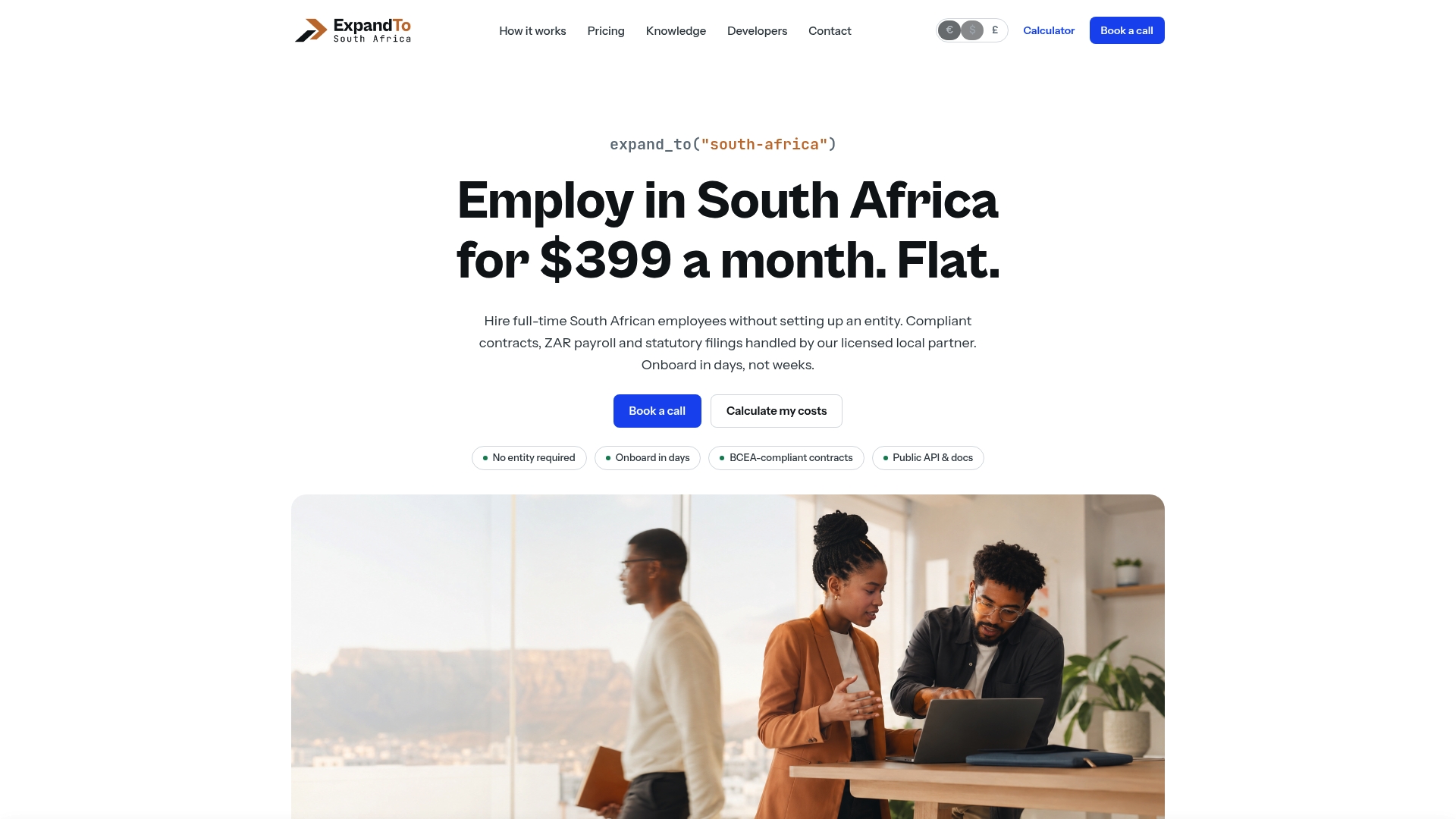
The service includes:
- BCEA-compliant employment contracts and CCMA-safe dismissal guidance
- ZAR payroll with monthly payslips and EMP201 filings with SARS
- UIF, SDL, and COIDA statutory contributions
- POPIA and GDPR-aligned data controls with EU data residency
- Open REST API with public documentation and sandbox keys
- Vetted talent sourcing bundled with EOR services
- Free transfers from other EOR providers
If you are ready to model the full employment cost before committing, the EOR services page includes a public employment cost calculator and full service scope detail. Start there, and you will have a signed contract within 48 hours of giving the instruction.
Useful sources
- EOR alternatives — People Managing People
- Owned vs partner entities — EOR Review Hub
- EOR Select — normalized dataset for EOR pricing and coverage
- Compare EOR Providers 2026 — eorHQ
- EOR services in South Africa – Expand to South Africa
- Employer of Record South Africa: The Complete Guide for International Businesses (2026) — Expand to South Africa
- OSHA laws and regulations — U.S. Department of Labor