

International talent recruitment is two jobs, not one: finding the right person, and then employing them lawfully in a country where you have no entity. For companies in the US, UK and Europe hiring skilled professionals in South Africa, the cleanest answer is to source the candidate and employ them through a local employer of record (EOR) that is built for that one country. At Expand to South Africa we do exactly that, with vetted talent sourcing and employment delivered through a licensed local partner. The rest of this article shows the process step by step, what each step costs, and where companies go wrong.
TL;DR
- Recruiting abroad fails most often after the offer, at contracts, payroll and tax, not at sourcing. Plan both halves together.
- South African employees come with fixed statutory costs: UIF at 1% from each side (capped), SDL at 1% above a payroll threshold, PAYE withheld monthly, plus COIDA.
- Calling a full-time worker a contractor is risky: section 200A of the Labour Relations Act presumes employment below the earnings threshold when any one of several factors is present.
- A local EOR lets you employ without registering a South African company. Our EOR service starts from £299 per employee per month.
- South Africa sits within about one hour of Central European Time, and skilled roles are typically 40-60% cheaper than in the UK or EU.
Table of Contents
- Why companies recruit in South Africa
- The international recruitment process, step by step
- The numbers to put in your budget
- Employee or contractor: where the risk sits
- Do you need a South African entity?
- For CTOs: automating the hire
- How we help
- Our perspective
- FAQ
- Sources
Why companies recruit in South Africa
Three reasons come up repeatedly with the founders and finance leads we work with: language, time zone and cost. English is the working language of business, the time zone overlaps with Europe to within about an hour of CET, and salaries for skilled roles typically run 40-60% below UK and EU levels. That overlap matters for the US as well: a South African developer is online during the European working day and shares several hours with US East Coast mornings.
The cost gap is real, but it is not the whole budget. A South African employee carries statutory employer costs that a contractor does not, which is why the plan has to cover employment, not just the hire. Our Remote talent in South Africa guide covers the roles and talent pools in more depth.
The international recruitment process, step by step
Efficient cross-border hiring is a sequence. Skip a step and the cost shows up later, usually in a payroll correction or a dismissal dispute.
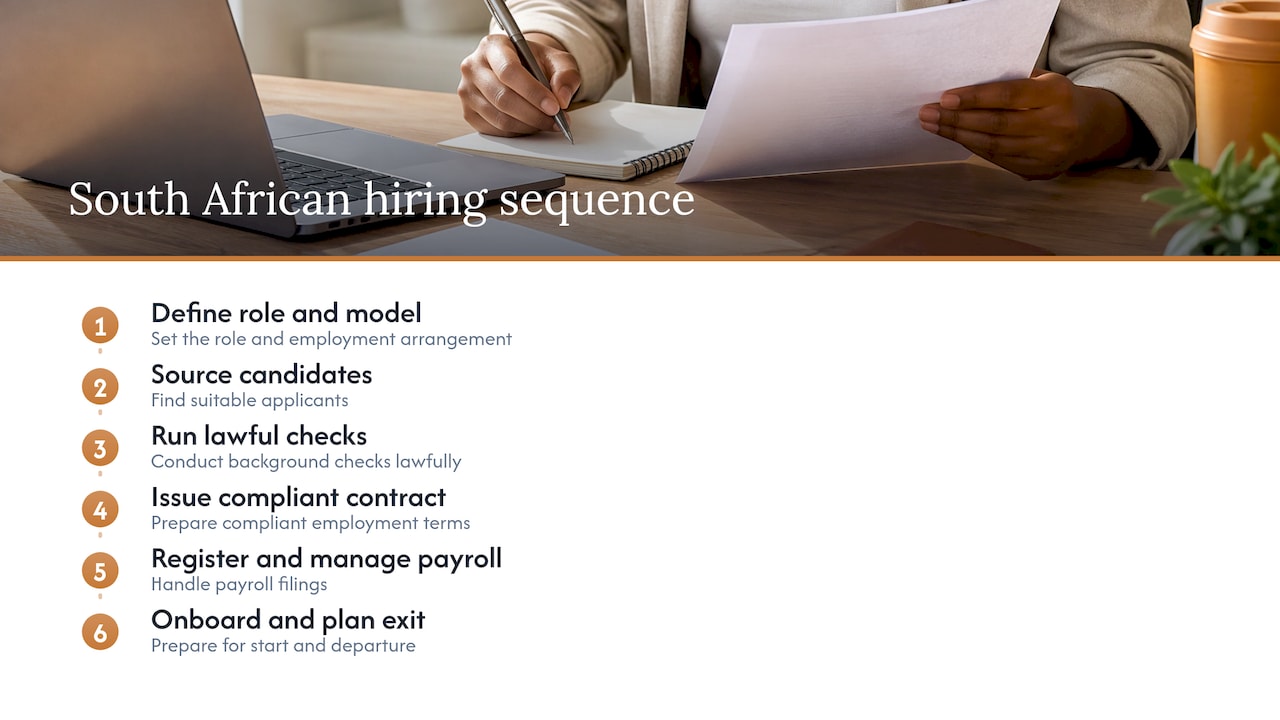
1. Define the role and the employment model first
Decide before you advertise whether this is a full-time employee, which in most cases it should be. If the person will work set hours, use your tools, report to your manager and work for you alone, South African law treats them as an employee whatever the paperwork says. Settling this at the start avoids rewriting the offer after you have chosen a candidate.
2. Source candidates
Sourcing for skilled roles in South Africa works best when it is run by people who know the local market, the notice periods candidates are serving, and what a competitive package looks like in rand. Our talent sourcing service provides vetted candidates for skilled roles, and the guide to talent sourcing in South Africa explains how the process runs for foreign employers.
Selection principles carry across borders. If you want a view on how to find and assess remote candidates, particularly for sales and marketing profiles, this piece on recruiting remote sales talent walks through selection and onboarding, including employment-agreement terms and workplace safety responsibilities.
3. Run background checks within the law
South Africa’s privacy law, POPIA, in force since 1 July 2020, shapes what you may check. According to DLA Piper’s employment guide for South Africa, criminal record checks need the candidate’s consent because they require fingerprints, credit reports are restricted to trust or finance roles and also need consent, and qualification and reference checks do not need consent but the applicant must be notified. Build those consent forms into your application flow. Our background checks guide for employers lists what is usual by role.
4. Issue a compliant contract
The Basic Conditions of Employment Act (BCEA) sets the floor for hours, leave and notice, and it requires written particulars of employment, including the place of work, even for people who work from home. Eversheds Sutherland’s South Africa compass also notes that health and safety duties can extend to a home office. The clauses that matter most are covered in our guide to essential employment contract clauses, and notice rules are in South African notice periods.
Fixed-term contracts have their own trap: the law restricts how long and how often you can use them before the person is treated as permanent. See the fixed-term contract rules.
5. Register, pay and file
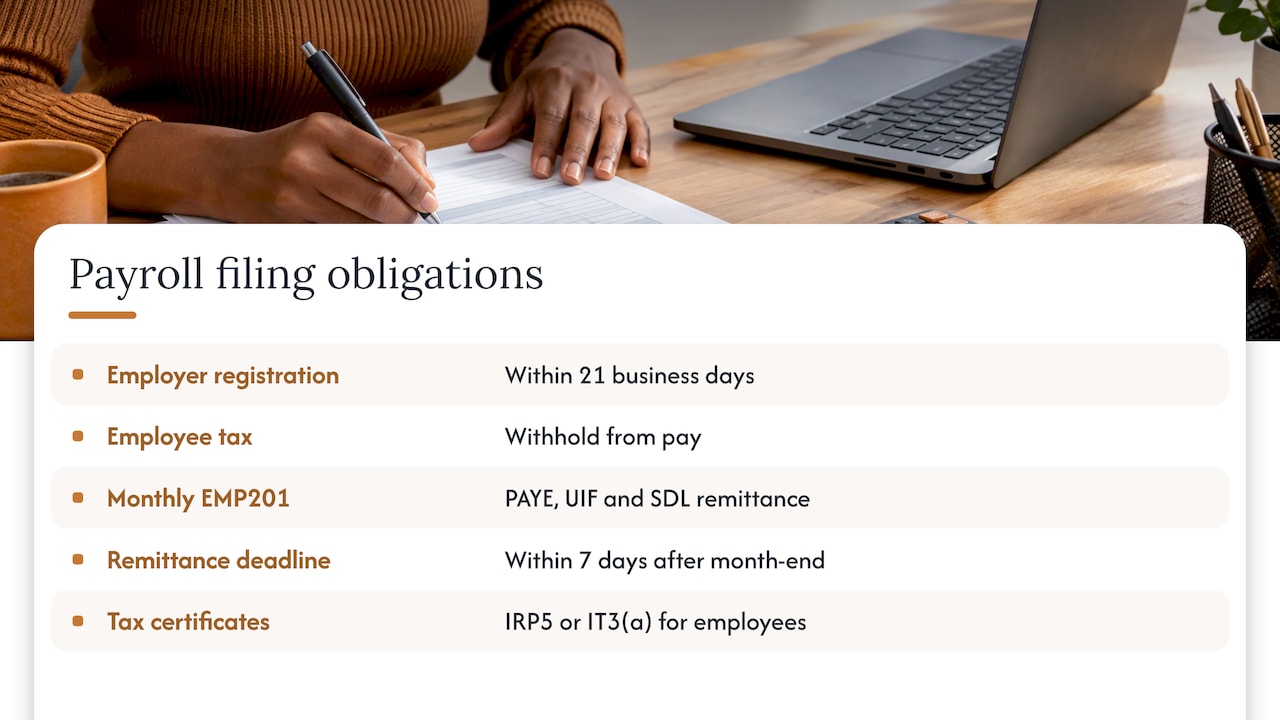
Once someone is on payroll, the filings start. The South African Revenue Service (SARS) employer guide for 2025/26 says employers must register within 21 business days of becoming an employer, withhold employees’ tax from pay, and remit PAYE, UIF and SDL with the monthly EMP201 return within seven days after month-end. Employees receive IRP5 or IT3(a) tax certificates. Late or missing filings attract penalties, so this is the step where a local specialist saves the most time. In our EOR service the licensed local partner handles ZAR payroll and the PAYE, UIF, SDL and COIDA filings, so your finance team does not run a second payroll in another currency. See payroll services in South Africa.
6. Onboard and plan the exit
Onboarding should be done within days of a signed contract, and the offboarding route should be understood on day one. Dismissals must follow the Labour Relations Act, and a new Code of Good Practice: Dismissal took effect on 4 September 2025, according to MJK Inc’s foreign employer guide. Fair process matters as much as the reason, because unfair-dismissal claims go to the CCMA, the statutory dispute body. We provide CCMA-safe dismissal guidance as part of the service.
The numbers to put in your budget
The figures below are the published rates for their stated periods. Minimum wage, thresholds and tax tables are updated annually, so confirm them against the official sources when you sign.
| Item | Figure | Period |
|---|---|---|
| National minimum wage | R30.23 per hour | From 1 March 2026 |
| BCEA earnings threshold | R269,600.90 per year | From 1 May 2026 |
| UIF | 1% from employer and 1% from employee, capped at R17,712 monthly earnings | 2026 |
| SDL | 1% of payroll, exempt if annual payroll does not exceed R500,000 | 2026 |
| Individual income tax | 18% to 45%; primary rebate R17,235; threshold R95,750 under age 65 | 2025/26 tax year |
The minimum wage, BCEA threshold, UIF and SDL figures come from MJK Inc’s guide; the tax bands, rebate and threshold come from the SARS employer guide. The BCEA threshold matters beyond pay: staff above it are outside the 45-hour week and the overtime rules, but they keep leave, notice and unfair-dismissal protection. Our guides to UIF contributions, SDL registration and South African employer taxes go through each one.
A worked example
Take a hire on a salary of R60,000 a month, which is above R17,712, so UIF is capped. Employer UIF is 1% of R17,712, which is R177.12, and the employee’s matching share is the same. SDL is 1% of R60,000, so R600 a month, provided your annual payroll exceeds R500,000. PAYE comes out of the employee’s pay and is not an extra cost to you, but it must be paid to SARS on time. Add COIDA, the workplace injury cover, and the EOR fee, and you have a monthly employer cost you can state before the offer goes out. Our public employment cost calculator does this arithmetic for any salary.
What an EOR fee should cover
Budget for the full year, not the first month: salary, employer contributions, benefits, the provider fee, any currency conversion, onboarding, and the cost of an exit including notice pay, unused leave and severance. Currency is the line that surprises finance teams most. Our flat fee has no setup charge and no FX loading, so the number on the quote is the number on the invoice. Our EOR service starts from £299 per employee per month, and the details are on the pricing page.
Compared with global platforms that cover 150 countries and charge $400 to $599 a month, a single-country provider can price lower because it does one jurisdiction and does not carry the overhead of the rest.
Employee or contractor: where the risk sits
The most common way an international hire goes wrong is a full-time worker engaged as a contractor. A common path abroad is to start with contractors and move to an EOR as headcount grows, and South Africa has a specific rule that makes the early contractor stage risky for full-time roles.
Section 200A of the Labour Relations Act presumes a person is an employee, whatever the contract says, if they earn at or below the BCEA threshold (R269,600.90 from 1 May 2026) and any one of several factors is present. MJK Inc’s guide lists control or direction of the work, integration into your organization, working an average of at least 40 hours a month over three months, and economic dependence among them. If a tribunal finds the person was an employee, the exposure can include back-dated PAYE, UIF and SDL, plus leave, overtime and unfair-dismissal claims.
If you already have South African contractors working full time for you, converting them to employees is the clean fix. The conversion needs a compliant contract, payroll registration and a clear start date. We transfer contractors and also employees from other EOR providers without a transfer fee.
Do you need a South African entity?
A foreign company has three options. It can set up a local subsidiary. It can employ directly: DLA Piper says a foreign company that is party to South African employment contracts must register as an external company with the Companies and Intellectual Property Commission and may owe corporate income tax. Or it can use an EOR. Eversheds Sutherland’s compass warns that a foreign entity may be deemed the sole employer after three months in a labour-leasing arrangement, so how the EOR structure is built matters.
With our service, employment is delivered through a licensed local partner that handles BCEA-compliant contracts, ZAR payroll and statutory filings, and we disclose plainly who your people’s legal employer is. For the model in detail, read what an employer of record service is, and for European companies in particular, EU company hiring in South Africa.
Remote work rules also vary by country. Deloitte’s International Employment Law Guide finds that more than half of the 64 countries it covers regulate remote work, so a policy copied from your home country will not necessarily fit.
For CTOs: automating the hire
If your team wants employment as a workflow rather than a ticket queue, we offer an open REST API with public docs and sandbox keys. It lets you trigger hires and keep payroll data in step with your own systems. For payroll data in your HR stack, see our HRIS integration guide.
How we help
We are an employer of record for South Africa and nothing else. Contracts are signed within 48 hours, onboarding follows within days, and data is handled under POPIA and GDPR with EU data residency. Pricing is flat from £299 per employee per month, with no setup fees. If you have a candidate in mind, we employ them. If you do not, we can source for you.
Start on the EOR pricing page, or see how our talent sourcing works.
Our perspective
Most international recruitment advice stops at the offer letter. In South Africa that is where the real work begins: the contract, the rand payroll, the monthly SARS return and, one day, a fair exit.
We chose to do one country. Global platforms spread their attention across 150 countries and price accordingly. Because we only work in South Africa, we can publish a flat price, put a cost calculator and API in public, and tell you honestly who the legal employer is.
Our advice to a founder hiring a first person here: hire them as an employee from the start, keep the contract specific to South African law, and know your full monthly cost before you make the offer.
Roel
FAQ
How long does it take to hire someone in South Africa through an EOR?
With us, signed contracts follow within 48 hours and full onboarding takes days. The longest part is usually the candidate’s notice period with their current employer, which you agree in the offer.
Can I hire a South African as a contractor instead?
Only if they run a genuine business of their own. Below the earnings threshold, section 200A presumes employment when any one listed factor applies, so a full-time role under your direction should be set up as employment.
Which taxes does an employer pay in South Africa?
You withhold PAYE from pay and remit it with the monthly EMP201, and you pay UIF and SDL, plus COIDA for workplace injury cover. Our EOR handles these filings through its licensed local partner.
What does an EOR cost in South Africa?
Our EOR service starts from £299 per employee per month, with no setup fees or FX loading. Salary and statutory employer contributions are on top, and the employment cost calculator shows the total.
Sources
- Deloitte, International Employment Law Guide
- SARS, Guide for Employers in respect of Employees’ Tax 2025/26
- DLA Piper, Global Expansion Guide: Employment, South Africa
- Eversheds Sutherland, Global Employment Compass: South Africa
- MJK Inc, Employment Law in South Africa: A Foreign Employer’s Guide