

A contract that works for a US, UK or EU employee does not automatically work for an employee in South Africa. The worker’s local law sets the floor, and the contract has to meet it. In South Africa that means the Basic Conditions of Employment Act (BCEA), and it is why a template from your home market is a starting point at best. Through our Employer of Record service, we issue BCEA-compliant contracts for international companies that hire in South Africa without a local entity, from £299 per employee per month. This guide shows what the contract must contain, which terms need local adaptation, and how to administer it afterwards.
TL;DR
- The BCEA requires specific written particulars (Section 29) to be given to every employee when employment starts.
- Choosing a foreign governing law does not remove the minimum protections of the country where the person physically works.
- Fixed-term contracts, probation and notice periods each have South African rules that a home-market template will not reflect.
- Records must be kept for three years after the last entry, and personal data is handled under POPIA.
- Whether someone is an employee or a contractor depends on how the work is actually done, not on the label in the contract.
Table of Contents
- Start with the right structure: employee or contractor
- Which law governs the contract
- What a South African employment contract must contain
- The terms that most often need local adaptation
- A drafting process that holds up
- Administering the contract after signature
- Doing it yourself, with a lawyer, or through an EOR
- Perspective
- Hiring your first South African employee
- FAQ
- Sources
Start with the right structure: employee or contractor
Before any clause is drafted, decide whether the person is an employee. The label you choose may not decide it. According to a South African law firm’s employment guide, the answer depends on the actual circumstances and the way the services are rendered, and where those differ from the contract wording, the reality prevails.
If you are converting a South African contractor who works set hours, under your direction and only for you, a new “independent contractor agreement” will not change what the relationship is. Writing a proper employment contract is the safer route. We handle this conversion for companies that want the person employed compliantly, without opening a subsidiary.
Which law governs the contract
Two questions are easily confused: which language the contract is written in, and which law governs it. An English-language document does not mean English or US law applies.
Parties can choose a governing law in an international contract, but, as a lawyer’s guide to global contract compliance explains, they cannot strip an employee of the minimum protections of the jurisdiction where the duties are physically performed. For a worker based in Cape Town, Johannesburg or Durban, those protections come from South African law.
The practical rule: draft the contract so that it references South African law and works with the BCEA, rather than patching a US at-will template. The BCEA applies to all employees and employers in South Africa, with narrow exceptions such as the defence and intelligence services and unpaid charity volunteers.
What a South African employment contract must contain
There is no general statutory requirement for a signed contract, but the BCEA requires written particulars, so putting the agreement in writing is the standard approach. Section 29 of the BCEA lists what the employer must give the employee at the start:
- the full names and addresses of the employer and employee;
- the job title or a brief job description;
- the place of work;
- the start date;
- ordinary hours of work;
- the wage or the rate and method of calculating it, and the overtime rate;
- any cash payments and payments in kind;
- how often pay is made and what deductions apply;
- leave entitlements;
- the notice period required to end the contract.
These are the legal minimum. Most companies add intellectual property assignment, confidentiality, remote-work and equipment terms, and data-protection wording. We cover the clause set in more detail in our guide to essential employment contract clauses for South Africa, and the hours rules in our note on BCEA working hours.
Pay and the minimum wage
The National Minimum Wage Act has applied since 1 January 2019, and the rate is reviewed regularly. Skilled remote roles sit far above it, but the stated wage still has to be expressed in rand and correctly structured. See our page on the South African minimum wage for the current rate.
Sectoral rules can override the contract
Collective agreements, sectoral determinations and ministerial variations may amend certain basic conditions and take precedence over individual contracts. If your hire works in a regulated sector, check what applies before you finalise terms. Our overview of South African labour law for foreign employers is a good map.
The terms that most often need local adaptation
Fixed-term contracts
For employees earning below the BCEA earnings threshold, fixed-term contracts are limited to three months unless there is a justifiable reason for a longer term, such as the nature of the work. A startup that wants a six-month trial contract needs to know this before it prints the paper. The threshold is adjusted by the government, so check the current figure on the official labour department site. Our page on the three-month rule for fixed-term contracts explains how it works in practice, and this fixed-term employment contract guide covers the drafting side.
Probation
South Africa has no prescribed probation period. It must be reasonable and linked to the nature of the job, and three to six months is common practice. Probation does not switch off employee protections: a probationer can still challenge an unfair dismissal. We set out how to run it in our probation guide.
Notice
Notice periods under the BCEA scale with length of service, and a contract can lengthen them but not shorten them below the statutory minimum. Our guide to South African notice periods gives the one-, two- and four-week rules. Write the notice clause once, correctly, because it also shapes any later dismissal process.
Visas for foreign nationals
If the person is not a South African citizen or permanent resident, they need an appropriate work visa, and cannot work while it is pending. Make the start date conditional on the visa and apply well in advance.
Data protection
Employee data in South Africa falls under the Protection of Personal Information Act (POPIA). Local HR advisers develop HR privacy policies and handle breach referrals to the Information Regulator, which shows how much of the contract and HR file POPIA touches. If you are in Europe, GDPR applies as well; see our pages on GDPR data transfers to South Africa and POPIA and GDPR payroll.
A drafting process that holds up
- Confirm the relationship. Employee or genuine contractor, judged on how the work is done.
- Fix the governing law. South African law for a worker in South Africa, with the BCEA minimums built in.
- Write the Section 29 particulars. Every item in the list above, in plain wording, with pay in rand.
- Choose the term. Permanent, or fixed-term with a documented justification if the pay is below the threshold.
- Add your commercial clauses. IP, confidentiality, equipment, remote-work expectations, kept consistent with local law.
- Set probation and notice. Reasonable probation, notice at or above the statutory minimum.
- Check visa and data terms. Work authorization, POPIA wording and, for EU companies, GDPR transfers.
- Sign, deliver and file. Give the employee a copy and store the record.
The common mistake is to do step 3 from memory. Missing or vague particulars are the easiest compliance gap for a regulator or the CCMA (the Commission for Conciliation, Mediation and Arbitration, the body that hears unfair dismissal disputes) to find. Our team issues contracts that contain the required particulars, and signed contracts are delivered within 48 hours.
Administering the contract after signature
A contract is a living document. When terms change, such as a raise, new hours or a new role, update the written terms. Keep them current.
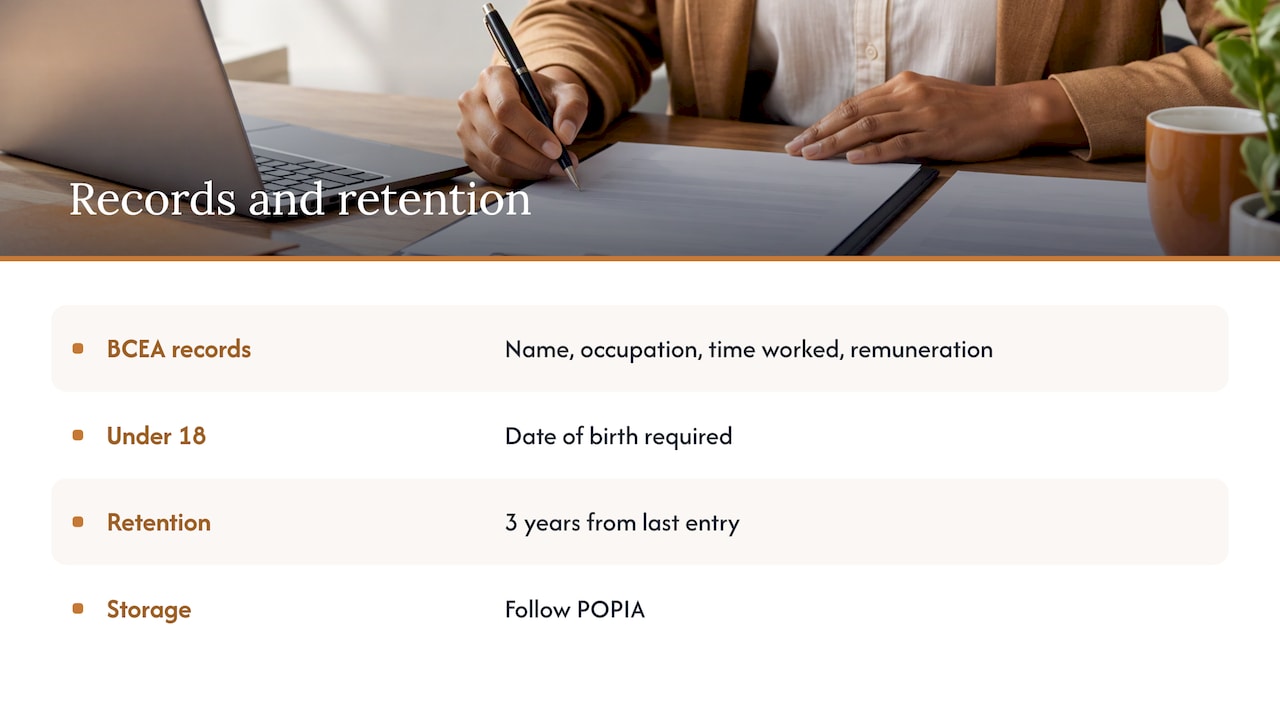
Section 31 of the BCEA requires records of each employee’s name, occupation, time worked and remuneration paid, plus date of birth if under 18, kept for three years from the date of the last entry. Plan storage and access for that period, and make sure it follows POPIA.
Payroll is where contract terms become money: PAYE, UIF, SDL and COIDA all flow from what the contract says. Our South Africa payroll and tax guide shows how those filings connect to the terms you write.
Doing it yourself, with a lawyer, or through an EOR
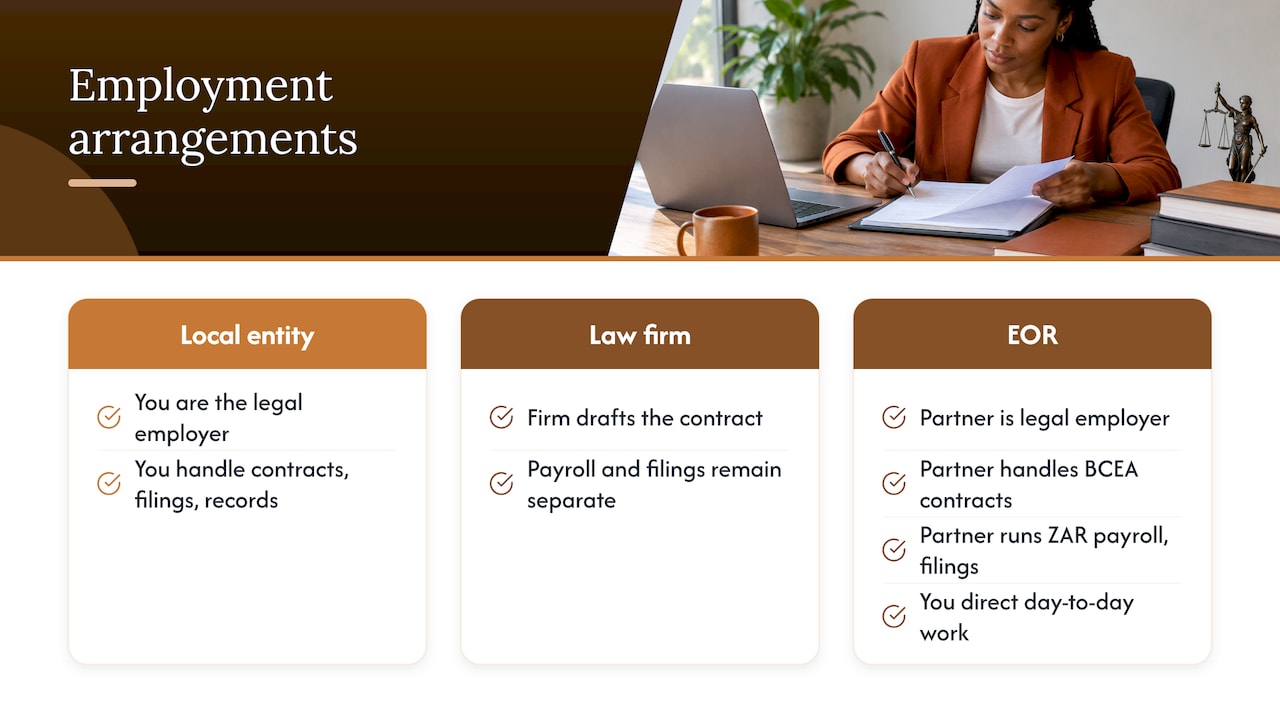
If you open a local entity, you become the legal employer and carry the contracts, filings and records yourself. A local employment law firm can draft the document, though ongoing payroll and filings remain separate work. Through an Employer of Record, a licensed local partner is the legal employer of your people. The partner handles BCEA-compliant contracts, ZAR payroll and statutory filings, while you direct the day-to-day work. We state plainly who legally employs your team, so there are no surprises on your side.
Our Employer of Record guide explains the model in full. Skilled roles in South Africa typically cost 40 to 60% less in salary than their UK or EU equivalents, and the time zone sits within about one hour of CET, so the team works your hours.
Perspective
Most contract problems we see start with a good intention: a founder reuses the template that worked at home. We think a South African hire should get a South African contract from day one, written to the BCEA and tied to the payroll that will carry it out.
That is why we work in one country only. A contract, the rand payroll, the PAYE, UIF, SDL and COIDA filings, and the exit process are one chain. When one company handles the chain, the contract and the filings cannot drift apart.
We also think you should know who legally employs your team, and what a dismissal needs to survive the CCMA. We publish the rules, a public employment cost calculator and an open API, so your finance and engineering teams can see the numbers before they commit.
Roel
Hiring your first South African employee
We provide Employer of Record services in South Africa from £299 per employee per month, with no setup fees or FX loading. That covers the BCEA-compliant contract, ZAR payroll and the statutory filings. If you also need the person found, we offer talent sourcing. Switching from another provider is free of transfer charges.
See what the service costs and includes, or model the full cost of a role with our employment cost calculator.
FAQ
Does South Africa require a written employment contract?
There is no general rule that the contract must be signed, but the BCEA requires the employer to give the employee written particulars at the start. In practice, a signed written contract containing those particulars is the standard way to meet the rule and to prove the terms later.
Can I use my home-country contract for a South African employee?
You can borrow its commercial clauses, but the governing terms must respect South African minimums. A chosen foreign law cannot remove the protections of the country where the person works. The safest approach is a contract written for South African law.
How long can a fixed-term contract run?
For employees below the BCEA earnings threshold, fixed-term contracts are limited to three months unless there is a justifiable reason for longer, such as the nature of the work. Check the current threshold on the labour department’s website, since it is adjusted over time.
How long must I keep employment records?
Section 31 of the BCEA requires records of name, occupation, time worked and remuneration to be kept for three years from the last entry. Personal data in those records must also be handled in line with POPIA.
Do I need a local entity to issue the contract?
No. With an Employer of Record, a licensed local partner is the legal employer and issues the contract, so you can hire without setting up a subsidiary.
Sources
- Basic Conditions of Employment Act, South African Department of Employment and Labour
- Employment: From Recruitment to Retirement, Cliffe Dekker Hofmeyr
- Global Employment Compass: South Africa, Eversheds Sutherland
- A Lawyer’s Guide to Global Employment Contract Compliance
- Employment Profile, Fairbridges