

South Africa is one hour ahead of Central European Time (CET) in winter and on the same clock as Central European Summer Time (CEST) in summer. The reason is simple: South Africa never changes its clocks, while Central Europe does. For a founder or HR lead in Europe, that means a South African hire sits inside your working day all year, with a one-hour shift you can plan around. If you are building a team there, our guide to time zone overlap with South Africa extends the same logic to UK and US hours, and we can employ your people on the ground through our Employer of Record service from £299 per month per employee.
TL;DR
- South African Standard Time (SAST) is UTC+2 all year, with no daylight saving.
- CET is UTC+1 in winter. In summer, Central Europe moves to CEST (UTC+2), which is identical to SAST.
- Winter rule: add one hour going from CET to SAST. Summer rule: add nothing.
- The shared working window is roughly 9:00 to 17:00 in Central Europe, which is 10:00 to 18:00 in South Africa in winter.
- Only the clock change dates in Europe matter for scheduling; South Africa never moves.
Table of Contents
- What SAST and CET actually mean
- The time difference, season by season
- When Europe changes its clocks
- Converting CET to SAST without a converter
- Working hours and the shared window
- Working hours are not only a clock question
- Running a distributed team across the hour
- Why the time zone matters when you hire an employee
- Hire in the same working day
- FAQ
- Sources
What SAST and CET actually mean
A time zone is a fixed offset from Coordinated Universal Time (UTC), the global reference clock. Two abbreviations matter here.
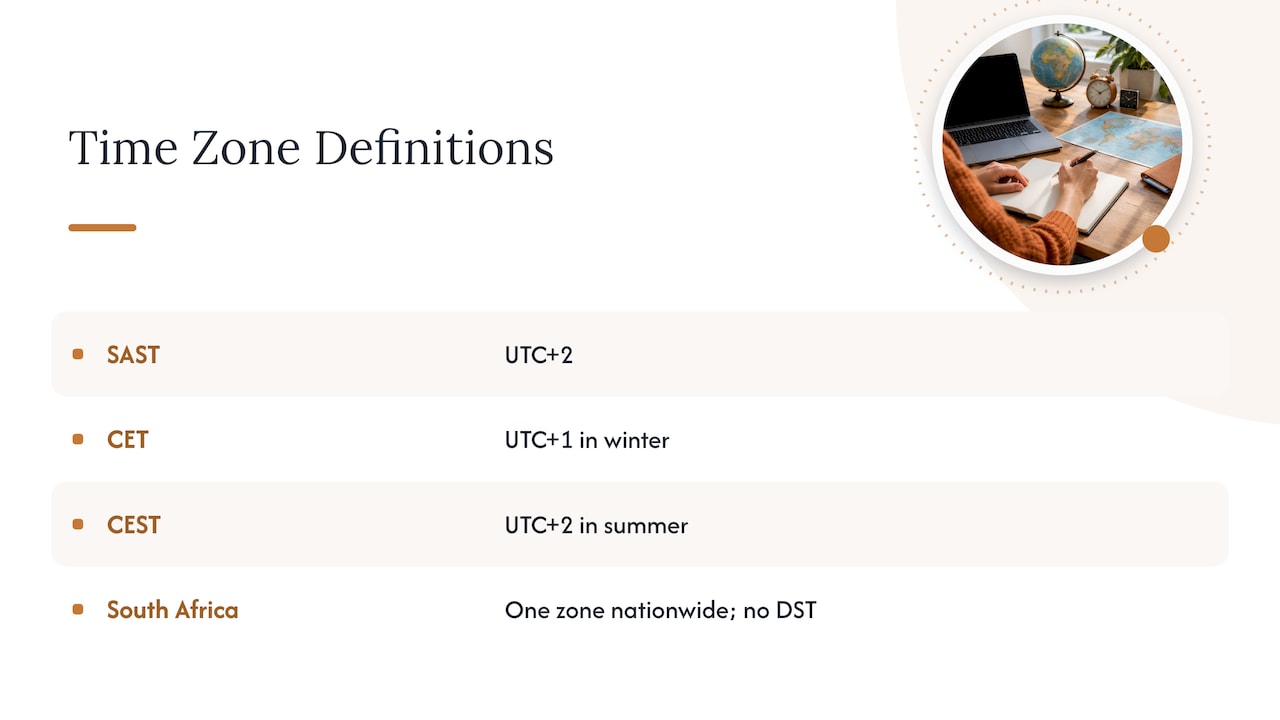
SAST, South African Standard Time. The National Metrology Institute of South Africa (NMISA), which keeps the country’s national time standard, states that SAST is defined as UTC plus 2 hours. The same offset covers Eswatini and Lesotho. The widely used IANA time zone database, which most operating systems and calendar tools rely on, lists South Africa as the Africa/Johannesburg zone at UTC+2 with no daylight-saving rule. In practice, that means your calendar software already knows the offset, and you never have to adjust for a seasonal change on the South African side.
CET, Central European Time. CET is UTC+1. It applies in winter in countries such as Germany, France, Italy, Spain, Poland, Norway, Sweden and Austria. In summer those countries switch to CEST, which is UTC+2, as set out in this time zone reference. People often write “CET” loosely to mean “Central European clock time” all year, which is where confusion starts. If someone tells you a meeting is at 10:00 CET in July, they almost always mean 10:00 local time in Berlin or Paris, which is technically CEST.
South Africa uses a single time zone nationwide. There is no difference between Johannesburg, Cape Town, Durban or Pretoria, and no change between provinces or at the borders with neighboring countries, according to a South African travel FAQ. That matters if you are hiring in more than one city: one clock covers the whole team.
The time difference, season by season
The gap between South Africa and Central Europe changes twice a year, but only because Europe moves.
| Period | Central Europe | South Africa | Difference |
|---|---|---|---|
| Late October to late March | CET, UTC+1 | SAST, UTC+2 | South Africa is 1 hour ahead |
| Late March to late October | CEST, UTC+2 | SAST, UTC+2 | No difference |
A practical way to remember it: in European winter, South Africa is one hour ahead of Paris. In European summer, Johannesburg and Paris show the same time. One African time guide puts it as winter equals CET plus one hour, summer equals CET, and that is the rule to keep in your head.
If you ask a search engine how many hours ahead of CET South Africa is, the answer you will usually see is “1 hour”. That is correct for the strict meaning of CET, the winter standard time. It stops being true for roughly seven months of the year, when your European colleagues are on CEST.
When Europe changes its clocks
European Union rules set summer time from the last Sunday in March to the last Sunday in October. Under Directive 2000/84/EC, the change happens at 01:00 UTC on both dates, and in Central Europe that means clocks go forward at 02:00 local time in spring (to 03:00) and back at 03:00 local time in autumn (to 02:00), according to timeanddate.com’s European reference.
The most recent switch back to CET was on Sunday, 25 October 2026. The next switch to CEST falls on Sunday, 28 March 2027, and the one after that on Sunday, 31 October 2027, under the rules in force when those calendars were published. Because EU rules could change, treat any specific date as something to confirm in your calendar tool each year. The recurring pattern is the part you can rely on: last Sunday in March, last Sunday in October.
The weeks around those two Sundays are the only risky ones for scheduling. If your team in South Africa has a recurring Monday call set in a calendar that was created before the change, check that it still lands where you expect. Modern calendar apps handle this automatically as long as the event is anchored to a named time zone (Europe/Berlin or Africa/Johannesburg) rather than a fixed UTC offset. Anchoring to a fixed offset is the most common cause of a call that suddenly sits an hour early or late.
Converting CET to SAST without a converter
The arithmetic is short enough to do in your head.
In winter (CET):
- 09:00 CET is 10:00 SAST
- 12:00 CET is 13:00 SAST
- 17:00 CET is 18:00 SAST
- Going the other way, 12:00 SAST is 11:00 CET
These reference points match standard CET-to-SAST conversion tables.
In summer (CEST):
- 09:00 CEST is 09:00 SAST
- 17:00 CEST is 17:00 SAST
A single test avoids mistakes: first ask whether Europe is on standard time or summer time at the date of the meeting, not today’s date. A call you book in October for a date in April lands on the summer pattern. That date-of-the-meeting rule is where most errors come from, particularly for companies planning onboarding sessions, payroll cut-off calls or quarterly reviews several months ahead.
Working hours and the shared window
A one-hour offset is among the smallest you can have between continents. The practical effect looks like this.
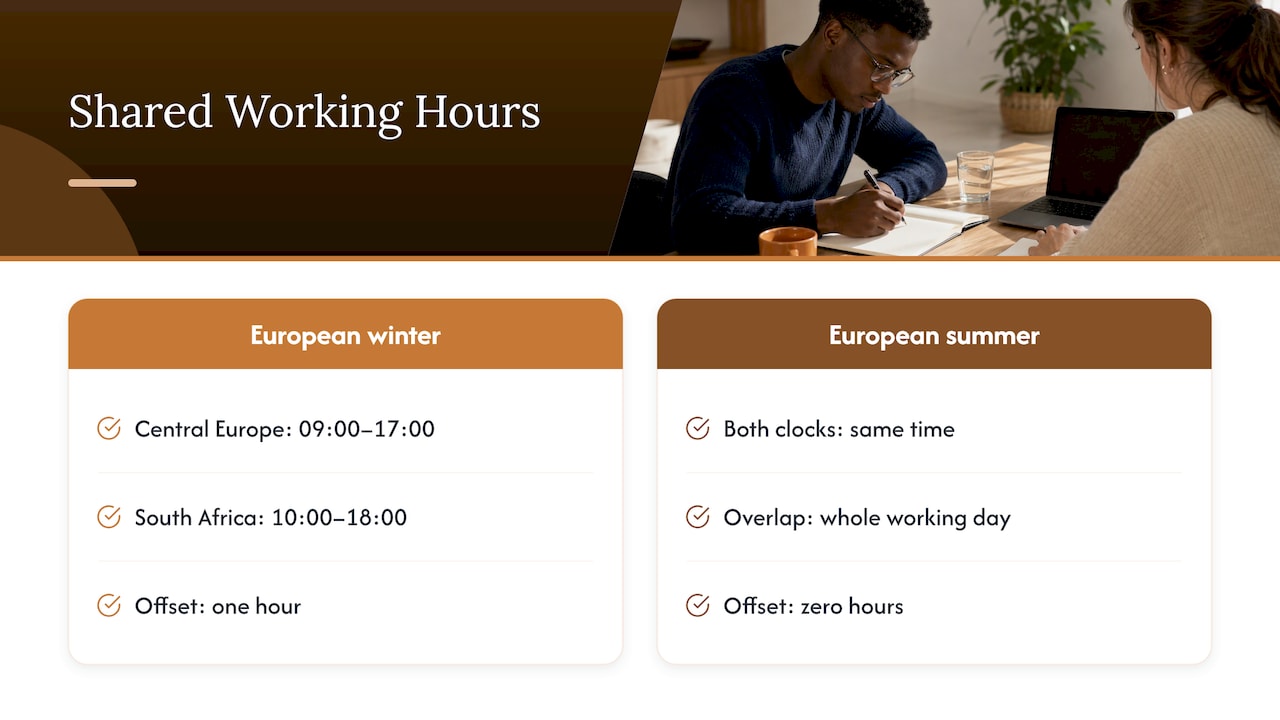
In European winter, a 9:00 to 17:00 day in Central Europe corresponds to 10:00 to 18:00 in South Africa. A converter that lists the best call window for this pair gives 9:00 to 17:00 in CET, or 10:00 to 18:00 in SAST. Both sides have a full day of overlap, minus one hour at each end. Your South African colleague finishes an hour later than you in clock terms, which makes it easy to agree an earlier start, for example 08:30 SAST, if you want to preserve a shared morning.
In European summer, the two clocks are identical, so the overlap is the whole working day. Your team’s stand-up, support hours and release windows can sit at the same numbers on both sides.
For comparison, teams hiring in India, the Philippines or the western United States work with a split day, where one side takes calls early in the morning or late at night. A South African employee in a Central European schedule does not need to do either. That is one of the reasons European companies look at South Africa for engineering, support, finance and operations roles. We also see founders weigh it against salary levels: on skilled roles, we typically see savings of 40 to 60 percent against UK and EU salaries, and our salary benchmarks for remote workers in South Africa show how that looks by role.
If you manage from the UK or North America, the overlap is narrower and shifts with each region’s own clock change. Our time zone overlap guide for UK, EU and US hours lays out the hours for each.
Working hours are not only a clock question
A shared time zone does not set the hours your South African employee works. That comes from the contract and from South African law. The Basic Conditions of Employment Act (BCEA) sets rules on ordinary hours, overtime, rest and public holidays, and your contract should reflect them. Our BCEA working hours guide for employers explains how those rules translate into contract and payroll steps.
Two practical points follow from the time zone:
- Public holidays follow the South African calendar, not yours. Your Central European or UK holidays do not apply, and South African ones do. Put both calendars in your planning tool.
- Define core hours in the contract or onboarding pack. For example, “available between 10:00 and 17:00 SAST for team calls” removes any ambiguity when Europe changes its clocks and the offset moves.
The remote onboarding guide covers how to set these expectations in the first weeks.
Running a distributed team across the hour
The time difference is small, so the management challenge is rarely the clock. It is habit: shared rituals, written handoffs, and clear expectations about response times. If you lead sales, support or customer success staff across two countries, a remote sales team management checklist gives a structure for cadence and accountability that works at any offset.
A few habits that suit the CET and SAST pairing:
- Write times with the zone. “10:00 SAST” is unambiguous. “10:00 my time” is not.
- Name the zone in the calendar invite, not only in the text. This protects recurring meetings through the clock changes in March and October.
- Mark the two transition weeks. Add a reminder for the last Sunday of March and of October to review recurring meetings.
- Keep one shared hour for the whole year. Between 10:00 and 17:00 Central European time, the two zones overlap in both seasons, so use that hour range for anything that must be live.
Why the time zone matters when you hire an employee
A time zone decides where your employee can sit in your working day. It does not decide who legally employs them. If you want a full-time South African employee on your team, the options are to set up a local entity, engage a contractor, or use an Employer of Record (EOR), a provider that legally employs the person locally on your behalf while you direct the day-to-day work.
A contractor can look attractive at first, because there is no payroll to run. But a long-term, full-time contractor working your hours with your tools and under your direction can create classification questions, which is why companies often convert such arrangements to employment. If that is your situation, our guide to employer of record services explains how the conversion works in South Africa.
For employees, the employer has to register and pay statutory contributions, among them PAYE (income tax withheld, filed through the EMP201 return with the South African Revenue Service), UIF (unemployment insurance), SDL (skills development levy) and COIDA (workplace injury compensation). Payroll taxes for employers in South Africa must be registered within 21 days, and our payroll and tax guide sets out the details. For a European team, the benefit of the small time difference is that your payroll, HR and legal questions can be answered during the same business day.
Our view on the one-hour question
We run Employer of Record for one country only, South Africa, and the time zone is one of the first things founders ask about. Our answer is that the overlap with Europe is a real working advantage: the offset is at most one hour, it never moves on the South African side, and you can plan around it with two dates a year.
What we would add is that the clock should not be the only reason to hire. The offset gets a person into your day. Compliant contracts, ZAR payroll, statutory filings and a clear answer to who legally employs your people are what keep the relationship sound once they are there. That is why we built our service around a single country, with a flat fee and no FX loading, rather than around 150 countries.
Our contracts are signed within 48 hours and onboarding takes days. For a team that works the same hours as yours, that speed matters more than anything on a rate card.
Roel
Hire in the same working day
If the time zone is what drew you to South Africa, the next step is to employ someone there without opening a local company. We provide Employer of Record services exclusively for South Africa: a licensed local partner issues BCEA-compliant contracts, runs ZAR payroll and handles PAYE, UIF, SDL and COIDA filings. Pricing is a flat fee, from £299 per month per employee, with no setup fees or FX loading. You can see the full terms on our pricing page.

If you need candidates first, our talent sourcing service finds skilled professionals in the same working-day window as your team. To estimate the full cost of a role before you commit, use our employment cost calculator.
FAQ
What time zone is South Africa in?
South Africa uses South African Standard Time (SAST), which is UTC+2. The country applies it nationwide and does not observe daylight saving, so the clock stays the same all year. NMISA, the national time authority, defines SAST as UTC plus 2 hours.
Is South Africa ahead of or behind CET?
South Africa is one hour ahead of CET, which is UTC+1. That holds in European winter, from late October to late March. When Central Europe moves to CEST (UTC+2) in summer, the two clocks show the same time.
How do I convert CET to SAST?
Add one hour in winter: 09:00 CET is 10:00 SAST. In summer, when Central Europe is on CEST, add nothing, because 09:00 CEST is 09:00 SAST. Always check which season applies on the date of the meeting rather than today’s date.
Does South Africa change its clocks when Europe does?
No. South Africa stays on UTC+2 all year, as the IANA time zone data shows. Only the difference changes, because Central Europe moves between UTC+1 and UTC+2 on the last Sundays of March and October.
Is there a good call window for a CET team and a South African team?
Yes. In winter, 9:00 to 17:00 CET corresponds to 10:00 to 18:00 SAST, and in summer the hours match exactly. Between 10:00 and 17:00 Central European time, both teams are at work in either season.
Sources
- NMISA, South African time service
- IANA time zone database, Africa, 2025b
- Institute of Citizen Science, time zones
- timein.africa, Africa vs Europe time difference
- timeanddate.com, time zones and DST in Europe
- Wikipedia, Central European Time
- timezoneconverter.co, DST calendar
- zoneclock.org, CET to SAST converter
- Savvy Time, CEST to SAST converter
- southafrica.co.za, general FAQ