

South Africa offers a large, English-speaking pool of software and ICT professionals, but demand for them is intense, so the way you hire matters as much as where you hire. The simplest compliant route for a foreign company is to employ people through a licensed local employer rather than a new subsidiary. We built Expand to South Africa for this: full-time South African employees, a flat fee from £299 per employee per month, and no entity to register.
This guide covers what the talent pool looks like, which skills are scarce, what remote work and power cuts mean in practice, what the law requires, and how to go from job post to a signed contract.
TL;DR
- South Africa has roughly 318,000 employed ICT professionals and about 118,000 open ICT vacancies, so good candidates are courted by local employers too.
- Software, web, data, cloud, cybersecurity and AI roles are where demand is strongest, and remote work for international employers is increasingly attractive to local practitioners.
- Employing in South Africa means BCEA-compliant contracts, ZAR payroll, PAYE, UIF, SDL and COIDA filings, plus POPIA for personal data.
- Skilled roles typically cost 40-60% less in salary than comparable UK or EU hires, and the time zone is within about one hour of Central European Time.
- An Employer of Record (EOR) legally employs your hire in South Africa while you direct their daily work.
Table of Contents
- What the South African tech talent pool looks like
- Which roles and skills are most in demand
- Remote work: who wants it and what it does to your odds
- What you can expect to pay
- The practical risks: power, connectivity and burnout
- What the law requires when you employ in South Africa
- From job brief to first day: a practical sequence
- Building an API-driven setup
- Our perspective
- Employing your first South African hire with us
- FAQ
- Sources
What the South African tech talent pool looks like
The market is big enough to hire from and tight enough to compete in. Collective X’s analysis of 32,082 job ads on Pnet and Career Junction puts the national ICT vacancy pool at about 118,000 positions against an employed ICT base of 318,000, a 27.2% vacancy rate. The same report finds that the top twenty job titles account for 78% of all vacancies, which tells you the demand is concentrated in a fairly small set of roles.
For a US founder, the number to take from this is not the size of the pool but the competition inside it. A candidate who is good at their job has several local offers. An international employer wins by being fast, clear about the employment terms and able to pay on time in rand.
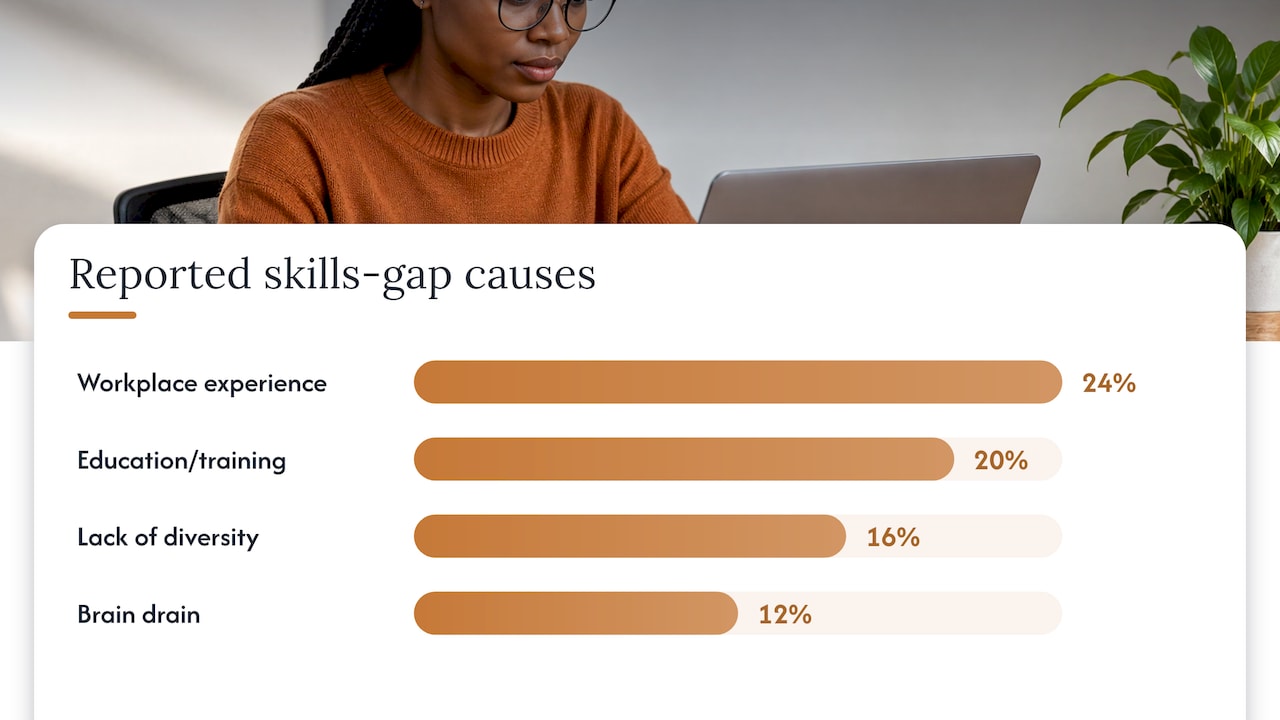
The skills gap has familiar causes. The IITPSA 2026 ICT Skills Survey, published on 4 November 2026, names a lack of workplace experience (24%) as the biggest reason for skills gaps, followed by gaps in education and training (20%), a lack of diversity (16%) and brain drain (12%). In practice, that makes people with several years of hands-on experience the scarce resource, and it is the group most international teams want.
Which roles and skills are most in demand
The most advertised roles in the Collective X data are software developers, web developers, IT support technicians and specialists, business analysts and Microsoft developers. Cloud engineering, cybersecurity, data science and DevOps are showing notable growth.
AI is the fastest-moving category. The IITPSA survey reports rapidly rising demand for AI engineers, machine learning engineers, generative AI specialists, prompt engineers and AI governance and compliance officers, especially in large enterprises, ICT firms and financial services. If you are hiring in those areas, expect to compete with South African banks and large technology firms, not only with other foreign companies.
What this means for how you write a job brief:
- Name the stack and the seniority. Generic titles such as “developer” attract the widest competition. Specific ones (for example a DevOps engineer on a named cloud platform) narrow the field to people who fit.
- Hire for the hard-to-fill role first. Support and web roles fill faster than data, security or AI roles.
- Offer a permanent contract. A full-time, legally compliant employment contract with leave, UIF and medical-aid-style benefits is a stronger offer than a contractor agreement, which matters most for senior people.
If you are deciding on engineering roles specifically, our page on hiring software developers in South Africa covers salaries and how to employ them.
Remote work: who wants it and what it does to your odds
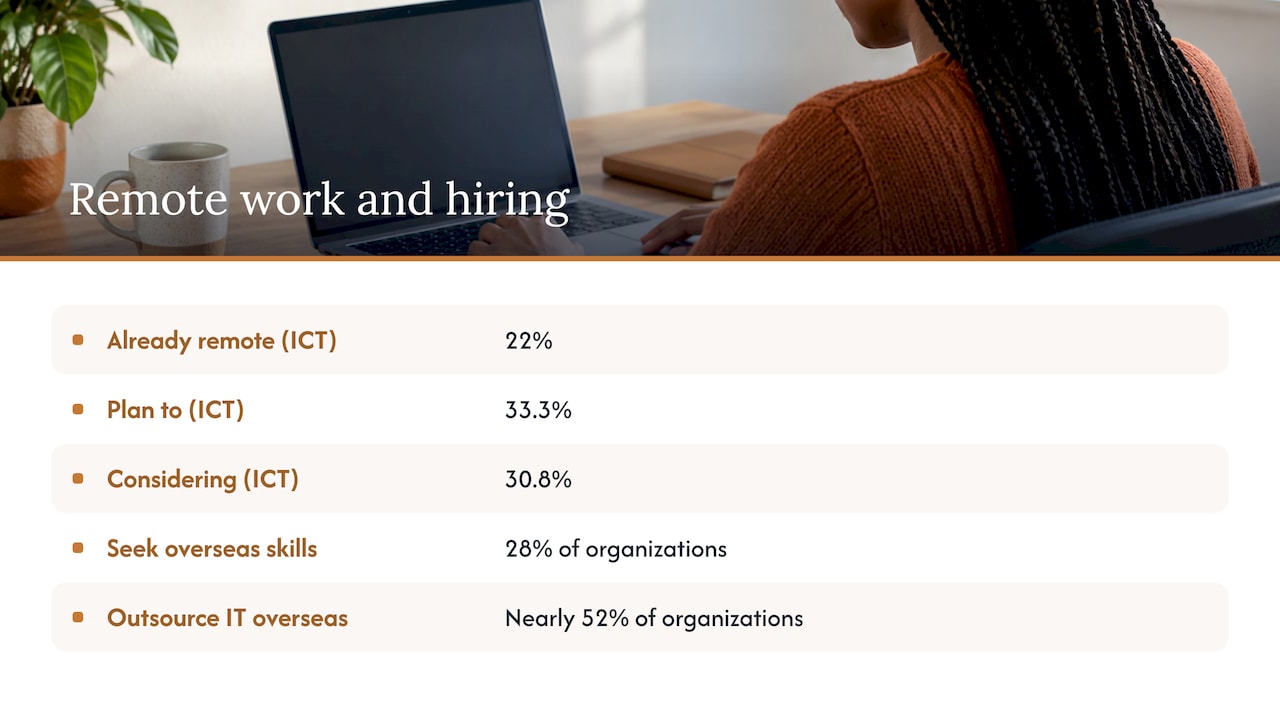
South African practitioners are open to working for foreign employers. The IITPSA survey finds that 22% of South African ICT practitioners already work remotely, 33.3% plan to and 30.8% are considering it, with contractors, freelancers and the self-employed especially interested in remote international opportunities. The same survey reports that 28% of organizations look overseas for specialised skills, and nearly 52% outsource IT functions overseas, so foreign employers are a normal part of the market.
That last group is worth noting if you currently work with South African contractors. Many are open to a stable employed role, and converting a contractor to an employee is a common reason teams come to us. It removes the misclassification risk that comes from treating a full-time, directed worker as self-employed.
The time zone
South Africa runs on UTC+2 all year and does not change its clocks. That is within about one hour of Central European Time, so European teams share almost the whole working day. For a US team the overlap is narrower: your morning meets their afternoon. Teams on the US East Coast typically build a standing two to three hour window for stand-ups and pairing, and let the rest of the day run asynchronously. Decide that window before you hire and put it in the job description.
What you can expect to pay
The cost gap is the usual reason a US or European company looks at South Africa. Our own benchmark is that skilled roles typically come in 40-60% below comparable UK or EU salaries, and our page on South African versus UK salaries explains why raw conversion misleads and purchasing power matters. For an engineering-specific figure, see our software engineer salary breakdown for 2026, which lists R38,000 to R40,000 per month for the role.
Two practical points for finance leads:
- Salary is not total employer cost. Add statutory contributions (UIF and SDL), COIDA assessments, leave, bonuses commonly paid in South Africa, and your EOR fee. Our public employment cost calculator does that sum for a given salary.
- Pay in rand, not dollars. Employees are paid in ZAR through local payroll. Currency conversion margins, when a provider applies them, quietly raise your cost. Our fee carries no FX loading and no setup fee.
If you are comparing EOR providers on price, global platforms charge $400 to $599 per month because they cover about 150 countries. A single-country provider can price lower because it only maintains one country’s compliance. Our comparison of EOR providers in South Africa sets the options side by side.
The practical risks: power, connectivity and burnout
It would be unfair to a new hire to ignore infrastructure. Load shedding, the scheduled rolling blackouts, had a measurable effect on ICT firms: TechCentral reported that its impact was low at stage 1, moderate at stages 2 to 4 and much worse beyond that, and that companies responded with solar power, energy-saving measures and bigger battery capacity.
The situation has improved but is not over. Eskom has officially ended load shedding, yet power outages remain widespread, with areas under load reduction expected to see outages until at least 2027, and infrastructure theft adds pressure on mobile networks.
For your hiring plan, that translates into a few simple measures that experienced remote teams already use:
- Ask where the employee works and whether the home has backup power or a fiber line with a battery-backed router.
- Budget a small, fixed work-from-home allowance for inverters, batteries or a mobile data backup.
- Agree an outage protocol: who is told, and how work is covered during a long outage.
Treating resilience as a shared cost, not a performance problem, is also good retention. For broader ideas on keeping distributed teams connected, see employee engagement trends for HR leaders.
What the law requires when you employ in South Africa
You cannot simply put a South African on a US payroll and ignore local rules. A person working in South Africa for a foreign company is generally an employee under South African law, which brings the following obligations:
- A compliant contract. The Basic Conditions of Employment Act (BCEA) sets minimum terms on working hours, leave, notice and pay. The Labour Relations Act (LRA) governs fair dismissal and the Commission for Conciliation, Mediation and Arbitration (CCMA) hears disputes.
- Payroll taxes. Every employer must withhold PAYE (income tax) and pay it to the South African Revenue Service (SARS) monthly through the EMP201 return. You also owe Unemployment Insurance Fund (UIF) and Skills Development Levy (SDL) contributions, and COIDA for workplace injury cover. Our guide to payroll taxes for employers explains the 21-day registration window, and our non-resident employer guide covers the PAYE rules that apply when your company is abroad.
- Data protection. The Protection of Personal Information Act (POPIA) applies to organizations outside South Africa that process personal information using means located in South Africa, and cross-border transfers are allowed where adequate protection, consent or contract necessity applies. Its maximum administrative fine is R10 million, and breaches must be reported as soon as reasonably possible. See our POPIA compliance guide for foreign employers.
The rules are also moving. On 26 February 2026 the Minister of Employment and Labour published the Labour Law Amendment Bill, 2025 for public comment, which seeks to amend the BCEA, the Employment Equity Act, the LRA, the National Minimum Wage Act and the Unemployment Insurance Act. Check the current text before you finalize contract templates.
Why an EOR rather than your own entity
Setting up a South African company means incorporation, tax and UIF registrations, a payroll function and ongoing filings, all before the first hire starts. With an EOR, a licensed local partner is the legal employer. In our model that partner handles the BCEA-compliant contracts, ZAR payroll and the PAYE, UIF, SDL and COIDA filings, and you direct the daily work. We also disclose plainly who legally employs your people, which is how an honest EOR relationship should work.
From job brief to first day: a practical sequence
- Define the role and the overlap window. Write the stack, the seniority and the hours you need in common. For a first hire, one well-specified role beats a vague “engineer”.
- Benchmark the salary. Use local salary data, not a currency conversion of your US band. Our employment cost calculator turns a gross salary into total employer cost.
- Source candidates. Our talent sourcing service finds vetted candidates for skilled roles, and our guide to talent sourcing for foreign employers shows what the process looks like.
- Interview and agree terms. Settle salary in rand, start date, notice period and any benefits before drafting.
- Sign the contract. We deliver signed contracts within 48 hours, and onboarding follows within days.
- Run payroll monthly. Salaries are paid in ZAR, and statutory filings are made on time. Our page on paying employees in ZAR explains the monthly EMP201 cycle.
- Plan the exit before you need it. Dismissal in South Africa must be substantively and procedurally fair. We give CCMA-safe dismissal guidance so a performance issue does not become a dispute.
If you are already using another EOR, transfers to us are free, and if you are working with South African contractors, the same process converts them into employees.
Building an API-driven setup
For CTOs who want hiring to be part of their own tooling, we offer an open REST API with public documentation and sandbox keys. That lets your HR system create employees and read payroll data without a manual export, which suits startups that run everything through code.
Our perspective
Most of the founders we talk to start with the same question: where do I find good engineers? It is the wrong first question. Finding people in South Africa is the easy part. The hard part is employing them correctly, month after month, in a country with its own tax authority, its own labour courts and its own data law.
That is why we do one country only. A platform covering 150 countries cannot know the details of BCEA contracts, EMP201 deadlines, UIF and COIDA the way a team that handles nothing else does. We think a flat fee, honestly disclosed legal employer, no FX loading and a public API are what a founder or finance lead should expect.
If you are hiring your first person in South Africa, begin with one role, a clear time zone window and a compliant contract. The rest follows from that.
Roel
Employing your first South African hire with us
Our Employer of Record service starts from £299 per employee per month, with no setup fees. It includes the compliant contract, ZAR payroll and all statutory filings, so your first hire starts without a South African entity. See the details on our EOR pricing page.

If you already have a shortlist, we can issue the contract within 48 hours. If you do not, our talent sourcing team can find vetted candidates for you. You can also start from our homepage.
FAQ
Is it legal to hire a South African developer without a local company?
Yes, through an Employer of Record. A licensed local partner becomes the legal employer, issues a BCEA-compliant contract and files PAYE, UIF, SDL and COIDA. You manage the work, and you do not need a South African subsidiary.
How much cheaper is South African tech talent?
For skilled roles, we typically see salaries 40-60% below comparable UK or EU roles. Compare total employer cost, not salary alone, and use our public calculator for the full figure. Our salary comparison page explains the purchasing power effect.
Will the time zone work for a US team?
South Africa is on UTC+2 all year, within about an hour of CET. For US teams, plan a shared window of two to three hours, usually your morning and their afternoon, and let everything else run asynchronously.
Do power cuts still affect remote work?
Load shedding has officially ended, but outages remain widespread in some areas, according to TechCentral. Ask about backup power and connectivity at hiring stage and agree an outage protocol.
Sources
- The South African AI workforce landscape (Collective X)
- IITPSA 2026 ICT Skills Survey
- How the ICT sector buckles under load shedding (TechCentral)
- Theft and power cuts hammer SA telecoms operators (TechCentral)
- Data Protected South Africa (Linklaters)
- POPIA vs GDPR: the differences that actually matter (MJK Inc)
- Employment & Labour Laws and Regulations 2026, South Africa