

A Dutch company can hire an employee who lives and works in South Africa without opening a South African subsidiary. You have two lawful routes: register and run payroll yourself, or use an Employer of Record (EOR) that employs the person locally on your behalf. For one to five hires, the EOR route is usually faster and carries less compliance risk. This guide explains how each route works, what South African law requires, and what it costs.
TL;DR
- A foreign employer is not required to form a legal entity just to run a payroll in South Africa, but signing local employment contracts can trigger external company registration.
- Every South African employee needs a written contract, PAYE, UIF, SDL and COIDA registration, all filed in rand.
- Misclassifying a South African employee as a contractor is the most common and expensive mistake for European startups.
- An EOR becomes the legal employer, so you manage the work while it handles contracts, payroll and filings. Ours starts from £299 per employee per month.
- South Africa sits within about one hour of Central European Time, so your team can work your normal Dutch day.
Table of Contents
- Why Dutch companies hire in South Africa
- Your three options for employing someone in South Africa
- Do you need a South African entity?
- What South African law requires of every employer
- Employer of Record or direct employment?
- Why not just hire a contractor?
- How to hire and onboard a South African employee: the steps
- What does it cost?
- Our perspective
- How we help Dutch companies hire in South Africa
- FAQ
- Sources
Why Dutch companies hire in South Africa
The appeal is practical. South Africa has a deep pool of English-speaking engineers, designers, finance and customer support staff, and the time zone overlap with the Netherlands is almost complete: the gap is at most one hour depending on the season. Skilled roles typically cost 40 to 60% less in salary than comparable roles in the UK or Western Europe, which is our own working benchmark from placing and employing people here.
The catch is that South African labour law is protective of employees. Contracts, notice, leave, dismissal procedure and statutory contributions are not optional extras, and they apply even if the employee works from a home office for a company with no local presence.
Your three options for employing someone in South Africa
| Route | What it means | Best for |
|---|---|---|
| Own South African entity | Incorporate a company, register with CIPC and SARS, run payroll in-house | Teams planning a sizable local operation |
| Direct employment from the Netherlands | Employ the person yourself and register as an employer in South Africa | Companies with in-house SA payroll know-how |
| Employer of Record | A licensed local provider is the legal employer and you direct the work | First hires, small teams, fast starts |
| Independent contractor | Invoice-based engagement | Genuinely independent work only |
The contractor route deserves its own warning, covered below. For the others, the sections that follow walk through what you actually carry as employer.
Do you need a South African entity?
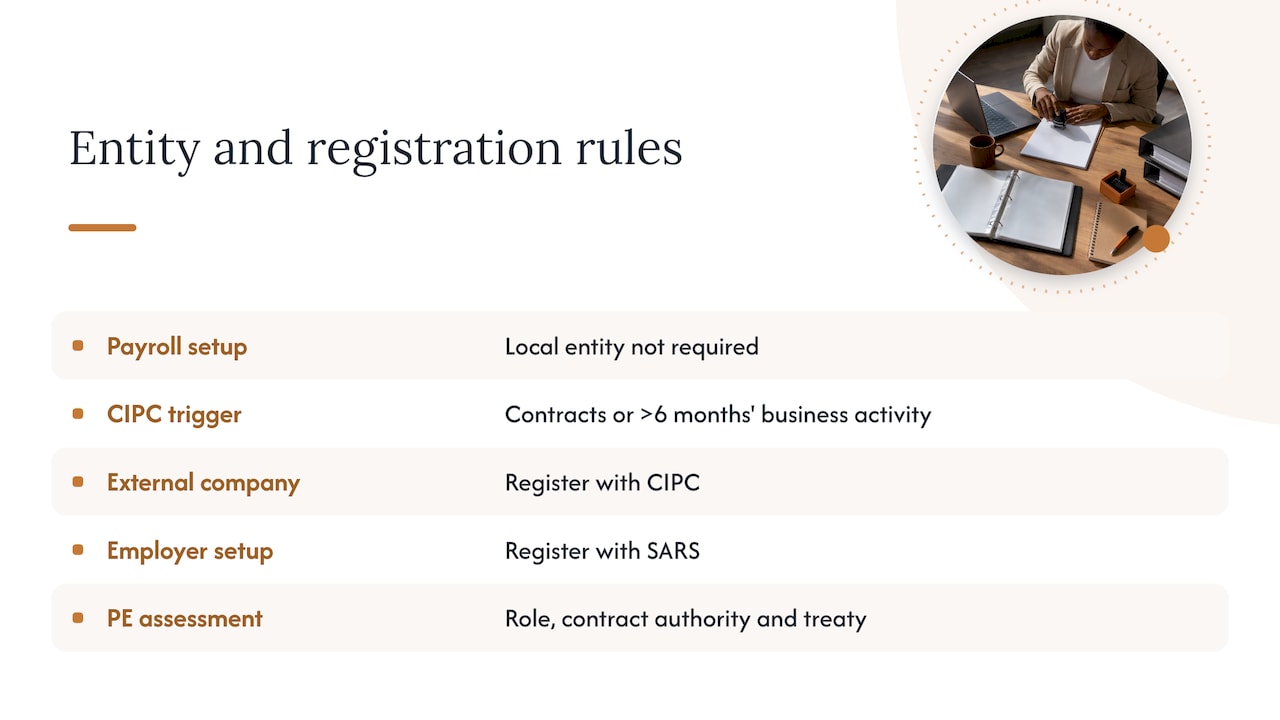
Not necessarily. Commentary from tax practitioners confirms a foreign employer does not have to form a local entity to set up payroll. There is a second rule to know, though. According to a global employment guide from DLA Piper, a foreign company must register with the CIPC as an external company if it enters employment contracts in South Africa, or if it conducts itself for more than six months in a way that reasonably indicates an intention to continually do business there.
So direct employment is possible, but it is not free of formalities. You would register as an external company, then register as an employer with SARS. Our own guide for EU companies hiring in South Africa covers the legal side from a European point of view.
There is also a corporate tax question your Dutch finance team will raise: whether a remote employee creates a permanent establishment for the company. The answer depends on the role, the authority the person has to conclude contracts, and the treaty. The Netherlands-South Africa double taxation agreement is published by SARS, and your Dutch tax adviser should review it against the actual role before the first contract is signed.
What South African law requires of every employer
Whoever is the legal employer must handle the following. Each item is a registration or filing, not a one-off.
- A written employment contract. The employer tax guide from JACC lists a written contract for each employee among the starting obligations. Contents must align with the Basic Conditions of Employment Act (BCEA): hours, leave, notice and remuneration. See our notes on essential contract clauses and BCEA working hours.
- PAYE. Employees’ tax is withheld monthly and paid to SARS, calculated on individual income tax brackets according to the SARS employer guide for the 2026 tax year. The top marginal rate is 45%. Our page on PAYE thresholds explains what HR needs to do.
- UIF. Contributions are mandatory at 1% from the employer and 1% from the employee, with a monthly remuneration ceiling of R17,712 per the same SARS guide. Employers must register with the Unemployment Insurance Fund as soon as they start activity as an employer. See our UIF contributions explainer and UIF registration guide.
- SDL. The Skills Development Levy is registered alongside PAYE where it applies. Our SDL rate page and SDL registration checklist go into detail.
- COIDA. Employers must register with the Compensation Fund, which works as state insurance for workplace injuries and diseases. Our COIDA guide for employers shows how it works in an EOR arrangement.
All of this is filed and paid in rand. Our overview of payroll taxes for employers covers the 21-day registration window, and paying employees in ZAR explains the monthly EMP201 cycle, due by the 7th.
Enforcement is not theoretical. In a September 2025 inspection in Rustenburg, an employer who could not produce payslips, contracts or attendance registers was fined R15,000. Records are the first thing inspectors ask for.
If you do run payroll yourself, whoever administers it locally will need to be comfortable with these registrations. Some companies send their administrators on professional training courses in Pretoria covering compliance and safety topics.
Employer of Record or direct employment?
Choose direct employment if you already have South African payroll expertise, or expect a local team large enough to justify an entity. Choose an EOR if you want a first hire working within days, without registrations, a local bank account or a rand payroll process of your own.
What decides it:
- Headcount and timeline. Under about five people, the fixed cost of compliance work per head is high when you do it yourself.
- Internal expertise. Someone must own EMP201 submissions, UIF declarations and COIDA returns every month.
- Dismissal risk. South African dismissal rules are procedural. A flawed process can lead to a CCMA claim even where the reason was valid.
- Exit plan. An EOR lets you transfer the employee to your own entity later if you grow.
An important honesty point: with an EOR, the provider’s local partner is the legal employer. You direct day-to-day work, but you should know exactly who holds the contract. We say so openly to every client.
Our complete guide to Employer of Record in South Africa and EOR services page describe the model in more depth.
Why not just hire a contractor?
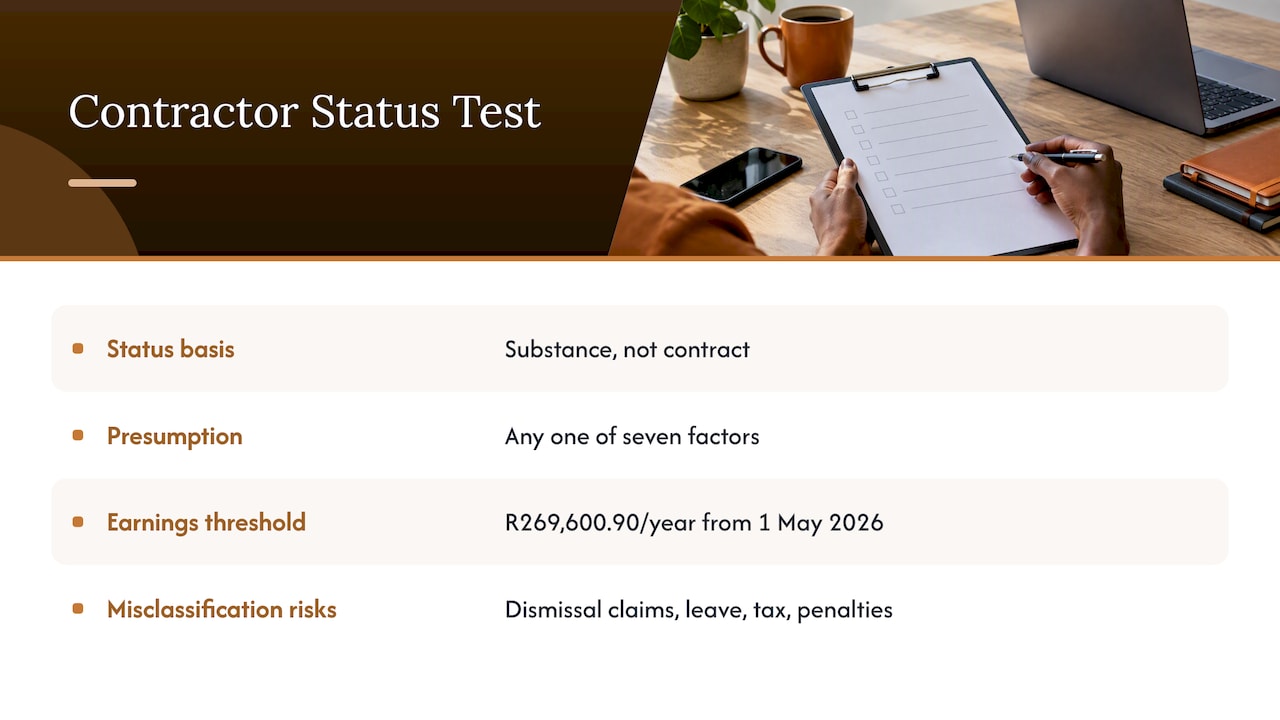
Many European startups begin with an invoice-based contractor, then discover the arrangement does not hold. In South Africa, status depends on the substance of the working relationship rather than the contract. Consequences of getting it wrong include unfair dismissal claims, back-dated leave, tax liabilities and penalties from SARS and the Department of Labour.
The law also creates a presumption. Under section 200A of the Labour Relations Act and section 83A of the BCEA, a person is presumed to be an employee if any one of seven factors is present, for workers earning at or below the earnings threshold. That threshold rose to R269,600.90 a year from 1 May 2026. A full-time developer working your hours, using your tools and taking your instructions will often fit.
Converting a contractor to an employee
A contractor who works like an employee should be converted deliberately:
- Issue a proper written employment contract.
- Register the person for PAYE, UIF and SDL, and cover COIDA.
- Address backdated BCEA entitlements, such as leave, as recommended by this classification guide.
- Agree notice terms, using the BCEA notice period rules as the floor.
We move existing contractors onto EOR employment regularly, and can take over from another EOR provider at no transfer charge.
How to hire and onboard a South African employee: the steps
- Define the role and salary. Benchmark in rand and check the total employer cost, not only gross pay.
- Pick the route. Entity, direct employment or EOR, using the criteria above.
- Find the person. Use your own network, a recruiter, or sourcing from your EOR provider. Our talent sourcing service is built for skilled roles, and our list of tech recruiters for international employers helps if you prefer to run your own search.
- Sign the contract. Check fixed-term rules, because a fixed-term contract beyond three months may need a justifiable reason in some cases.
- Register and set up payroll. Employer registrations, bank details, tax number, UIF and COIDA.
- Connect your systems. If you want payroll data in your own tools, see our guide on HRIS integration for South African payroll.
- Run the first payroll. Rand salary, PAYE and UIF deducted, statutory payments made by the due dates.
With an EOR, steps 4 to 7 are handled for you.
What does it cost?
Three cost layers apply, whichever route you choose:
- Salary. Negotiated in rand. Skilled-role salaries often sit 40 to 60% below UK and Western European levels.
- Statutory employer costs. Employer UIF at 1% up to the monthly ceiling, SDL, and COIDA assessment.
- Service cost. Either your internal admin and adviser time, or an EOR fee.
EOR pricing varies between providers by coverage, so compare on what is included: setup fees, FX loading on salary payments, termination support and whether the price is flat. Our EOR service starts from £299 per employee per month, with no setup fees or FX loading. Rates for the Netherlands will be converted from sterling at your own bank’s rate. A public cost calculator on our site shows the full employment cost for a given salary.
Our perspective
We built Expand to South Africa for one country because compliance is local work. A platform covering 150 countries cannot know the practical details of an EMP201 submission or a CCMA dismissal process as well as a team that only does South Africa.
Dutch founders usually come to us with the same question: can we employ one engineer in Cape Town without a subsidiary? The answer is yes, and it should take days, not months. Our fee is flat, with no setup charge and no FX loading, so the cost is easy to put in a budget.
We also tell clients plainly who the legal employer is, how dismissal works and what happens if they want to leave. Honest disclosure builds trust, and it is the foundation of how we work.
Roel
How we help Dutch companies hire in South Africa
We provide Employer of Record services exclusively in South Africa: BCEA-compliant contracts, ZAR payroll, and PAYE, UIF, SDL and COIDA filings through a licensed local partner. Contracts are typically signed within 48 hours, and data is handled under POPIA and GDPR with EU data residency.
See our pricing or payroll services to start planning your first hire.
FAQ
Can a Dutch company employ someone in South Africa without a local entity?
Yes. Foreign employers are not required to form an entity to run payroll. Be aware that entering employment contracts locally can require external company registration with the CIPC. An EOR avoids both steps.
Which taxes and contributions apply to a South African employee?
PAYE is withheld from salary, UIF is 1% each from employer and employee up to a monthly ceiling of R17,712, and SDL and COIDA apply to the employer. All are filed and paid in rand.
Is it safer to hire a South African as a contractor?
Not if the person works like an employee. South African law looks at the real relationship, and a presumption of employment applies below the earnings threshold. Misclassification can lead to back pay and penalties.
How long does hiring through an EOR take?
With us, contracts are typically signed within 48 hours and full onboarding follows within days. The main variable is how quickly you and the candidate agree terms.
Sources
- Entity formation in South Africa (LexisNexis Tolley)
- Global Expansion Guide: Employment, South Africa (DLA Piper)
- Becoming an Employer (JACC)
- SARS Guide for Employers, 2026 tax year
- BizPortal (CIPC)
- Department of Employment and Labour: Rustenburg inspection
- Netherlands-South Africa double taxation agreement (SARS)
- How to classify workers correctly in 2026 (HR Spot)
- The earnings threshold: R269,600.90 from 1 May 2026 (MJK Inc)