

To onboard an employee in South Africa you need three groups of paperwork: the employee’s identity and tax details, written particulars of employment that meet Section 29 of the Basic Conditions of Employment Act (BCEA), and your own payroll and statutory records. Everything else, such as handbooks, NDAs and welcome packs, is good practice rather than law. This guide walks through each group, when to collect it, how long to keep it, and what changes if the hire is a foreign national or sits under an Employer of Record.
TL;DR
- Three things are non-negotiable: the employee’s identity and tax details, written particulars of employment under BCEA Section 29, and the payroll records you must keep for SARS and the Department of Employment and Labour.
- Timing matters: written particulars are due when employment starts, not after the probation period.
- Retention differs by law: BCEA records are kept for three years after the last entry; SARS records for five years.
- POPIA applies from the first form: collect only what you need now, and know who holds it, where, and for how long.
- Foreign nationals need a different file: a general work visa brings extra documents and employer undertakings.
Table of Contents
- Who this checklist is for
- The three layers of onboarding paperwork
- Documents the employee provides
- Documents the employer must issue: written particulars
- Payroll and statutory registrations before the first payslip
- Records you must keep, and for how long
- Handling the file under POPIA
- Extra documents when you hire a foreign national
- Good-practice documents that are worth the effort
- A timeline: what to collect and when
- How an Employer of Record changes the checklist
- What we do at Expand to South Africa
- Our perspective
- FAQ
- Sources
Who this checklist is for
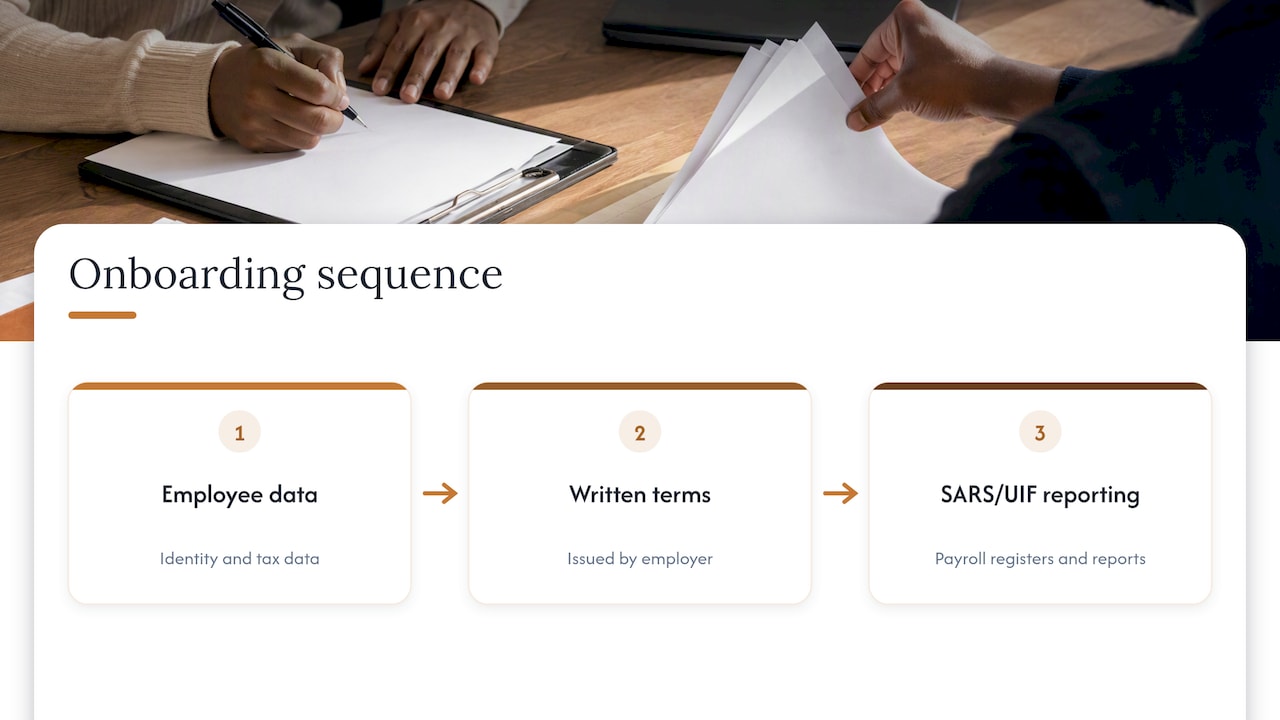
Most readers of this page are founders, HR leads or finance managers outside South Africa who are about to employ their first person there. The US and UK checklists you know (Form I-9, W-4, right-to-work checks) do not carry over. South Africa has its own sequence: the employee supplies identity and tax data, the employer issues written terms, and the payroll side registers and reports to SARS and the UIF.
If you employ through your own local entity, every document below is your responsibility. If you employ through an Employer of Record (EOR), the local employer of record holds the file, and your job is to supply role details and approve the terms. We cover that split later.
The three layers of onboarding paperwork
It helps to separate documents by why they exist.
| Layer | Purpose | Examples |
|---|---|---|
| Legally required from the employee | Lets you run payroll and tax correctly | ID or passport number, address, date of birth, tax reference number |
| Legally required from the employer | Sets the terms and proves compliance | Written particulars, payslips, time and pay records, tax and UIF records |
| Good practice | Reduces disputes, speeds up the first month | Handbook, confidentiality agreement, policies, onboarding checklist |
Keeping these layers apart avoids two common mistakes: asking for far more personal data than you need, and assuming that a handshake and a start date count as an employment file.
Documents the employee provides
The SARS guide for employers sets out the information an employee must give you: surname and full names, address, South African ID number or passport number, date of birth, and an income tax reference number if they have one (SARS PAYE guide for employers, 2026 tax year). The same list appears in the earlier guide for the 2023 tax year, so it is stable.
In practice, ask for:
- A certified or clearly legible copy of the ID document or passport. It confirms the name and number you will use on every return and payslip.
- Proof of residential address. SARS requires the address; a utility bill or bank statement is the usual evidence, though the guide itself asks for the details, not a specific proof.
- Income tax reference number. A first-time employee may not have one. Do not delay the start date for it; the employee can register with SARS, and you apply the correct tax treatment in the meantime.
- Bank account details. Payroll is paid in rand (ZAR) into a South African bank account, so you need the account holder’s name, bank and account number. Confirm the account is in the employee’s own name.
- Contact and next-of-kin details. These are useful for emergencies, but they involve a third party’s data, which we cover under POPIA below.
Qualification and reference checks
South African law does not prescribe a list of certificates you must collect. Whether you verify degrees, professional registrations or references depends on the role. For regulated or financial roles, verification is sensible. For others, collect only what you will actually check, and record the outcome rather than storing every scan indefinitely.
Documents the employer must issue: written particulars
The BCEA requires an employer to give each employee written particulars of employment when the employee starts work (BCEA, Section 29). The required content includes:
- the employer’s name and address
- the employee’s job title or a brief job description
- the start date
- ordinary hours of work
- remuneration and how it is calculated
- overtime rate and how it is paid
- deductions
- leave entitlement
- notice period
- a list of any other documents, such as a policy or collective agreement, that are incorporated by reference
A contract can cover all of this, and for most employers it should. A signed contract is the cleanest way to deliver the particulars, and it gives you a place to add confidentiality, intellectual property and restraint clauses. Our guide to essential employment contract clauses for South Africa goes through what to add beyond the statutory minimum.
Is a written contract legally compulsory?
An employment relationship can exist in South Africa without a written contract, and a verbal agreement is not less valid, only harder to prove (Griessel Consulting). That is a point about proof, not a license to skip paper. The written-particulars duty under the BCEA still applies, so a verbal deal leaves you non-compliant on day one and exposed in any later dispute at the CCMA.
Align the particulars with working time and pay rules
Two clauses cause the most mismatch between foreign templates and local law: working hours and public holiday pay. If your template says “flexible hours, no overtime”, check it against BCEA working hours and public holiday pay rules before you issue it. Employees who earn above the BCEA earnings threshold are treated differently on some provisions, so the salary level affects the wording.
Payroll and statutory registrations before the first payslip
A new hire also triggers employer-side registrations and records. You cannot pay a first salary properly without them.
- PAYE, SDL and UIF with SARS. An employer who is not yet registered must register, and the deadlines are short. See our summary of registering for payroll taxes within 21 days and the SDL registration checklist.
- UIF contributions. Both employer and employee contribute, up to a monthly earnings cap. Details and the EMP201 versus uFiling distinction are in our UIF contributions guide.
- Skills Development Levy. The rate and the grant-claim angle are explained in our SDL rate guide.
- COIDA. Employers register with the Compensation Fund for workplace injury cover and report earnings annually.
- Tax tables. Check the current thresholds in our PAYE thresholds guide before you set up the first payroll run.
Payslips
From the first payment, each employee needs a payslip with prescribed content. The BCEA Section 33 requirements are covered in our payslip requirements guide. Treat the payslip template as part of the onboarding pack, not something to build in month two.
Records you must keep, and for how long
Onboarding creates the file; retention rules decide how long it lives. Two regimes apply, and they use different clocks.
| Regime | What to keep | Minimum period |
|---|---|---|
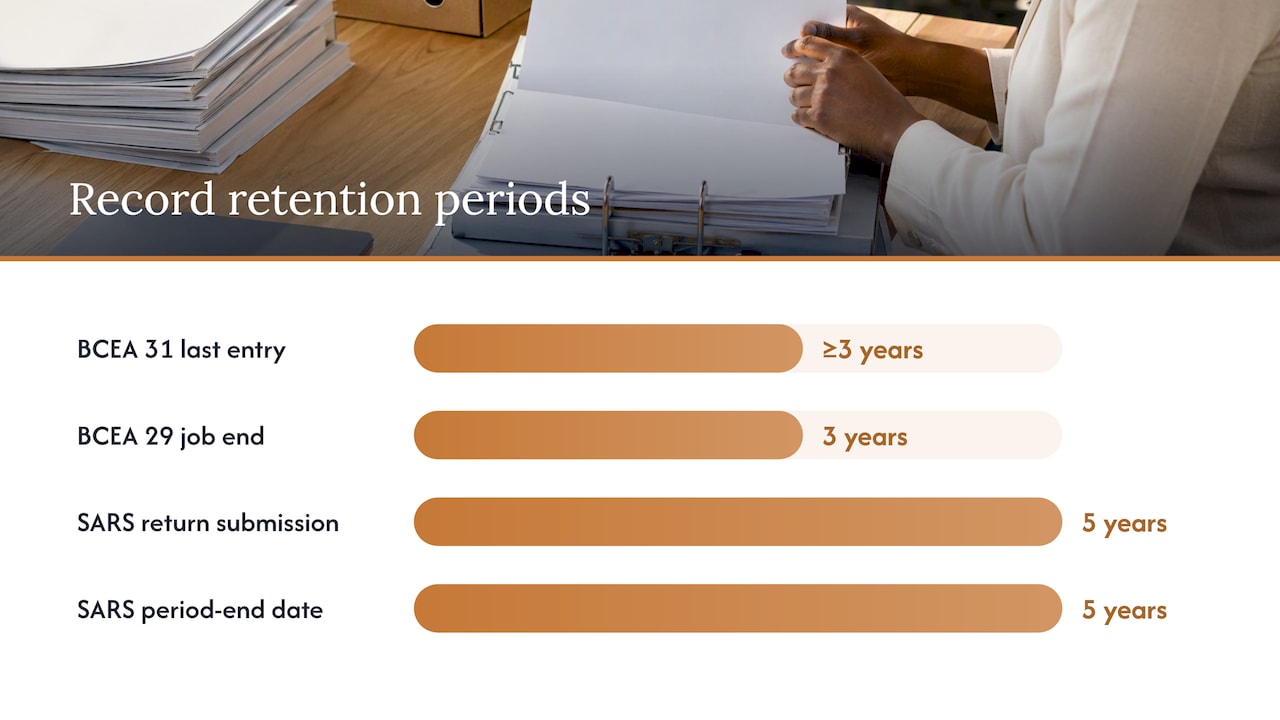
| BCEA Section 31 | Employee name and occupation, time worked, remuneration paid, date of birth for employees under 18 | At least three years after the last entry (Department of Employment and Labour, BCEA text) |
| BCEA Section 29 | Written particulars | Three years after employment ends (BCEA) |
| SARS | Remuneration paid, tax deducted, UIF contributions, tax reference numbers | Five years from the date of submission of the return and five years from the end of the tax period (SARS Monthly Tax Digest, April 2025) |
The SARS guide for the 2027 tax year lists the record content: remuneration, employees’ tax deducted, UIF contributions and income tax reference numbers. It adds that records relevant to an audit, objection or appeal must be kept until the audit ends or the decision becomes final.
The practical rule: keep payroll-related records for the longer SARS period, and do not delete anything that is under query. Everything else can be disposed of on a schedule, which matters for POPIA.
Handling the file under POPIA
An onboarding file is a bundle of personal information: ID numbers, addresses, bank details, sometimes health or family data. The Protection of Personal Information Act (POPIA) applies to all of it.
What that means in practice:
- Collect for a defined purpose. Personal information must be processed lawfully and be adequate, relevant and not excessive. Collecting something because it might be useful later is not the same as collecting it because it is necessary now (MASA).
- Treat next of kin as data subjects. Commentary from a leading South African law firm advises that employers notify next of kin that their details are being processed, obtain consent, and be able to prove it (Cliffe Dekker Hofmeyr, 2020).
- Appoint an Information Officer. Employers must have one to oversee POPIA compliance, including impact assessments and securing information against unauthorized access or loss (Cliffe Dekker Hofmeyr, 2020).
- Dispose at the end. On termination, delete personal information except what legislation requires you to retain, which is why the retention table above matters.
- Plan the full life cycle. A sound process covers collection, access, storage, sharing, retention and secure deletion.
If payroll is handled by a third party, the processor relationship should be documented. Our POPIA data processing agreement checklist lists what to cover. Also avoid sending ID scans by email; use an access-controlled portal.
Extra documents when you hire a foreign national
If the employee is not a South African citizen or permanent resident, work authorization comes first. The Department of Home Affairs notice for the general work visa, effective 9 October 2024, requires SAQA-evaluated foreign qualifications (or proof that an evaluation has been applied for), plus employer undertakings that include responsibility for deportation costs and reporting noncompliance or changes in employment (Department of Home Affairs).
The South African High Commission in Canberra’s guidance adds that the application needs an employment contract meeting South African labour standards and a written undertaking from the employer about repatriation costs, and that employers must evidence business registration with the Commission on Intellectual Property and Companies (CIPC) (DIRCO).
Two consequences for a foreign company:
- Without a registered South African business, you cannot provide the CIPC proof yourself. This is one of the cases where a local employing entity, whether your own subsidiary or an Employer of Record, is a practical requirement.
- The contract must be finished before the visa application, so contract drafting moves to the start of your timeline.
Most remote hires from abroad are South African citizens living in South Africa, and this section will not apply. Check status at the offer stage, not after the notice period with their previous employer has started.
Good-practice documents that are worth the effort
No statute requires these, but a clean onboarding pack usually includes them. Typical contents are a welcome email, an employee information form, a confidentiality agreement, a handbook and an onboarding checklist (HR Simplified).
What we would prioritize, in order:
- Confidentiality and IP assignment. Essential for software, design and analytical roles.
- Disciplinary code and grievance procedure. If a dismissal is ever challenged, a documented, communicated procedure is the first thing a CCMA commissioner looks for.
- Leave and remote-work policy. Sets expectations on annual leave, sick leave, equipment and working hours.
- IT and data security acknowledgement. Particularly if the employee handles customer data.
- Handbook. Useful, but a short, accurate one beats a long imported one that cites foreign law.
A timeline: what to collect and when
| Stage | Documents and actions |
|---|---|
| Offer | Offer letter that matches the final contract; confirm citizenship or visa status; request ID details and tax number |
| Before day one | Signed contract with all Section 29 particulars; bank details; POPIA notice; payroll and statutory registration complete |
| Day one | Policies acknowledged; confidentiality agreement signed; equipment and systems access logged |
| First payroll | Payslip in the BCEA format; PAYE, UIF and SDL declared and paid on the EMP201 |
| First 90 days | Probation reviews documented; any role changes recorded in writing |
| Exit | Records retained per the table above; remaining personal information deleted |
How an Employer of Record changes the checklist
With an EOR, the legal employer is a licensed local entity, which signs the contract, runs the payroll and files the returns. Your company directs the day-to-day work. The employee file lives with the employer of record, so most of the registrations and payslip duties above are no longer yours to build.
That shift does not remove your role. You still need to supply an accurate job description and salary, approve the terms, and respond promptly to requests for documents. For a deeper picture of the legal structure, see our complete guide to Employer of Record in South Africa, and for the risks to weigh, Employer of Record risks for U.S. companies.
What we do at Expand to South Africa
We employ people in South Africa through our own South African employing entity, EOR SA (Pty) Ltd, for one country only. The onboarding file is part of the service: BCEA-compliant contracts, ZAR payroll, and the statutory filings with SARS (PAYE, UIF, SDL and COIDA). We aim to have signed contracts within 48 hours, and onboarding follows within days. Pricing starts at £299 per employee per month, listed on our pricing page, and you can read what the service covers on our EOR services page. If you are moving staff from another provider or converting a contractor, we can work from the existing file instead of starting over.
Our perspective
We see the same pattern with international teams. The first hire is treated as an HR form-filling exercise, and the first real problem shows up months later: a contract that does not match local working-time rules, a payslip missing a required field, or an ID scan sitting in a shared inbox with no deletion date.
Three habits prevent most of that. First, write the contract for South Africa, not for your home market. Second, decide on the day you collect a document how long you will keep it and who can open it. Third, know who legally employs your person, and say so in plain words in the contract. That last point is the one most foreign founders skip, and it is the one that matters when something goes wrong.
South African talent is also a real business case: skilled roles typically cost 40 to 60 percent less than comparable UK or EU salaries, and the time zone is within about one hour of Central European Time, so teams can work the same day. A clean onboarding file is what lets you capture that advantage without carrying legal risk.
— Roel
FAQ
What documents are required to onboard an employee in South Africa?
You need the employee’s full names, address, ID or passport number, date of birth and tax reference number if any, and you must give written particulars of employment when they start. You must also keep payroll, tax and UIF records. Handbooks, NDAs and policies are good practice, not statutory.
Do I need a written employment contract?
A verbal agreement is legally valid, but it is harder to prove. The BCEA also requires written particulars at the start of employment, so a written contract is the simplest way to comply. It also gives you a place for confidentiality and IP terms.
How long must I keep onboarding records?
BCEA records and written particulars must be kept for at least three years, counted from the last entry or the end of employment respectively. SARS records are kept for five years from submission and from the end of the tax period. Anything linked to an audit, objection or appeal stays until it is resolved.
Does POPIA apply to onboarding documents?
Yes. Collect only what you need, tell people how their data is used, secure it, and delete it when you no longer need it or the law no longer requires you to hold it. Next-of-kin details need particular care, since those people have not given you their data themselves.
What changes if the new hire is not a South African citizen?
You need valid work authorization first. For a general work visa, that includes evaluated qualifications, an employment contract that meets South African labour standards and employer undertakings on repatriation costs, and proof of business registration with the CIPC.
Sources
- SARS PAYE guide for employers, 2026 tax year
- SARS PAYE guide for employers, 2023 tax year
- SARS PAYE guide for employers, 2027 tax year
- SARS Monthly Tax Digest, April 2025
- Basic Conditions of Employment Act, Section 29
- Basic Conditions of Employment Act, Department of Employment and Labour
- Griessel Consulting on offers of employment
- Cliffe Dekker Hofmeyr Employment Alert, 2020
- Cliffe Dekker Hofmeyr POPI guideline, 2020
- MASA, documents to request from candidates
- Department of Home Affairs, general work visa requirements
- DIRCO, work permit guidance
- HR Simplified, onboarding pack contents
Recommended
- Offboarding Checklist for South Africa: 12 Steps for Employers
- Hiring in South Africa for International Employers: Benefits, Costs, EOR
- Remote Hiring in South Africa: The 2026 Employer’s Guide to Compliant Scaling
- Employer of Record South Africa: The Complete Guide for International Businesses (2026)