

A 13th cheque is not a statutory entitlement under the Basic Conditions of Employment Act, but it becomes legally enforceable the moment it is written into a contract, company policy, or collective agreement. A 2026 Labour Court ruling confirmed that employers cannot unilaterally withdraw a guaranteed 13th cheque once it forms part of an employee’s terms. Once paid, the amount is taxable under PAYE and can noticeably reduce take-home pay in the month it lands.
TL;DR:
- Unconditional payment wording, binding policy language, collective agreements, or years of consistent payments without a clear discretion clause can establish entitlement.
- Employers can annualize a known bonus across pay periods to soften withholding, but they must still report it accurately in EMP201 submissions and EMP501 reconciliation.
- If payment is withheld, employees can cite the guarantee in an internal grievance, then approach the CCMA or seek enforcement under BCEA section 77.
- For established arrangements, labor commentary recommends at least six months’ notice; employers should also consult affected staff and secure signed amendments before changing contractual terms.
Table of Contents
- What a 13th cheque is and how it differs from a bonus
- When a 13th cheque becomes legally required
- How SARS taxes a 13th cheque and what it means for payroll
- The 2026 Labour Court ruling and what employees can do if payment is withheld
- How employers should set or change bonus arrangements without disputes
- How a 13th cheque affects UIF, SDL, and COIDA contributions
- How much South African employers typically pay as a 13th cheque
- When South African employers typically pay the 13th cheque
- How the 13th cheque fits with other year-end payments
- How employers and employees have handled 13th cheque disputes in practice
- What the 2026 ruling means for how we think about payroll and contracts
- FAQ
- Sources
What a 13th cheque is and how it differs from a bonus
A 13th cheque typically equals one month’s basic salary or total cost to company, paid once a year, most commonly in November or December to coincide with holiday expenses. The term gets used loosely, so it helps to separate what you might actually be dealing with:
- Guaranteed 13th cheque: a fixed annual payment written into the employment contract or company policy, payable regardless of performance.
- Discretionary bonus: a payment the employer may choose to award based on company profitability, individual performance, or both, with no binding obligation to pay it every year.
- Production or performance bonus: tied to specific targets, often calculated as a percentage of salary or a flat rate once thresholds are met.
Some employers fold the 13th cheque into total cost to company, meaning the employee effectively pre-funds it through slightly lower monthly pay. Others pay it as an additional, separate amount on top of the annual salary. That structural choice changes the payroll mechanics but not the underlying legal question: whether the payment is owed.
When a 13th cheque becomes legally required
The BCEA does not mandate a 13th cheque in any form. According to CEOSA, payment of a 13th cheque is not a statutory right in South Africa, and entitlement depends entirely on what the contract, policy, or bargaining council agreement says. Understanding how an obligation actually arises matters more than the label attached to the payment:
- Contractual wording controls the outcome. A clause stating the employer “will pay” a 13th cheque each year creates a binding obligation, while language such as “at the employer’s sole discretion” does not.
- Policy documents can create the same effect. A written bonus policy distributed to staff, even outside the contract itself, can be treated as a binding term if it uses firm, unconditional language.
- Collective agreements bind all covered employees. Where a bargaining council or recognition agreement specifies a 13th cheque, it applies regardless of individual contract wording.
- Established practice can imply an entitlement. CEOSA notes that consistent payment over several years, without a clear discretionary caveat, can lead a court to find an implied term based on duration, regularity, and how the employer communicated the payment.
BusinessTech reinforces the same test: a 13th cheque becomes payable once it is guaranteed by contract, policy, or agreement, and remains discretionary otherwise. For employers drafting or reviewing terms, our guide to essential employment contract clauses walks through the specific wording that separates a guaranteed payment from a discretionary one.
How SARS taxes a 13th cheque and what it means for payroll
A 13th cheque is taxable remuneration, not a tax-free gift. SARS guidance treats bonuses and special awards as part of an employee’s remuneration for PAYE purposes, with specific codes and exclusions applying to long-service awards and other special payments. Payroll systems commonly process the 13th cheque alongside the ordinary salary using annualized tax tables, which is why a bonus month often produces a larger-than-expected deduction.
- Bonuses are included in PAYE calculations in the month they are paid, not spread automatically across the tax year.
- Employers can choose to annualize the tax impact of a known bonus across multiple pay periods to soften the single-month deduction, rather than applying the full marginal effect at once.
- EMP201 monthly submissions and the EMP501 annual reconciliation must reflect the bonus accurately, since a mismatch between declared and paid PAYE triggers SARS queries.
One month’s extra income pushed through standard tax tables can shift an employee into a visibly higher withholding bracket for that period, according to SARS’s own PAYE codes guide, which is the main reason employees are often surprised by a smaller-than-expected net bonus. Our breakdown of PAYE thresholds covers how these brackets apply across salary bands.
The 2026 Labour Court ruling and what employees can do if payment is withheld
In Chemical Energy, Paper, Printing, Wood and Allied Workers Union obo Members v Avacare Health Group (Pty) Ltd and Another, the Labour Court confirmed in 2026 that an employer cannot unilaterally withdraw a 13th cheque once it qualifies as a contractual entitlement, and ordered the unpaid amounts settled under BCEA section 77(3). The ruling gives employees a concrete enforcement path when a guaranteed payment is withheld without consent.
If your 13th cheque is contractual and your employer stops paying it without agreement, you have several routes, including how to resolve a labor dispute in Dubai fast if working internationally How To Resolve A Labor Dispute In Dubai Fast | Goodhand UAE.
- Raise an internal grievance first, citing the specific contract or policy clause that guarantees the payment.
- Refer an unfair labour practice dispute to the CCMA if the internal process stalls or the employer refuses to engage.
- Approach the Labour Court under BCEA section 77 for direct enforcement of the contractual term, as happened in the Avacare case.
Pro Tip: Keep your signed contract, recent payslips, and any written communication about the bonus in one folder before you raise a dispute, since courts and the CCMA weigh documented history heavily when deciding whether a payment was truly discretionary.
Likely remedies include an order for specific performance (payment of the outstanding amount), back pay, and in some cases damages for breach of contract. Our payslip requirements guide explains what BCEA section 33 requires on a payslip, which matters if you need to prove a pattern of payment later.
How employers should set or change bonus arrangements without disputes
Reducing legal exposure starts with knowing what you have already promised, in writing or in practice. Before making any change to bonus structure, run through these steps:
- Audit every contract and payroll record to confirm whether the 13th cheque has been treated as contractual, policy-based, or purely discretionary in your business.
- Give substantial advance notice before changing or removing an established bonus. Labor commentary commonly recommends at least six months’ notice for long-established arrangements, according to Shiftmate’s analysis of the 2026 ruling.
- Consult affected staff and secure written agreement for any amendment to contractual terms, rather than announcing a change unilaterally.
- Label discretionary payments clearly on payslips and in policy documents, stating explicitly that the payment is not guaranteed and may vary or cease.
Pro Tip: If a payment is genuinely ex gratia, say so in writing every time you pay it, since silence over several years is exactly what courts treat as evidence of an implied entitlement.
Cliffe Dekker Hofmeyr makes the same point: employers who want to preserve discretion must document it consistently, not assume it is understood. For employers who would rather have this handled correctly from day one, our payroll services cover statutory filings, payslip compliance, and clear policy documentation as part of the standard setup.
How a 13th cheque affects UIF, SDL, and COIDA contributions
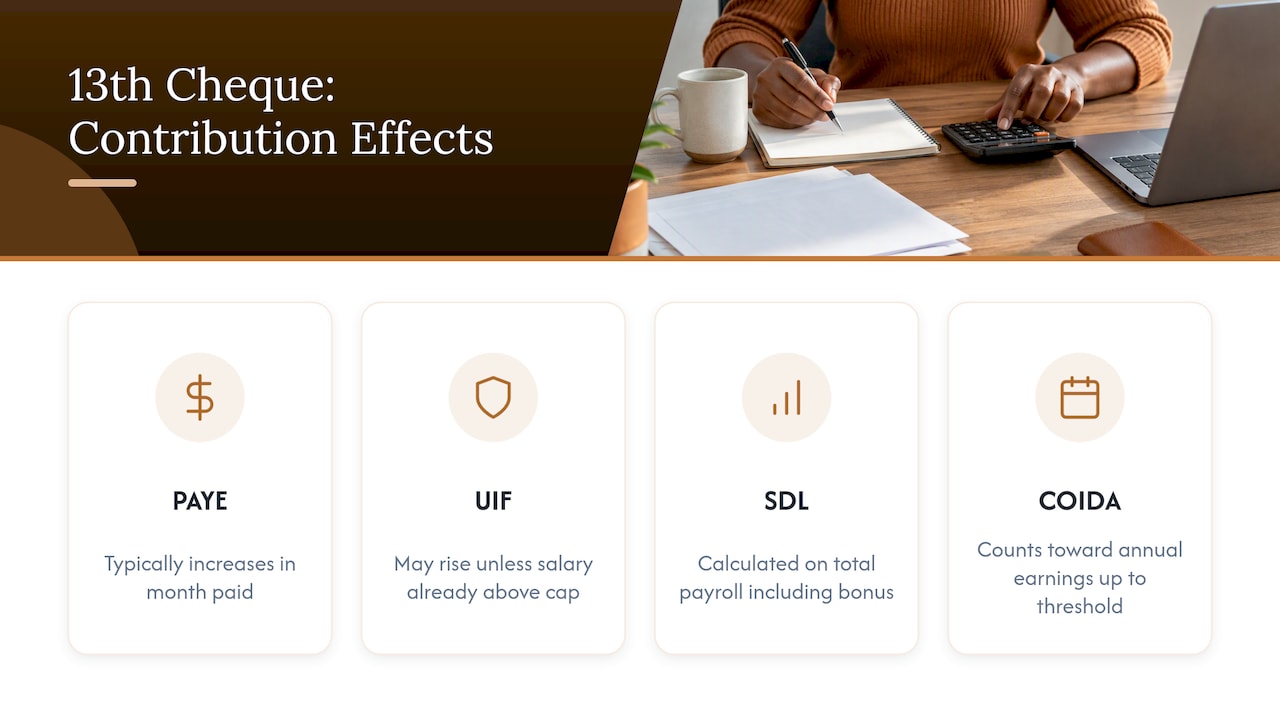
A 13th cheque counts as remuneration for most statutory contribution purposes, which means it typically increases UIF and SDL liability for the month it is paid, alongside the higher PAYE deduction. Because UIF contributions are calculated on remuneration up to a capped monthly threshold, employees already earning above that cap in their ordinary salary may see little or no additional UIF deducted on the bonus itself, while those below the cap will see their contribution rise for that pay period.
SDL, the Skills Development Levy, is calculated on total payroll remuneration including bonuses, so employers should expect their monthly SDL liability to tick up in the month the 13th cheque is disbursed across the workforce. COIDA, which funds the compensation fund for occupational injuries, is based on annual earnings up to the published earnings threshold, and a 13th cheque paid within the assessment year forms part of that earnings calculation for the employer’s annual return.
None of these contributions require special handling beyond accurate payroll reporting, but the timing matters. A large one-off payment processed through the same payroll run as ordinary salary can distort monthly SDL and UIF totals if the payroll system is not set up to separate and correctly classify the bonus line. Employers managing payroll internally should confirm that their system flags the 13th cheque correctly for each contribution type rather than lumping it in as undifferentiated salary. Our overview of employer payroll tax registration and reporting covers how these contributions interact across a full payroll cycle.
How much South African employers typically pay as a 13th cheque
The most common benchmark remains one month’s basic salary or one month’s cost to company, which is where the term “13th cheque” originates: it is effectively a thirteenth monthly payment in a twelve-month year. Some employers calculate it strictly on basic salary, excluding allowances and benefits, while others base it on full cost to company, which produces a noticeably larger payout for employees with significant benefit components in their package.
Industries and company sizes vary in how rigidly they apply the one-month standard. Larger employers and those with recognized bargaining councils tend to formalize the 13th cheque as a guaranteed contractual term, often tied to a specific calculation method set out in a collective agreement.
BusinessTech draws a useful distinction here: the line between a guaranteed 13th cheque and a discretionary performance bonus is often where disputes start, because employees assume consistency implies a right while employers assume they retained flexibility. Whichever approach your business takes, writing the calculation method into the contract or policy removes ambiguity before it becomes a dispute.
When South African employers typically pay the 13th cheque
Most South African employers pay the 13th cheque in November or December, timed to help employees cover holiday season and school-related expenses at year end. This timing is a practice rather than a legal requirement, so contracts and policies should state the specific payment date or window rather than relying on “December” as an assumed default.
Some employers split the payment, releasing half mid-year and half in December, while others tie the payment date to a specific payroll run, such as the final pay cycle before the festive shutdown. Where a bargaining council agreement governs the sector, the agreement itself usually sets the payment window, removing employer discretion over timing even if the amount is fixed.
For payroll teams, the practical task is ensuring the bonus run is scheduled early enough to allow for PAYE calculation, EMP201 submission alignment, and any internal sign-off before the payment date promised to staff. A late or inconsistent payment date, even by a few days, can itself become evidence in a dispute if employees have come to expect payment on a specific day each year.
How the 13th cheque fits with other year-end payments
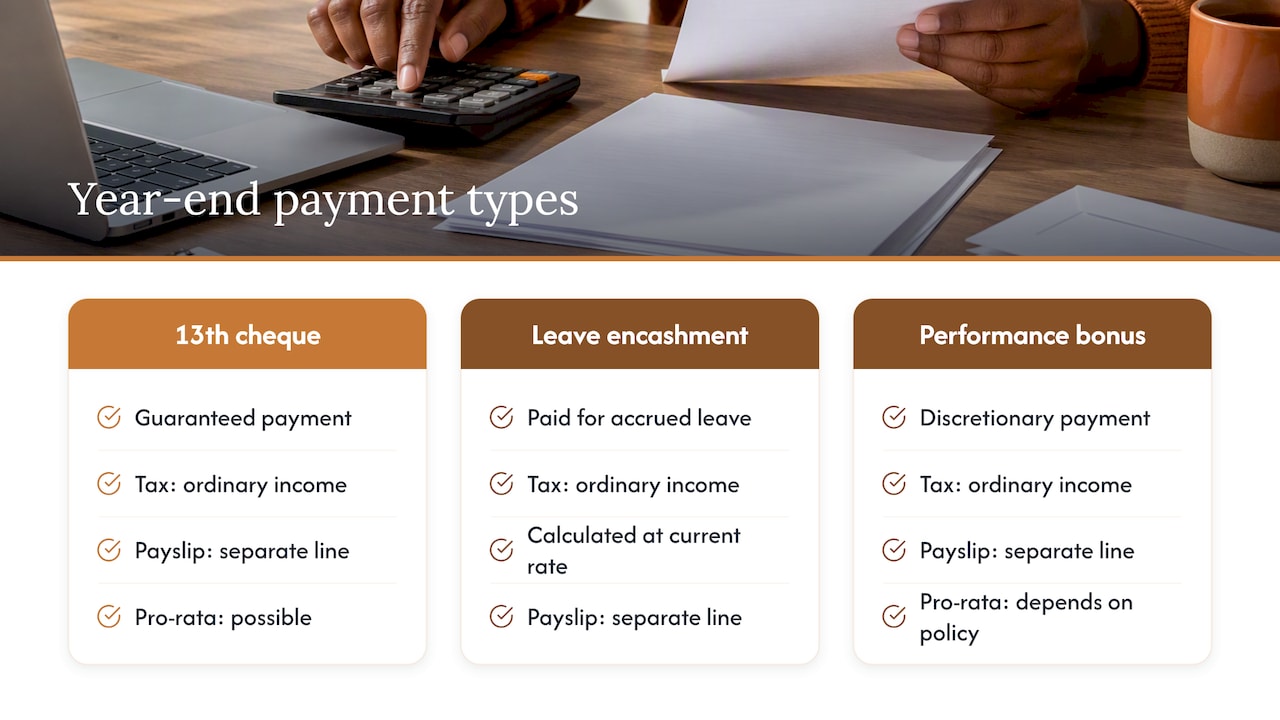
December payroll runs often carry more than the 13th cheque alone. Many employees also cash out accrued annual leave at year end, particularly where company policy caps leave carry over into the new year, and some receive separate performance bonuses on top of a guaranteed 13th cheque. Each of these payments has its own tax treatment and payslip line, and conflating them creates confusion for both payroll teams and employees trying to understand their net pay.
Leave encashment is calculated on the employee’s current daily or monthly rate and is taxed as ordinary income, same as the 13th cheque, but it should appear as a distinct line item rather than being folded into the bonus figure. Where an employee receives a 13th cheque, a discretionary performance bonus, and a leave payout in the same payroll run, the combined PAYE effect can be substantial, which is exactly the scenario where annualizing tax treatment in advance helps avoid an unpleasant surprise.
Employers should also check whether any of these payments interact with other year-end obligations, such as pro-rated 13th cheques for employees who joined partway through the year or who are leaving before the scheduled payment date. Contracts and policies that specify a pro-rata formula for partial years prevent disputes when employment starts or ends outside the normal annual cycle.
How employers and employees have handled 13th cheque disputes in practice
Consider an employee who joined a company with a written offer letter stating a “guaranteed annual 13th cheque equal to one month’s salary, payable each December.” Three years later, the company experiences a difficult year and attempts to skip the payment without consulting staff. Because the offer letter used unconditional language, this is precisely the scenario the Avacare ruling addresses: the employer cannot unilaterally withdraw a contractual entitlement, and the employee has a clear basis for a CCMA referral or Labour Court claim.
Compare that with a company whose policy document states that “a discretionary bonus may be paid at year end, subject to company performance and management approval.” Even if this bonus has been paid every year for a decade, the explicit discretionary language gives the employer a stronger position, though a long, uninterrupted history of payment without variation can still invite scrutiny over whether practice overtook the written caveat.
A third scenario involves a company that wants to shift from a guaranteed 13th cheque to a performance-linked structure going forward. Handled well, this means written notice to all affected staff at least six months ahead, a consultation process, and signed amendments to individual contracts. Handled poorly, as a one-line email announcement two weeks before December payroll, it is the fact pattern most likely to end up in front of the CCMA.
What the 2026 ruling means for how we think about payroll and contracts
The Avacare judgment raises the practical bar for contract clarity more than it changes the underlying law. Employers were always free to make 13th cheques discretionary, but the ruling confirms that courts will hold them to whatever language they actually chose, not to what they later wish they had written.
The priority for any business employing staff in South Africa is straightforward: tidy contract language, transparent payroll that shows exactly how bonus figures were calculated and taxed, and clear communication before any change takes effect. In our work managing BCEA-compliant contracts and ZAR payroll for international employers, we have found that disputes almost always trace back to vague wording written years earlier, not to bad faith at the point of payment.
— Roel
This article is general information, not a substitute for advice from a qualified lawyer. Consult a qualified legal professional about your own circumstances before acting on anything here.
FAQ
What is the 13th cheque?
A 13th cheque is an extra month’s salary paid once a year, typically equal to one month’s basic salary or cost to company. It is not required by the Basic Conditions of Employment Act, so whether you are entitled to it depends on your contract, your employer’s policy, or a collective agreement.
Is a 13th cheque guaranteed by South African law?
No South African legislation requires employers to pay a 13th cheque. According to CEOSA, entitlement arises only from the employment contract, a written company policy, or a bargaining council agreement, and courts will also consider consistent past practice as evidence of an implied entitlement.
Can an employer stop paying a 13th cheque without notice?
Not if the 13th cheque is a contractual entitlement. The 2026 Labour Court ruling confirmed that employers cannot unilaterally withdraw a guaranteed 13th cheque, and employees can pursue a CCMA referral or Labour Court claim under BCEA section 77 if it is withheld.
How is a 13th cheque taxed in South Africa?
A 13th cheque is taxed as ordinary remuneration under PAYE in the month it is paid, following SARS’s guidance on employee tax codes. Because it is added on top of the normal monthly salary, it can push that month’s withholding noticeably higher than usual, which is why some employers annualize the tax treatment in advance.
What qualifies as long service for South African bonus purposes?
Long-service awards follow their own SARS reporting codes and exclusion thresholds, separate from ordinary bonus treatment, though exact qualifying criteria are set by each employer’s own policy rather than a single national standard. Employers should confirm the applicable code and threshold with their payroll provider or SARS guidance before processing a long-service payment.