

Under the Basic Conditions of Employment Act, night work is work performed after 18:00 and before 06:00, and employers must compensate it with an allowance or a reduction in normal working hours, as set out in section 17. Some sectors, such as Wholesale and Retail, fix a specific percentage. Transport and health protections apply once night work becomes regular.
TL;DR:
- Employers must check if sectoral determinations or bargaining council agreements set specific night work allowances, as these often exceed the BCEA minimum of 10%.
- Regular night workers working more than one hour after 23:00 at least five times a month are entitled to additional safety, health, and medical protections.
- Payroll calculations must account for sector-specific rates, the hourly wage base, and whether allowances are paid or hours are reduced, with overtime and public holiday work attracting extra allowances.
- Written contracts, detailed payslips, and documented transport and health arrangements are essential to ensure compliance and readiness for inspections or disputes.
- International employers must process night allowances through a local payroll that files statutory taxes correctly and provides transparent payslips in South African rand.
Table of Contents
- BCEA Section 17 and the Code of Good Practice: What Employers Must Do
- Sectoral Determinations and Local Policies: When a Fixed Rate Applies
- How to Calculate Night Shift Allowance: Step-By-Step With Worked Examples
- Employer Checklist: Contracts, Payroll, Transport, and Health Protections
- Running Night Pay Through Local Payroll or an EOR
- Priorities for HR Teams Getting Night Pay Right
- If You Need Help With Compliant Night-Shift Payroll and Contracts
- Sources
- FAQ
BCEA Section 17 and the Code of Good Practice: What Employers Must Do
Section 17 of the Basic Conditions of Employment Act defines night work as work performed after 18:00 and before 06:00 the next day. Once an employee works within that window, the employer owes compensation, and the law gives two routes: pay an allowance, or reduce the employee’s normal working hours without cutting pay. Employers choose the mechanism, but they cannot skip both.
The Act does not stop at pay. Where employees regularly work at night, employers must also arrange transport between the workplace and home (or the employee’s usual pick-up point) for the hours when public transport is unsafe or unavailable. The Code of Good Practice on the Arrangement of Working Time treats this transport duty, along with health protections, as part of a wider compliance package rather than a box to tick once the allowance is paid.
A separate threshold determines when extra protections kick in. An employee becomes a “regular night worker” once they work more than one hour after 23:00 at least five times a month, or at least 50 times a year, under the definition in the BCEA. Crossing that threshold triggers additional duties:
- Employers must inform regular night workers, in writing and in a language they understand, of health and safety hazards linked to night work.
- Employers must give regular night workers the opportunity to undergo a medical examination, at the employer’s expense, before starting night work and at regular intervals afterward.
- Employees found medically unfit for night work, where practicable, must be transferred to suitable day work.
- Pregnant employees and nursing mothers have specific protections around night work assignments.
The Code of Good Practice also pushes employers toward sensible roster design: rotating shifts fairly, giving adequate rest between shifts, and accounting for family responsibilities when building schedules. For HR teams, this means recordkeeping matters as much as the payslip line. Rosters, written notices, and medical exam records should be retained and dated, since these documents are what an inspector or the CCMA will ask for if a dispute arises. For a broader look at how these duties interact with general shift work rules, see our guide on shift work in South Africa.
Sectoral Determinations and Local Policies: When a Fixed Rate Applies
The BCEA sets the floor, but it does not fix a percentage. Sectoral determinations, bargaining council agreements, and individual employer policies often do, and HR should check these before assuming a generic rate applies.
Sectoral Determination 9, which covers the Wholesale and Retail sector, is the clearest example. It defines night work in that sector as work after 19:00 and before 07:00, a window one hour wider than the BCEA default on each end. It also requires a minimum night-work allowance of at least 10% of the employee’s hourly wage for every hour or part of an hour worked at night.
Hospitality sector determinations use different wording and structures, so a rule that applies to a retail cashier will not automatically apply to a hotel night porter. The lesson for HR is consistent across sectors: read the specific determination or bargaining council agreement that covers the employee’s industry before running any calculation.
- Check whether a sectoral determination or bargaining council agreement covers the employee’s industry.
- Confirm the determination’s own night-work window, since it may differ from the BCEA’s 18:00 to 06:00 default.
- Apply any fixed percentage or rand-per-hour figure the determination specifies rather than defaulting to a generic rate.
- Review employer-specific or municipal policies where they exist, since these can set workplace rules on top of the statutory floor.
Municipal and other public-sector employers sometimes formalize their own night-shift allowance policies. The Kokstad municipal night shift allowance policy, covering the 2022-23 financial year, is a public example of how a single employer sets out eligibility, rates, and administrative contacts for night-shift pay. These documents illustrate a broader point: many South African employers, public and private, layer workplace-specific rules on top of the BCEA floor, and HR should not assume the statutory minimum is the only rule in play.
How to Calculate Night Shift Allowance: Step-By-Step With Worked Examples
Calculating a night shift allowance correctly means working through three questions in order, then applying the math consistently across the payroll run.
- Confirm the applicable rule. Check whether a sectoral determination or bargaining council agreement sets a specific percentage or rand figure for the employee’s sector. If none applies, the BCEA default of an allowance or reduced hours governs, and the employer sets a reasonable rate through the contract or workplace policy.
- Determine the pay base. Decide whether the allowance is calculated on the employee’s hourly rate or as a percentage of monthly basic salary converted to an hourly equivalent. This choice affects both the payslip line and the PAYE reporting treatment.
- Apply the allowance or the reduced-hours equivalent. Multiply the agreed percentage by the hours actually worked at night, or, if the employer chose reduced hours instead of a cash allowance, adjust the roster so the employee works fewer hours for the same base pay.
Worked example A: An employee in the Wholesale and Retail sector earns an hourly wage of R60. Under Sectoral Determination 9, the employer must pay at least 10% of that hourly wage for every hour worked at night.
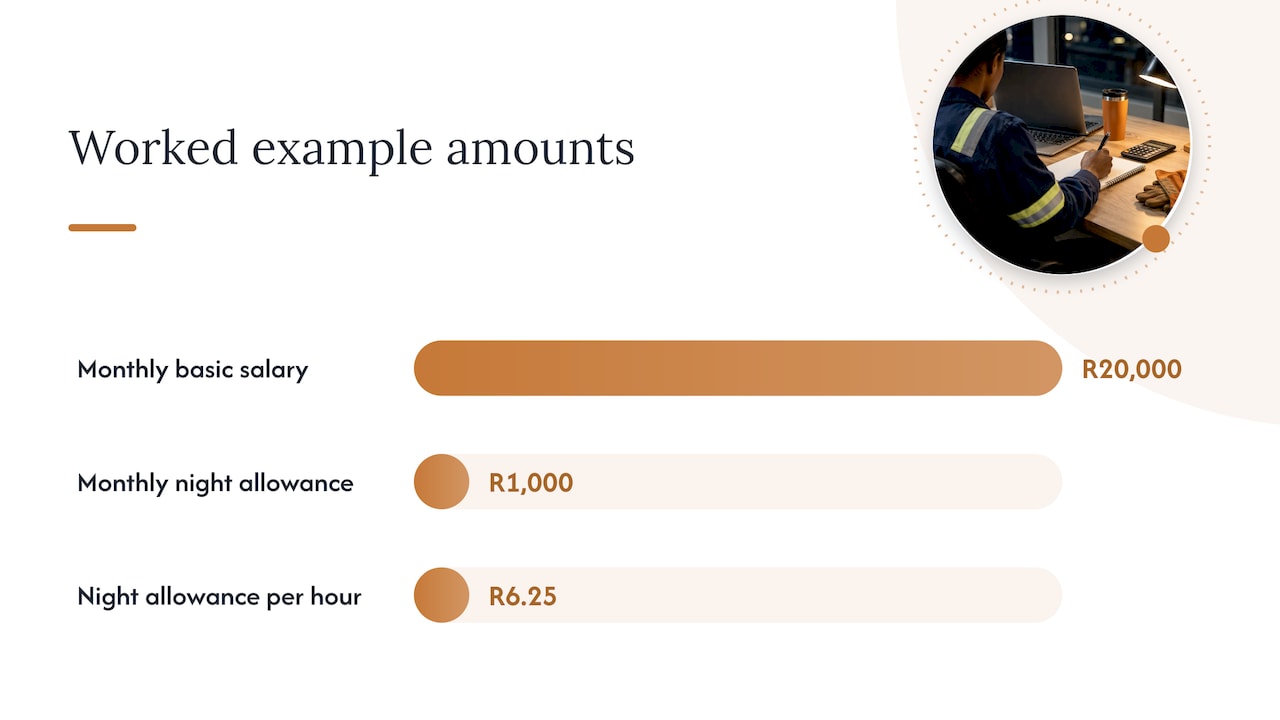
If the monthly basic salary is R20,000 and the employee works an average of 20 night shifts a month at 8 hours each (160 hours), the monthly allowance is R1,000 (5% of R20,000), which works out to R6.25 per hour worked at night.
Statistic callout: The Basic Conditions of Employment Act sets the regular night worker threshold at more than one hour after 23:00, at least five times a month or 50 times a year. Crossing it triggers written hazard information and employer-funded medical examination rights, regardless of which sector the employee works in.
A few edge cases trip up payroll teams routinely. Overtime hours worked at night still attract the night allowance in addition to overtime pay, since the two are separate legal obligations. Public holidays worked at night stack the night allowance on top of the public holiday premium. Part-hours count under Sectoral Determination 9’s “part of an hour” wording, so a shift ending at 06:30 still earns the allowance for that half hour. Shifts that cross midnight are treated as a single continuous period for allowance purposes, not split into two separate calculations. For readers building out broader payroll logic, our guide to BCEA working hours and payroll steps covers how these rules interact with standard hour calculations, and Kloqk’s guide to daylight saving payroll adjustments is a useful reference for shift-timing edge cases more generally.
Employer Checklist: Contracts, Payroll, Transport, and Health Protections
Getting the allowance right on paper is only part of the job. HR teams also need contracts, payroll systems, and records that hold up under scrutiny.
- Include a written clause in the employment contract specifying the night-work window, the allowance rate or reduced-hours arrangement, and the transport commitment; our contract clause guide has sample language for this.
- Show the night allowance as a distinct line on the payslip, separate from basic salary and overtime, so the employee can verify the calculation.
- Confirm how the allowance interacts with PAYE, UIF, and SDL: in most cases it forms part of taxable remuneration and is included in the calculation base for these statutory deductions.
- Document transport arrangements in writing, including routes, pick-up points, and who bears the cost, since this is a specific BCEA duty for regular night workers.
- Keep signed records of hazard information disclosures and medical examination offers for every regular night worker, dated and filed.
Pro Tip: Store night-shift rosters, allowance calculations, and medical exam offers in one file per employee. If a wage inspector or the CCMA asks for proof of compliance, a single organized file settles the question faster than reconstructing records after the fact.
Health and safety duties run alongside the pay obligation, not instead of it. Employers must transfer an employee found medically unfit for night work to suitable day work where this is practicable, and must keep that process documented as well. For guidance on folding these requirements into a written company policy, see our notes on remote work policy compliance.
Running Night Pay Through Local Payroll or an EOR
When an international employer hires staff in South Africa without a local entity, night shift allowances still have to flow through a compliant payroll system tied to a registered South African employer.
When evaluating a vendor for this work, ask for a sample payslip showing how night allowances, overtime, and statutory deductions appear separately. Ask for evidence of recent PAYE and UIF filings, not just a description of the process. Confirm that payslips and contracts are issued in a language the employee understands, and that pay is calculated and disclosed in South African rand, since currency and language transparency both matter for compliance and for employee trust. Some Employer of Record providers structure employment this way for international companies hiring in South Africa, coding statutory items separately and filing them through a licensed local partner. Our Employer of Record overview explains how these functions fit together operationally.
Priorities for HR Teams Getting Night Pay Right
Start with the frequency test: know which employees cross the regular night worker threshold, since that single fact triggers medical exam and hazard-disclosure duties most employers overlook. Next, check whether a sectoral determination overrides the generic BCEA allowance, because guessing at a percentage is the most common payroll error. Finally, put transport arrangements in writing, not just in practice. These three fixes resolve most of the disputes we see arise from night-shift pay.
— Roel
If You Need Help With Compliant Night-Shift Payroll and Contracts
Getting night-shift pay right across contracts, payroll coding, and statutory filings takes ongoing attention, particularly for an employer managing this from outside South Africa. Expand to South Africa provides Employer of Record services built specifically for this market: BCEA-compliant contracts, ZAR payroll with night allowances coded transparently, and PAYE, UIF, SDL, and COIDA filings handled through a licensed local partner.

- BCEA-compliant employment contracts with night-work and transport clauses included.
- ZAR payroll with statutory filings handled monthly on your behalf.
- Transparent payslips showing allowance, overtime, and deductions as separate lines.
When comparing vendors, ask for a sample payslip and recent evidence of statutory filings before signing anything. Expand to South Africa’s Employer of Record service is priced from £299 per employee per month, with no setup fees. Check current availability and get a quote on our pricing page.
Sources
- Basic Conditions of Employment Act No. 75 of 1997
- Code of Good Practice on the Arrangement of Working Time
- Sectoral Determination 9: Wholesale and Retail Sector — night work
- MUNICIPAL NIGHT SHIFT ALLOWANCE POLICY 2022 23FY
FAQ
How do you calculate night shift allowance in South Africa?
Confirm which rule applies first: a sectoral determination, a bargaining council agreement, or the BCEA default. Then multiply the agreed percentage by the hourly wage and the hours worked at night, as shown in Sectoral Determination 9’s 10% minimum for Wholesale and Retail employees.
Do you get a shift allowance for working night shift?
Yes, under section 17 of the BCEA, employees who work between 18:00 and 06:00 must be compensated with an allowance or a reduction in normal working hours. Some sectors, such as Wholesale and Retail, mandate a specific minimum percentage instead of leaving the rate to employer discretion.
What is the allowance for working a night shift?
The BCEA does not fix a universal rand or percentage figure, leaving employers to set an allowance or offer reduced hours instead. Where a sectoral determination applies, such as Sectoral Determination 9 for Wholesale and Retail, the minimum is at least 10% of the hourly wage per hour or part hour worked at night.
Is night shift allowance taxable in South Africa?
Night shift allowances generally form part of an employee’s taxable remuneration and are included in the calculation base for PAYE, UIF, and SDL. Employers processing payroll should confirm the specific treatment with their payroll provider or SARS guidance, since the exact reporting method can depend on how the allowance is structured on the payslip.
What happens if an employer does not pay the required night shift allowance?
An employee who is not compensated for night work as required under section 17 of the BCEA can raise the matter with the employer directly, refer a dispute to the CCMA, or report the employer to the Department of Employment and Labour. Keeping clear records of hours worked and pay received strengthens any claim.