

A US company has three real routes to hire someone based in South Africa: engage them as an independent contractor, register as a local employer and run payroll directly, or use an Employer of Record. Most US employers without a South African entity choose the Employer of Record route because it handles PAYE, UIF, SDL, and COIDA filings with SARS on the employer’s behalf while paying the worker legally in ZAR.
TL;DR:
- Use contractor agreements only for short, clearly scoped projects; ongoing roles treated as employment carry misclassification exposure and call for an EOR or local employer.
- Direct employers must register with SARS within 21 business days, then handle monthly EMP201 filings and biannual EMP501 reconciliations, plus applicable SDL and COIDA obligations.
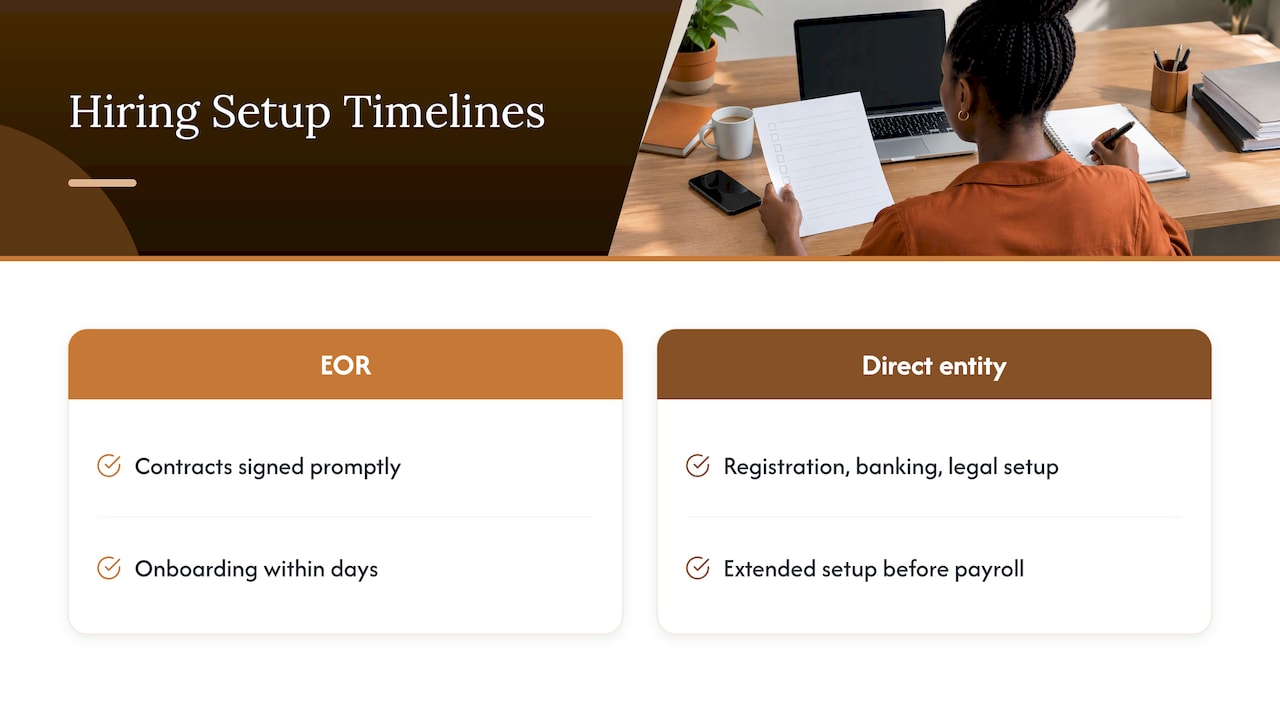
- An EOR can complete onboarding, including payroll setup, within days, while forming a local entity requires registration, banking, and legal work before payroll can begin.
- Budget beyond gross salary for employer UIF at 1% of remuneration, subject to a monthly cap, plus applicable SDL, COIDA, benefits, and payroll fees.
- Foreign employment income remains taxable in part: section 10(1)(o)(ii) caps the exemption at R1 million annually and requires qualifying days.
Table of Contents
- Why Hire South African Talent for a US Team
- Three Hiring Routes: What Each One Asks of You
- Compliance and Payroll Checklist: What to Budget For
- Practical Hiring Steps From Sourcing to First Payroll
- Budgeting Example: Building the Total Employer Cost
- Timelines: EOR Speed Versus Building Local Capability
- A Specialist’s View on Choosing the Right Hiring Route
- How We Help You Hire Quickly and Stay Compliant
- FAQ
- Sources
Why Hire South African Talent for a US Team
South African salaries for skilled technical and operational roles often run well below UK and EU benchmarks for comparable experience, and many employers use a potential cost saving as a rough modeling heuristic when comparing total employer cost against UK or EU hires, rather than a fixed guarantee for every role. The real number depends on the role, seniority, and how you structure benefits, so treat it as a starting point for budgeting, not a promise.
Beyond cost, the workforce itself is a draw. English is a primary business language across South Africa, so there is no translation layer slowing down interviews, documentation, or day-to-day collaboration.
- Cape Town and Johannesburg have become established hubs for software engineering, customer support, and finance talent.
- Local job boards and recruitment agencies show steady posting activity for roles explicitly aligned to US working hours.
- The time zone offers overlap with Central European business hours, while also allowing meaningful overlap with both European and US East Coast business hours.
That overlap matters more than it sounds. A South African-based employee can join an Eastern-time call without working through the night, which keeps synchronous collaboration realistic instead of a scheduling compromise.
Three Hiring Routes: What Each One Asks of You
Each hiring route carries a different compliance burden, and the right choice depends on how much administrative risk you want to own.
Independent contractor. This works for short-term, project-based work where the person controls their own hours and tools. The risk is misclassification: if SARS or a labor authority views the relationship as employment in substance, you can face back taxes, penalties, and employee benefit claims. Our partner guide on contractor versus employee status walks through the factors that distinguish the two under South African law.
Direct local employer. This means registering your own entity or acting as a representative employer in South Africa. You become responsible for PAYE withholding, monthly EMP201 filings, and the annual EMP501 reconciliation. It gives you full control, but it also means building local HR and payroll capability from scratch, a path we cover in detail in our employer payroll taxes guide.
Employer of Record. An EOR becomes the legal employer on paper, runs payroll in ZAR, handles every statutory filing, and issues a contract that meets Basic Conditions of Employment Act requirements. You direct the person’s day-to-day work; the EOR carries the compliance load.
- Contractor: fast but carries misclassification exposure.
- Direct employer: full control but slow to set up and administratively heavy.
- EOR: legal employer of record with payroll and filings handled for you.
Pro Tip: If you are unsure which route fits, start by asking whether the role is full-time and ongoing; if it is, an EOR almost always removes more risk than a contractor agreement.
Compliance and Payroll Checklist: What to Budget For
Before you pay anyone in South Africa, a few SARS requirements shape both your timeline and your budget. Employers must register with SARS within 21 business days of becoming an employer, and register for PAYE, SDL, and UIF where applicable, according to SARS employer guidance. Our 21-day registration checklist breaks this into a step-by-step process.
UIF contributions sit at 1% of remuneration from both employer and employee, with a monthly salary cap, as described in SARS UIF guidance. That cap determines the ceiling on UIF deductions regardless of how high the gross salary runs.
Employers who pay remuneration are obliged to withhold employees’ tax and issue IRP5 or IT3(a) certificates at year end. If no South African entity or representative employer exists, the worker may need to register as a provisional taxpayer and manage their own filings directly with SARS, which shifts both the admin burden and the risk of missed deadlines onto the employee.
Plan for these recurring filings:
- EMP201: monthly PAYE, UIF, and SDL declaration and payment.
- EMP501: biannual reconciliation of everything declared and paid during the period.
- COIDA registration: covers workplace injury compensation where the role requires it.
- SDL: the Skills Development Levy, applicable once payroll exceeds the threshold set by SARS.
Getting EMP501 wrong is one of the more common payroll headaches we see, and our EMP501 reconciliation guide covers the fixes employers most often need.
Practical Hiring Steps From Sourcing to First Payroll
Once you have chosen a route, the hiring process itself follows a fairly consistent sequence.
- Source candidates through job boards, local recruiters, or a talent sourcing service that screens for availability during your working hours.
- Screen for time zone fit early in the interview process, since overlap expectations should be set before an offer, not after.
- Draft a BCEA-compliant offer that states salary in ZAR and itemizes statutory benefits as part of the total compensation picture, not as hidden extras.
- Confirm who the legal employer is before signing anything. Our guide to confirming the legal employer lists the checks worth running under an EOR arrangement.
- Run onboarding, which includes ID verification, tax forms, UIF and SDL registration details, and the handoff to whoever runs payroll going forward.
A clean handoff at step five is where most delays happen, usually because registration paperwork gets started late rather than in parallel with the offer stage.
Budgeting Example: Building the Total Employer Cost
Total employer cost is never just the gross salary. It is gross salary plus employer-side UIF, SDL and COIDA contributions where applicable, plus payroll administration, plus any benefits you choose to offer.
- Gross salary: the base figure a candidate sees in their offer.
- Employer UIF: 1% of remuneration, capped per the SARS UIF threshold.
- SDL and COIDA: smaller percentage-based additions depending on payroll size and role risk category.
- Payroll admin or EOR fee: a flat or percentage-based cost layered on top.
Say a UK employer budgets £50,000 a year for a mid-level developer role. A comparable South African hire, once gross salary and statutory contributions are totaled, can land well below that figure, which is where the possibility of savings can make sense as a modeling assumption rather than a universal outcome. Because every role and benefit package differs, we built a public employment cost calculator so you can model your own numbers instead of relying on a generic range.
Timelines: EOR Speed Versus Building Local Capability
Setting up a South African entity to hire directly typically takes an extended period of registration, banking, and legal setup before you can run a single payroll cycle. Using an Employer of Record compresses that dramatically: contracts can be signed promptly, and full onboarding, including payroll setup, can be completed within days, as outlined on our fast contract turnaround page.
Expect some delays regardless of route. Background checks and preparing clean records for EMP501 reconciliation later in the year are the two most common causes of a slower start.
A Specialist’s View on Choosing the Right Hiring Route
We think too many US employers default to contractor agreements out of habit, when a full-time, ongoing role almost always fits better under an Employer of Record once you weigh the misclassification exposure. Contractor status still makes sense for short, clearly scoped project work. For anything longer, an EOR removes the registration burden entirely, and a compliant provider will handle your data under POPIA and GDPR standards, which matters once you are moving payroll and personal information across borders.
— Roel
How We Help You Hire Quickly and Stay Compliant
We built Expand to South Africa around one country only, which means every contract, payroll run, and statutory filing we handle is built specifically around South African labor law.
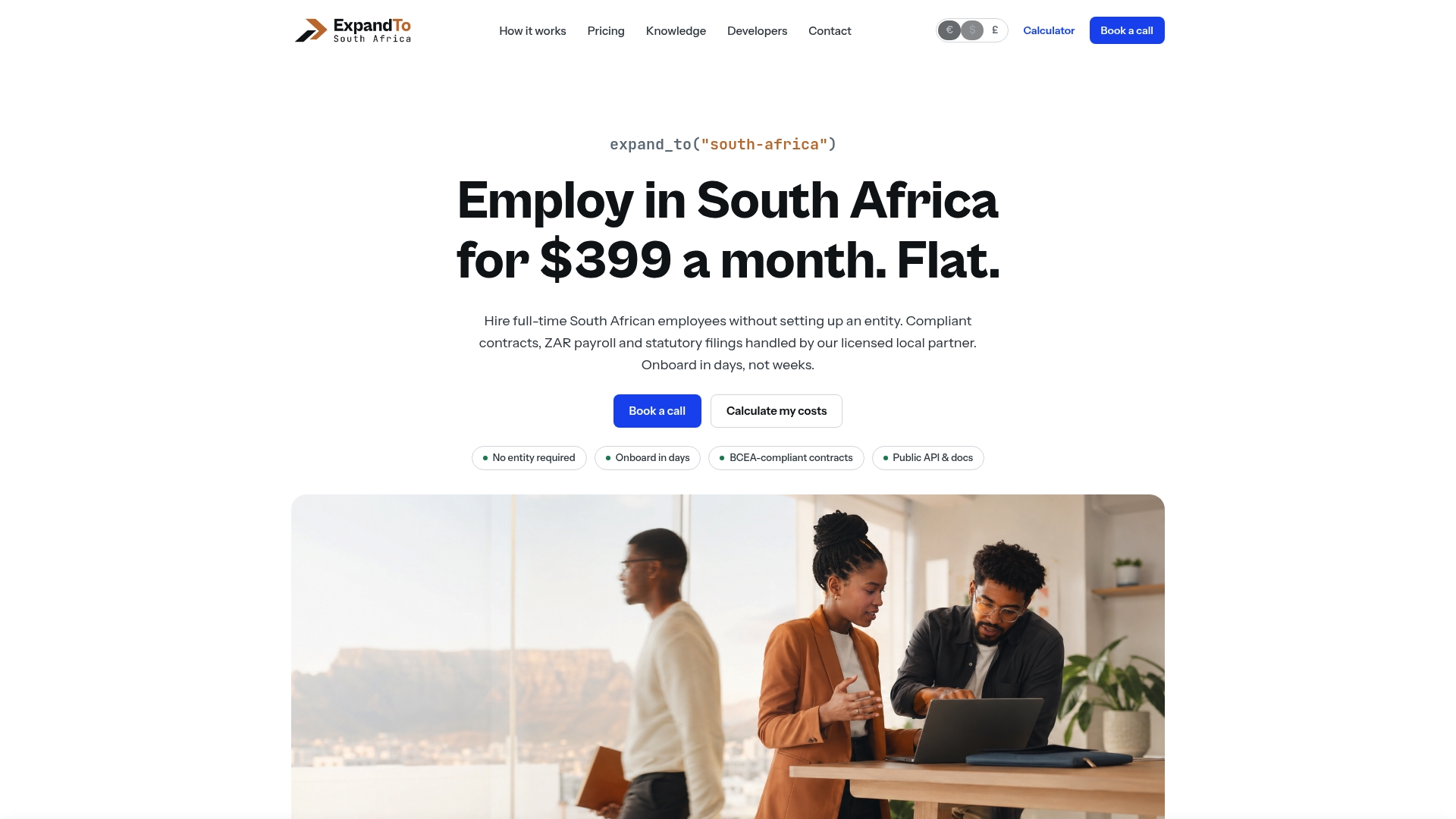
- We draft BCEA-compliant employment contracts and run your payroll in ZAR without requiring you to register a local entity.
- We file PAYE, UIF, SDL, and COIDA on your behalf, so EMP201 deadlines stay off your plate.
- We offer talent sourcing for skilled roles alongside the employer of record service itself.
Our Employer of Record services in South Africa are priced from £299 per month per employee, flat, with no setup fees. If you want to see your own numbers before talking to anyone, run our public employment cost calculator on the same page, or request a quote to get a signed contract moving this week.
FAQ
How many US companies operate in South Africa?
Public figures on the exact count of American companies with a presence in South Africa are not listed in available government sources we can cite here. The US State Department’s investment climate statement does confirm that South Africa remains a regional investment hub with established institutions like DTIC and InvestSA supporting foreign investors.
What are the top companies to work for in South Africa?
This varies by industry and changes year to year, and no single authoritative ranking is cited in our sources here. What is consistent is that Cape Town and Johannesburg have become recruitment hubs for US-aligned roles in tech, support, and finance, with active hiring reflected in current job board listings.
How do US companies legally hire foreign workers based abroad?
US companies typically hire foreign-based workers through an independent contractor agreement, a local entity that registers as an employer, or an Employer of Record that becomes the legal employer on their behalf. The EOR route is the fastest for companies without a local entity, since it avoids a multi-month registration process and the EOR handles PAYE, UIF, and other statutory filings directly with SARS.
Can I work for a US company while living in South Africa?
Yes, and many South Africans already do this through remote contractor agreements or Employer of Record arrangements. If no South African entity or representative employer exists, the worker may need to register as a provisional taxpayer and handle their own filings with SARS, which an EOR arrangement avoids by taking on the employer role directly.
Is foreign employment income tax-free for South Africans working remotely?
No, foreign employment income is only partially exempt. The exemption under section 10(1)(o)(ii) is capped at R1 million per year and requires meeting specific day-count qualifying periods, so income above that threshold can still be subject to South African tax.
Sources
- PAYE-GEN-01-G21 – Guide for Employers iro Employees Tax for 2027 – External Guide
- 2025 South Africa Investment Climate Statement