

For global hires, match your EOR tier to your scale. For South Africa specifically, Expandtosouthafrica is the fastest and most transparent route: flat-fee pricing at €350 per employee per month, BCEA-compliant contracts signed within 48 hours, and ZAR payroll with full statutory filings handled by a licensed local partner.
The broader market breaks into three tiers. At the low end, published floor prices start at a low tier. Mid-tier providers cluster around a moderate price level. Enterprise platforms like Globalization Partners and Pebl (formerly Velocity Global) operate on negotiated quotes only. Pricing transparency is itself a selection criterion: if a vendor won’t publish a number, budget for surprises.
Quick picks by buyer job:
- Fast pilot hire (one to three employees): Expandtosouthafrica for South Africa; RemoFirst or Remote People for other markets where published low fees matter most.
- Enterprise breadth (50+ countries, procurement-driven): Globalization Partners (G-P), Pebl, or Deel.
- Price-sensitive mid-market: Multiplier or Oyster HR.
- Contractor-heavy teams: Payoneer Workforce Management (formerly Skuad) or Deel.
- Single-country compliance depth (South Africa): Expandtosouthafrica, the only provider on this list built exclusively for South Africa, with BCEA, PAYE (EMP201 with SARS), UIF, SDL, COIDA, and POPIA/GDPR data handling as standard.
Onboarding SLA across most providers runs days to two weeks. Expandtosouthafrica targets signed contracts within 48 hours and full onboarding within days.
Table of Contents
- Top EOR providers compared at a glance
- How do you choose the right Employer of Record?
- What does an EOR actually cost, and what drives the price?
- EOR vs. PEO vs. hiring contractors: what’s the legal difference?
- Top EOR provider profiles: verdicts, pricing, and best-for
- How we selected and evaluated the EORs in this shortlist
- Which EOR should you pick for your specific hiring scenario?
- Key Takeaways
- The EOR market rewards specificity, not breadth
- Hiring in South Africa? Expandtosouthafrica gets you there faster
- Useful sources and further reading
Top EOR providers compared at a glance
The table below covers the dimensions that most influence procurement decisions. Pricing reflects published floor prices or “quote only” indications where no public price exists. Country coverage figures are vendor-stated.
| Provider | Best for | Pricing model / typical range | Country coverage | Compliance & payroll depth | Notes |
|---|---|---|---|---|---|
| Expandtosouthafrica | Single-country South Africa depth | Flat fee: $399/mo per employee | South Africa only | BCEA contracts, ZAR payroll, PAYE/UIF/SDL/COIDA, POPIA & GDPR | 48-hr contract signing; free transfers from other EORs |
| Deel | Broad global coverage, contractors + employees | From ~$599/mo (EOR); contractor product lower | 150+ countries | Owned entities; multi-product HR/payroll | Large owned-entity footprint |
| Remote | Enterprises needing owned-entity global coverage | From ~$599/mo | 80+ countries | Owned entities; full payroll & benefits | Enterprise SLAs available |
| Multiplier | Mid-market price/coverage balance | From $399/mo | 150+ countries | Owned entities in key markets | Mid-tier pricing |
| Oyster HR | Mid-market self-service experience | From $599/mo | 180+ countries | Statutory filings, benefits management | Transparent product tiers |
| RemoFirst | Price-sensitive buyers | From ~$199/mo | 180+ countries | Standard statutory filings | No setup/termination fees |
| Remote People | Low fees + capped security deposits | Low published fee | 150+ countries | Standard statutory filings | Capped deposit for high-salary hires |
| Payoneer Workforce Management | Contractor + employee mixed teams | Quote-based | 150+ countries | Multi-currency payroll; contractor tooling | Formerly Skuad |
| Globalization Partners (G-P) | Large enterprise procurement | Quote only | 180+ countries | Deep country coverage; enterprise SLAs | Custom enterprise contracts |
| Pebl (formerly Velocity Global) | Obscure market enterprise coverage | Quote only | 185+ countries | Enterprise-grade; negotiated terms | Recently relaunched platform |
| Rippling | US-based companies adding global payroll | Quote-based | 50+ countries | Strong US payroll; global EOR add-on | Best known for US HR platform |
| Safeguard Global | Payroll-first buyers needing EOR | Quote-based | 180 countries | Deep local payroll operations | Combined payroll + EOR model |
| Omnipresent | Compliance-first distributed teams | From $599/mo | 150+ countries | Managed compliance services | Strong compliance focus |
| Papaya Global | Payroll infrastructure + optional EOR | Quote-based | 150+ countries | Integrated payroll automation | Payroll-first platform |
| Atlas HXM | US-market expansion | Quote-based | 150+ countries | US-focused depth | Strong US positioning |
| TriNet | US SMBs needing PEO/EOR hybrid | Quote-based | US-focused | PEO model; strong US benefits | Primarily a US PEO |
| Horizons | Mid-market global EOR | From ~$299/mo | 180+ countries | Standard statutory filings | Competitive published pricing |
| GoGlobal | Mid-market compliance-focused buyers | Quote-based | 100+ countries | Compliance-oriented service model | Managed service approach |
| Rivermate | Startups and lean teams | From ~$299/mo | 150+ countries | Standard filings | Startup-friendly terms |
| TopSource Employer of Record | Buyers seeking Gartner-reviewed providers | Quote-based | 50+ countries | Statutory filings; compliance focus | Listed on Gartner Peer Insights |
| Headway Workforce Solutions | Workforce management + EOR | Quote-based | US and select markets | Workforce management depth | Combined staffing + EOR |
| Multiplier | Mid-market (see above) | From $399/mo | 150+ countries | Owned entities in key markets | — |
Key dimensions to scan: pricing transparency, owned-entity vs. partner-network model, and whether the provider handles your specific statutory filings. For South Africa, that means PAYE (EMP201), UIF, SDL, and COIDA, not just generic “payroll.”
How do you choose the right Employer of Record?
The five criteria that should decide your shortlist are: compliance depth, country coverage fit, pricing transparency, integrations and tech stack, and onboarding and exit terms. Everything else is secondary.
Compliance depth
Ask every vendor for documentary evidence of their entity model in your target country. “We have coverage” is not the same as “we have a registered employer entity.” A partner-network model is not inherently inferior, but you need to know who legally employs your people and who carries the liability when a statutory filing is late. For South Africa, the relevant filings are PAYE (EMP201 submitted to SARS), UIF, SDL, and COIDA. Any EOR that cannot name those specifically has not done this before.
Country coverage fit
Published country counts are marketing figures. A vendor claiming 180 countries may have owned entities in 40 and partner arrangements in the rest. The practical question is: does the provider have a verified, active employment entity in the specific country you need, and can they show you the registration? EOR services that accelerate market entry do so because they have already solved the entity problem in that market, not because they have a partner they can call.
Pricing transparency
According to market research on EOR costs, typical EOR fees range from $200 to $800 per employee per month, or roughly 10–15% of gross salary, depending on the country and provider. That range is wide enough to matter at scale. A vendor that won’t publish a price is almost always more expensive than one that does. Request a fully loaded quote: base fee, benefits markup, deposit requirements, currency conversion policy, and termination costs.
Statistic callout: EOR fees typically run $200–$800 per employee per month, or 10–15% of gross salary. At 10 employees, the difference between a $199/mo and a $599/mo provider is $48,000 per year before benefits markups.
Integrations and tech stack
Your EOR needs to connect to your HRIS (Workday, BambooHR, HiBob), your payroll system, and ideally your ATS. Providers with open APIs and published documentation (Expandtosouthafrica publishes sandbox keys) let your engineering team validate the integration before you sign. Providers with closed or undocumented APIs create lock-in.
Onboarding and exit terms
Ask for the specific SLA from signed contract to first payroll run. Ask whether there is a minimum contract duration and what the termination notice period is. Some providers require 30 to 90 days’ notice and charge a termination fee. Others, including Expandtosouthafrica, offer free transfers from competing EOR providers.
Checklist of questions to ask vendors:
- Who is the legal employer of record in the target country, and can you provide the entity registration?
- What statutory filings do you handle, and what is your liability if a filing is late or incorrect?
- What is the payroll cadence, and how are currency conversions handled?
- What is the security deposit requirement, and is it capped?
- What is the minimum contract term and termination notice period?
- Do you offer a pilot or trial arrangement for a single employee?
- What is your SLA from signed agreement to first payroll run?
- How do you handle employee terminations, and do you provide CCMA-safe (or equivalent) dismissal guidance?
Red flags to watch for:
- No published pricing and refusal to provide a written quote before contract signature.
- Vague answers about the entity model (“we have partners in most countries”).
- No evidence of local licenses or employer registrations.
- Minimum contract terms of 12 months or longer with no pilot option.
- Benefits markups that are not disclosed as a separate line item.
Pro Tip: Ask the vendor to send you a copy of a sample employment contract for your target country before you sign anything. A provider that hesitates to share a redacted sample contract has something to hide about their compliance posture.
What does an EOR actually cost, and what drives the price?
EOR pricing follows three common shapes, and understanding which one you’re buying matters more than the headline number.
1. Flat per-employee fee. A fixed monthly amount regardless of salary. Expandtosouthafrica charges a flat fee per employee per month. RemoFirst publishes a floor price at a low monthly amount. This model is the most predictable for finance teams because the cost scales linearly with headcount, not with salary increases.
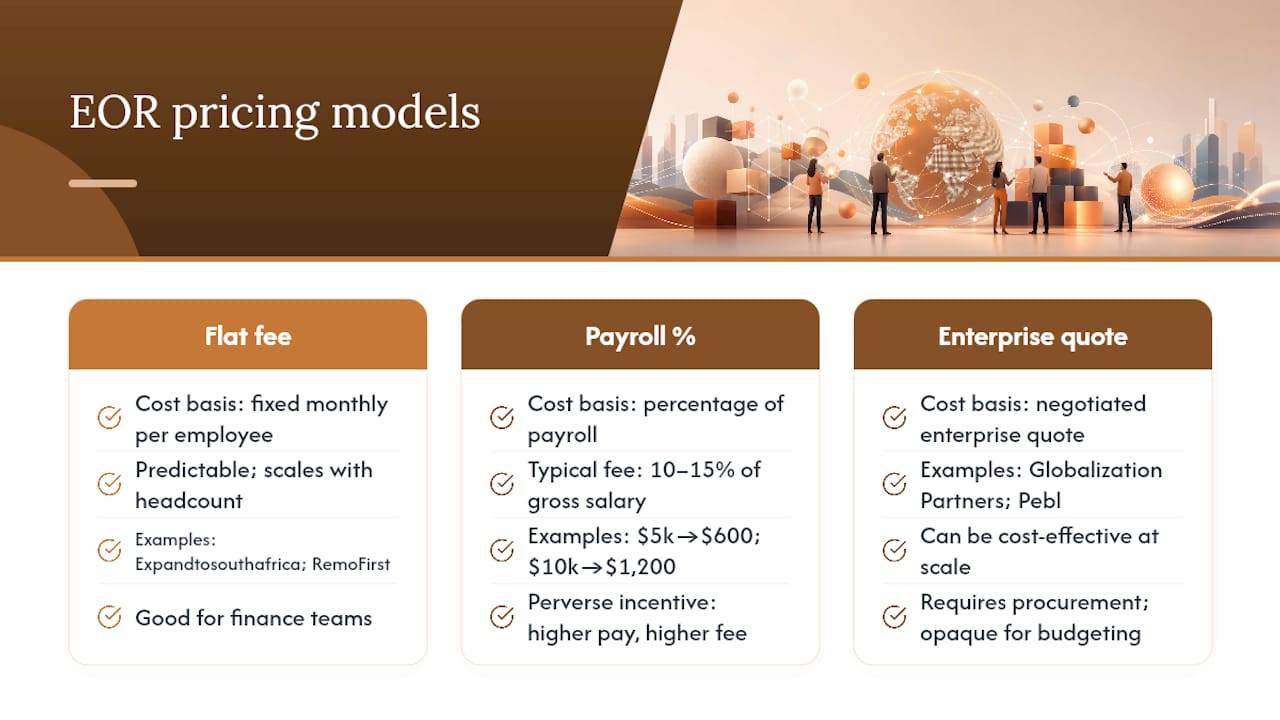
2. Percentage of payroll. Typically 10–15% of gross salary. This model benefits the provider when you hire senior talent and can create a perverse incentive: the more you pay your employees, the more the EOR earns. At a $5,000/month gross salary, a 12% fee is $600/month. At $10,000/month, it’s $1,200/month.
3. Quote-only enterprise pricing. Providers like Globalization Partners and Pebl do not publish prices. Enterprise deals are negotiated based on headcount, countries, and contract length. These arrangements can be cost-effective at scale but require procurement cycles and offer no transparency for initial budgeting.
Example total-cost calculation: South Africa software developer
| Cost component | Monthly amount (USD) |
|---|---|
| COIDA (estimated, varies by industry) | ~$15 |
| EOR flat fee (Expandtosouthafrica) | $399 |
For context, a comparable developer role in the UK or Germany typically costs $6,000–$8,000 per month in total employer cost. South Africa’s skilled talent pool offers 40–60% salary savings versus UK and EU equivalents, and the ±1 hour CET time zone overlap makes real-time collaboration practical.
Note: This is general information, not legal or financial advice. Confirm current SARS thresholds and statutory rates with a qualified professional or the relevant authority before making employment decisions.
EOR vs. PEO vs. hiring contractors: what’s the legal difference?
An Employer of Record is the sole legal employer of your worker in the target country. A Professional Employer Organization (PEO) operates under a co-employment model. An independent contractor arrangement places the worker outside the employment relationship entirely. These are not interchangeable, and choosing the wrong model creates real legal exposure.
Employer of Record responsibilities:
- Signs the employment contract as the legal employer.
- Runs local payroll in the statutory currency and cadence.
- Handles all tax filings (PAYE, UIF, SDL, COIDA in South Africa).
- Administers statutory benefits and leave entitlements under local law.
- Manages termination in compliance with local labor law (in South Africa, the Labour Relations Act and BCEA govern this).
- Carries employer liability for compliance failures.
How a PEO differs:
A PEO co-employs workers alongside the client company. This model is most common in the United States, where it gives the client access to the PEO’s benefits pool and HR infrastructure. TriNet is a well-known US PEO. The key distinction: in a PEO arrangement, the client company typically needs its own legal entity in the jurisdiction. An EOR removes that requirement entirely.
Contractor engagements:
Hiring someone as an independent contractor avoids the cost and complexity of employment, but it carries misclassification risk. Most jurisdictions, including South Africa, apply a substance-over-form test: if the worker is integrated into your operations, works set hours, and uses your equipment, they may be deemed an employee regardless of what the contract says. Misclassification can trigger back taxes, penalties, and statutory benefit obligations. Payoneer Workforce Management and Deel both offer contractor-specific products that include misclassification risk assessments.
When to choose each model:
Use an EOR when you need a full-time employee in a country where you have no legal entity and don’t want to establish one. Use a PEO when you already have a US entity and want to outsource HR administration and benefits. Use a contractor arrangement only for genuinely independent, project-based work where the substance-over-form test is clearly satisfied.
Top EOR provider profiles: verdicts, pricing, and best-for
Expandtosouthafrica
Expandtosouthafrica is the recommended choice for any company hiring in South Africa. It is the only provider on this list built exclusively for one country, which means every feature, every compliance workflow, and every support conversation is specific to South African law. The flat fee of €350 per employee per month covers BCEA-compliant contracts, ZAR payroll, PAYE (EMP201 with SARS), UIF, SDL, and COIDA filings. Data is handled under POPIA and GDPR with EU data residency. Contracts are signed within 48 hours. The open REST API with public documentation and sandbox keys makes integration straightforward for technical teams. Free transfers from other EOR providers remove the switching cost for companies already on a global platform.
For South Africa hires specifically, a single-country specialist is faster to onboard, more transparent on pricing, and more accountable on compliance than a global generalist that treats South Africa as one of 150 line items.
Deel
Deel covers 150+ countries with a mix of owned entities and partner networks. Its EOR product starts around $599 per month, and it also offers a lower-cost contractor management product. The platform’s breadth makes it a strong choice for companies that need a single vendor across many markets. The trade-off is that per-country depth varies: South Africa is covered, but it is not a specialization.
Remote
Remote operates owned entities in 80+ countries and positions itself toward enterprise buyers with formal SLAs. Published EOR pricing starts at a higher monthly fee. Its payroll and benefits management tooling is mature, and it has a strong track record with distributed engineering teams. Enterprise contracts include dedicated support tiers.
Multiplier
Multiplier sits in the mid-market tier, with published pricing starting at a moderate monthly fee and owned entities across a significant number of markets. It is a practical choice for companies that want more coverage than a single-country specialist but don’t need the full enterprise procurement cycle that G-P or Pebl require.
Oyster HR
Oyster HR covers 180+ countries with a clean self-service platform and transparent product tiers. Pricing starts at a moderate monthly fee. Its user interface is frequently cited in customer reviews as one of the cleaner experiences in the market. Mid-market HR teams that want to manage EOR relationships without heavy vendor management overhead tend to find it a good fit.
RemoFirst
RemoFirst publishes a floor price at a low monthly amount with no setup fees and no termination fees. That commercial simplicity is its primary differentiator. Coverage spans 180+ countries. For price-sensitive buyers running a small number of hires in markets where compliance depth is less critical, it is worth evaluating.
Remote People
Remote People offers published EOR fees at a low level, and caps its security deposit, which matters when you’re hiring senior talent with high gross salaries. A capped deposit reduces the upfront cash requirement significantly compared to providers that require two to three months of total employer cost as a deposit.
Payoneer Workforce Management (formerly Skuad)
Payoneer Workforce Management covers many countries and has particularly strong tooling for mixed employee and contractor teams. Its multi-currency payroll support is a genuine differentiator.
Globalization Partners (G-P)
G-P is an enterprise-first provider with coverage across 180+ countries and a procurement model built for large organizations. Pricing is quote-only. Its depth of country coverage and enterprise SLAs make it a credible choice for multinational rollouts, but the absence of published pricing makes it unsuitable for companies that need to budget before entering a procurement cycle.
Pro Tip: When evaluating G-P or Pebl for an enterprise deal, ask specifically for the SLA on statutory filing accuracy and the remediation process if a filing error triggers a penalty. Enterprise pricing should include indemnification language.
Pebl (formerly Velocity Global)
Pebl covers many countries and recently relaunched its platform. Like G-P, it operates on negotiated enterprise quotes. Its strength is coverage of less common markets where other providers have thin or no owned-entity presence.
Rippling
Rippling is primarily a US HR and payroll platform that has added global EOR capabilities. For US-based companies that already use Rippling for domestic HR, adding global EOR through the same platform reduces integration complexity. Its global EOR coverage is narrower than dedicated EOR providers.
Safeguard Global
Safeguard Global combines payroll services with EOR capabilities, making it a practical option for buyers who need deep local payroll operations rather than a lighter-touch EOR wrapper. Its combined service model suits companies with complex payroll requirements in multiple markets.
Omnipresent
Omnipresent takes a compliance-first approach to global EOR, with managed HR services for distributed teams. Pricing starts at a moderate monthly fee. It suits companies that prioritize compliance rigor over platform self-service.
Papaya Global
Papaya Global is a payroll-first platform that offers EOR services as part of a broader workforce management suite. Its automation capabilities are strong. Buyers who want payroll infrastructure with EOR as an optional layer, rather than EOR as the primary product, tend to find it a better fit than pure-play EOR providers.
Atlas HXM
Atlas HXM positions itself with particular depth in the US market. For companies expanding into the United States from abroad, Atlas HXM’s US-focused product and customer support are worth evaluating alongside the larger global platforms.
TriNet
TriNet is a US PEO, not a global EOR. It is included here because it appears in many EOR shortlists, but the distinction matters: TriNet requires a US legal entity and operates under co-employment. It is the right choice for US SMBs that want to outsource HR and benefits administration domestically, not for companies hiring internationally without a local entity.
Horizons
Horizons covers 180+ countries with published pricing starting around $299 per month. It sits between the low-cost tier (RemoFirst) and the mid-market tier (Multiplier, Oyster) on price, and its coverage is broad. A reasonable option for companies that want published pricing without the floor-price trade-offs of the lowest-cost providers.
GoGlobal
GoGlobal takes a managed-service approach to global EOR across 100+ countries. Its compliance focus and hands-on service model suit companies that prefer a more consultative relationship with their EOR provider over a self-service platform.
Rivermate
Rivermate targets startups and lean teams with published pricing starting around $299 per month and startup-friendly contract terms. Its coverage spans 150+ countries. For early-stage companies making their first international hire, the combination of transparent pricing and flexible terms reduces procurement friction.
TopSource Employer of Record
TopSource is listed on Gartner Peer Insights and covers 50+ countries. Pricing is quote-based. It suits buyers who weight Gartner peer reviews heavily in their vendor selection process.
Headway Workforce Solutions
Headway combines workforce management and staffing with EOR capabilities, primarily in the US and select markets. It is a practical option for buyers that need workforce management depth alongside EOR services rather than a pure-play global EOR.
How we selected and evaluated the EORs in this shortlist
The shortlist prioritizes four criteria, in this order: pricing transparency, compliance evidence, country coverage verification, and verified customer feedback.
Providers were identified through the Shortlister Q3 2026 vendor list, cross-referenced against Gartner Peer Insights EOR reviews and market roundups that publish floor pricing. Pricing data was checked against vendor pricing pages. Country coverage figures are vendor-stated and should be verified for your specific target market before procurement.
Evaluation criteria applied:
- Customer feedback: — Gartner Peer Insights reviews were used as a corroborating signal, with the caveat that enterprise buyers are overrepresented in that dataset. Mid-market and startup buyers should weight their own peer networks accordingly.
Expandtosouthafrica was evaluated on the same criteria and leads the shortlist for South Africa hires on the basis of single-country compliance depth, flat-fee €350 pricing transparency, and a documented 48-hour contract signing SLA.
Which EOR should you pick for your specific hiring scenario?
Short pilot hire (one to three employees, single country)
Pick: Expandtosouthafrica for South Africa; RemoFirst or Rivermate for other markets. Both publish low floor prices and impose no setup or termination fees, which limits your exposure if the pilot doesn’t convert to a permanent hire. Require a written SLA for first payroll run before signing.
Multi-country scale (five or more countries simultaneously)
Pick: Deel or Remote. Both have owned-entity presence across a broad range of markets and mature platforms for managing multiple country payrolls from a single dashboard. Negotiate a per-employee rate reduction at volume; most providers will move on price at 10+ employees.
Enterprise procurement (50+ employees, formal RFP process)
Pick: Globalization Partners (G-P) or Pebl. Both are built for enterprise procurement cycles with custom SLAs, indemnification language, and dedicated account management. Require documented entity registrations for every country in scope before contract signature.
Contractor-dominant teams transitioning to employment
Pick: Payoneer Workforce Management or Deel. Both offer contractor management products alongside EOR, which lets you run contractors and employees on the same platform during a transition period. Ask specifically about misclassification risk assessment tools.
Single-country South Africa depth
Pick: Expandtosouthafrica. No other provider on this list was built exclusively for South Africa. The combination of BCEA-compliant contracts, ZAR payroll, PAYE/UIF/SDL/COIDA filings, POPIA/GDPR data handling, and CCMA-safe dismissal guidance is not replicated by any global generalist at this price point (€350/mo). For companies hiring remote teams in South Africa, the specialist model reduces both compliance risk and total cost.

Key Takeaways
The single most important decision in EOR procurement is validating the provider’s actual entity model in your target country before you sign, not after.
| Point | Details |
|---|---|
| Validate entity evidence first | Ask for the employer entity registration in your target country before signing any contract. |
| Demand published pricing | EOR fees typically range across a broad band per employee per month; a vendor that won’t publish a price will often cost more. |
| Match provider tier to your scale | Flat-fee specialists suit pilots and single-country hires; enterprise platforms suit multi-country rollouts. |
| South Africa compliance requires named filings | Any EOR for South Africa must handle PAYE (EMP201), UIF, SDL, and COIDA, not just generic “payroll.” |
| Expandtosouthafrica for South Africa hires | Flat-fee €350/mo, BCEA-compliant, ZAR payroll, 48-hr contract signing, and POPIA/GDPR data handling. |
The EOR market rewards specificity, not breadth
Most EOR shortlists treat country count as the primary ranking signal. That framing serves global platforms well and serves you poorly. A provider that covers 185 countries but handles South Africa through a partner it has never audited is not a safer choice than a specialist that has processed hundreds of South African payroll runs and can cite the current COIDA cap from memory.
The more useful question is not “how many countries does this provider cover?” but “how deeply does this provider know the specific country I need to hire in?” For most markets, that question is hard to answer without a reference call with an existing client in that country. For South Africa, the answer is visible in the product: does the provider name BCEA, LRA, PAYE EMP201, UIF, SDL, COIDA, and POPIA as specific handled obligations, or does it say “South Africa: compliant employment”?
The second underappreciated dimension is exit terms. The EOR market has a lock-in problem. Providers with 12-month minimums and 90-day termination notice periods are not offering you flexibility; they are pricing in the cost of your inertia. Before you sign, model the exit cost as carefully as you model the onboarding cost. A provider that offers free transfers and no termination fees is making a different kind of commitment than one that charges you to leave.
Hiring in South Africa? Expandtosouthafrica gets you there faster
Global EOR platforms cover South Africa, but none of them were built for it. Expandtosouthafrica is the only provider on this shortlist that exists exclusively to employ people in South Africa on behalf of international companies, and that specificity shows up in every part of the service.
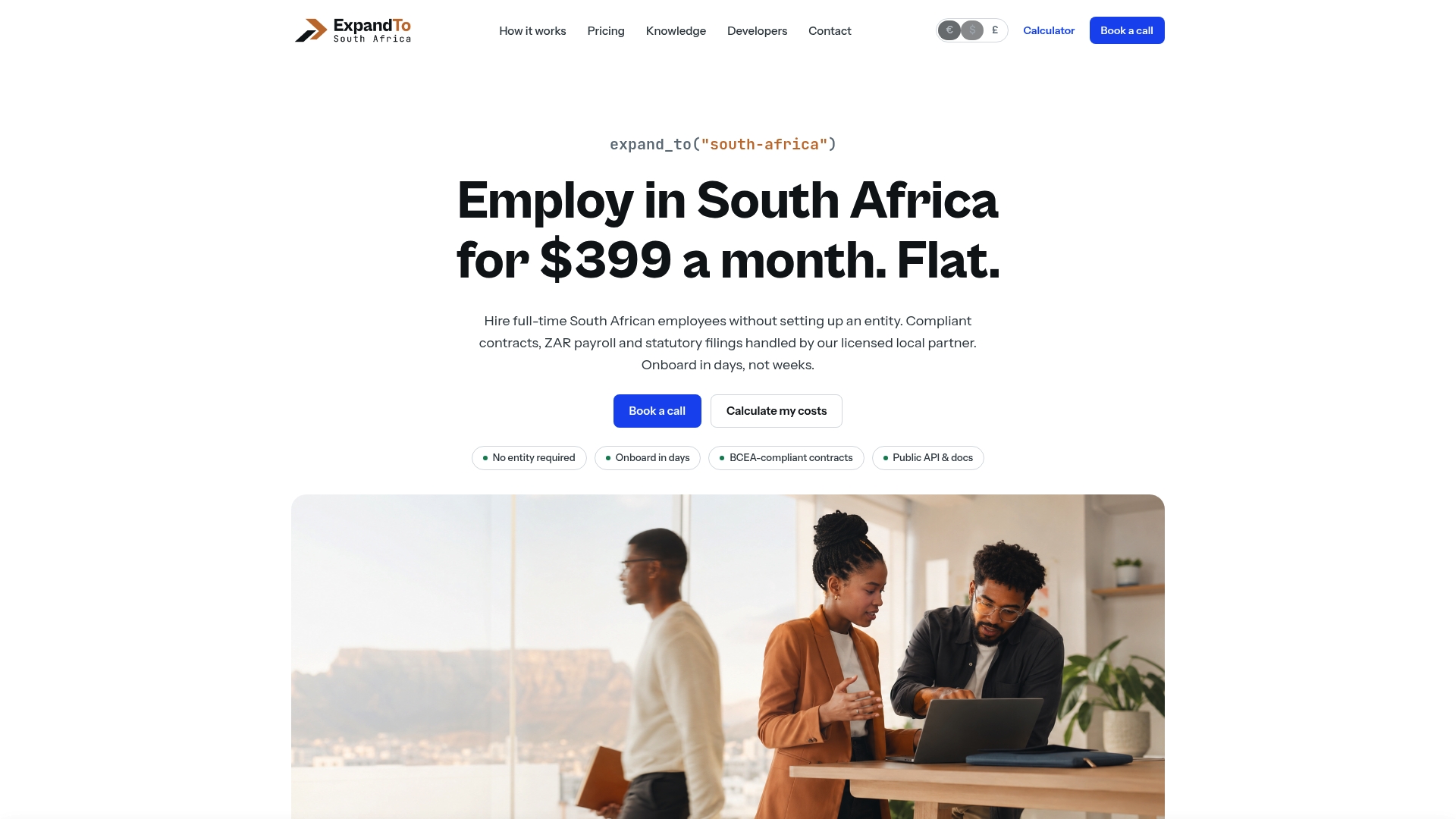
The flat fee is $399 per employee per month, with no setup fees and no FX loading. That covers BCEA-compliant employment contracts, ZAR payroll, and all statutory filings: PAYE (EMP201 with SARS), UIF, SDL, and COIDA. Data is handled under POPIA and GDPR with EU data residency. Contracts are signed within 48 hours. The open REST API with public documentation and sandbox keys means your technical team can validate the integration before you commit. Free transfers from other EOR providers mean switching costs are zero if you’re already on a global platform.
For companies that want to move quickly, the South Africa EOR service page includes a public employment cost calculator and full service scope. If you need compliance detail first, the complete guide to South African employment law covers BCEA, LRA, PAYE thresholds, and POPIA obligations in full. Get a quote or start your first hire today.
Useful sources and further reading
The following sources were used to compile and verify this shortlist. They are also useful starting points for your own procurement research.
Market research and vendor lists:
- Complete review of the 8 best Employer of Record (EOR) providers
- Best Employer of Record Services: Top 11 Vendors Q3 2026 | Shortlister
- Best Employer of Record (EOR) Reviews 2026 | Gartner Peer Insights
- How Much Does an Employer of Record Cost (EOR)?
- EOR services in South Africa – Expand to South Africa
- Employer of Record South Africa: The Complete Guide for International Businesses (2026)
- Employer of Record Indonesia Helps Singaporean Founders Expand Faster 2026
South Africa-specific resources from Expandtosouthafrica:
- EOR services in South Africa — service scope, flat-fee pricing, and employment cost calculator.
- Employer of Record South Africa: The Complete Guide for International Businesses (2026) — BCEA, LRA, PAYE thresholds, POPIA/GDPR, and COIDA obligations.
- South Africa PAYE Thresholds 2026 — current SARS PAYE thresholds for HR and payroll teams.
- Payroll services in South Africa — statutory payroll filings and ZAR payroll processing detail.
- Remote Hiring in South Africa: The 2026 Employer’s Guide to Compliant Scaling — practical guide for building remote teams in South Africa.
- Knowledge hub — full library of South Africa employment and payroll resources.