

South Africa sits on one clock all year, UTC+2, so its overlap with Europe is almost a full working day and its overlap with the United States depends on which coast you are on and which shift you set. If you are hiring there, we at Expand to South Africa employ people in South Africa on your behalf, and the hours you agree in the contract decide how much live collaboration you get. This guide gives the numbers for each region and a method for turning them into a schedule.
TL;DR
- South Africa uses South African Standard Time (UTC+2) year-round and never changes its clocks, so every seasonal shift in overlap comes from your side.
- Central Europe has 7 to 8 hours of overlap on a 9-to-5 day. The UK has 6 to 7 hours, depending on British Summer Time.
- US Eastern has about 1 to 2 hours on matching 9-to-5 schedules. A later South African shift can raise that to 4 to 6 hours. US Pacific has none on standard hours.
- Put the working hours, and any later shift, in the employment contract from day one so the schedule is part of the job and not a favor.
Table of Contents
- What time zone is South Africa in?
- How to calculate overlap in four steps
- Overlap with the UK and Ireland
- Overlap with Central Europe
- Overlap with the United States
- What changes twice a year
- Setting working hours in a South African contract
- Which roles suit which overlap
- Perspective
- Hiring in South Africa with the hours you need
- FAQ
- Sources
What time zone is South Africa in?
South African Standard Time (SAST) is defined as UTC plus two hours, according to the National Metrology Institute of South Africa. The whole mainland, from Cape Town to Johannesburg to Durban, uses it. The only exception is remote Marion Island in the Prince Edward Islands, which timeanddate lists separately at UTC+3. No employee you hire will be there.
There is also no daylight saving. The IANA time zone database shows no recurring daylight-saving rule for the South African zone. Johannesburg is at UTC+2 in January and in July.
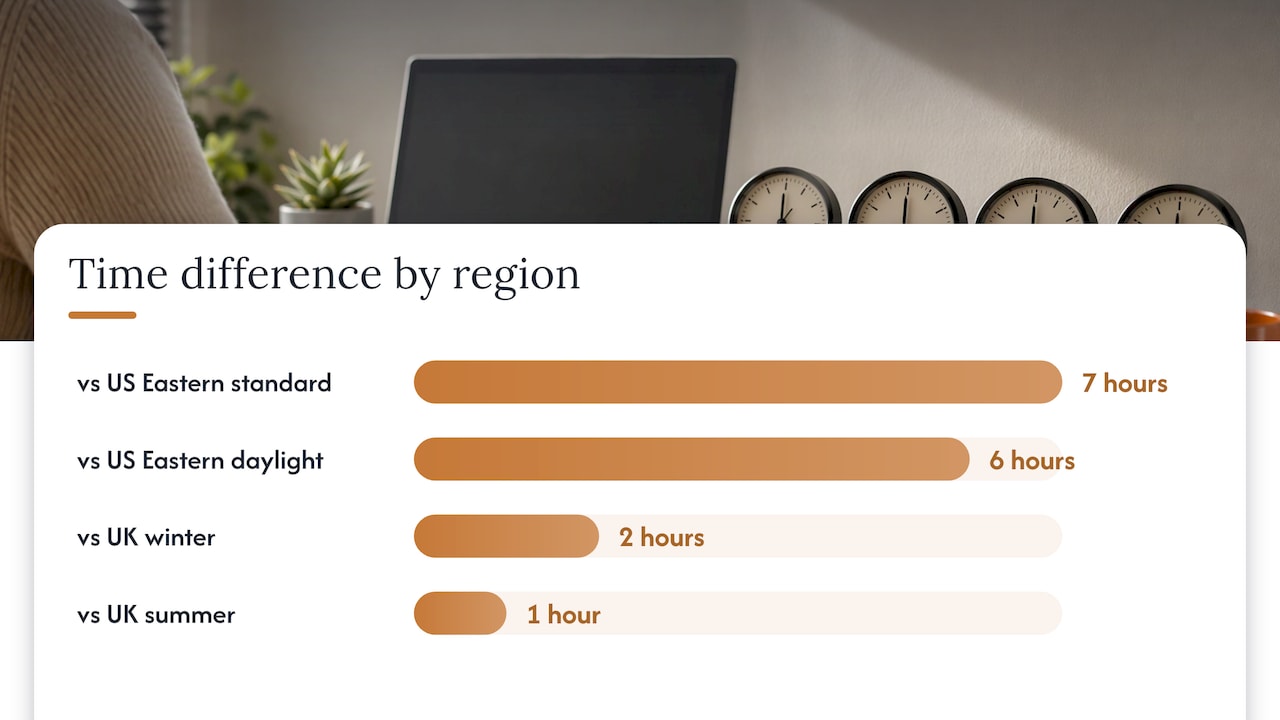
That single fact is the useful one for planning. A South African colleague’s clock never moves. When your office in London, Berlin or New York changes its clocks, the gap between you changes by one hour, and that is the only reason the overlap shifts during the year.
Two common mix-ups are worth clearing up, since people search for them:
- Is South Africa on EST? No. EST is UTC-5 and SAST is UTC+2, so South Africa is seven hours ahead of US Eastern standard time. While the US is on daylight time (EDT, UTC-4), the gap is six hours.
- Which country is two hours behind South Africa? The UK in winter (UTC+0) is two hours behind. In British Summer Time (UTC+1) it is one hour behind.
How to calculate overlap in four steps
You do not need a converter for this. Use UTC offsets and subtract.
- Write down both offsets for the season. South Africa is always +2. Your office is +1 in London in summer, +0 in winter, +1 or +2 in Central Europe, and -4 to -8 across the US depending on zone and daylight time.
- Find the gap. Subtract your offset from +2. London in winter gives 2 hours. New York in summer gives 6.
- Convert your core hours into South African time. Add the gap. A 9:00 to 17:00 day in London in winter becomes 11:00 to 19:00 in South Africa.
- Intersect it with the South African working day. On a 9:00 to 17:00 schedule, the overlap is whatever falls inside both windows. For the London winter example, that is 11:00 to 17:00, six hours.
Repeat the calculation twice a year, when your region changes its clocks. For the exact transition dates in your country, rely on your own government’s or standards body’s published rules, as the changeover dates differ between the US and Europe.
Overlap with the UK and Ireland
The UK is the easiest match outside Europe. On a standard 9:00 to 17:00 day on both sides:
- British Summer Time (UTC+1): South Africa is one hour ahead. London’s 9:00 to 17:00 is 10:00 to 18:00 in South Africa, so you share 10:00 to 17:00, seven hours.
- UK winter (UTC+0): South Africa is two hours ahead. London’s day is 11:00 to 19:00 there, so you share 11:00 to 17:00, six hours.
In both seasons, a South African employee’s morning is a London morning plus one or two hours. Their first hour or two, 9:00 to 11:00 in winter, belongs to them for focused work before your team logs in. Many managers use that block for deep work and the shared block for meetings, reviews and handovers.
If you want to see how UK and South African business hours compare across the winter GMT and summer BST periods, this UK and South Africa market comparison lays the two markets side by side. For UK employers weighing the legal route, our page on UK hiring in South Africa covers the three ways to employ there.
Overlap with Central Europe
Central Europe is where the match is strongest.
- European summer (CEST, UTC+2): the clocks are identical. Eight hours of overlap on a 9:00 to 17:00 day, zero gap.
- European winter (CET, UTC+1): South Africa is one hour ahead. A 9:00 to 17:00 day in Berlin or Amsterdam is 10:00 to 18:00 in South Africa, so you share seven hours.
For a team in the Netherlands, Germany, France, Spain or Italy, a South African hire works as a same-day colleague. Stand-ups, support rotas and sprint ceremonies can run at a single fixed local time with no one stretching their day. Eastern European offices on UTC+2 or UTC+3 in winter and summer also sit within an hour of South Africa, though you should run the four steps above against your exact zone.
Overlap with the United States
The US is where scheduling takes thought. South Africa is a long way ahead of the Americas, so a matching 9:00 to 17:00 day leaves little shared time, and the answer depends on your zone.
| Your US zone | Gap to South Africa (US daylight / standard) | Shared hours, both on 9:00 to 17:00 |
|---|---|---|
| Eastern | 6 / 7 hours | 2 / 1 |
| Central | 7 / 8 hours | 1 / 0 |
| Mountain | 8 / 9 hours | 0 / 0 |
| Pacific | 9 / 10 hours | 0 / 0 |
The figures are my arithmetic from UTC offsets: South Africa at UTC+2 against the US zones at UTC-4 to UTC-7 on daylight time, and UTC-5 to UTC-8 on standard time. They assume both sides keep the same nine-to-five day. Nobody has to.
Make the shift do the work
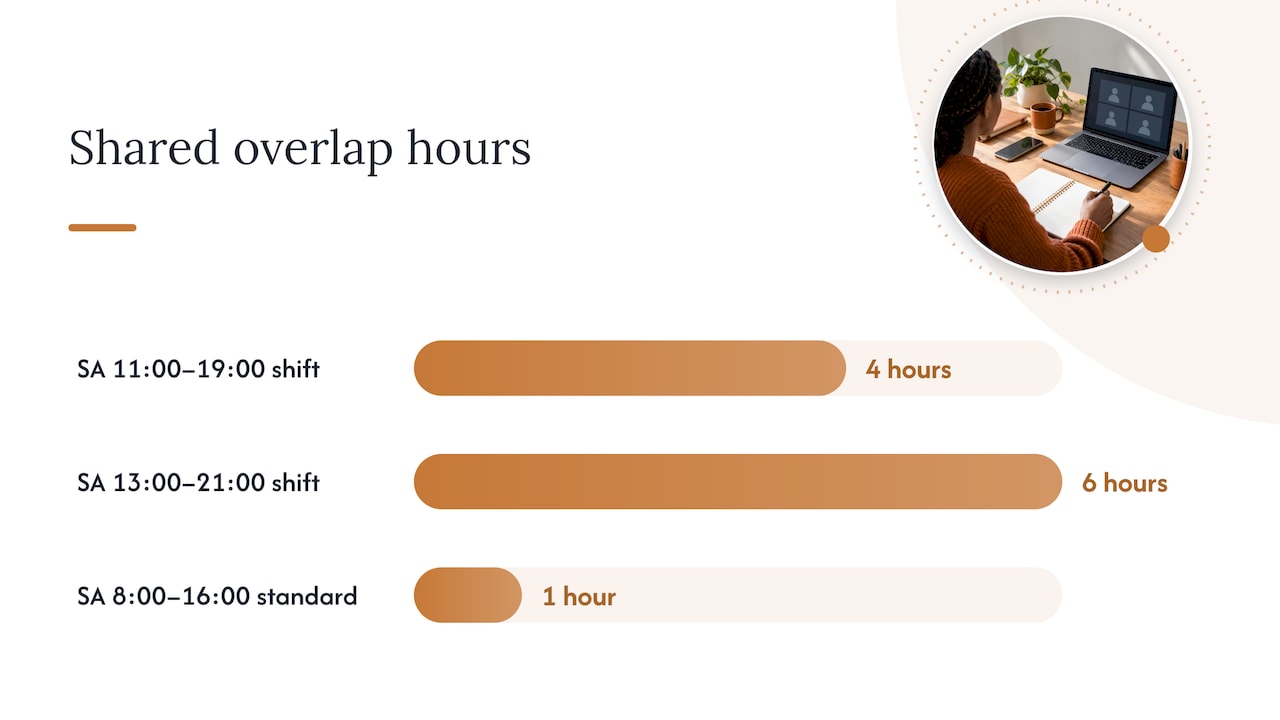
The fix for the US is to move the South African working day later, not to ask your team to start at dawn. Some examples, using US Eastern on daylight time (a 9:00 to 17:00 day in New York is 15:00 to 23:00 in South Africa):
- South Africa 11:00 to 19:00: shared window of 15:00 to 19:00 South African time, which is 9:00 to 13:00 in New York. That is four hours covering your whole US morning.
- South Africa 13:00 to 21:00: shared window of 15:00 to 21:00, six hours, covering 9:00 to 15:00 in New York.
- South Africa 8:00 to 16:00 (standard day): shared window 15:00 to 16:00, only one hour in New York’s early morning.
In US standard time, add an hour to all of these on the South African side, and the New York morning starts at 16:00 in South Africa.
For US West Coast teams, no reasonable shift gives a long live window, so design the work around handoffs: your team finishes in the evening, the South African colleague picks up in their morning, and you wake up to progress. Roles that suit this are engineering, QA, data work, support queues and operations, where the work passes cleanly from one person to the next.
Our page on hiring from the US sets out the routes and payroll rules for American employers.
What changes twice a year
Because South Africa never changes its clocks, you are the one who moves. When your country goes onto daylight time, the gap to South Africa shrinks by one hour. When it comes off, the gap grows by one.
Three practical habits keep this from becoming an annual scramble:
- Anchor recurring meetings to one side’s clock. Decide whether the calendar series belongs to your time zone or to South Africa’s, and keep it there. Calendar tools shift the other side’s time automatically.
- Check the weeks between transitions. The US and Europe do not change clocks on the same weekend, so for a short stretch the gap to South Africa differs from what either region’s usual figure suggests. A US-Europe-South Africa meeting can move by an hour for a couple of weeks.
- Write the core hours in the contract in South African time. An employee should know that “core hours 11:00 to 19:00 SAST” is fixed, and any local adjustment is a conversation, not a drift.
Setting working hours in a South African contract
Scheduling is not only a calendar question. South African employment is governed by the Basic Conditions of Employment Act (BCEA), which sets maximum ordinary hours, overtime rules, rest periods and limits on night work. A shifted schedule that ends late in the evening needs to be agreed in writing and handled correctly on payroll.
Two of our pages cover this in detail. BCEA working hours explains the contract and payroll steps. Shift work in South Africa covers employee rights and the job options for shifted roles. The short version: write the start and end times into the contract, state the weekly total, and keep to the legal limits on overtime and rest.
When the employee is hired through an Employer of Record, the contract is issued by the local legal employer, so the schedule you want has to be settled before the offer goes out. Our onboarding timeline shows where that decision sits between offer and first day.
Which roles suit which overlap
Overlap matters differently by job. A rough guide:
- Needs the full overlap (engineering leads, account managers, customer-facing sales): Europe and the UK fit with no changes. For US Eastern, move the shift later.
- Needs a daily sync only (developers, designers, analysts): a two-hour shared window is enough for planning and review. Use written updates and recorded walkthroughs for the rest.
- Needs coverage more than conversation (support, operations, back office): South Africa’s clock can extend your service hours. A support team in South Africa can pick up where a European team stops for the day, or cover the early hours before a US team starts. See our page on hiring customer support in South Africa for salaries and how to employ them.
The cost side often settles the matter. For skilled roles, we typically see salaries 40 to 60% below UK and EU levels, and our salary comparison for employers and remote salary benchmarks show the detail by role. Combined with a time zone that overlaps Europe almost entirely, the practical question for most employers is not whether the clock works, but how to employ the person properly.
Perspective
Most founders ask us about time zones as if it were a risk to be managed. We see it the other way round. South Africa is within one hour of Central European time all year, and it does not move its clocks. For a European or UK team that is about as close to a same-office rhythm as you can get from a remote hire.
The US is a scheduling decision, not a barrier. A later shift of a few hours turns a one-hour overlap into four or six, and that is a clause in an employment contract, not a compromise on talent. We would rather you set it up properly at the start, with the hours in writing and the BCEA limits respected.
We built Expand to South Africa for one country only. That is why we can tell you which hours work for which region, and why the contract, ZAR payroll and statutory filings can follow from the schedule you chose.
Roel
Hiring in South Africa with the hours you need
If the overlap suits your team, the next question is who legally employs the person. Through our Employer of Record service you can hire full-time employees in South Africa without setting up a local entity. Pricing starts from £299 per employee per month, and the licensed local partner handles BCEA-compliant contracts, ZAR payroll, and the PAYE, UIF, SDL and COIDA filings. Contracts are signed within 48 hours.

See the pricing page for what is included, or read how a legal employer arrangement works before you decide.
FAQ
Does South Africa have daylight saving time?
No. South Africa uses SAST at UTC+2 all year, and the IANA time zone data shows no recurring daylight-saving rule for it. The gap to your office changes only when your own country moves its clocks.
How many hours of overlap does South Africa have with the UK?
On a 9:00 to 17:00 day on both sides, you share seven hours during British Summer Time and six hours in UK winter. The South African employee is one hour ahead in summer and two hours ahead in winter.
Can a South African employee work US Eastern hours?
Yes, with a later shift agreed in the contract. A South African day of 11:00 to 19:00 covers the New York morning (9:00 to 13:00) during US daylight time. Keep to the BCEA limits on hours and rest, and put the schedule in writing.
Does all of South Africa use the same time?
The mainland does. Timeanddate lists one exception, Marion Island in the Prince Edward Islands, at UTC+3. For hiring purposes, every city uses SAST.
Is South Africa in the EST time zone?
No. South Africa is at UTC+2, while EST is UTC-5. The gap is seven hours when the US is on standard time and six hours when Eastern time is on daylight time (EDT).
Sources
- National Metrology Institute of South Africa: South African Standard Time
- IANA time zone database: Africa
- Timeanddate: Time zones in South Africa