

The cost of employing someone in South Africa is their gross salary plus a small layer of statutory employer contributions, roughly 1.5% to 4.7% on top of pay in the worked example below. On top of that come any customary benefits you choose to offer, and the fee of whoever employs them on your behalf if you do not have a local entity. The payroll burden is much lighter than in most of Europe. The real cost drivers are the salary band for the role, how you structure benefits, and the compliance mistakes that turn into disputes.
This guide walks through each component with current 2026 figures, a worked example, and a comparison of the ways a US or European company can put someone on a South African payroll.
TL;DR
- Statutory employer on-costs are low. Employer UIF is 1% of pay up to a monthly cap, the Skills Development Levy (SDL) is 1% of payroll once you pass the threshold, and COIDA is a rate set by industry class.
- Salary is the main cost. Skilled tech roles are paid in rand and, in our experience, typically come in 40% to 60% below equivalent UK or EU salaries. One 2026 benchmark puts the saving at 50% to 70%.
- A legal floor exists. The national minimum wage is R30.23 per hour from February 2026, though skilled hires sit far above it.
- Without a local entity you need an Employer of Record (EOR). Ours is a flat $399 (€350 / £299) per employee per month, with no setup fees or FX loading.
- Use the calculator. Our employment cost calculator turns a salary into a total employer cost.
Table of Contents
- The components of employment cost in South Africa
- Salary: what skilled roles cost
- The legal floor: national minimum wage
- Statutory employer contributions
- A worked example: R50,000 per month
- Benefits and leave that change the real number
- Contractor or employee: the misclassification cost
- Ways to employ in South Africa and what each costs
- Our perspective: the cost that surprises companies
- How we price it
- A budgeting checklist for your first hire
- FAQ
- Sources
The components of employment cost in South Africa
Think of total cost to company as five layers. Only the first is large.
- Gross salary, paid monthly in South African rand (ZAR).
- Statutory employer contributions: UIF, SDL and COIDA.
- Customary or contractual benefits: a 13th cheque, medical aid, retirement fund contributions.
- Leave and notice obligations under the Basic Conditions of Employment Act (BCEA), which affect productivity and payout liabilities rather than cash outlay each month.
- The employing structure: your own subsidiary, or an EOR fee.
PAYE (employee income tax) is withheld from the employee’s pay, not added to your cost, but you are responsible for deducting and paying it to the South African Revenue Service (SARS). The SARS employer tax deduction tables set out how much to withhold. Employers declare and pay PAYE, UIF and SDL together through the monthly EMP201 return, due by the 7th of the following month. We cover the deadlines in more detail in our guide to payroll taxes for employers in South Africa.
Salary: what skilled roles cost
Salary levels vary by city, seniority and how scarce the skill is. For software roles, one 2026 benchmark has intermediate developers earning R28,000 to R42,000 per month and senior developers R45,000 to R70,000, with senior specialists such as AI engineers or cloud architects exceeding R100,000. A separate full stack developer salary breakdown publishes average monthly gross figures by experience level, starting with R18,000 to R26,000 for juniors with up to two years of experience.
For a more detailed look at one role, see our page on software engineer salaries in South Africa, or the guide to hiring software developers in South Africa. If you are hiring for support rather than engineering, the equivalent page is customer support salaries in South Africa.
Why salaries are lower than in the UK, EU or US
The rand-denominated pay scale, lower living costs and a large English-speaking graduate pool all contribute. The same benchmark notes that international firms hiring from South Africa typically save 50% to 70% against equivalent UK or EU roles, even after local benefits. Our own planning figure for skilled roles is the more conservative 40% to 60%, and we suggest you budget on that range.
Two things sit alongside the saving. South Africa runs on GMT+2, so the working day overlaps with Europe almost fully (within about one hour of Central European Time) and with the US East Coast in the morning. Also, the overall labour market is slack, with official unemployment at 33.6% in the second quarter of 2026, but that does not mean senior engineers are easy to hire. The pool with international-grade skills is limited and large local employers compete for it, so lowball offers fail.
The legal floor: national minimum wage
The Minister of Employment and Labour announced an increase of the national minimum wage to R30.23 per hour on 3 February 2026. The Department of Employment and Labour publishes a revised February 2026 minimum wage flyer with the full detail. Sector-specific determinations, for example for domestic workers, set their own rates, so check the instrument that applies to your industry.
For a remote professional hire this floor is almost never the binding constraint. It matters if you employ support staff, data labelers or other entry-level roles, where you should confirm the hourly rate against your contracted hours.
Statutory employer contributions
UIF (Unemployment Insurance Fund)
Both employer and employee contribute 1% of remuneration, subject to a monthly earnings ceiling. Current 2026 payroll tools show the cap at R17,712 per month, which makes the maximum monthly contribution R177.12 for each side. Any employee earning above the cap costs you R177.12 per month in UIF, no more.
SDL (Skills Development Levy)
SDL is 1% of total payroll and applies only to employers whose annual payroll exceeds R500,000, according to the same calculator’s summary of the rules. A single employee on R50,000 per month earns R600,000 a year, so the threshold is crossed with one senior hire. Confirm your position with a payroll adviser.
COIDA (Compensation for Occupational Injuries and Diseases)
COIDA is the workplace injury insurance scheme. The assessment is a percentage of annual earnings, and the percentage depends on your industry class. For 2026/2027, tariffs range from 0.18% for Class A to 3.34% for Class I, with earnings assessed up to a ceiling of R668,000 per employee. Office-based software and services work normally sits at the low end, but your class is set by the Compensation Fund, not by you.
A worked example: R50,000 per month
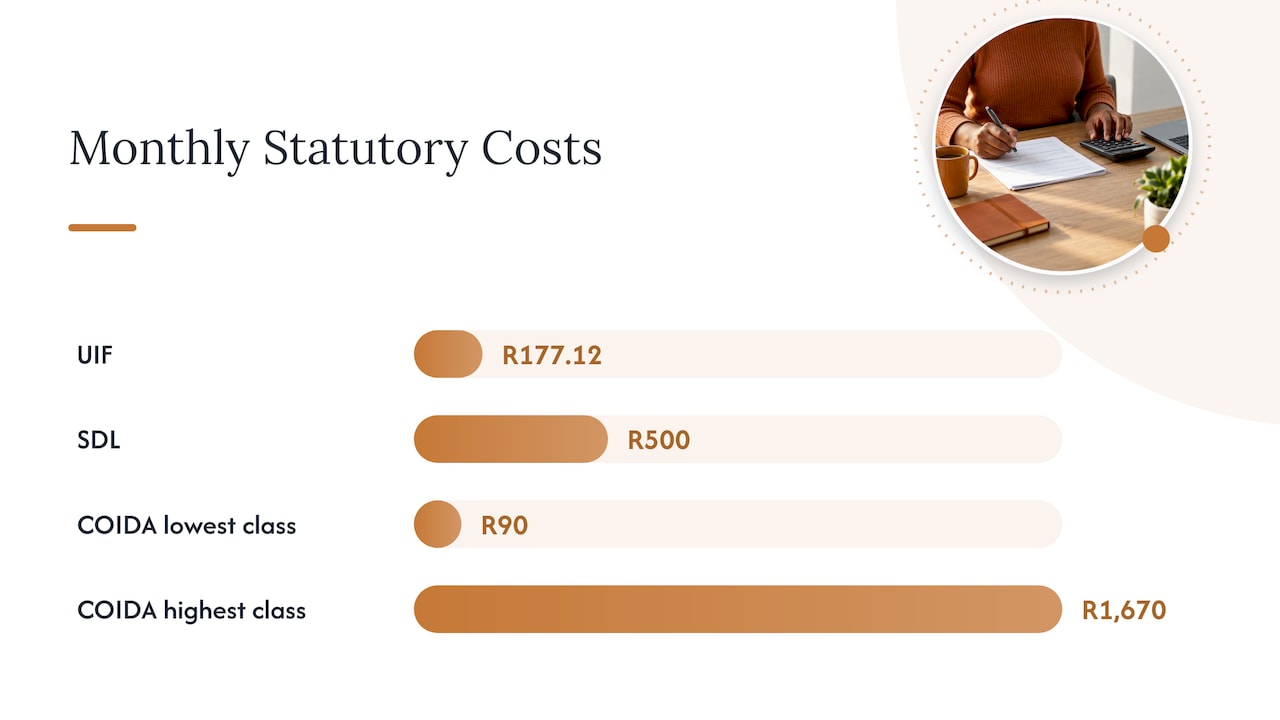
Take a senior developer on a gross salary of R50,000 per month, with no extra benefits. The table shows the statutory layer using the rules above.
| Item | Monthly cost to employer |
|---|---|
| Gross salary | R50,000.00 |
| Employer UIF (1%, capped) | R177.12 |
| SDL (1%, payroll above R500,000 a year) | R500.00 |
| COIDA at 0.18% (lowest class) | R90.00 |
| COIDA at 3.34% (highest class) | R1,670.00 |
| Total statutory cost, low case | R50,767.12 |
| Total statutory cost, high case | R52,347.12 |
The statutory layer therefore adds about 1.5% to 4.7% to salary. For a realistic office-based role you should land near the low end. The COIDA figures are a simple monthly proration of the annual percentage and your actual assessment depends on your registered class and declared earnings.
These figures exclude the optional benefits below. They also exclude employer retirement fund contributions, which are not a legal requirement for you to offer but are common in competitive packages.
Benefits and leave that change the real number
The statutory layer is small, so benefits decide whether your budget is accurate.
- 13th cheque. An extra month of salary paid at year end is widely expected in South Africa but is not legally mandatory unless your contract says so. If you offer it, provision for it at 1/12 of annual salary, or about 8.3% on top of base pay.
- Medical aid. Not mandated, but a strong retention tool because public healthcare capacity is limited. Employer contributions are a negotiated line in the package.
- Retirement fund. Common for senior hires. Treat 5% to 10% of salary as a planning range for competitive offers, and confirm against what your target candidates currently receive.
- Leave. The BCEA sets minimum annual leave, sick leave and family responsibility leave. These are time costs, not cash costs, but they are legally enforceable and must appear in the contract.
If your 13th cheque, medical aid and pension add up to 20%, the fully loaded cost of the R50,000 hire in the example above rises to roughly R60,800 to R62,400 per month. Even then it sits well below a comparable UK, EU or US package.
Contractor or employee: the misclassification cost
Many foreign companies start with a contractor to avoid the compliance burden. That works until the relationship looks like employment: fixed hours, your tools, one client, ongoing integration into your team. South African law looks at the substance of the relationship, not the label. A misclassified worker can claim employee protections, and you can face back-liability for contributions. For a plain-language explanation of the test, see this guide to independent contractor versus employee in South Africa.
Converting a contractor to a compliant employee usually costs less than people expect, because the statutory layer is small. The larger change is moving from a flexible invoice to a contract with notice periods, leave and dismissal procedure under the Labour Relations Act (LRA).
Ways to employ in South Africa and what each costs
A US or European company has three realistic routes. We describe them by type.
| Route | Setup | Ongoing cost | Best for |
|---|---|---|---|
| Own South African subsidiary | Registration, bank account, SARS and UIF/COIDA registration | Accountant, payroll provider, audit and director costs on top of salary | 10 or more hires, long-term presence |
| Multi-country EOR platform | Contract signing, no entity | Per-employee fee across 150 or so countries | Teams hiring in many countries at once |
| South Africa-only EOR (us) | Contract signing, no entity | Flat $399 (€350 / £299) per employee per month | One to 20 hires in South Africa |
| Contractor | Almost none | Invoice rate, plus misclassification risk | Short, genuinely independent projects |
The subsidiary route gives control, but you carry every statutory duty yourself, and it makes sense once headcount justifies the fixed overhead. Multi-country platforms are built for breadth, and published per-employee fees for them run roughly $400 to $599 per month in our reading of the market. A country-specialist EOR concentrates on one legal system, which in our view means fewer surprises on payroll, filings and dismissals.
The permanent establishment question
Employing someone yourself in South Africa without an entity can create tax and corporate exposure, including permanent establishment risk for the foreign company. An EOR becomes the legal employer, which removes the registration and filing burden from your business. Your advisers should still review how the person’s role is directed. Our guide for US companies hiring in South Africa sets out the routes and the payroll rules on both sides.
Our perspective: the cost that surprises companies
We run an EOR for one country only, so we see the same pattern every time. Founders arrive worried about payroll taxes, and the figures turn out to be modest. The costs that actually hurt are three others.
First, an unrealistic salary offer. A company converts a UK salary to rand, subtracts 60%, and finds the market will not accept it for a senior role. Benchmark the role against local data before you write the offer.
Second, a badly handled exit. A dismissal without a fair reason and fair procedure ends up at the CCMA, and the cost of one dispute can exceed a year of EOR fees. That is why we put dismissal guidance into the service from the first contract rather than at the end.
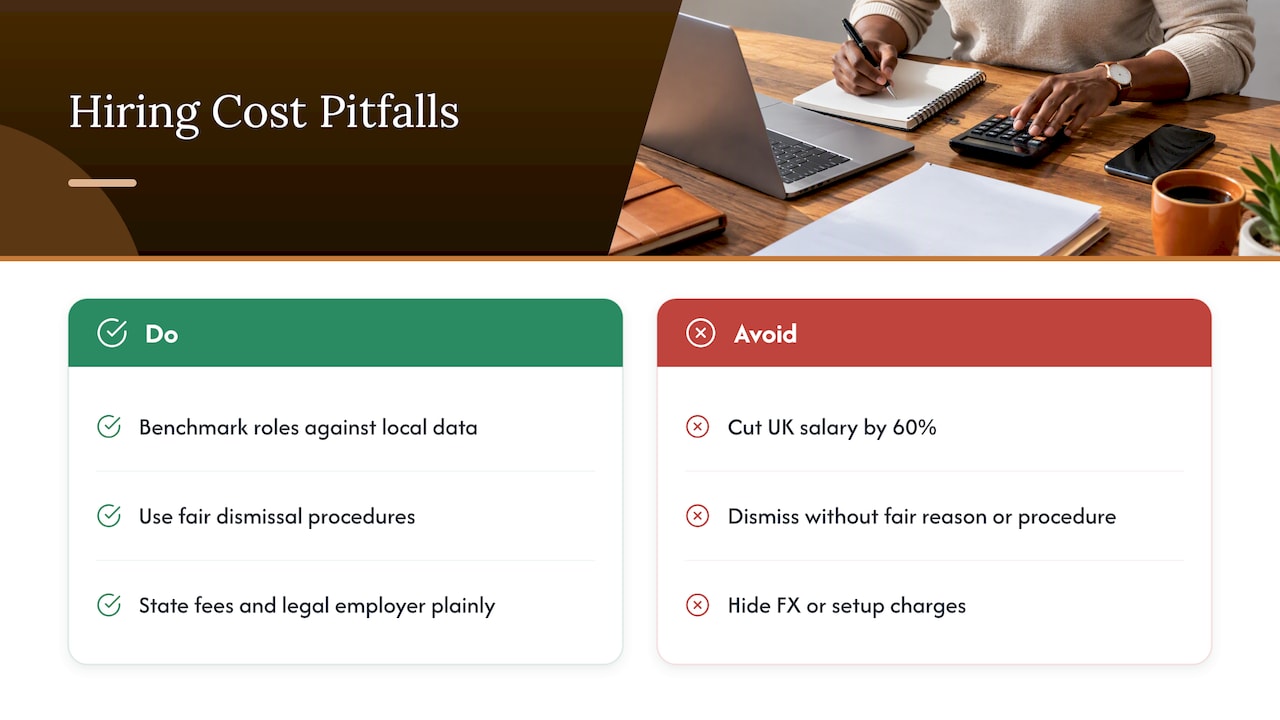
Third, opaque fees. FX loading and setup charges are easy to hide in a quote. We charge a flat monthly fee, no setup fee and no FX loading, and we say plainly that our licensed local partner is the legal employer of record, so you know who stands behind the contract.
If you take one number away, make it the whole picture: salary, benefits, a 1.5% to 4.7% statutory layer and a flat fee. That adds up to a predictable monthly line you can put in a budget.
— Roel
How we price it
Our Employer of Record service costs $399 (€350 / £299) per employee per month. That covers a BCEA-compliant contract, ZAR payroll, PAYE, UIF, SDL and COIDA filings, and handling of personal data under POPIA and GDPR with EU data residency. Contracts are signed within 48 hours, and onboarding follows within days. If you already use another EOR, transfers to us are free.
See the full EOR pricing, run your own numbers in the employment cost calculator, or read the complete guide to Employer of Record in South Africa. If you also need to find the person, we run talent sourcing for skilled roles.
A budgeting checklist for your first hire
- Benchmark gross salary against current local data for the exact role and city.
- Add employer UIF (R177.12 per month at the cap) and SDL if payroll will exceed R500,000 a year.
- Add COIDA at the rate for your registered industry class.
- Decide on a 13th cheque, medical aid and retirement contributions, and cost them as percentages.
- Add your EOR fee or entity overhead.
- Hold a reserve for notice pay and leave payout, which the contract and the BCEA define.
- Recheck the figures each March and April, when minimum wage, tax tables and COIDA tariffs are updated.
FAQ
How much does it cost to employ someone in South Africa?
The cost is the gross salary plus employer UIF, SDL where applicable, and COIDA, which together add roughly 1.5% to 4.7% in our worked example. Add benefits such as a 13th cheque or medical aid if you offer them. If you use an EOR, add its monthly fee.
Is South African payroll cheaper than payroll in Europe?
For skilled roles it usually is, mainly because of lower salaries rather than lower tax. We see typical savings of 40% to 60% against UK or EU roles, and a 2026 benchmark cites 50% to 70%. The savings depend on seniority and on the benefits you offer.
What is the minimum wage in South Africa?
The national minimum wage is R30.23 per hour from February 2026. Some sectors have their own determinations, so check the one that covers your employee.
Do I need a South African company to hire an employee there?
No, if you use an Employer of Record, which employs the person legally and runs payroll and filings for you. Without one, you generally need your own registered employer presence with SARS, UIF and COIDA. Ask a South African tax adviser about your specific facts.
Sources
- Nucamp: cost of living vs tech salaries in South Africa in 2026
- Jobrato: full stack developer salaries in South Africa
- Statistics South Africa: Mbalo Brief, August 2026
- South African Government: national minimum wage increase, February 2026
- Department of Employment and Labour: national minimum wage flyer 2026
- SARS: guide for employers on tax deduction tables
- ClearComply: COIDA tariffs of assessment 2026/2027
- Paytools: payroll cost calculator 2026
- Mortgagecalculator.co.za: domestic worker cost calculator