

Restraints of trade are enforceable in South Africa, but only if they are reasonable. The presumption of validity set out in Magna Alloys gives these clauses legal force from the outset, while the four-part test from Basson v Chilwan and the practical guidance from Reddy v Siemens decide whether a specific clause survives a challenge. Courts balance protectable interests like trade connections and confidential information against your constitutional right to earn a living, and Section 22 sits behind every ruling.
TL;DR:
- Restraints of trade are generally enforceable if they are precise, supported by concrete evidence, and tied to protectable interests like client relationships or trade secrets.
- Restraints lasting more than 12 months often face increased scrutiny and may be reduced or struck down unless justified by industry specifics.
- Evidence such as access logs, role descriptions, and client assignments is critical to prove a restraint’s reasonableness and enforceability.
- Courts now emphasize functional reach over strict geographical boundaries, especially given remote work trends, requiring tailoring the scope accordingly.
- Challenging a restraint involves demonstrating overbreadth, lack of genuine interest, or that the clause seeks to block competition without protecting legitimate interests.
Table of Contents
- Legal Foundation and the Key Cases That Decide Enforceability
- The Four-Part Test and What Counts as a Protectable Interest
- Common Durations and Territorial Scopes Courts Will Accept
- How to Challenge a Restraint and What Remedies Apply
- Checklist for Employers: Drafting Restraints That Hold Up
- Practical Compliance Notes for International Employers Hiring in South Africa
- Restraint of Trade vs. Non-Compete Clauses in South Africa
- How Recent Case Law Has Shaped Restraint Enforcement
- Bargaining Power and Fairness in Restraint Disputes
- Examples of Enforceable and Unenforceable Restraints
- How Restraint of Trade Plays Out Across Different Sectors
- Practical Risk Management When Hiring Across Borders
- How We Support Compliant Hiring and Restraint Readiness in South Africa
- FAQ
- Sources
Legal Foundation and the Key Cases That Decide Enforceability
South African law starts from a position that surprises many employees: a signed restraint is presumed valid and enforceable until the person resisting it proves otherwise. This principle comes from Magna Alloys, which held that restraint clauses are not automatically against public policy. Section 22 of the Constitution protects your right to choose your trade, occupation, or profession freely, and that right sits in constant tension with a former employer’s wish to protect what it built.
Basson v Chilwan turned that tension into a structured enquiry. The court set out four questions that still guide every restraint dispute in the country, weighing the employer’s protectable interest against the employee’s right to work.
Reddy v Siemens refined how courts handle disputed facts in these applications. The Supreme Court of Appeal confirmed that reasonableness is a value judgment, not a mechanical checklist, and clarified where the onus sits when the parties disagree on the underlying facts.
Outcomes vary sharply depending on the evidence:
- A clause tied to named clients and a specific role is more likely enforced as written.
- An overbroad clause covering unrelated business lines is often read down to a narrower scope.
- A restraint with no identifiable protectable interest behind it is routinely struck down entirely.
The Four-Part Test and What Counts as a Protectable Interest
The Basson framework asks four connected questions, and a court works through them in sequence:
- Does the employer have a protectable interest, such as trade secrets, client connections, or confidential pricing models?
- Is that interest genuinely threatened by the employee’s new role?
- Does the employee’s interest in earning a living outweigh the employer’s interest in protection?
- Does any broader public policy factor affect the balance?
Protectable interests typically fall into two categories: trade secrets (formulas, strategic plans, proprietary processes) and trade connections (client relationships, supplier networks, goodwill built through personal contact). A generic skill set the employee brought with them rarely qualifies.
Employers preparing to enforce a restraint need a concrete evidentiary record, not just the signed agreement. That means access logs showing what confidential systems the employee touched, a role description that ties their work to the protected interest, and contemporaneous documents like client assignment sheets or pricing approvals. Courts weigh this evidence heavily, and practitioners note that restraints must be precise and supported by proof, since template “overkill” restraints with broad territory and long duration are a common pitfall that gets narrowed or refused.
Pro Tip: Keep a simple access log for any employee handling client lists or pricing data. It becomes the first exhibit if you ever need to enforce a restraint.
Common Durations and Territorial Scopes Courts Will Accept
Employee restraints in South Africa commonly run for 6 to 24 months, and there is no fixed statutory maximum. Courts decide reasonableness based on the industry and how quickly the protected information loses its competitive value.
- A 6 to 12 month restraint for a sales role is rarely contested successfully.
- A 24 month restraint faces more scrutiny and often needs strong evidence of a slow-moving industry to survive.
- A restraint with no time limit, or one stretching well beyond two years, invites a court to strike or shorten it.
24 months is a common, though frequently contested, duration in South African restraint litigation. Kern Attorneys notes that courts regularly reduce or strike durations they view as excessive once the employer’s actual need is tested against the facts.
Geographic scope has shifted too. Courts increasingly look at functional competitive reach rather than strict map boundaries, reflecting how remote work and cross-border operations have changed who actually competes with whom. A restraint confined to Gauteng might get enforced as written when the employee’s clients sit there, while a national restraint for a role with no national client contact typically gets narrowed to the area where the employee actually worked.
How to Challenge a Restraint and What Remedies Apply
If you are an employee facing a restraint, the law gives you no automatic exit, but there are established grounds to challenge enforcement:
- Argue the employer has no genuine protectable interest in your new role.
- Show the restraint’s duration, territory, or scope is broader than necessary.
- Demonstrate the clause exists purely to block competition, not to protect a legitimate interest.
- Point to a changed role or seniority that no longer matches what the restraint was drafted for.
Employers typically move fast. Restraint applications are frequently brought as urgent matters, and courts expect the employer to explain the urgency and present preserved evidence, client lists, access records, and communications promptly after discovering the breach. These disputes can land in either the Labour Court or the High Court depending on the relief sought, and the onus generally sits with the employee once the employer shows a signed, facially valid restraint. Possible outcomes range from a full interdict, to a narrowed or “read down” order, to damages where an interdict is no longer practical.
Pro Tip: Before litigation starts, consider negotiating a limited undertaking, agreeing to avoid specific clients or a shorter window, which often resolves disputes faster than a court application.
Checklist for Employers: Drafting Restraints That Hold Up
A restraint drafted around your actual business, rather than copied from a template, has a far better chance of surviving a challenge.
- Tailor the clause to the specific role, named clients, and realistic territory rather than defaulting to continent-wide language.
- Build in divisibility or severability wording so a court can sever an unreasonable part while keeping the rest intact, a strategy practitioners recommend because it preserves enforceability even when one element is challenged.
- Record the consideration given for the restraint, whether a signing bonus, a role change, or ongoing compensation tied to the clause.
- Restrict system and client access by role so you can later prove exactly what each employee could see.
- Maintain a simple record of which employees were assigned to which clients or projects.
Pro Tip: Tie the restraint to named clients or specific activities rather than an entire industry. Courts consistently favor precision over breadth, and a tailored clause also reads naturally alongside well-drafted employment contract clauses.
Practical Compliance Notes for International Employers Hiring in South Africa
If you employ staff in South Africa from abroad, a restraint clause only works if the underlying employment relationship is itself compliant. Before relying on a restraint, check that:
- The employment contract meets BCEA requirements and the restraint sits as a separate, clearly drafted clause.
- PAYE, UIF, SDL, and COIDA filings are current, since a dispute over the underlying employment relationship can undermine a restraint claim.
- Evidence of access and client contact is preserved from day one, not reconstructed after a resignation.
- Local counsel reviews the clause before you attempt to enforce it, particularly if the employee’s role evolved since signing.
When a dispute turns urgent, move quickly and document everything. When it does not, a negotiated settlement or CCMA-based resolution often protects business continuity better than a drawn-out court fight.
Restraint of Trade vs. Non-Compete Clauses in South Africa
South African law does not treat “restraint of trade” and “non-compete clause” as two separate legal categories. A non-compete clause is simply one type of restraint of trade, specifically one that stops a former employee from working for a competitor or starting a competing business. The broader restraint of trade umbrella also covers non-solicitation clauses (barring contact with former clients), non-dealing clauses (barring any dealing with named clients regardless of who initiates contact), and confidentiality restrictions.
All of these are judged under the same framework: the Basson four-part test, informed by the Magna Alloys presumption of validity. There is no separate, lighter standard for a clause just because it is labeled “non-compete” rather than “restraint of trade.” What changes is the practical analysis: a non-compete clause that blocks you from working in your entire field faces heavier scrutiny than a non-solicitation clause that only stops you from approaching specific former clients, because the former restricts your livelihood more severely.
For drafting purposes, this distinction matters operationally even if it does not change the legal test. A narrower non-solicitation clause is easier to justify and more likely to survive intact, while a sweeping non-compete covering an entire industry invites a court to read it down. Our article on non-compete clauses specifically walks through drafting choices that apply this distinction in practice.
How Recent Case Law Has Shaped Restraint Enforcement
The core doctrine from Magna Alloys and Basson has held steady for decades, but the way courts apply it keeps shifting with how people actually work. Reddy v Siemens remains a key reference point for how courts resolve disputed facts in these applications, treating reasonableness as a considered value judgment rather than a box-ticking exercise, and that approach continues to guide how lower courts weigh conflicting evidence.
One clear trend involves geography. Courts increasingly assess functional competitive reach rather than strict territorial boundaries, a shift driven by remote work and businesses operating across borders rather than from a single office. A restraint written for a pre-remote-work world, defining territory by branch location, now reads oddly against a workforce that serves clients nationally from a laptop.
A second trend involves scrutiny of evidence. Courts increasingly expect employers to justify specific scope, duration, and territory with real evidence rather than relying on the strength of a signed document alone. The written clause starts the enquiry; it does not end it. For employers, this means the operational discipline of tracking access and client assignments has become as important as the wording of the clause itself.
Bargaining Power and Fairness in Restraint Disputes
Restraints of trade sit inside employment relationships that are rarely negotiated between equals. A new hire signing a standard contract on their first day has little practical room to push back on a restraint clause buried in the paperwork, and South African courts are aware of this imbalance even though the Magna Alloys presumption does not disappear because of it.
Fairness enters the analysis mainly through the reasonableness enquiry itself. A court weighing the Basson factors will consider whether the employee had any real opportunity to negotiate, whether they received distinct consideration for accepting the restraint, and whether enforcing the clause would leave them unable to earn a living in their field. None of these factors override the presumption of validity on their own, but together they shape how strictly a court reads the clause’s scope.
This is part of why courts favor precision over breadth. A junior employee bound by a restraint that matches a senior executive’s non-compete, same territory, same duration, same industry coverage, signals that the clause was never tailored to the actual bargaining position or risk profile of the person who signed it. That mismatch often becomes the strongest argument an employee can raise, not because bargaining power is a separate legal test, but because it exposes the restraint as disconnected from any genuine protectable interest tied to that specific role.
Examples of Enforceable and Unenforceable Restraints
The clearest way to understand how South African courts apply this doctrine is to compare outcomes side by side.
An enforceable restraint typically looks like this: a senior sales employee with direct client relationships signs a 12-month restraint limited to the specific clients they managed, within the region they actually served. The employer can point to access logs, client assignment records, and a role description tying the employee to those exact relationships. Because the clause is narrow and the evidence is concrete, courts tend to enforce it largely as written.
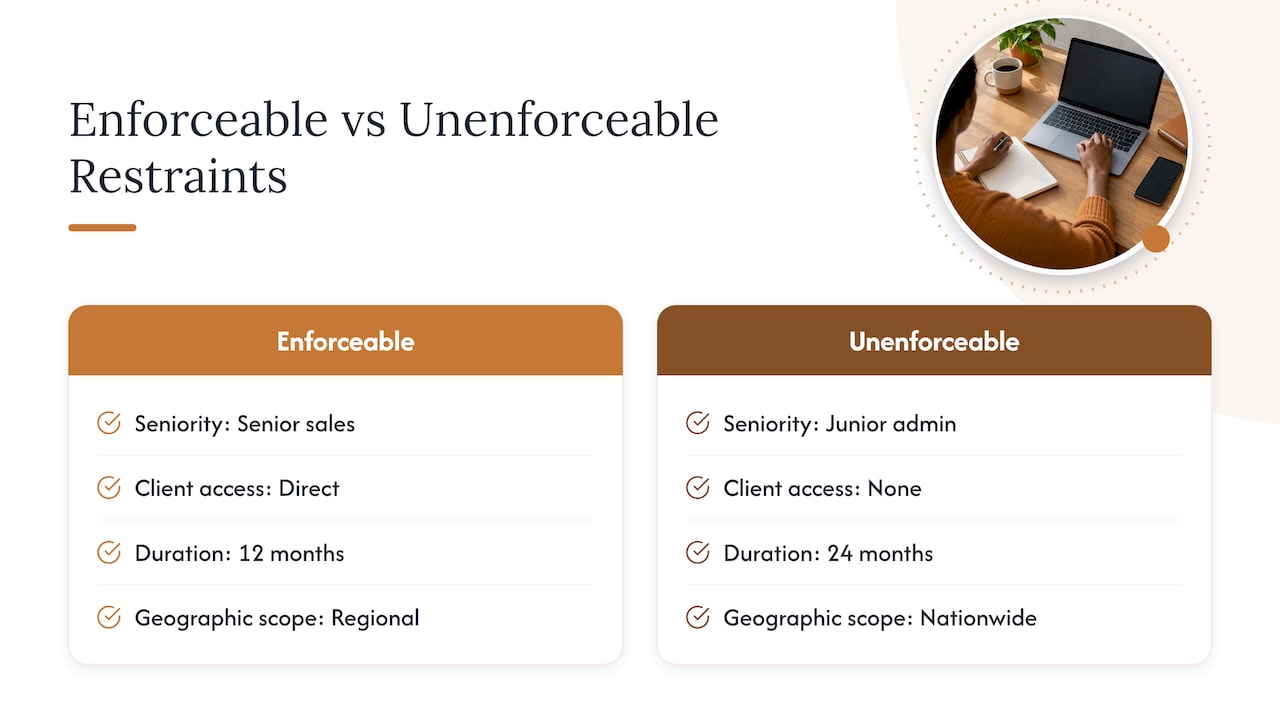
An unenforceable restraint typically looks like this: a junior administrative employee with no client contact signs a 24-month, nationwide clause barring them from working for any competitor in the industry. There is no protectable interest specific to their role, no evidence of confidential access, and the scope vastly exceeds what their position could threaten. Courts routinely strike clauses like this entirely, or narrow them so severely they lose practical effect.
Many real disputes sit between these extremes, which is exactly where the Basson four-part test does its work: a mid-level employee with partial client access and a broadly worded clause might see a court enforce the restraint for six months in a narrowed territory rather than the full term and scope originally drafted. The outcome depends entirely on matching the clause’s reach to the evidence the employer can actually produce.
How Restraint of Trade Plays Out Across Different Sectors
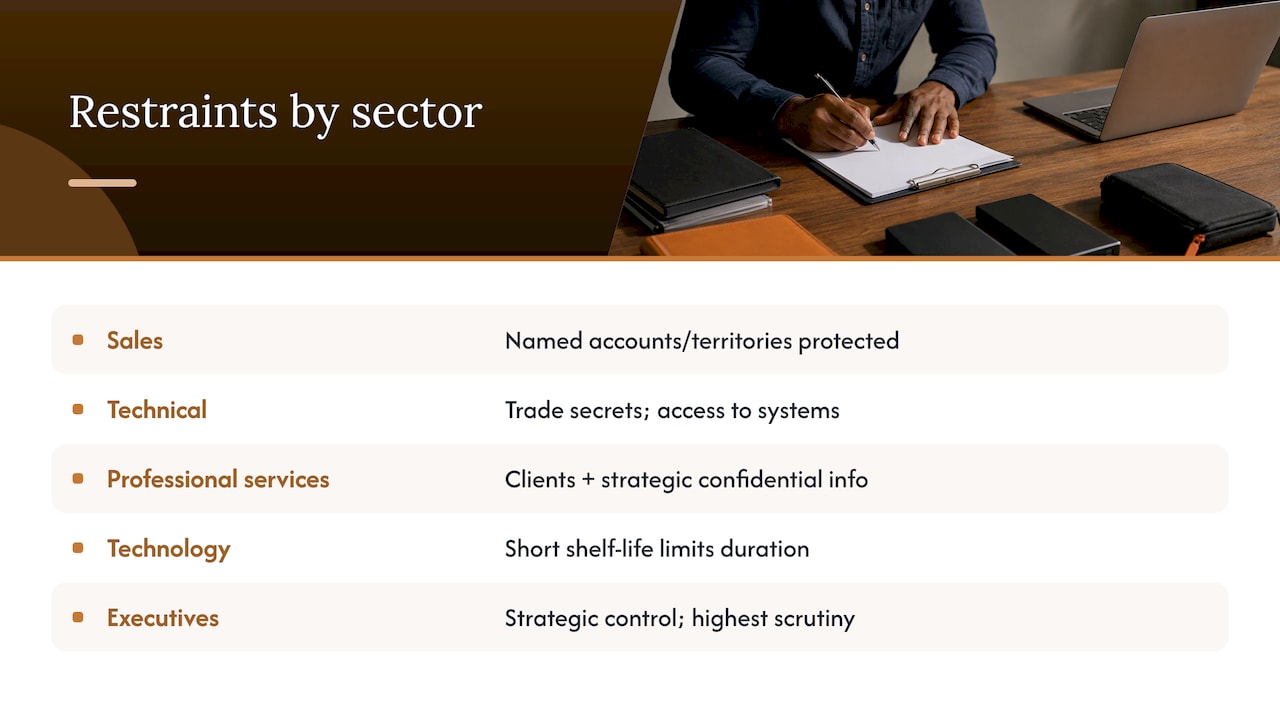
The same legal test applies everywhere in South Africa, but how it lands differs sharply by sector. In sales and client-facing roles, trade connections are the dominant protectable interest, and restraints tend to focus on named accounts and territories rather than broad industry bans. In technical and engineering fields, trade secrets, proprietary processes, and confidential technical know-how carry more weight, and courts look closely at what systems and documentation the employee actually accessed.
Professional services, including finance, consulting, and legal practice, often involve both client relationships and confidential strategic information, which tends to produce broader restraints that still need specific evidentiary support to survive. In fast-moving sectors like technology, the shelf-life of information matters a great deal: a 24-month restraint protecting a pricing model that changes every quarter is harder to justify than the same duration protecting a long-term client relationship in professional services.
Executive and senior management restraints tend to draw the most scrutiny and the most willingness from courts to enforce them as written, since these roles typically involve genuine strategic knowledge and real influence over client relationships. Whatever the sector, the underlying question stays the same: does the specific role create a real, identifiable risk to a protectable interest, matched by evidence rather than assumption.
Practical Risk Management When Hiring Across Borders
Restraints work best when they are precise. An overbroad template weakens your case before you ever reach court, and the evidence, not the signature, decides most disputes. International employers hiring into South Africa should insist on local legal review of any restraint clause and keep access and client records from day one, long before a dispute arises.
— Roel
How We Support Compliant Hiring and Restraint Readiness in South Africa
We built our Employer of Record services around exactly this gap: a restraint clause is only as strong as the employment relationship underneath it. When you hire through us, your contracts are BCEA-compliant from the start, your ZAR payroll runs correctly, and your statutory filings, PAYE, UIF, SDL, and COIDA, are handled without you needing a local entity.

- We deliver signed, locally vetted contracts within 48 hours, with full onboarding completed in days.
- Our flat fee for Employer of Record services in South Africa starts from £299 per employee per month, with no setup fees or FX loading.
- We offer talent sourcing for skilled roles when you need vetted candidates, not just compliant paperwork.
A well-drafted restraint clause tied to a properly documented employment relationship gives you a far stronger position if a dispute ever reaches court. Check our pricing or explore our full EOR services to see how we can get your South African hire onboarded correctly from day one.
This article is general information, not a substitute for advice from a qualified lawyer. Consult a qualified legal professional about your own circumstances before acting on anything here.
FAQ
How can you get out of a restraint of trade in South Africa?
There is no automatic statutory exit from a restraint of trade in South Africa. You must persuade a court the clause is unreasonable, typically by showing the employer has no genuine protectable interest, that the scope is overbroad, or that it exists only to block competition rather than protect a real business interest.
How long can a restraint of trade be enforced in South Africa?
Employee restraints commonly run for 6 to 24 months, though there is no fixed legal maximum. Courts often reduce or strike durations they consider excessive once they weigh the employer’s actual need against the industry and the employee’s role.
What are the main legal tests for a restraint of trade in South Africa?
The core test comes from Basson v Chilwan, which asks whether the employer has a protectable interest, whether it is threatened, how the competing interests balance, and whether public policy affects the outcome. This sits alongside the Magna Alloys presumption that a signed restraint is valid until proven otherwise.
What does “restraint of trade” mean in a South African employment contract?
A restraint of trade is a contractual clause that limits a former employee’s ability to compete, solicit clients, or use confidential information for a specified time and area after they leave. It is enforceable only if it protects a legitimate interest and is reasonable in scope, geography, and duration, as explained in detail by MJ Kotze Inc.
Do employers need to prove an employee actually misused confidential information?
No. South African courts frequently accept that demonstrating access to confidential information and the potential for competitive harm is sufficient, without requiring proof that misuse actually occurred. This is why maintaining clear access and role records matters so much for employers.
Sources
- Restraint of Trade Agreements in South Africa | MJ Kotze Inc
- Understanding Restraints of Trade in South Africa
- Restraint of trade in SA | Kern Attorneys
- Reddy v Siemens 2006 SCA 164 | SAFLII