

Product Managers in South Africa earn a median base salary in the range of R580,000–R950,000 per year at the mid-career level, with total compensation often running higher once bonuses and benefits are included. Indeed reports an average base of R40,776 per month (roughly R489,000/year) across 37 submissions as of May 7, 2026, while Glassdoor’s Johannesburg page and Levels both show city-level figures that track closely with that national average.
Quick city and percentile snapshot (2026 data):
- Johannesburg (25th/50th/75th): approximately R480,000 / R650,000 / R950,000 per year
- Cape Town (25th/50th/75th): approximately R450,000 / R620,000 / R900,000 per year
- National median (all levels combined): approximately R489,000–R650,000 per year base
Sources triangulated: Levels.fyi, Glassdoor, PayScale, and Indeed. Sample sizes vary by platform (37–200+ submissions), so the ranges above reflect a triangulated view rather than any single dataset.
Key Takeaways
| Point | Details |
|---|---|
| National median base | Mid-level PMs earn R580,000–R950,000/year; the Indeed-reported average is R489,000/year base across 37 submissions. |
| City premium | Johannesburg median (R650,000) runs slightly above Cape Town (R620,000) at the 50th percentile. |
| Seniority range | Entry roles start at R320,000–R550,000; Director/Head of Product reaches R1,800,000–R2,600,000+. |
| True employer cost | Add UIF (1%), SDL (1%), COIDA (~1%), and benefits to gross salary; a R750,000 base costs notably more all-in per year. |
| Expandtosouthafrica | Handles BCEA contracts, ZAR payroll, and all statutory filings for $399/month flat, with contracts signed within 48 hours. |
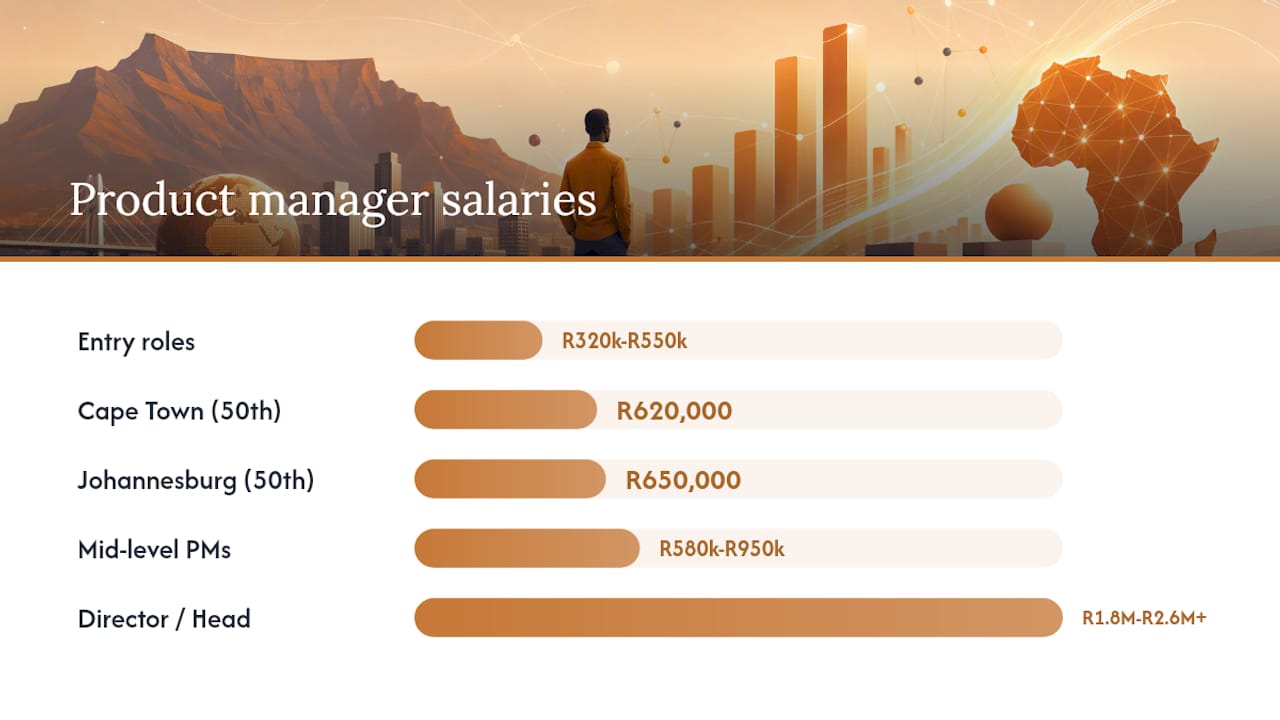
Table of Contents
- What does product manager salary in South Africa look like city by city?
- How does pay change from junior to director level?
- How does your industry affect what you pay a product manager?
- What does total compensation look like beyond base salary?
- How should you benchmark and negotiate product manager offers?
- What is the true employer cost of hiring a product manager in South Africa?
- Where do these numbers come from, and how should you read them?
- My take on what hiring managers consistently get wrong
- Hiring a product manager in South Africa without the compliance overhead
- Sources
What does product manager salary in South Africa look like city by city?
Johannesburg consistently reports the highest median pay among South African metros, driven by the concentration of financial services, large technology firms, and multinational headquarters. Cape Town follows closely, with a slight discount that reflects both a smaller enterprise market and a higher proportion of startup and scale-up employers that offset lower cash with equity.
When you set pay bands, the 50th percentile is your market-rate anchor. Targeting the 75th is appropriate for senior hires or roles requiring specialized domain knowledge (fintech, e-commerce, or platform engineering). The 90th percentile is relevant only for Director-level or Head of Product positions where the talent pool is genuinely thin.
A practical note on currency: these figures are denominated in South African rand (ZAR). For USD budgeting, divide by the prevailing ZAR/USD rate. At R18.50/USD, the national median of R580,000 equals approximately $31,350 per year in base salary alone.
How does pay change from junior to director level?
Seniority is the single largest driver of pay variance in South African product management. Jobrato’s 2026 sector analysis provides the clearest experience-tier breakdown available, and it maps well against PayScale and Glassdoor submissions.
- Entry / Associate PM (0–2 years): R320,000–R550,000 per year. Titles include Associate Product Manager, Junior PM, or Graduate PM. At the 50th percentile, expect R420,000–R450,000. Product Owner roles at this level overlap significantly; PayScale reports an average Product Owner total compensation of R617,495 with a range of roughly R303,000–R1,000,000, which spans entry through senior.
- Mid-level PM (3–5 years) generally earn salaries falling within a typical mid-career range often cited in market postings, reflecting the most common experience tier.
- Senior PM (6–9 years) usually command higher compensation levels reflecting ownership of significant product responsibilities, with strong negotiation leverage especially in fintech and SaaS sectors.
- Lead, Head of Product, or Director level roles typically earn at the top end of the pay scale, reflecting senior leadership responsibilities. Compensation structures vary notably between sectors, with banking offering substantial cash bonuses and tech companies providing equity incentives.
Typical progression timelines run 18–30 months between associate and mid-level, and 24–36 months between mid and senior, assuming consistent performance.
How does your industry affect what you pay a product manager?
Sector matters as much as seniority when you are setting a compensation budget. Jobrato’s analysis draws a clear line between two dominant pay architectures in South Africa:
That distinction has direct budget implications. A senior PM at a Series B SaaS company may earn a lower base but hold stock appreciation rights (SARs) or options that could materially increase total compensation over a 3–4 year vesting period.
Industries that typically pay above the national median:
- Banking and financial services (Absa, Standard Bank, Nedbank, FNB): highest guaranteed cash, structured bonus pools
- Fintech and payments (scale-ups and licensed payment service providers): competitive cash plus early equity
- E-commerce and retail tech: ERI data shows an e-commerce Product Manager average near R976,466/year, reflecting the premium for platform-scale experience
- Telecommunications (MTN, Vodacom): strong base pay, lower equity, generous benefits
Industries that typically pay at or below the median:
- Early-stage startups (pre-Series A): lower base, higher equity risk, often no formal bonus structure
- Non-profit and public sector: structured grades, limited flexibility
- Traditional retail (non-digital): product roles are newer and pay bands are still maturing
Pro Tip: When benchmarking for a fintech or banking hire, request total guaranteed package (TGP) figures from Glassdoor and PayScale separately from tech-sector submissions. Mixing the two pools in a single average will understate what banking candidates expect and overstate what a startup can realistically offer.
What does total compensation look like beyond base salary?
Base salary is only part of what a Product Manager in South Africa expects. Structuring a competitive offer means understanding each component and how it adds up.
- Base salary: The fixed monthly amount, typically paid 12 times per year. Some employers pay a 13th cheque (an additional month’s salary) as a guaranteed year-end payment, which is common in banking and large corporates.
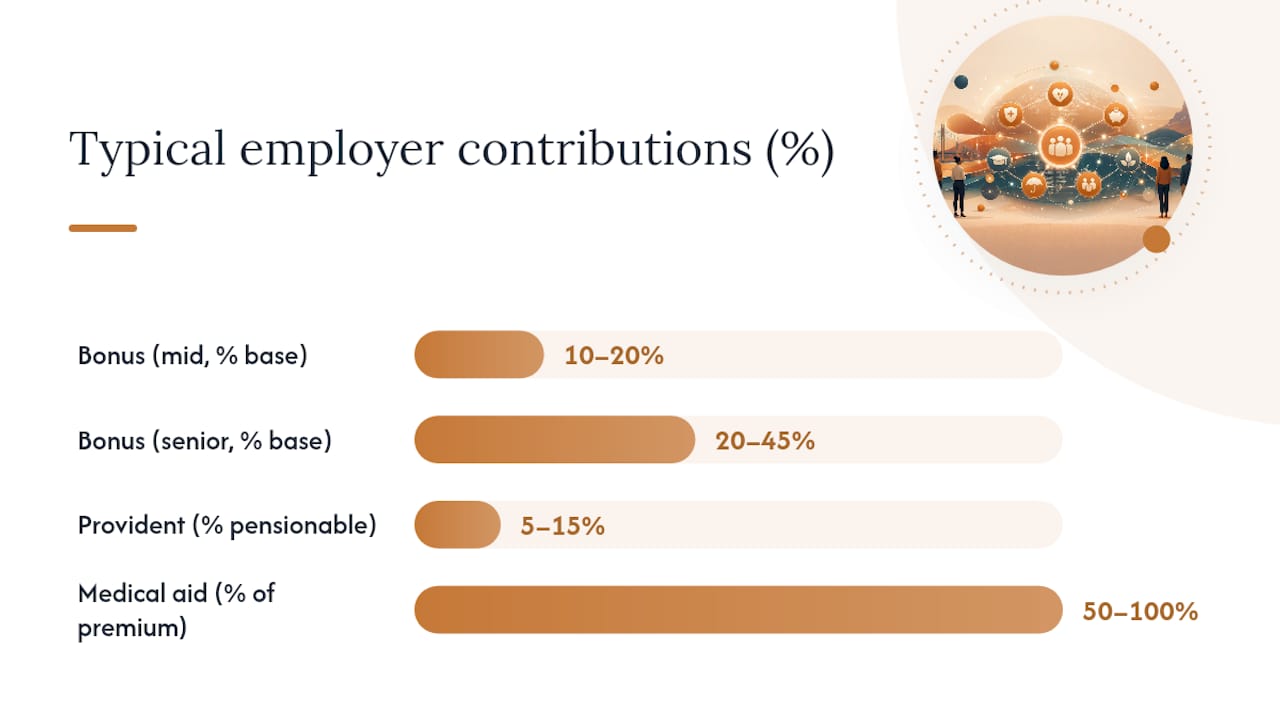
- Performance bonus: Usually 10–20% of base for mid-level PMs, rising to 20–45% for senior and director-level roles in financial services. Startups may offer discretionary bonuses with no guaranteed floor.
- Equity / stock appreciation rights (SARs): More common in tech and fintech. Vesting schedules of 3–4 years with a one-year cliff are standard. Early-stage companies may grant options; listed companies typically use SARs or restricted share units (RSUs).
- Medical aid subsidy: Employers commonly contribute 50–100% of the employee’s medical aid premium. Discovery Health and Momentum are the dominant providers. This is a significant benefit: a comprehensive plan for an individual can cost R3,000–R5,000 per month.
- Provident / pension fund contribution: Employer contributions of 5–15% of pensionable salary are standard. These are tax-deductible for the employer up to SARS thresholds.
- Leave entitlements: The Basic Conditions of Employment Act (BCEA) mandates a minimum of 15 working days of annual leave per year. Most professional roles offer 20 days.
A total compensation example for a mid-level PM in Johannesburg includes base salary, performance bonus, medical aid subsidy, and provident fund contributions, combining to a figure moderately above base pay but varying by employer and benefits.
SalaryExpert’s data for specialized Digital Product Manager roles shows a median near R988,330/year, which aligns with this total-comp picture for experienced mid-to-senior candidates in digital-first organizations.
How should you benchmark and negotiate product manager offers?
A structured approach saves time and reduces the risk of losing a candidate to a competing offer or overpaying relative to the market.
- Define your comparator cohort. Decide whether you are benchmarking against the national market, a specific city, or a specific sector. A fintech hire in Cape Town requires a different reference set than a mid-level PM at a Johannesburg retailer.
- Choose your percentile target. The 50th percentile is market rate. Use the 65th–75th percentile for roles where you need to move quickly or where the candidate has specialized skills (platform, AI/ML product, or regulated financial products).
- Separate base from total comp. Candidates in South Africa increasingly evaluate total guaranteed package (TGP), which bundles base, employer benefits contributions, and sometimes a guaranteed bonus. State both figures clearly in the offer letter.
- Include statutory employer costs in your budget. The gross salary you offer is not your total cost. Add UIF, SDL, COIDA, and benefits contributions before presenting a budget to your finance team (see the worked example in the next section).
- Account for currency and payroll logistics. If you are hiring from the US or Europe, decide whether the employee is paid in ZAR or USD. ZAR payroll is standard for South African residents and required for PAYE compliance. USD arrangements introduce FX risk for the employee and complicate statutory filings.
For negotiation specifically:
- South African candidates expect a counter-offer opportunity. Build 5–8% of headroom into your initial offer.
- Notice periods of one to three months are standard at senior levels under the BCEA. Factor this into your start-date planning.
- Remote-work allowances (home office, data/connectivity stipends) are increasingly expected and can be structured as tax-efficient expense reimbursements under SARS rules.
- Equity vesting language should specify the governing law (South African or foreign) and the treatment of unvested shares on termination, particularly given CCMA jurisdiction over unfair dismissal claims.
What is the true employer cost of hiring a product manager in South Africa?
The gross salary is the starting point, not the final number. Every South African employer must budget for statutory contributions on top of the employee’s package. Here is a worked example for a mid-level PM at R750,000 per year (R62,500/month gross).
At R18.50/USD, the total annual employer cost for this hire is approximately $47,757.
Statutory obligations every employer must understand:
- PAYE (Pay As You Earn): Withheld from the employee’s salary and remitted monthly to SARS via the EMP201 return. The employer is legally responsible for correct withholding.
- UIF (Unemployment Insurance Fund): 1% from the employer and 1% from the employee, capped at a monthly remuneration ceiling set by the Department of Employment and Labour.
- SDL (Skills Development Levy): 1% of total leviable payroll, payable by employers with an annual payroll above R500,000. Funds are administered by sector education and training authorities (SETAs).
- COIDA (Compensation for Occupational Injuries and Diseases Act): Annual assessment based on earnings and industry risk class. Rates vary; budget approximately 1% for office-based professional roles.
Pro Tip: US employers paying in USD should confirm with their payroll provider that ZAR payroll is run locally for PAYE compliance. POPIA (South Africa’s data protection law) and GDPR both apply when personal payroll data flows between South Africa and the EU or US. Expandtosouthafrica handles data under POPIA and GDPR with EU data residency, which removes this compliance burden from your team. For payroll cadence, South Africa’s standard is monthly payroll, which aligns well with the ±1 hour CET time zone overlap for European finance teams.
Use Expandtosouthafrica’s employment cost calculator to run these numbers against any salary figure before you make an offer.
Where do these numbers come from, and how should you read them?
No single salary database covers the South African product management market with enough depth to rely on alone. Cross-referencing three or more sources gives you a more defensible benchmark.
- Levels.fyi: Provides city-level pages (Cape Town, national) with median and typical ranges. Strongest for tech and multinational roles. Sample sizes are smaller than Glassdoor but submissions tend to be more detailed.
- Glassdoor: City-specific pages for Johannesburg with employer-submitted samples. Good for corporate and financial services benchmarks. Check the “last updated” date on each page; figures can lag by 6–12 months.
- PayScale: Experience-level splits make it useful for setting entry-to-mid bands. The Product Owner page (R617,495 average total comp) is a reasonable proxy when Product Manager sample sizes are thin.
- Indeed: Useful for base-salary averages (R40,776/month as of May 7, 2026, from 37 submissions). The sample is smaller than Glassdoor, so treat it as a directional check rather than a primary benchmark.
Methodology notes worth keeping in mind:
- Prefer the median over the mean when sample sizes are below 50. A handful of Director-level submissions can pull the mean significantly above the typical candidate’s expectation.
- Single-employer pages on Indeed (for example, a large multinational’s senior PM listings) often reflect a narrow, high-end slice of the market. Indeed’s employer-specific pages for companies like Amazon are based on limited submissions and should not be used for market-wide benchmarking.
- When your target role is a specialized variant (Digital PM, e-Commerce PM, Technical PM), check SalaryExpert and ERI in addition to the general PM pages. Specialization premiums of 20–40% above the general median are common.
- WorldSalaries reports a median Product Owner salary of approximately R431,300/year, which is useful as a lower-bound comparator when your role sits closer to a Product Owner than a full Product Manager scope.
My take on what hiring managers consistently get wrong
South African product management salaries look straightforward on a spreadsheet, but the most common mistake I see from US and European hiring managers is treating the national average as the relevant benchmark for every hire. It is not. A senior fintech PM in Johannesburg with payments domain expertise and FSCA regulatory knowledge is not competing in the same talent pool as a mid-level PM at a Cape Town e-commerce startup. The salary difference between those two candidates can exceed R500,000 per year in total compensation, and conflating them in a single benchmark will either price you out of the fintech hire or overpay for the startup role.
The second mistake is underestimating the speed at which senior South African PMs receive competing offers. The talent pool at the R1.1m–R1.65m band is genuinely thin. If your process runs longer than three weeks from first interview to signed offer, you will lose candidates. An Employer of Record structure, where contracts can be signed within 48 hours of agreement, removes one of the most common delay points: the legal and payroll setup that a new entity hire requires.
For most international companies hiring one to five Product Managers in South Africa, establishing a local subsidiary is rarely justified by the volume. The compliance overhead of PAYE registration, UIF filings, SDL submissions, and COIDA assessments is material, and the CCMA’s jurisdiction over unfair dismissal adds legal risk that is best managed by a specialist. An EOR is the faster, lower-risk path until headcount justifies the entity investment.
Hiring a product manager in South Africa without the compliance overhead
Knowing the salary benchmarks is only half the work. The other half is making sure the offer is legally compliant, the payroll runs correctly in ZAR, and your statutory obligations to SARS, the UIF, and COIDA are met from day one.
Expandtosouthafrica is built for exactly this situation: an international company that wants to hire a full-time South African Product Manager without setting up a local entity. For a flat fee of $399 per employee per month (no setup fees, no FX loading), Expandtosouthafrica handles BCEA-compliant contracts, ZAR payroll, PAYE filings via EMP201, UIF, SDL, and COIDA, all under POPIA and GDPR with EU data residency. Contracts are signed within 48 hours. If you also need help finding the right candidate, talent sourcing is available as part of the service.
Your next steps:
- Run your salary figure through the employment cost calculator to get a full employer-cost breakdown in ZAR and USD before you make an offer.
- Review the EOR services page to confirm scope and compliance coverage.
- Contact Expandtosouthafrica to get a tailored cost estimate and start onboarding within days.
Sources
These public pages are the most reliable starting points for verifying or updating the figures in this article:
- Product Manager Salary in South Africa: Tech vs. Banking Sectors – Jobrato
- Product Owner Salary in South Africa in 2026 | PayScale
- Product manager salary in South Africa
- Product Manager Salary in Cape Town, South Africa
- Salary: Product Manager in Johannesburg, South Africa 2026
Recommended
- Hire software developers in South Africa (salaries + how to employ them) – Expand to South Africa
- Hire customer support in South Africa (salaries + how to employ them) – Expand to South Africa
- Data Analyst Salary South Africa: 2026 Employer Guide | Expand to South Africa
- Hire sales reps in South Africa (salaries + how to employ them) – Expand to South Africa