

South African law sets no fixed probation period, but it must be reasonable, commonly three to six months, and probationary employees carry full unfair dismissal protection from their first day. We recommend employers act on three fronts immediately: write probation terms into the contract, document every review in detail, and follow a fair procedure before extending or ending employment.
TL;DR:
- Probation periods in South Africa are typically three to six months and must be reasonable; they do not reduce the employee’s unfair dismissal protection from day one.
- Employers must include written probation terms in the employment contract, document all reviews carefully, and follow a fair process before dismissing or extending employment.
- Documentation should include clear, measurable performance criteria, scheduled reviews, and records of support and interventions to withstand CCMA scrutiny.
- Extending probation requires written reasons and a new timeframe; dismissals must be based on documented performance and conducted through a proper pre-dismissal hearing.
- Statutory entitlements such as leave and UIF contributions apply from the first day, regardless of probation status, and the law does not specify a fixed probation length.
Table of Contents
- What probation does and the legal rights of probationary employees
- How long is reasonable: deciding and documenting probation duration
- Fair procedure during probation: a step-by-step checklist for employers
- Extending, confirming, or dismissing after probation: lawful steps and risk mitigation
- Contract wording, BCEA written particulars, and recordkeeping checklist
- Common mistakes and red flags HR should fix immediately
- Impact of probation period on employee benefits and entitlements
- Differences in probation period treatment across various South African industries or sectors
- Legal consequences and remedies for employees if probation is unfairly terminated
- Employer and employee obligations during probation beyond dismissal procedures
- Best practices for conducting effective performance evaluations during probation
- Our take on where employers get probation wrong
- Need compliance support for South African hires?
- FAQ
- Sources
What probation does and the legal rights of probationary employees
Probation exists so employers can assess whether a new hire suits the role before confirming permanent appointment. It is not a separate legal category with weaker protections. The Code of Good Practice on Dismissal, contained in Schedule 8 to the Labour Relations Act, treats probation as a tool for evaluating suitability, not a license to dismiss without reason.
Many employers assume new hires only gain protection after a qualifying period, similar to rules in other countries. That assumption is wrong here.
- Unfair dismissal protection applies from the employee’s first day, with no waiting period before a CCMA referral becomes possible.
- Probation clauses must appear in the written contract from the start; employers cannot impose probation retroactively once employment has begun.
- Informal understandings of a “trial period” carry no legal weight unless captured in writing and backed by a fair process.
Unfair dismissal protection applies from day one, according to the Code of Good Practice on Dismissal, meaning a dismissal during month one of probation faces the same scrutiny as one in month eleven of permanent employment. The Labour Relations Act 66 of 1995 is the governing statute behind this protection, and the CCMA treats probation disputes with the same rigor it applies to any other unfair dismissal claim. Employers who rely on casual, undocumented decision-making during probation routinely lose these cases, not because the dismissal was wrong in substance, but because the process behind it could not be proven.
How long is reasonable: deciding and documenting probation duration
No statute caps probation length in South Africa. The Code of Good Practice on Dismissal requires only that the period be reasonable and tied to how long it actually takes to judge whether someone fits the role. Common practice typically involves a probation period lasting a few months, but a specialist or senior position can justify longer, provided you can show why.
- Map the role’s complexity: a call center agent needs far less time to prove competence than a senior engineer learning a bespoke system.
- Factor in training time: if onboarding alone takes eight weeks, probation should extend well beyond that before any fair assessment is possible.
- Set measurable milestones in advance: targets, deliverables, or certifications the employee must reach by specific dates.
- Keep a short justification note on file whenever probation runs longer than six months, explaining the role-specific reasons.
Pro Tip: Write your reasoning for a longer probation period into the contract itself, not just an internal memo, so the employee has seen and acknowledged it from day one.
Fair procedure during probation: a step-by-step checklist for employers
A defensible probation dismissal rests entirely on process. Skipping steps here is the most common reason employers lose CCMA cases, even when the underlying performance concerns were real.
- Set objective, written performance criteria and share them with the employee on or before their start date.
- Hold structured review meetings at regular intervals, recording the date, attendees, and specific feedback given.
- Offer genuine support, such as training or coaching, document each intervention, and set a measurable improvement window.
- Hold a pre-dismissal hearing, allow the employee to bring a representative, and record their responses in writing.
- Deliver a written outcome and observe the notice periods set out in the Basic Conditions of Employment Act.
Two patterns separate defensible dismissals from ones that collapse under CCMA scrutiny:
- Employers who document coaching and set measurable, time-bound goals fare substantially better when a dispute reaches the CCMA.
- Employers who rely on verbal warnings or vague dissatisfaction, without dates or written criteria, struggle to prove their case even when the performance issue was genuine.
Pro Tip: Treat every probation review as if a commissioner will read it later. A one-paragraph summary with a date, named attendees, and specific next steps beats a lengthy but vague email every time.
If you are navigating a dismissal that blends performance and conduct concerns, our guide to misconduct dismissal in South Africa walks through the separate procedural requirements that apply.
Extending, confirming, or dismissing after probation: lawful steps and risk mitigation
At the end of probation, you have three paths: extend, confirm, or dismiss. Each carries distinct documentation requirements.
- To extend lawfully, state valid reasons in writing, set fresh objectives, and define a new timeframe; an extension with no stated reason is itself a common ground for challenge.
- To confirm appointment, keep a written record of the final review and the decision, even though no further action is required from the employee’s side.
- To dismiss, tie every reason directly to documented performance or conduct records, and complete the pre-dismissal hearing before issuing any outcome.
- Watch for recurring CCMA challenge themes: extensions with no new objectives, dismissals with no prior warning of shortcomings, and outcomes that cite reasons never raised in earlier reviews.
Case-law analysis from academic reviews of probation dismissals confirms that courts reject the idea that probation permits summary dismissal, reinforcing that substance and process both matter, regardless of how early in employment the dismissal happens.
Contract wording, BCEA written particulars, and recordkeeping checklist
Your written contract is the foundation of a defensible probation process. Without a clear clause, you cannot rely on probationary status at all.
- Include duration, the specific criteria for success, the process for extension, and any notice terms that apply during probation itself.
- Meet the written particulars requirements under the Basic Conditions of Employment Act, including minimum notice entitlements that apply once probation ends.
- Keep reviews, warnings, training logs, and final outcome letters on file for the duration of employment and beyond, in case of a later referral.
- If no written probation clause exists, you cannot impose a probationary regime retroactively. This is a common litigation trap; fix it going forward by issuing an addendum for new hires rather than assuming past hires are covered.
Pro Tip: Store probation documentation separately from general HR files so a reviewer or commissioner can trace the full timeline in minutes, not hours.
For sample clauses and the full list of required written particulars, see our breakdown of essential employment contract clauses for South Africa.
Common mistakes and red flags HR should fix immediately
Several patterns show up again and again in disputed probation cases, and most are avoidable with small process changes.
- Treating probation as a free pass to dismiss without documentation, training logs, or measurable criteria in place.
- Extending probation repeatedly with no stated reason, which courts and commissioners read as an attempt to avoid permanent status.
- Blending disciplinary processes into probation reviews without separating the two procedurally, which confuses the record and weakens either case.
- Skipping BCEA notice rules or failing to offer support before moving to dismissal.
Fix these with three simple tools: a probation checklist pinned to every new hire’s file, a standard meeting note template for reviews, and a short extension justification form that managers must complete before any extension takes effect.
Impact of probation period on employee benefits and entitlements
Probationary status does not reduce statutory entitlements. Employees on probation remain covered by the same Unemployment Insurance Fund contributions, Skills Development Levy obligations, and Compensation for Occupational Injuries and Diseases Act protections as permanent staff, because these flow from employment itself, not from confirmed status.
Where differences do appear, they typically sit in company policy rather than law: some employers withhold discretionary benefits, such as medical aid subsidies or performance bonuses, until probation is confirmed. That is lawful provided the contract states it clearly, but it must not extend to statutory entitlements like leave accrual or UIF contributions, which apply from the first day of employment regardless of probationary status.
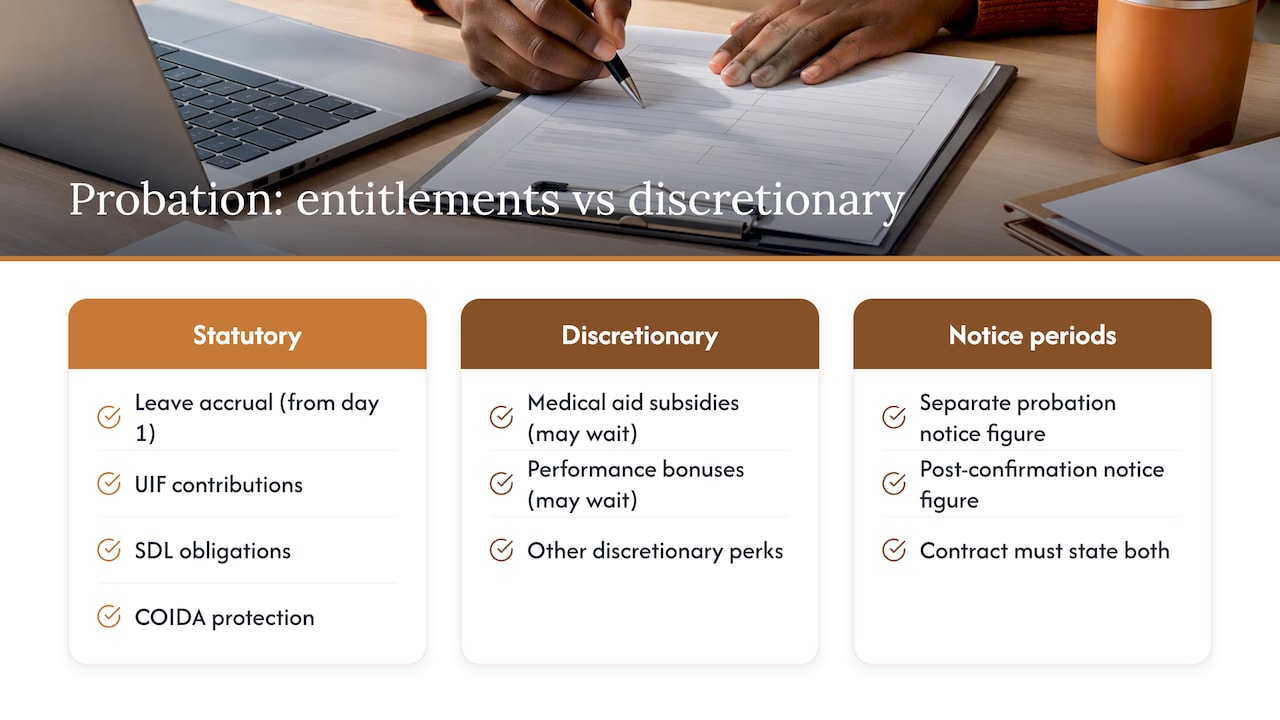
Notice periods during probation can differ from post-probation notice, and your contract should spell out both figures separately so there is no ambiguity about which applies when. Confusing the two is a frequent source of disputes when a probationary employee resigns or is dismissed and expects the longer, post-confirmation notice period to apply.
Differences in probation period treatment across various South African industries or sectors
Probation length and rigor vary by sector, largely because the time needed to assess suitability differs by role complexity. Entry-level retail or hospitality positions often run shorter probation periods, sometimes one to three months, since competency becomes clear quickly. Technical, engineering, and specialist professional roles tend toward the longer end of the typical three to six month range, since skills and fit take longer to evaluate.
Sectors covered by bargaining councils or sectoral determinations may have additional rules layered on top of general labor law, including specific notice periods or probation terms set by collective agreement. Employers in construction, mining, and certain unionized industries should check the applicable bargaining council agreement before setting probation terms, since these can override or supplement the general Basic Conditions of Employment Act defaults.
Public sector and parastatal employers often apply longer, more formalized probation processes with multiple review stages, reflecting internal governance requirements rather than any different legal standard. Regardless of sector, the underlying legal principle from the Code of Good Practice on Dismissal remains constant: duration must be reasonable, and fair process applies throughout.
Legal consequences and remedies for employees if probation is unfairly terminated
An employee dismissed unfairly during probation has the same remedies available as any other unfairly dismissed employee. They can refer a dispute to the CCMA, typically within strict time limits after the dismissal, and a commissioner will assess both the substantive reason and the procedure followed.
Remedies a commissioner can award include reinstatement, re-employment, or compensation, and the outcome depends heavily on whether the employer kept adequate records. The Department of Employment and Labour has emphasized that probation cannot be used to cycle through employees as a way of avoiding permanent status, and dismissals that fit this pattern face heightened scrutiny.
Employers who skip documented reviews or a pre-dismissal hearing expose themselves to compensation awards even when the underlying performance concern was genuine, because the CCMA assesses fairness of process separately from fairness of outcome. If you are facing a referral or want to understand the early timeline, our guide on CCMA unfair dismissal for employers abroad covers the first 72 hours in detail.
Employer and employee obligations during probation beyond dismissal procedures
Probation is a two-way arrangement, not a one-sided evaluation window. Employers must communicate expectations clearly, provide the training or support reasonably needed to meet them, and conduct reviews at the intervals promised in the contract. Failing to provide promised training, then dismissing for underperformance, weakens your position considerably if challenged.

Employees, in turn, are expected to engage honestly with feedback, meet reasonable performance standards, and raise concerns about unclear expectations or inadequate support rather than staying silent until a review goes badly. Both sides benefit from treating probation as a structured onboarding period rather than a passive waiting game.
Beyond performance, ordinary employment obligations continue unchanged: health and safety duties, confidentiality terms, and codes of conduct all apply to probationary employees exactly as they would to any permanent staff member. Employers should resist the temptation to relax enforcement of workplace policies during probation simply because the relationship still feels provisional.
Best practices for conducting effective performance evaluations during probation
Effective probation evaluations share a few consistent traits. They are scheduled in advance rather than sprung on the employee, tied to specific, written criteria set at the start of employment, and focused on observable outcomes rather than general impressions.
- Schedule reviews at fixed intervals, such as monthly, and stick to that schedule even when performance looks strong.
- Use the same written criteria from the contract as the basis for every review, so the employee can track progress against a stable standard.
- Give the employee a chance to respond in writing and include that response in the record.
- End every review with clear next steps and a date for the following check-in, regardless of how the current one went.
Employers who skip structured reviews in favor of informal check-ins often find they have little to show a commissioner later, even when real conversations happened. A short written summary after each meeting protects both you and the employee by creating a shared, accurate record of what was discussed and agreed.
Our take on where employers get probation wrong
The biggest risk during probation is not the dismissal itself. It is the illusion that probation grants informal flexibility that the law never actually provides. We see employers treat early-stage hires casually, skip written criteria, and then scramble for documentation once a dispute lands at the CCMA.
Three priorities matter most: write objective criteria into the contract from day one, hold and document every review on schedule, and bring in HR or legal expertise before extending or dismissing, not after a complaint arrives. For complex cases involving specialist roles or cross-border hiring, a labor attorney’s early input is worth far more than a rushed decision.
— Roel
Need compliance support for South African hires?

Managing probation correctly from abroad adds complexity: unfamiliar notice rules, local documentation standards, and statutory filings most international HR teams have never handled. Our Employer of Record services help international companies hiring full-time staff in South Africa by managing local HR compliance and payroll.
- BCEA and LRA-compliant contracts with probation clauses.
- Local ZAR payroll, PAYE, UIF, and COIDA statutory filings handled.
- Contracts signed promptly and onboarding completed efficiently to support your hiring needs.
If you are weighing whether to onboard a South African hire directly or verify documents during recruitment, our partner at Oaths handles digital certification of South African documents for employees and employers abroad. When you are ready to see costs, check our pricing for Employer of Record services, from £299 per month per employee.
FAQ
What is the salary during a 3-month probation period in South Africa?
Employees on probation are entitled to the full salary and benefits specified in their contract; South African law does not permit reduced pay simply because someone is on probation. Any pay structure must match what was agreed in writing before employment began.
Can I be terminated during the probation period?
Yes, but only through a fair process: written criteria set at the start, documented reviews, an opportunity to improve, and a pre-dismissal hearing before any final decision. Unfair dismissal protection under the Code of Good Practice on Dismissal applies from the employee’s first day, with no waiting period.
What is the law of a 3-month probation period?
South African law sets no fixed three-month rule; the Code of Good Practice on Dismissal requires only that probation be reasonable and linked to the time needed to assess suitability. Three months is common for straightforward roles, but the actual requirement is reasonableness, not a specific number.
How does a 3-month probation period work in practice?
A typical probation period involves written performance criteria shared at the start, scheduled reviews during the period, and a final assessment before the employer confirms, extends, or ends the employment relationship. Throughout, the employee retains full unfair dismissal protection and the employer must follow fair procedure at every stage.