

The right Oyster HR alternative depends on one question: what is your primary constraint? If your legal team requires direct-liability controls, an owned-entity Employer of Record such as Remote is the correct category. If you need to consolidate HR, IT, and payroll into a single system, Rippling leads that field. If cost is the primary driver for global contractor or EOR coverage, Remofirst and Multiplier offer lower entry points. And if your requirement is a single country, specifically South Africa, Expandtosouthafrica is the only specialist built exclusively for that market, with BCEA-compliant contracts, ZAR payroll, and statutory filings handled by a licensed local partner at a published flat fee of €350 / $399 / £299 per employee per month.
Shortlist by use case:
- Strict compliance / owned-entity requirement: Remote, Deel (owned-entity markets)
- All-in-one HR, IT, and payroll consolidation: Rippling
- Finance-first payroll with strong GL integrations: Papaya Global
- Low-cost global EOR or contractor-first hiring: Remofirst, Multiplier
- Mid-market with US-based PEO needs: Justworks
- European-focused EOR with GDPR depth: WorkMotion
- Single-country South Africa specialist: Expandtosouthafrica
The Oyster HR alternatives market has expanded considerably, with public pricing bands spanning a wide range to reflect genuinely different products, not just different price points. That spread reflects genuinely different products, not just different price points.
Table of Contents
- How do the top Oyster HR alternatives compare?
- Per-provider profiles: what each alternative actually delivers
- How do you choose the right Oyster HR alternative?
- Why do companies look for alternatives to Oyster HR?
- How we evaluated these platforms
- Key Takeaways
- What most EOR comparisons get wrong
- Expandtosouthafrica: the South Africa-only EOR built for compliance-first hiring
- Useful sources and vendor docs to read next
How do the top Oyster HR alternatives compare?
The table below maps each provider across the dimensions that matter most to HR and finance procurement teams. Pricing bands reflect publicly available list pricing; negotiated enterprise rates typically run lower.

| Provider | Best for | Pricing band (per employee/mo) | Countries | EOR model | Onboarding time | Payroll & benefits | Key integrations | Support / SLA | Compliance guarantee | Data residency |
|---|---|---|---|---|---|---|---|---|---|---|
| Deel | Global contractor + EOR at scale | contractor and EOR pricing available | 150+ | Mixed (owned + partner) | onboarding times vary by region | Full payroll, benefits, equity | Slack, QuickBooks, Xero, BambooHR | chat support; dedicated CSM at enterprise | Contractual indemnity | Multiple regions |
| Remote | Owned-entity compliance, IP-sensitive hires | EOR pricing as published | 80+ owned entities | 100% owned entity | typical onboarding days reported | Full payroll, benefits, stock options | Greenhouse, Lever, Workday, NetSuite | 24/7 support; SLA on payroll accuracy | Direct liability via owned entity | GDPR-compliant |
| Rippling | HR + IT + payroll consolidation | Custom (platform fee + per-seat) | 150+ EOR markets | Partner-model EOR | 5–10 days | Full payroll, device mgmt, benefits | 500+ apps, Salesforce, Okta, Workday | Business-hours + enterprise SLA | Compliance automation | US-primary; multi-region |
| Multiplier | Cost-sensitive global EOR | ~$400 EOR | 150+ | Mixed | 3–5 days | Payroll, benefits, equity | Xero, QuickBooks, Workday, Greenhouse | chat support | Contractual indemnity | GDPR-aligned |
| Papaya Global | Finance teams needing GL-level payroll data | ~$650–$770 EOR | 160+ | Partner-model | 5–10 days | Payroll, benefits, workforce analytics | SAP, Oracle, NetSuite, Workday | Dedicated CSM; SLA on payroll | Contractual indemnity | Multi-region, GDPR |
| WorkMotion | European-focused EOR with GDPR depth | ~$399 EOR | 160+ | Mixed | 3–7 days | Payroll, benefits | BambooHR, Personio, Workday | Business-hours; email SLA | Contractual indemnity | EU data residency |
| Justworks | US-based SMB / PEO co-employment | ~$59–$99 PEO | US-focused (limited EOR) | PEO (co-employment) | 1–3 days | Full US payroll, benefits, workers’ comp | QuickBooks, Xero, Gusto integrations | Dedicated team; phone + chat | Shared liability (PEO model) | US |
| Remofirst | Low-cost global EOR | ~$199 EOR | 180+ | Partner-model | 3–5 days | Payroll, basic benefits | Deel API, BambooHR | Email + chat; limited SLA | Contractual indemnity | Multi-region |
| Expandtosouthafrica | Single-country South Africa specialist | €350 / $399 / £299 flat per employee per month | South Africa only | Licensed local partner | 48-hr contracts; days to full onboard | ZAR payroll, PAYE, UIF, SDL, COIDA | Open REST API, public sandbox keys | Dedicated support; CCMA guidance | BCEA / LRA / COIDA compliant | POPIA + GDPR, EU residency |
How to read this table by buyer profile:
- Compliance-first buyers (legal / IP-sensitive): prioritize the EOR model column and the compliance guarantee column. Owned-entity providers carry direct liability; partner-model providers pass some risk to the local partner entity.
- Finance-first buyers: weight the GL integrations column and payroll SLA. Papaya Global and Rippling offer the deepest accounting-system connectors.
- Growth-at-speed buyers: onboarding time and country count matter most. Remofirst and Multiplier cover the widest markets at the lowest entry cost.
- Single-country South Africa buyers: Expandtosouthafrica is the only provider in this table built exclusively for that market, with statutory filing depth (EMP201, UIF, SDL, COIDA) that global platforms rarely match at the country level.
A note on list pricing: most providers publish a starting price that reflects their simplest use case. Full-service EOR with benefits, equity support, and dedicated account management typically adds cost. Always request a total employer cost breakdown, not just the platform fee.
Per-provider profiles: what each alternative actually delivers
Deel
Best for: companies scaling global contractor and employee headcount across multiple regions simultaneously.

Deel covers 150+ countries through a combination of owned entities and local partner arrangements. Its contractor management product starts around $49 per contractor per month, while full EOR service runs approximately $599 per employee per month. The platform handles equity and stock option support, which matters for growth-stage companies distributing options internationally. G2 reviewers consistently rate Deel highly for its breadth of country coverage and the speed of its onboarding workflow.
Pros: wide country coverage; strong equity and contractor management; extensive integration library (Slack, QuickBooks, Xero, BambooHR, and more).
Cons: partner-model entities in some markets reduce direct-liability clarity; pricing at scale can climb quickly; customer support quality varies by region.
The owned-entity vs partner-entity distinction matters here. In markets where Deel uses a partner entity rather than its own legal entity, the direct-liability posture changes, and your legal team should confirm which model applies in each target country before signing.
Remote
Best for: enterprises and IP-sensitive organizations that require a 100% owned-entity EOR model.
Remote operates its own legal entities in 80+ countries, which means it, not a third-party partner, is the employer of record in every market it covers. That structure gives legal teams direct-liability clarity and is the preferred model when protecting intellectual property or maintaining strict compliance controls. G2 reviews highlight Remote’s compliance depth and its stock option management as standout features.
Pros: owned-entity model in all covered markets; strong IP and compliance protections; GDPR-compliant data handling.
Cons: higher per-employee cost (~$599/mo); country coverage narrower than partner-model competitors; less suited for contractor-only use cases.
For a deeper look at how Remote’s owned-entity model compares to Deel’s mixed approach, the Deel vs Remote analysis on Expandtosouthafrica’s site walks through the trade-offs in practical terms.
Rippling
Best for: mid-market and enterprise teams that want to consolidate HR, IT device management, and payroll into one platform.
Rippling is not a pure EOR. It is an all-in-one workforce platform that adds EOR capability on top of a core HR and IT management system. Reviewers consistently rate it as the top option for feature breadth and integration depth, with 500+ app connectors including Salesforce, Okta, and Workday. The EOR component uses a partner model, so the same owned-entity caveat applies. Pricing is custom and typically involves a platform fee plus per-seat charges.
Pros: unmatched integration library; HR, payroll, and IT device management in one system; strong compliance automation.
Cons: partner-model EOR in most markets; pricing complexity; overkill for teams that only need EOR without the broader platform.
If you are evaluating Rippling specifically for South Africa hiring, the Rippling alternatives guide on Expandtosouthafrica’s site covers the compliance gaps that matter in that market.
Multiplier
Best for: cost-sensitive buyers who need global EOR coverage across 150+ countries without Deel-level pricing.
Multiplier positions itself as a mid-market EOR with full-service payroll, benefits, and equity support at a lower entry price than Remote or Deel’s EOR tier. G2 reviewers note its clean onboarding workflow and responsive support as strengths. The platform integrates with Xero, QuickBooks, Workday, and Greenhouse.
Pros: competitive pricing (~$400/mo EOR); strong country coverage; equity support included.
Cons: partner-model entities in many markets; compliance depth varies by country; fewer enterprise-grade integrations than Rippling or Papaya Global.
Papaya Global
Best for: finance teams that need GL-level payroll data, workforce analytics, and deep integrations with ERP systems like SAP, Oracle, and NetSuite.

Papaya Global is the most finance-oriented platform in this comparison. Its payroll engine feeds directly into enterprise accounting systems, and its workforce analytics layer gives CFOs visibility into total employer cost across markets. G2 reviews highlight its reporting depth and ERP integrations as primary differentiators. Pricing runs higher than most alternatives, typically $650–$770 per employee per month for full EOR service.
Pros: best-in-class GL and ERP integrations; strong payroll analytics; dedicated CSM with SLA.
Cons: among the highest price points in the market; partner-model EOR; implementation complexity for smaller teams.
Understanding the different types of payroll services helps finance teams decide whether a payroll-first platform like Papaya Global or a managed EOR service better fits their reporting requirements.
WorkMotion
Best for: European-headquartered companies prioritizing GDPR compliance and EU data residency.
WorkMotion covers 160+ countries and stores data within the EU, which matters for companies subject to strict data protection obligations. G2 reviewers and Trustpilot feedback point to its compliance documentation and European support team as strengths. It integrates with BambooHR, Personio, and Workday.
Pros: EU data residency; strong GDPR compliance posture; competitive pricing (~$399/mo EOR).
Cons: support hours are primarily European business hours; less depth in APAC and Americas markets; fewer enterprise integrations than Rippling or Papaya Global.
Justworks
Best for: US-based SMBs that want a PEO co-employment model with bundled benefits, workers’ compensation, and a named HR specialist.
Justworks operates as a Professional Employer Organization rather than a pure EOR. Under the PEO model, it co-employs your US staff, sharing administrative liability and providing access to large-group benefits rates. Pricing runs $59–$99 per employee per month for US-based teams. International EOR capability is limited, so Justworks is primarily relevant for companies whose global hiring need is secondary to a US workforce management problem.
Pros: strong US benefits access; shared liability under PEO model; fast onboarding (1–3 days); phone and chat support.
Cons: limited international EOR coverage; not suitable as a primary global hiring platform; PEO model requires co-employment acceptance.
For buyers weighing PEO vs EOR structures, the PEO vs EOR guide on Expandtosouthafrica’s site explains the liability and operational differences clearly.
Remofirst
Best for: cost-sensitive buyers who need the widest possible country coverage at the lowest entry price.
Remofirst covers 180+ countries and prices its EOR service at approximately $199 per employee per month, making it the lowest-cost full-service EOR in this comparison. The trade-off is a partner-model entity structure in most markets and a lighter support offering compared to Deel or Remote. It integrates with BambooHR and exposes an API for custom workflows.
Pros: lowest EOR price point in this comparison; widest country coverage; API access.
Cons: partner-model entities throughout; limited SLA commitments; support is primarily email and chat with no dedicated CSM at standard tiers.
Expandtosouthafrica
Best for: international companies hiring full-time employees in South Africa without setting up a local entity.
Expandtosouthafrica does one country, and it does it properly. Employment is delivered through a licensed local partner who handles BCEA-compliant contracts, ZAR payroll, and all statutory filings: PAYE (EMP201 filed with SARS), UIF, SDL, and COIDA. Signed contracts are returned within 48 hours, with full onboarding completed within days. Pricing is a published flat fee of €350 / $399 / £299 per employee per month, with no setup fees and no FX loading.
Pros: single-country depth that global platforms cannot match; transparent flat pricing with no hidden fees; POPIA and GDPR compliance with EU data residency; CCMA-safe dismissal guidance; free transfers from other EOR providers; open REST API with public docs and sandbox keys.
Cons: South Africa only, so not suitable for multi-country hiring programs; no equity or stock option management layer; not a fit for US PEO needs.
The employment cost calculator on the Expandtosouthafrica site lets you model total employer cost before committing, which is a level of pricing transparency most global platforms do not offer.
| Provider | Typical onboarding time | Pricing band (EOR, per employee/mo) |
|---|---|---|
| Deel | 2–5 days | ~$599 |
| Remote | 3–7 days | ~$599 |
| Rippling | 5–10 days | Custom |
| Multiplier | 3–5 days | ~$400 |
| Papaya Global | 5–10 days | ~$650–$770 |
| WorkMotion | 3–7 days | ~$399 |
| Justworks | 1–3 days (US PEO) | ~$59–$99 |
| Remofirst | 3–5 days | ~$199 |
| Expandtosouthafrica | 48-hr contracts; days to full onboard | €350 / $399 / £299 flat per employee per month |
How do you choose the right Oyster HR alternative?
The evaluation process has two phases: filtering by must-have criteria, then scoring on nice-to-haves. Most procurement teams skip the first phase and spend weeks comparing features that are irrelevant to their actual constraint.
Must-have checklist
- Entity model confirmed: does the provider own its legal entity in your target country, or does it use a local partner? Get this in writing.
- Statutory filings in-country: can the provider demonstrate it files PAYE, social contributions, and any sector-specific levies (such as COIDA in South Africa) directly with the relevant authority?
- Payroll SLA documented: is there a contractual SLA for payroll accuracy and on-time payment? If not, it is a deal-breaker.
- Data residency confirmed: where is employee data stored, and does that satisfy your GDPR, POPIA, or other data protection obligations?
- GL integration available: can payroll data feed directly into your accounting system (NetSuite, SAP, Xero, QuickBooks) without manual export?
Nice-to-have criteria
- Equity and stock option management
- Device management integration (relevant for Rippling-style consolidation)
- Talent sourcing bundled into the EOR fee
- Public API with sandbox access for finance automation
Deal-breakers
- Opaque entity model with no written disclosure of who legally employs your staff
- No SLA on payroll timeliness or accuracy
- No local statutory filing capability in your priority country
- No API or GL connector for finance reporting
Questions to ask every vendor
- In which countries do you own your legal entity, and in which do you use a partner? Provide a country-by-country list.
- Who is the named employer on the employment contract your worker receives?
- What is your contractual SLA for payroll accuracy and on-time disbursement?
- How do you handle workers’ compensation or its local equivalent (for example, COIDA in South Africa)?
- Which GL and accounting systems do you integrate with natively, and is that a real-time feed or a batch export?
- Where is employee data stored, and under which data protection framework?
- What is your process for compliant termination in this country, and who carries the liability?
- What are your payroll cutoff dates, and how do you handle mid-cycle hires?
- How do you handle currency conversion and FX loading on employer cost?
- What is your transition process if we move to a different EOR provider?
Timeline and cost expectations
A typical EOR transition moves through four stages: pilot (30–60 days, one or two employees), signed Statement of Work, contract transfer from the previous provider, and first payroll run. Budget for a one-time transition cost if you are moving employees from another EOR, and confirm whether the new provider charges a setup fee. Expandtosouthafrica, for example, offers free transfers from other EOR providers with no setup fee.
Pro Tip: If your company does not have a dedicated HR team, weight the managed-service and support-SLA columns more heavily than the feature list. A software-only EOR with no named specialist can leave a finance team managing compliance questions it is not equipped to answer. In that scenario, a PEO or a specialist EOR with dedicated support is the better fit, even at a higher per-employee cost.
Why do companies look for alternatives to Oyster HR?
Oyster HR is a well-regarded platform for specific use cases. It handles cross-border equity and stock options well, and its B-Corp certification resonates with mission-driven organizations. But product reviews consistently identify three categories of buyer who outgrow it or find it misaligned with their needs.
Common drivers for switching:
- Owned-entity compliance requirement: enterprises with IP-sensitive operations or legal teams that require direct-liability controls find Oyster’s partner-model structure insufficient.
- Pricing sensitivity: at scale, Oyster’s per-employee cost can exceed what lower-cost alternatives charge for comparable coverage.
- Finance and GL integration depth: finance teams that need payroll data to flow directly into SAP, Oracle, or NetSuite often find Oyster’s integration layer less mature than Papaya Global or Rippling.
- Country coverage gaps: Oyster covers a wide range of markets, but depth of statutory filing capability varies; buyers with complex requirements in specific countries sometimes find specialist providers more reliable.
- All-in-one consolidation: companies that want to merge HR, IT, and payroll into a single system find Rippling a more natural fit than a pure EOR.
- Single-country South Africa requirement: Oyster does not offer the statutory filing depth, CCMA guidance, or POPIA-specific data handling that South Africa-focused hiring requires.
Two scenarios where the alternative category becomes clear:
An enterprise with a software development team in South Africa, where IP assignment and CCMA-compliant dismissal procedures are non-negotiable, needs a provider that understands the Basic Conditions of Employment Act and the Labour Relations Act at a granular level. A global EOR covering 150 countries cannot replicate that depth. Expandtosouthafrica’s South Africa EOR guide covers exactly those requirements.
A finance team at a 500-person company that needs payroll data reconciled against its Oracle ERP on the same day payroll runs needs a platform with a native ERP connector and a documented SLA. That profile points to Papaya Global, not a startup-oriented EOR.
When staying with Oyster still makes sense: if your company is a growth-stage startup issuing international stock options and values B-Corp alignment in its vendor relationships, Oyster remains a strong fit. The alternatives in this comparison do not uniformly match its equity management depth.
How we evaluated these platforms
This comparison was built by the team at Expandtosouthafrica, drawing on vendor documentation, public pricing pages, independent review platforms (G2, Trustpilot), and direct buyer feedback from HR and finance decision-makers at international companies. The evaluation was last updated in 2026.
Selection and weighting criteria:
- Compliance and entity model (highest weight): owned-entity vs partner-model, statutory filing capability, and contractual liability posture.
- Country coverage and depth: number of markets covered, and whether coverage reflects genuine statutory filing capability or a thin reseller arrangement.
- Integrations: native connectors to HRIS, ATS, and GL/accounting systems, and whether API access is available.
- Pricing transparency: whether list pricing is publicly available and whether total employer cost can be modeled before signing.
- Support and SLA: documented SLAs for payroll accuracy, onboarding time, and dedicated account management.
- Onboarding speed: time from signed agreement to first payroll run.
Sources consulted: G2 reviews for Deel, Remote, Rippling, Multiplier, Papaya Global, WorkMotion, and Remofirst; Trustpilot reviews for WorkMotion; PeopleManagingPeople’s roundup of Oyster HR alternatives; HR.software’s Oyster HR review; EORHQ’s Remote and Rippling analyses; and Expandtosouthafrica’s own public documentation and pricing pages.
The reviewer for this article is Roel, writing on behalf of Expandtosouthafrica. Roel’s team works directly with international companies hiring in South Africa and has reviewed the statutory filing and compliance requirements of the South African market in depth.
Key Takeaways
The best Oyster HR alternative is determined by your primary constraint: owned-entity compliance, HR/IT consolidation, cost, or single-country South Africa depth.
| Point | Details |
|---|---|
| Entity model is the first filter | Ask every provider whether they own their legal entity in your target country; partner-model EORs carry different liability. |
| Pricing bands vary widely | Public EOR pricing ranges from roughly $199 to $770+ per employee per month; always request a total employer cost breakdown. |
| Consolidation vs specialist | Rippling suits HR/IT/payroll consolidation; single-country specialists like Expandtosouthafrica deliver deeper statutory compliance per market. |
| Finance teams need GL integration | Papaya Global and Rippling offer the strongest native connectors to SAP, Oracle, NetSuite, and Workday for payroll reconciliation. |
| South Africa specialist option | Expandtosouthafrica offers a flat €350 / $399 / £299 per employee per month with BCEA-compliant contracts, ZAR payroll, and all statutory filings. |
What most EOR comparisons get wrong
The standard EOR comparison article ranks providers by feature count and country coverage. That framing misses the question that actually determines outcomes: who is legally responsible when something goes wrong?
Most buyers discover the owned-entity vs partner-entity distinction only after a payroll dispute or a termination challenge surfaces. By then, the contract is signed and the liability question is academic. The smarter approach is to treat entity ownership as a binary filter before any feature evaluation begins. If your legal team requires direct liability, you are choosing between Remote and a small number of owned-entity providers. Everything else is a secondary consideration.
The second thing most comparisons underweight is country-level depth. A provider that covers 180 countries may handle South Africa through a local reseller with no direct knowledge of COIDA contribution caps, CCMA procedures, or POPIA data handling requirements. Breadth and depth are not the same thing. For South Africa specifically, the 2026 employer’s guide to compliant scaling lays out what genuine compliance looks like at the statutory level.
One practical recommendation: before committing to any global EOR rollout, run a 30–60 day pilot with two or three employees and define your finance KPIs in advance. Measure payroll accuracy, on-time disbursement, and GL reconciliation time. Those three metrics will tell you more about a provider’s operational quality than any sales demo. Involve your legal team in reviewing the entity model and the indemnity clauses before the pilot ends, not after the full contract is signed.
Expandtosouthafrica: the South Africa-only EOR built for compliance-first hiring
If your requirement is South Africa and South Africa only, the global platforms in this comparison are not the right tool. They cover the country, but they do not specialize in it.
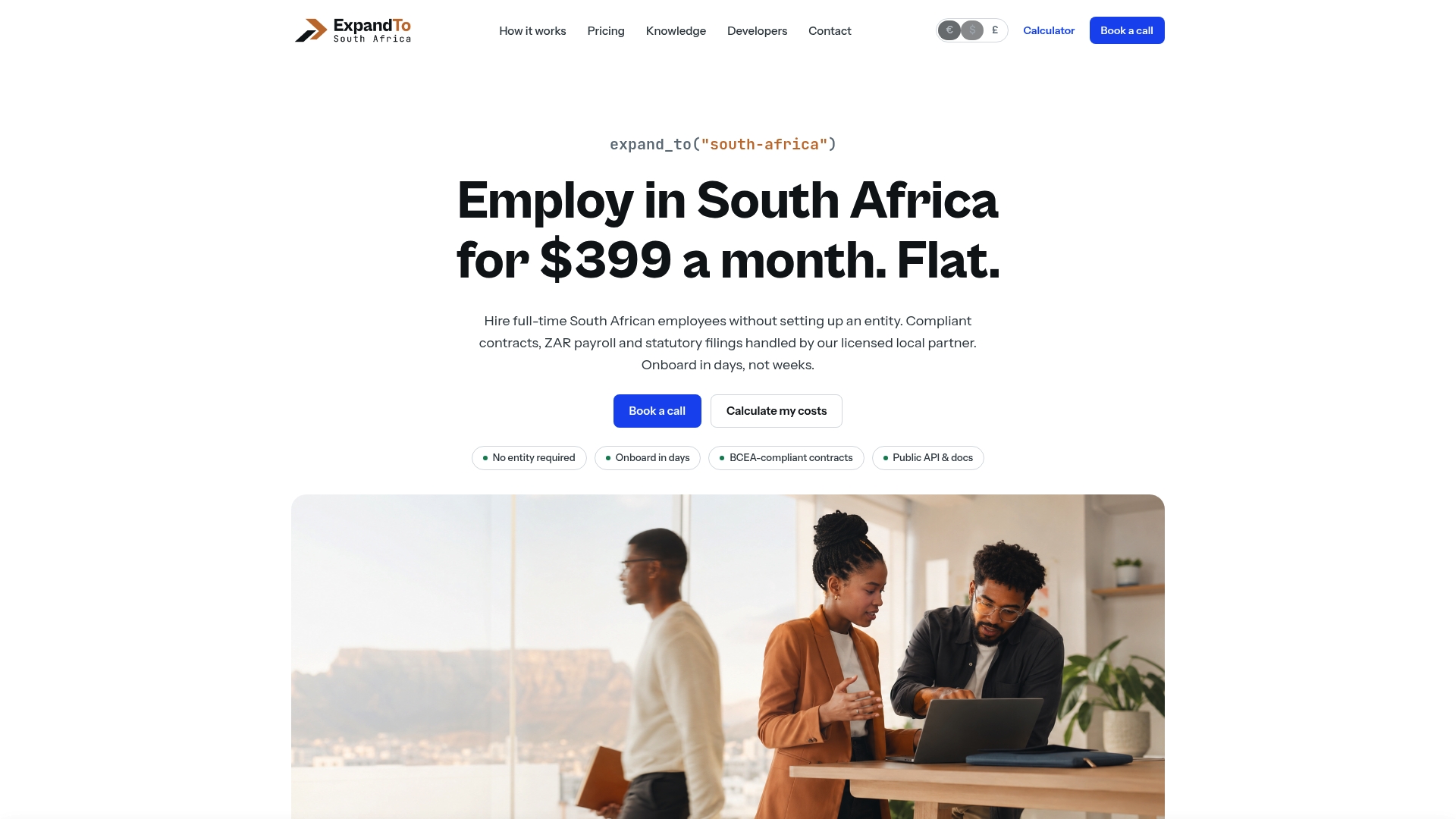
Expandtosouthafrica handles every element of South African employment: BCEA-compliant contracts signed within 48 hours, ZAR payroll processed locally, and all statutory filings submitted directly with the relevant authorities: PAYE via EMP201 with SARS, UIF, SDL, and COIDA. Employment is delivered through a licensed local partner, and data is handled under both POPIA and GDPR with EU data residency. Pricing is a published flat fee of €350 / $399 / £299 per employee per month, with no setup fees, no FX loading, and free transfers from other EOR providers.
What you get that global platforms do not offer:
- CCMA-safe dismissal guidance built into the service
- Vetted talent sourcing in South Africa bundled into total employer cost
- A public employment cost calculator so you can model total cost before signing
- An open REST API with public documentation and sandbox keys for finance automation
- Honest disclosure of who legally employs your people
HR and finance teams with a South Africa hiring requirement should request a demo that includes a statutory filing walkthrough, a live run of the employment cost calculator, and access to sandbox API keys. That 45-minute session will confirm whether the platform matches your compliance and finance reporting requirements. Start the conversation with Expandtosouthafrica directly.
Useful sources and vendor docs to read next
The sources below are organized by buyer role: legal teams should start with the compliance and entity model references, finance teams with the payroll and GL integration analyses, and HR teams with the onboarding and review platform links.
For legal and compliance teams:
- Remote review (EORHQ): the clearest independent explanation of owned-entity vs partner-entity trade-offs and their liability implications.
- Oyster HR review (HR.software): covers Oyster’s strengths (equity, B-Corp) and the compliance scenarios where alternatives are more appropriate.
- EOR services in South Africa (Expandtosouthafrica): primary reference for BCEA, LRA, COIDA, and POPIA compliance requirements in South Africa.
For finance teams:
- Rippling vs Papaya Global (EORHQ): compares the two strongest GL-integration platforms and explains when each fits a finance-first buyer.
- Types of payroll services (Tax Management EU): explains payroll outsourcing models and helps finance teams map service types to reporting requirements.
- South Africa PAYE thresholds 2026 (Expandtosouthafrica): jurisdiction-specific payroll thresholds and statutory filing obligations for South Africa.
For HR and operations teams:
- 10 Best Oyster HR Alternatives (PeopleManagingPeople): broad market roundup with public pricing signals and use-case positioning for the main alternatives.
- G2 reviews: Deel, Remote, Rippling, Multiplier, Papaya Global, WorkMotion: verified buyer reviews for onboarding experience, support quality, and platform usability.
- Remote hiring in South Africa: 2026 employer’s guide (Expandtosouthafrica): step-by-step implementation guide for companies scaling South Africa hires, including timeline and onboarding expectations.
This article covers general information about EOR and HR platform options. It is not legal or financial advice. Confirm current statutory rates, filing requirements, and contractual terms with a qualified legal or HR professional before making employment decisions in any jurisdiction.