

To offboard an employee in South Africa, you confirm the reason for the exit and the notice owed, settle final pay and leave, issue a certificate of service, report the termination to the Unemployment Insurance Fund (UIF) by the seventh day of the following month, close the tax record with SARS, and only then archive the file. Asset return and account shutdown run alongside those steps. This checklist puts the steps in order, names who owns each one, and flags where foreign employers most often slip.
TL;DR
- Start by classifying the exit: resignation, fixed-term expiry, dismissal or retrenchment. Final pay, tax treatment and paperwork all depend on that label.
- Notice under the BCEA is generally one, two or four weeks depending on service, and it should be in writing. Your contract may be more generous.
- Every departing employee is entitled to a certificate of service, whatever the reason for leaving. The UIF termination declaration is due by the seventh day of the following month.
- Keep the contractual last day, the payroll date and the UIF reporting date as three separate controls.
- If you employ through an Employer of Record, tell it the moment an exit is likely. The legal employer owns the statutory filings, and you own the handover and access.
Table of Contents
- Why offboarding in South Africa is a legal process, not just an IT task
- The 12-step offboarding checklist
- The documents you should hold at the end
- Our view: where foreign employers get offboarding wrong
- How an Employer of Record handles the statutory side
- FAQ
- Sources
Why offboarding in South Africa is a legal process, not just an IT task
Many US and European teams treat offboarding as a handover plus an account shutdown. In South Africa, the exit also creates statutory duties that exist even when the resignation is friendly. The Basic Conditions of Employment Act (BCEA) gives every employee a certificate of service on termination, and the UIF expects an accurate employer declaration. SARS expects the tax record to reflect how the employment ended.
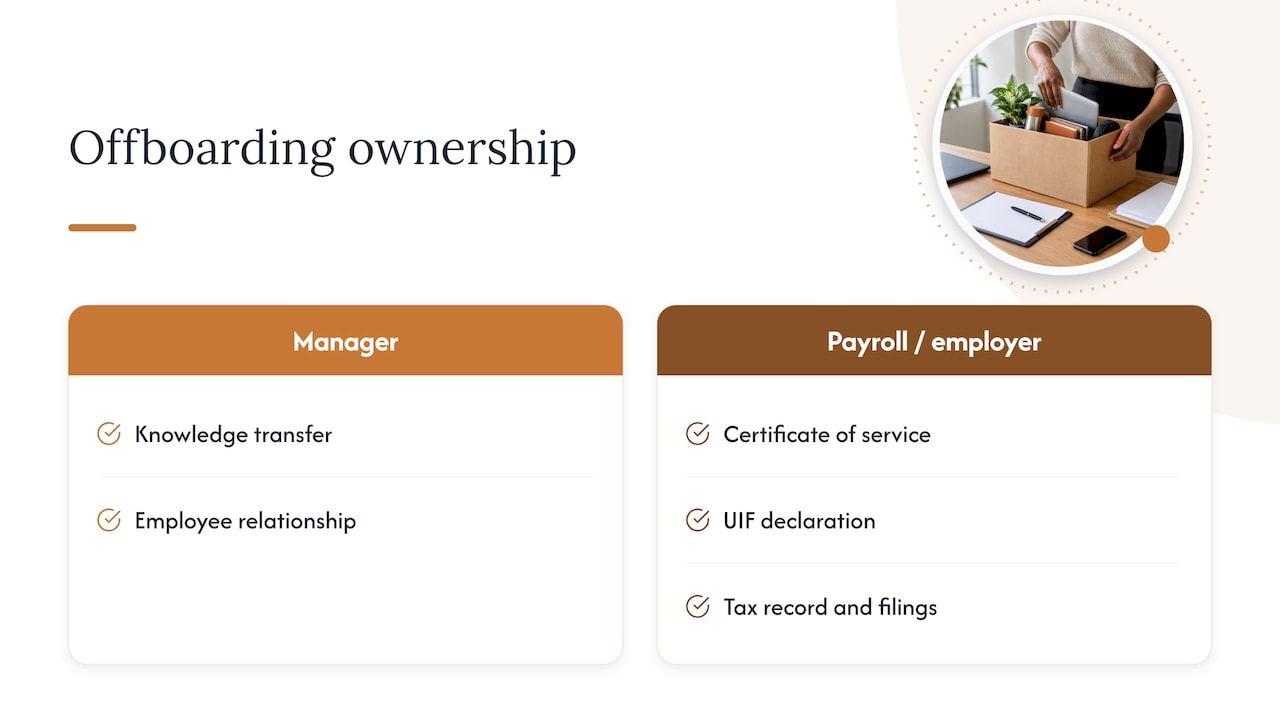
That is why ownership matters. A defensible checklist assigns the statutory steps to HR or payroll, not only to the departing person’s manager. The manager owns knowledge transfer and the relationship. Payroll and the legal employer own the numbers and the filings.
If you do not run a South African entity, someone else is the legal employer on paper. Before you start any offboarding, confirm who that is. Our guide to six checks to confirm the legal employer in South Africa explains how to verify it, because the answer decides who signs the certificate and who files with the UIF and SARS.
The 12-step offboarding checklist
The table gives the sequence at a glance. The sections below explain each step.
| # | Step | Owner | When |
|---|---|---|---|
| 1 | Acknowledge the exit in writing | HR or legal employer | Day of notice |
| 2 | Classify the exit type | HR and legal employer | Immediately |
| 3 | Confirm notice and last working day | HR | Within days |
| 4 | Notify payroll, manager, IT | HR | Within days |
| 5 | Plan the handover | Manager | During notice |
| 6 | Calculate final pay and leave | Payroll | Before last day |
| 7 | Review deductions | Payroll | Before last day |
| 8 | Recover assets | Manager and IT | Around last day |
| 9 | Remove access on a risk-based timeline | IT | Set in advance |
| 10 | Issue the certificate of service and final payslip | Payroll | On termination |
| 11 | Report to UIF and close the tax record | Payroll | By the 7th of next month |
| 12 | Archive the file and audit after exit | HR and IT | After the last payment |
1. Acknowledge the exit in writing
Record the date you received the resignation or issued the termination notice, and who gave it. A resignation should be in writing, and a written acknowledgment protects both sides if the last day or the reason is later disputed. Keep a single dated record of the final working day, the departure type, the direct manager and the role’s key responsibilities.
2. Classify the exit type
Decide at once whether this is a resignation, a fixed-term contract expiry, a dismissal or a retrenchment. This is the most important step, because it drives everything after it: notice, severance, the UIF reason code and the tax route. A resignation and a retrenchment can have the same last day and completely different paperwork.
Dismissals and retrenchments fall under the Labour Relations Act (LRA) and need a fair reason and a fair procedure. They are not something to run from a template. If you are considering either, take advice from your legal employer or a South African labour specialist before you say anything to the employee. Our page on severance pay in South Africa shows how the one-week-per-completed-year calculation works for operational-requirements exits.
3. Confirm notice and the last working day
The BCEA’s notice rules set the statutory minimum at:
- one week if the employee has worked six months or less;
- two weeks if more than six months but not more than one year;
- four weeks if more than one year.
These are floors, subject to statutory and contractual exceptions, and a contract can require longer. Check the signed agreement first, then the statute. Our explainer on South African notice periods covers how to count them and what happens if the employee leaves early or you pay in lieu.
Write the confirmed last day into the record. Do not assume it equals the date the final salary is paid or the date you report to the UIF. They are three different dates.
4. Notify payroll, the manager and IT
Send one internal notice to everyone who has to act: payroll, the line manager, IT and, if you use one, your Employer of Record. Include the exit type, last day and any agreed early release from duties. A late message to payroll is the commonest cause of overpayments and wrong leave balances.
5. Plan the handover
The handover is the part of offboarding your business actually feels. Build it while the person is still working their notice:
- List open projects, owners of recurring tasks, client contacts and credentials held in personal accounts.
- Ask the employee to document processes in the shared workspace, not in private files.
- Schedule overlap with the successor or the manager, and set a date by which handover notes are reviewed.
- Note which decisions the employee was making alone, so someone takes them over explicitly.
If handovers keep going wrong, the cause is usually that knowledge lives in one person’s head. Operational playbooks and delegation systems fix that before anyone resigns, and this overview of exit-ready business systems with practical examples shows what documented, transferable processes look like in practice.
South Africa sits within about an hour of Central European Time, so live handover sessions with a European team fit inside normal working hours. For US teams, schedule them in your morning.
6. Calculate final pay and leave
Final pay normally includes salary up to the last day, payment for accrued unused annual leave, and anything else owed under the contract, such as a pro-rata bonus if the contract provides for one. The BCEA sets a minimum of 21 consecutive days of annual leave per leave cycle, and the accrued balance at exit must be paid out. Our guide to annual leave in South Africa for payroll teams shows how to value the balance.
Do not apply one formula to every exit. SARS treats ordinary termination differently from retrenchment, retirement or death. For an ordinary exit, leave pay is remuneration for services. For retrenchment, retirement or death, payments can need a tax directive and different IRP5 treatment. Build an exception path for those cases rather than relying on the normal monthly payroll run.
7. Review deductions
Check any deduction against what the law and the employee’s written agreement allow, for example for an unreturned laptop or an outstanding advance. Do not deduct an amount you cannot support in writing. If the employee disputes it, pay the undisputed portion and resolve the rest separately. Show every deduction clearly on the final payslip; the BCEA section 33 payslip rules set out what that payslip must contain.
8. Recover assets
List every item issued: laptop, phone, security keys, company card, licences. Agree a return method (courier from a remote location is typical) and a date, and get a signed or emailed confirmation when each item arrives. For remote staff, ship a prepaid return kit in advance so the return does not depend on goodwill after the last day.

9. Remove access on a risk-based timeline
Agree in advance when accounts close. A low-risk role might keep email until the last working hour. An engineer with production access, a finance user or someone leaving on bad terms may lose access the moment notice is given or an exit meeting starts. Decide this with IT, not on the day.
Cover the full list: single sign-on, email, code repositories, cloud consoles, password managers, shared credentials and API keys, payment tools, and any personal devices with company data. Rotate any shared secret the person knew. Keep evidence of each revocation with a date.
10. Issue the certificate of service and final payslip
BCEA section 42 entitles the employee to a certificate of service on termination, whatever the reason for leaving. It is not a reference letter. It must contain:
- the employee’s full name and the employer’s name and address;
- the applicable bargaining council or sectoral standard, if any;
- the start and end dates of employment;
- the job title or a brief description of the work;
- remuneration at the time of termination;
- the reason for termination, if the employee asks for it.
Issue the final payslip with it. Together with the written notice, these form the core of your offboarding document pack.
11. Report to the UIF and close the tax record
The employer must report changes from the previous month, terminations included, by the seventh day of each month, using the UI-19 declaration or an approved electronic route. The form asks for a termination reason such as resigned, dismissed, contract expired or retrenched, so the classification you made in step 2 has to match what you file.
Accuracy matters because the employee may claim UIF benefits. The Department of Employment and Labour warns that missing or outdated declarations can delay benefit processing. Give the employee the documents they need promptly, and do not promise approval or payment dates. Those are for the UIF to confirm, and the Department’s guidance on claiming unemployment benefits is the place for the employee to check current requirements.
On tax, the employer issues an IRP5 or related certificate in line with SARS rules. The SARS guide to employees’ tax certificates for 2026 covers the format and what applies to people who leave before the reconciliation period closes. Timing and treatment vary with the exit type, so ask your payroll provider to confirm the route for each case. Our overview of payroll services in South Africa explains how these filings fit together monthly.
12. Archive the file and audit after exit
File the resignation or termination record, contract, final payslip, certificate of service, UIF and tax records, leave reconciliation, asset-return confirmations, access-revocation evidence and handover notes in one place. Set a retention period with your legal employer, since different statutes have different periods and you should not guess.
Then run a short audit two to four weeks after the exit. Check that no account still works, no recurring payment still reaches the person, no shared password is unchanged, and the UIF and tax submissions were accepted.
The documents you should hold at the end
Use this as a closing test. If any item is missing, the file is not complete.
- Written resignation or termination notice and your acknowledgment
- Confirmation of notice period and last day
- Final payslip with leave and deductions shown
- Certificate of service
- UIF UI-19 or electronic declaration confirmation
- Tax certificate or final tax record
- Leave and benefits reconciliation
- Asset-return confirmation
- Access-revocation log
- Handover notes
- For dismissals and retrenchments: the procedure records relevant to the reason for termination
Our view: where foreign employers get offboarding wrong
We work only in South Africa, so we see the same three errors repeatedly.
First, teams treat the last working day as the finish line. It is not. The UIF declaration, the tax record and the post-exit audit all land after it, and the reporting date can fall weeks later.
Second, they apply a home-country mindset. A US employer used to at-will termination, or a European one used to its own notice rules, may assume the exit is quick. In South Africa, especially for dismissals and retrenchments, procedure is what makes an exit fair. We advise clients to involve us before a difficult conversation, not after it, so the process can be CCMA-safe from the start.
Third, they do not know who legally employs their people. Under an Employer of Record arrangement, the legal employer signs the documents and files with the authorities. We think you should know that name, and we disclose it to every client. When you know it, offboarding is simple: you run the handover and the access, and the filings are done by the party that is accountable for them.
— Roel
How an Employer of Record handles the statutory side
If you employ in South Africa through us, the licensed local partner that is the legal employer prepares the written termination record, the final payslip in ZAR and the certificate of service, and handles the UIF, SARS and COIDA filings. You stay in charge of the business side: the handover, the assets and the access. Our service covers BCEA-compliant contracts, ZAR payroll and the statutory filings for a flat fee, from £299 per employee per month, with no setup fees. If you are moving an existing team from another provider or converting contractors, see the EOR services page or the complete guide to employing in South Africa.
When a departure leaves a gap, you can also fill it through our talent sourcing service. Skilled hires in South Africa typically cost 40 to 60 percent less in salary than comparable roles in the UK or EU, and the time zone overlap makes handover to the next person easy.
FAQ
What are the legal requirements for resigning in South Africa?
The employee should give written notice and work the applicable notice period, which under the BCEA is generally one, two or four weeks depending on length of service. The contract may set a longer period. The employer still has to issue a certificate of service and settle final pay correctly.
What should be in an employee offboarding checklist?
At minimum: a written record of the exit, notice and last day, handover, final pay and leave, a deductions review, the certificate of service, the UIF declaration, tax close-out, asset return, access removal, record retention and an exit conversation. For dismissals and retrenchments, add the procedural records.
When must the UIF be told that an employee has left?
The employer must report the previous month’s changes, including terminations, by the seventh day of each month. The declaration needs the correct termination reason and remuneration information, because the employee’s benefit claim relies on it.
Is a certificate of service the same as a reference letter?
No. It is a statutory document under BCEA section 42 listing the employee’s details, employment dates, job title or description and final remuneration, plus the reason for termination if the employee asks. A reference letter is optional and subjective.
Can I run South African offboarding from abroad?
Yes, but the statutory steps must be done by the legal employer in South Africa. If you have no local entity, that is your Employer of Record. Confirm who it is and agree the process before the first exit happens.
Sources
- Basic Conditions of Employment Act (Department of Employment and Labour)
- UI-19 employer declaration, gazetted 4 November 2019
- Know Your UIF Rights 2022
- Basic Guide to the Unemployment Insurance Fund
- SARS guide to employees’ tax certificates 2026