

Under South African law, the minimum notice period for resignation or dismissal is 1 week for employees with six months or less of service, 2 weeks for those with more than six months but not more than a year, and 4 weeks for anyone employed a year or longer. Notice must be given in writing, unless the employee cannot read or write, in which case the employer must explain it in a language the employee understands. Payment instead of working notice is allowed, but it follows specific rules set out in the Basic Conditions of Employment Act and confirmed by Labour.
TL;DR:
- Employers and employees must give notice periods that are equal and comply with the minimum requirements based on tenure, with no party bound to a shorter period than the other.
- Notice must be officially in writing, unless the employee cannot read or write, in which case the employer must explain and confirm understanding in a language the employee understands.
- Employers can pay employees instead of requiring them to work out the notice, but only if that arrangement is documented, and the final pay must include all accrued leave and deductions.
- Longer notice periods, such as three months, are enforceable only if both parties agree and the contract explicitly binds them equally; unilateral or one-sided clauses are not valid.
- Failing to give proper notice allows the employer to claim damages, restrict final pay deductions to lawful limits, or treat the resignation as serious misconduct, depending on circumstances.
Table of Contents
- The Basic Conditions of Employment Act: statutory rules and how to read them
- How to give valid notice and what form it must take
- Working the notice period vs being paid in lieu of notice
- Are longer notice periods, like 3 months, enforceable?
- What happens if someone doesn’t give proper notice
- Part-time, fixed-term, farm and domestic workers, and collective agreements
- Checklists for employees and HR, plus a ready resignation line
- Why you can trust this guidance
- The part of notice periods everyone gets wrong
- Sources
- FAQ
The Basic Conditions of Employment Act: statutory rules and how to read them
The notice period rules sit in section 37 of the Basic Conditions of Employment Act, which sets the minimum durations and the writing requirement, while section 38 governs payment instead of notice. These sections apply symmetrically: whatever notice period binds the employer also binds the employee, and neither side can be held to a shorter period than the other side owes.
That symmetry is the part employers most often overlook when drafting contracts. A company cannot legally write a clause requiring an employee to give four weeks’ notice while the employer only owes two. The BCEA summary published by the Western Cape government confirms the same three tiers apply regardless of which party is ending the relationship, with the added detail that farm and domestic workers employed more than six months also qualify for the full four weeks.
Collective agreements between a registered trade union and an employer can vary these minima in specific circumstances, though they cannot simply erase the statutory floor. Contracts can lengthen notice within the bounds the law allows, but they cannot shrink it below the statutory minimum for either party.
- Notice minima apply equally to both employer and employee under section 37.
- Neither party can be bound to a shorter notice period than the other.
- Collective agreements may adjust notice periods only within the limits the Act permits.
How to give valid notice and what form it must take
Notice has to be in writing except when an employee cannot write, in which case the employer must explain the notice orally in a language the employee understands and confirm that the employee understood it. Timing matters too: notice generally cannot be given, or cannot run, during certain other forms of protected leave, and it does not run concurrently with annual leave, though sick leave is treated differently.
- Put the resignation or termination notice in writing, dated, and signed by the person giving it.
- Keep a copy and, for employers, log the date received against the employee’s file.
- Confirm delivery by e-mail or a signed acknowledgment so there is no dispute later about when notice started running.
Good recordkeeping avoids arguments about the last working day, which matters when calculating final pay and leave accruals.
Working the notice period vs being paid in lieu of notice
Section 38 of the Basic Conditions of Employment Act allows an employer to pay an employee instead of requiring them to work out the notice period. If the employer chooses to waive the notice, payment is generally still owed unless both parties agree otherwise. While an employee is working notice, ordinary contractual principles apply: tendering services generally entitles the employee to be paid, unless the employer has a valid contractual defense.
- An employer can buy out the notice period and send the employee home immediately, provided pay for that period is settled.
- If an employer dismisses someone during their notice period without cause, the remaining notice pay is typically still owed.
- An employee who simply stops showing up before notice expires risks being held in breach of contract.
Pro Tip: Put any notice buy-out in writing, even a short e-mail, so both sides have a record of what was agreed and when.
Are longer notice periods, like 3 months, enforceable?
Contracts can specify longer notice periods than the statutory minimum, and three-month notice clauses are common for senior or specialized roles. The rule that protects employees is narrower than many assume: an employer cannot require an employee to give longer notice than the employer itself would owe. So a genuinely mutual three-month clause is enforceable, but a one-sided version that only binds the employee is not.
- Confirm the contract defines “month” consistently, since a calendar month and a rolling 30-day period can produce different last working days.
- State clearly when the notice clock starts, typically the date written notice is received, not the date it is signed.
- Review lopsided clauses that bind only the employee to a longer period than the employer owes; these invite challenge.
Our guide to employment contract clauses for South African hires covers how to draft notice terms that hold up.
What happens if someone doesn’t give proper notice
When an employee walks out without serving proper notice, the employer has options rather than a single automatic penalty. The employer can hold the employee to the contract and claim damages for losses caused by the early departure, or in some cases treat serious misconduct as grounds for summary dismissal without notice at all.
- The employer may claim damages for provable losses caused by the unnotified departure.
- Deductions from final pay for loss or damage generally require the employee’s written agreement and a fair process first.
- Departmental guidance on lawful deductions notes a common practical limit, generally treated as no more than 25% of net remuneration in typical loss-or-damage cases.
The Department of Employment and Labour’s basic guide to deductions sets out that employers cannot simply withhold final salary for an unserved notice period without following this process.
Court and arbitration outcomes on notice pay disputes are not uniform. In Empact Group (Pty) Ltd v Malope and Others, the Labour Court examined how arbitration awards on notice pay get reviewed, weighing whether the employee had tendered services and whether any contractual defense applied. The lesson for both sides is that these disputes turn on facts, not a fixed formula.
Part-time, fixed-term, farm and domestic workers, and collective agreements
The standard tiers do not apply uniformly to every worker. Employees working fewer than 24 hours a month for an employer generally fall outside this chapter of the Act entirely, which matters for casual or very part-time arrangements.
- Farm and domestic workers employed more than six months are entitled to the full four weeks’ notice, matching the top tier regardless of exact tenure beyond that point.
- Fixed-term contracts are usually not terminable early on notice at all unless the contract itself explicitly permits it.
- Bargaining council or collective agreements can shorten statutory notice periods in specific, permitted circumstances, so always check the applicable agreement first.
Our breakdown of BCEA working hours rules covers the 24-hour threshold and related exclusions in more detail.
Checklists for employees and HR, plus a ready resignation line
Getting notice right is mostly about paperwork discipline on both sides. Here is a short sequence for each party.
- Employees: Check your contract’s notice clause first, since it may exceed the statutory minimum.
- Employees: Submit resignation in writing, keep a copy, and offer to work the notice period or discuss a buy-out.
- HR: Acknowledge receipt in writing and confirm the employee’s final working day.
- HR: Calculate final pay, including accrued annual leave, UIF, and PAYE deductions, and document any waiver or buy-out agreement in writing.
A neutral, safe line an employee can copy directly into a resignation letter: “I am writing to give formal notice of my resignation from my position, effective [last working day], in accordance with the notice period set out in my employment contract.”
Pro Tip: Calculate final pay, including leave accrual, before the last day arrives, not after, so there are no delays or disputes once the employee has left.
Why you can trust this guidance
Roel writes on employment law and payroll compliance for Expand to South Africa, a platform that specializes exclusively in South African employment contracts, ZAR payroll, and statutory compliance for international employers. This guidance draws directly on the Basic Conditions of Employment Act and official labour guidance rather than secondhand summaries. For related reading, see our notes on severance pay calculations and contract clause drafting in South Africa.
The part of notice periods everyone gets wrong
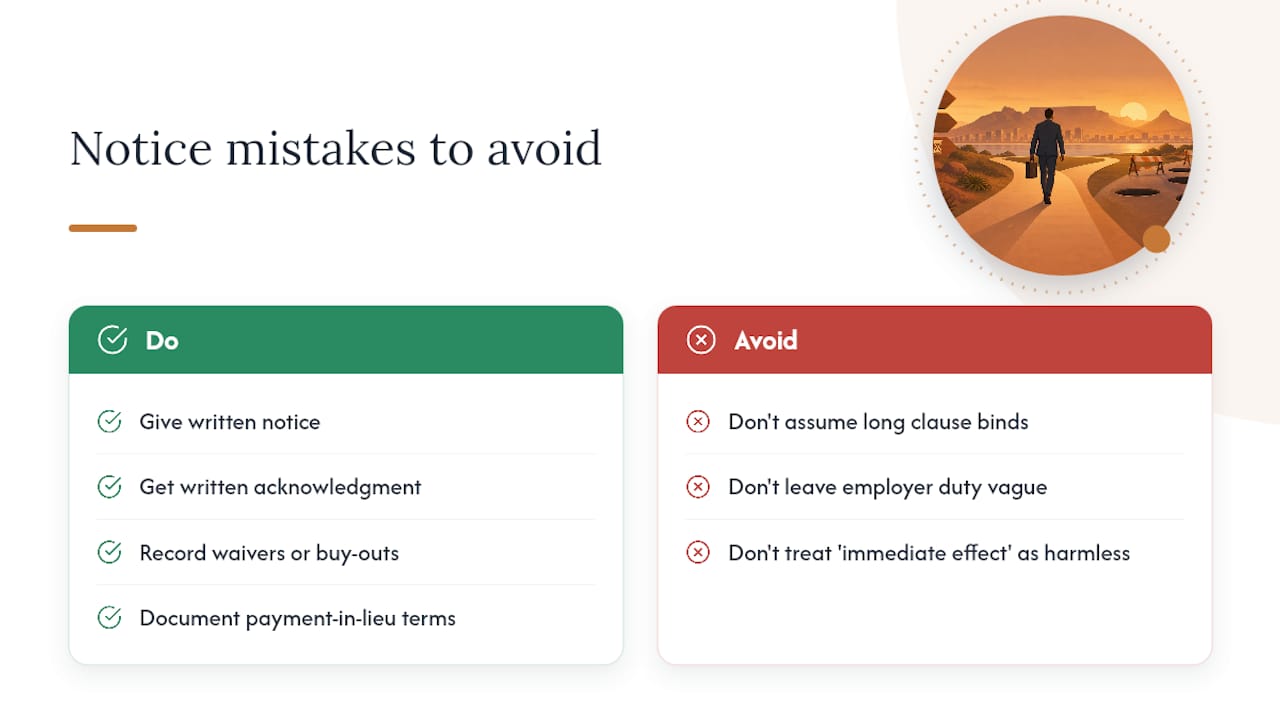
Most disputes over notice periods do not come from ignorance of the BCEA minima. They come from employers assuming a longer contractual notice clause automatically binds the employee while leaving the employer’s own obligation vague, and from employees assuming that resigning “with immediate effect” carries no consequences.
Neither assumption survives contact with the law. The BCEA’s symmetry rule is stricter than most templates acknowledge, and the payment-in-lieu mechanic under section 38 is more forgiving to employers than employees expect, provided it is documented properly. If you take one thing from this guide, prioritize the paperwork: a written notice, a written acknowledgment, and a written record of any waiver or buy-out. The statutory minima rarely cause disputes on their own. Poor documentation around them does.
— Roel
This article is general information, not a substitute for advice from a qualified lawyer. Consult a qualified legal professional about your own circumstances before acting on anything here.
Sources
- Basic Conditions of Employment Act No. 75 of 1997 (Parliament of South Africa PDF)
- Basic Conditions of Employment Act summary (Western Cape government)
- Empact Group (Pty) Ltd v Malope and Others 2025 ZALCJHB 5 (saflii)
FAQ
What is the legal notice period for resigning in South Africa?
The BCEA sets three tiers: 1 week for six months or less of service, 2 weeks for more than six months up to a year, and 4 weeks for a year or more. Your contract may specify a longer period, but it cannot legally shorten these minimums.
What happens if I don’t give 4 weeks notice?
Your employer can generally hold you to the contract and claim damages for provable losses caused by your early departure, or deduct from final pay only after following a fair process with your written agreement. The Department of Employment and Labour’s deductions guide explains that employers cannot simply withhold your final salary without that process.
Is a 3-month notice period required in South Africa?
No, three months is not a statutory requirement anywhere in the BCEA. It only applies if your specific employment contract states it, and even then the same clause must bind your employer equally, not just you.
Should I give 2 weeks notice or 4?
It depends entirely on your length of service and what your contract says, not personal preference. Check your tenure against the BCEA tiers first, then check your contract, since a written agreement can extend the statutory minimum but cannot reduce it.