

The European Commission has not issued an adequacy decision for South Africa, so when you send an employee’s personal data from the EU to South Africa, you need an Article 46 safeguard, in practice standard contractual clauses (SCCs) plus a documented transfer impact assessment. The UK follows the same logic. South Africa’s own law, POPIA, then adds rules for any data that flows back out. You can handle both, but only if you know who the data exporter is, who the importer is, and which contract sits between them. This guide walks through that for founders, HR leads and finance owners hiring in South Africa.
TL;DR
- South Africa has no EU adequacy decision, so transfers from the EU usually rely on standard contractual clauses under Article 46.
- UK companies face the same result: data sent to staff employed by a different company is a restricted transfer that needs an Article 46 mechanism.
- POPIA section 72 governs data leaving South Africa and requires adequate protection, consent, or a contractual basis.
- You need a signed data processing agreement, a transfer impact assessment and a breach plan that uses the Information Regulator’s eServices portal.
- A single-country Employer of Record with EU data residency removes most of the cross-border movement in the first place.
Table of Contents
- Why two laws apply to one employee file
- Direction one: EU or UK to South Africa
- Direction two: South Africa back out to HQ
- What to put in place: a practical checklist
- Rights and accountability
- How the Employer of Record model changes the transfer picture
- Perspective
- Hire in South Africa with the data question already answered
- FAQ
- Sources
Why two laws apply to one employee file
A South African employee hired by a company in Berlin, London or Austin generates personal data: ID number, tax number, bank details, payslips, performance notes. Two regimes can govern that file at the same time.
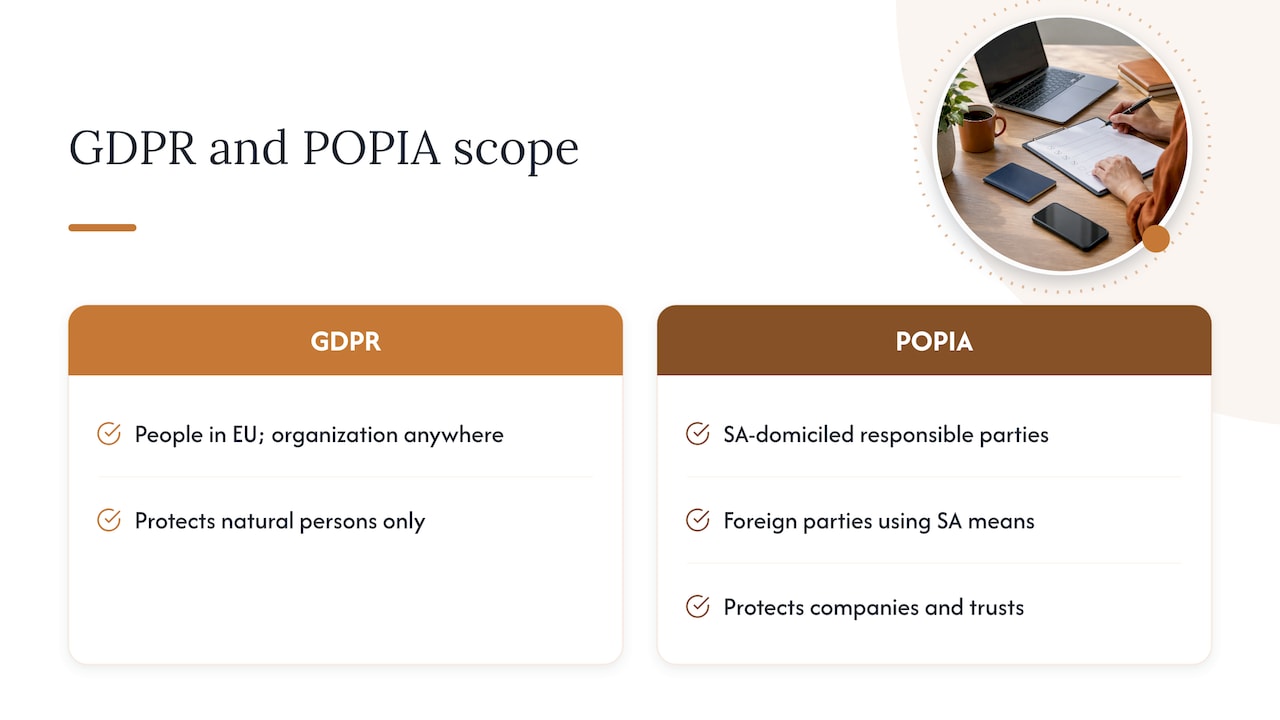
The GDPR applies to organizations processing personal data of people in the EU, wherever the organization sits. POPIA, the Protection of Personal Information Act 4 of 2013, applies to a responsible party domiciled in South Africa, and to foreign parties that process personal information using means located in the country, according to section 3(1) of the Act. Sections 3 and 72 commenced on 1 July 2020, so the transfer rules have been enforceable for several years.
In plain terms: the moment your HQ in Europe sends payroll data to South Africa, GDPR Chapter V on international transfers is in play. The moment a South African payroll provider sends that data back to HQ, POPIA section 72 is in play. Many employers only think about the first direction.
One structural difference matters here. POPIA protects juristic persons (companies and trusts) as well as individuals, while the GDPR protects only natural persons. For employee files this rarely changes the analysis, but it explains why Employer of Record models rely on written transfer agreements rather than on the other regime’s adequacy status alone.
Direction one: EU or UK to South Africa
No adequacy decision means you need a safeguard
The European Data Protection Board (EDPB) explains the order of options in its guide for small and medium businesses: first an adequacy decision, and if there is none, appropriate safeguards under Article 46 such as SCCs, binding corporate rules, codes of conduct or certification. Article 49 derogations exist, but they are exceptions to be read narrowly and cannot become the routine route. Regular payroll transfers are routine, so a derogation is the wrong foundation.
Since South Africa has no adequacy decision, SCCs are the usual instrument.
Which SCC module fits an employer
For a transfer from an EU company to a South African service provider that processes data on its instructions, the 2021 SCCs are normally Module 2, controller to processor. The South African provider is the data importer. The clauses are annexed to the data processing agreement, and the annexes describe what data moves, why, and which security measures apply.
The SCCs also carry rights for the people whose data is moved. According to the European Commission’s SCC Q&A, data subjects can enforce the clauses as third-party beneficiaries, complain to the importer or to their EEA supervisory authority, and claim compensation from the exporter for damage caused by a breach. That last point is why the exporter, meaning your company, stays accountable even when a partner holds the data.
The transfer impact assessment
The EDPB lists a documented transfer impact assessment (TIA) among the SCC requirements. It records the circumstances of the transfer, the laws of the destination country, including public-authority access, and any additional safeguards. For South Africa, a practical TIA covers:
- what categories of employee data move (identity, tax, bank, contract, leave records);
- the importer’s technical measures, such as encryption, role-based access and logging;
- the importer’s commitment to challenge unlawful access requests and to tell you about them;
- where the data is stored.
Enterprise customers often send their own TIA questionnaire, so having a ready answer set shortens procurement. Practice since the Schrems II ruling also favors supplementary measures such as encryption, with keys held in Europe under the exporter’s control, where the data allows it.
The UK position
UK GDPR transfer rules do not apply when the receiver is your own employee or part of the same legal entity. That distinction decides everything in an Employer of Record setup. According to ACCA’s guidance (February 2026), data sent to outsourced South African staff employed by a different company is a restricted transfer, and because South Africa lacks UK adequacy regulations, it needs an Article 46 mechanism. A UK company hiring through a local employing entity should therefore plan for the UK addendum or equivalent safeguards, just as an EU company plans for SCCs.
What about US companies?
There is no US federal equivalent of Chapter V. If your US company has EU or UK staff or customers, their data stays under the GDPR or UK GDPR. For the South African employee’s own data, POPIA applies to how it is processed in South Africa, and your contract with the local employer should say so. If your HQ is in the US and your South African hire never touches EU data, the main transfer rules you meet are POPIA’s.
Direction two: South Africa back out to HQ
Payroll reports, HRIS records and performance data often travel from South Africa to your headquarters. Section 72(1) of POPIA forbids a responsible party in South Africa from transferring personal information to a third party in a foreign country unless one of these applies:
- The recipient is subject to a law, binding corporate rules or a binding agreement that gives substantially similar protection, including for onward transfers.
- The data subject consents.
- The transfer is necessary to perform a contract with the data subject, or to take pre-contractual steps at their request.
- The transfer is necessary for a contract concluded in the data subject’s interest with a third party.
- The transfer is for the data subject’s benefit, consent is not reasonably practicable to obtain, and the person would likely consent.
For an employer, the second and third grounds are tempting, but consent from an employee is weak in practice because the power balance is uneven, and an employment contract does not automatically cover every onward flow, such as sending data to a group analytics tool. The cleaner route is the first ground: a data transfer agreement that sets POPIA-standard protection at the recipient.
CMS notes a quirk: because POPIA covers companies and the GDPR does not, relying on GDPR adequacy alone does not satisfy section 72 for a company’s information. Employers usually sign a transfer agreement that implements POPIA standards. The same source adds that binding corporate rules do not need to be registered with the regulator under POPIA, and that EU-style SCCs can be awkward to adapt because European organizations are reluctant to amend them. A pragmatic approach is one agreement stack: SCCs for the inbound leg, a POPIA-aligned clause set for the outbound leg, and a single data map that both refer to.
Special personal information needs extra care
Employee health data, union membership or biometric details count as special personal information. Under section 57(1)(d), prior authorization from the Information Regulator is required before transferring special personal information, or children’s information, to a foreign country that does not provide adequate protection under section 72. If your HR process includes medical certificates or disability accommodations, keep those documents in South Africa and send HQ a summary only. A leave balance is enough for most reporting purposes.
What to put in place: a practical checklist
South African guidance for growing businesses converges on a short list of actions, summarized in Miway’s POPIA steps. Adapted for a foreign employer:
| Step | What it means | Who usually owns it |
|---|---|---|
| Map the data | List what employee data exists, where it is stored, who receives it and how long it is kept | HR with IT |
| Choose the legal basis | Document why each category is processed (contract, legal obligation, consent only where freely given) | HR with counsel |
| Sign the agreements | DPA plus SCCs inbound, POPIA-aligned transfer terms outbound | Legal or finance |
| Complete the TIA | Record destination law, access risks and safeguards | Legal or the data protection officer |
| Secure access | Role-based access, multi-factor authentication, patching, tested backups | IT |
| Name the Information Officer | Register the person responsible under POPIA | The South African employer |
| Prepare the breach plan | Detection, containment, risk assessment, notification | Operations |
Breach notification differs between the regimes
The GDPR sets a 72-hour clock for notifying the supervisory authority. POPIA section 22 instead requires notifying the Information Regulator and affected data subjects as soon as reasonably possible after discovering a security compromise, and operators must tell the responsible party immediately, per Miway. Since 1 April 2025, notifications must go through the Regulator’s eServices portal, and email submissions are no longer accepted. Write one runbook that satisfies the stricter of the two clocks, and name who files in each jurisdiction.
Rights and accountability
Employees keep rights on both sides. Under POPIA they can ask whether a responsible party holds their information and request access, ask for correction, destruction or deletion, object to processing, and complain to the Information Regulator, as set out in a POPIA policy published by a South African employer. They may also seek civil damages under section 99, per Compliance by Design. Non-compliance with section 72 counts as interference with the protection of personal information under the Act.
So accountability does not disappear when you outsource payroll. Your contract should state who answers data subject requests, within what time, and how the partner escalates incidents to you.
How the Employer of Record model changes the transfer picture
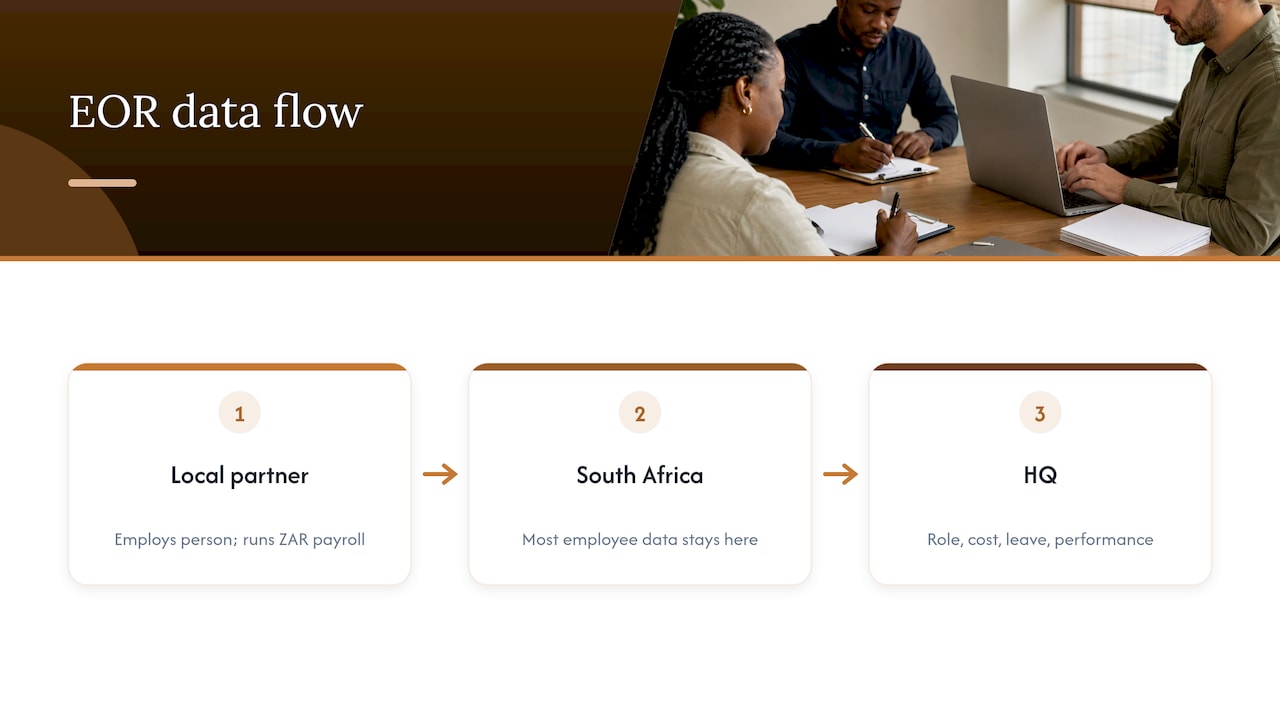
The fewer times data crosses a border, the fewer transfer mechanisms you must maintain. With an Employer of Record, a licensed local partner employs the person, issues the BCEA-compliant contract, runs ZAR payroll and files with SARS (PAYE through EMP201, UIF, SDL and COIDA). Most employee data therefore stays in South Africa, where POPIA governs it, and what reaches your HQ can be limited to what you need for management: role, cost, leave, performance.
That model also forces a question every buyer should ask: who is the legal employer and who is the data controller for which data? We state it plainly. The local partner is the legal employer, and you direct the work. That split is the reason the contract stack above exists.
For deeper detail, our pages on POPIA and GDPR compliance for South African payroll, the data processing agreement checklist for payroll teams and POPIA compliance for foreign employers cover each document line by line. If you are an EU company, how to hire in South Africa legally places the data work inside the wider hiring process. If you connect payroll to your HR system, read the HRIS integration guide first, because integrations are where uncontrolled data flows usually start.
Perspective
Most transfer problems we see described start from the same assumption: that a compliance label on a platform settles the question. It does not. What settles it is a map of where each data field lives, a contract that matches the map, and a provider that works in one legal system well enough to answer your questions.
We built Expand to South Africa for one country only. Data is handled under POPIA and GDPR with EU data residency, and the local partner that employs your people runs contracts, ZAR payroll and statutory filings. Because we do one country, the same team that explains section 72 also knows what an EMP201 submission needs, so the data flows and the payroll flows are designed together.
Our advice to a founder hiring a first person in Johannesburg or Cape Town: treat the data agreement as part of the hiring plan, not a legal afterthought. Ask who the legal employer is, who the controller is, and where the data sits. We answer those openly, because honest disclosure of who legally employs your people is part of how we work.
Roel
Hire in South Africa with the data question already answered
Our Employer of Record service covers compliant contracts, payroll and statutory filings for a flat fee of from £299 per month per employee, with no setup fees or FX loading. Contracts are signed within 48 hours, and onboarding follows within days. Data is handled under POPIA and GDPR with EU data residency.
If you also need candidates, our talent sourcing service finds vetted skilled professionals, and the Employer of Record guide explains the full model.
FAQ
Does the GDPR apply to a South African employee’s data?
It applies when you, as an EU-based or EU-targeting organization, process personal data of people in the EU, and when your company is established in the EU. A South African employee’s file held by your EU company falls under the GDPR through your establishment, while POPIA governs processing in South Africa. Plan for both.
Is there an EU adequacy decision for South Africa?
No. The Commission has not issued one, so EU businesses sending data to South African providers usually rely on SCCs under Article 46. The UK has no adequacy regulations for South Africa either, so UK companies need an equivalent Article 46 mechanism.
Can I rely on employee consent to transfer data out of South Africa?
POPIA section 72 lists consent as one ground, but for ongoing employment data a binding agreement providing equivalent protection is a sturdier basis. Consent from an employee can be questioned, and it can be withdrawn. Use consent only for narrow, optional flows.
Who files a breach notification?
Under POPIA the responsible party notifies the Information Regulator and affected individuals as soon as reasonably possible, using the eServices portal. Operators must tell the responsible party immediately. Your agreement should name who files in each jurisdiction and how quickly the partner escalates to you.
Do I need a transfer impact assessment for every hire?
The assessment attaches to the transfer relationship, not each person. One documented TIA covering the categories of data, the South African importer and its safeguards can serve all employees, and you update it when the data, the provider or the law changes.
Sources
- Protection of Personal Information Act 4 of 2013 (SAFLII)
- EDPB: International data transfers, guide for SMEs
- European Commission: Standard Contractual Clauses Q&A
- Goshen Attorneys: When does GDPR apply in South Africa?
- MJK Inc: POPIA and GDPR dual compliance
- ACCA: UK adequacy regulations
- CMS: Managing cross-border data transfers
- Mayer Brown: cross-border data transfer strategies
- Miway: POPIA compliance steps
- Compliance by Design: POPIA overview
- Adcorp POPIA and PAIA policy