

An EU company can hire in South Africa in three ways: open a local subsidiary, engage the person as an independent contractor, or employ them through an Employer of Record (EOR). For a full-time team member who works under your direction, the EOR route is usually the fastest compliant option, because South African law treats the worker as an employee whatever the contract says, and someone has to register as the employer with SARS and the Department of Employment and Labour. This guide explains what that means in practice, what it costs, and where EU founders most often go wrong.
TL;DR
- South Africa looks at the substance of the relationship, not its label. A full-time contractor who follows your schedule and uses your tools is likely to be treated as an employee.
- Statutory employer costs are modest: 1% UIF (capped), 1% SDL (above a payroll threshold) and COIDA assessments, on top of salary. The real risk is non-registration, not the rates.
- An EOR lets you employ without a subsidiary. Ours is a flat £299 per employee per month, with no setup fees or FX loading.
- South Africa sits within about one hour of Central European Time, so your team shares your working day.
Table of Contents
- Why EU companies look at South Africa
- Three ways to hire in South Africa from the EU
- Why the contractor route is riskier than it looks
- What South African employment law requires
- What employing someone costs on top of salary
- The enforcement climate
- How an Employer of Record works for an EU company
- Our perspective
- Hiring talent, not just paperwork
- Employing in South Africa through us
- Before you hire: a short checklist
- FAQ
- Sources
Why EU companies look at South Africa
Three reasons come up again and again. The first is time zone: South Africa runs on one time zone all year, within about one hour of CET depending on the season, so stand-ups, support shifts and pair programming need no rearranging. The second is language and talent depth: English is the business language, and the country has experienced developers, finance professionals, customer support teams and marketers. The third is cost. For skilled roles we typically see salaries 40 to 60% below comparable UK and EU packages, though the gap varies by seniority and role.
The savings only hold if you hire properly. Retrospective claims for leave, severance and unpaid contributions can erase them quickly, which is why the legal structure matters more than the salary figure.
Three ways to hire in South Africa from the EU
| Route | Best for | Main drawback |
|---|---|---|
| Local subsidiary | Teams of 10+ with a long-term presence | Company registration, SARS and labour registrations, local accounting and directors; slow to set up and to close |
| Independent contractor | Genuine project work, outside your control | Reclassification risk if the person works like an employee |
| Employer of Record | 1 to 15 full-time hires, testing the market | Monthly fee per employee; the EOR is the legal employer |
A subsidiary gives you full control, but it also gives you every obligation: payroll registration, annual reconciliations, COIDA returns and local bookkeeping. If you are hiring your first person in the country, that is usually more machinery than the role justifies. Our complete guide to Employer of Record in South Africa compares the options in more depth.
Why the contractor route is riskier than it looks
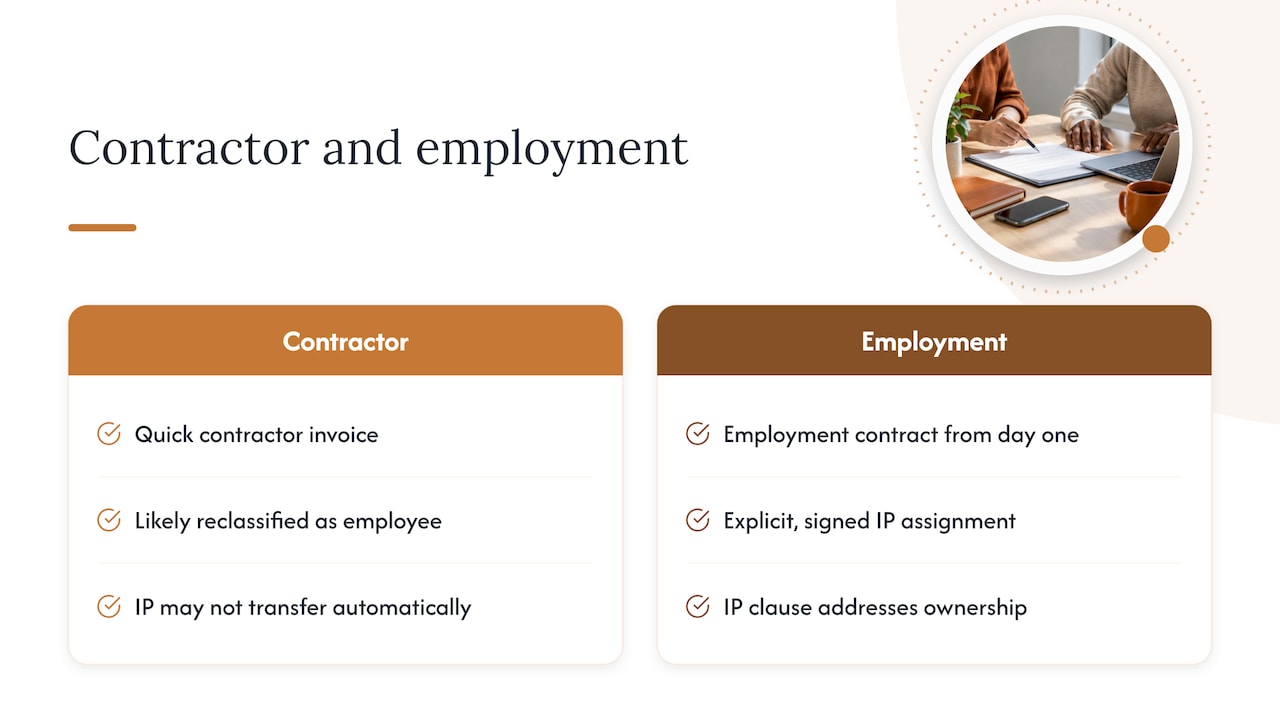
Many EU founders start with a contractor invoice because it is quick. The difficulty is that South African law applies a substance-over-label test. According to South African technology lawyers MJ Kotze Inc, a worker who has set hours, uses company equipment and is integrated into internal teams will likely be reclassified as an employee. That can bring retrospective claims for statutory benefits, leave and severance.
The same source stresses a second point that surprises software companies: intellectual property assignment must be explicit and signed to satisfy Section 22(3) of the Copyright Act, otherwise a foreign principal may not automatically own code its remote worker writes. A properly drafted employment contract, with an IP clause, deals with this from day one.
If you are weighing the classification question more generally, this guide on classifying employees versus independent contractors sets out the typical tests. Apply them with South African law in mind: control, economic dependence and integration all point towards employment.
A quick self-check
Ask yourself whether the person:
- works fixed or expected hours for you;
- works mainly or only for your company;
- uses your tools, email address and internal systems;
- reports to a manager on your team;
- is paid a regular monthly amount rather than per deliverable.
Three or more “yes” answers means you are hiring an employee, and should treat the arrangement as such.
What South African employment law requires
Employees in South Africa are protected by the Basic Conditions of Employment Act (BCEA) and the Labour Relations Act (LRA). A few points an EU employer should know before drafting anything:
- Annual leave: at least 21 consecutive days per leave cycle for full-time workers, plus public holidays.
- Notice periods: under the BCEA, one week if the employee has served six months or less, two weeks for more than six months up to one year, and four weeks after a year of service, according to the same summary.
- Minimum wage: the national minimum wage rose to R30.23 per hour from 1 March 2026. Skilled professional roles sit far above it, but sector rules can differ.
- Dismissal: it must be substantively and procedurally fair. A dismissal that skips the process can end in a CCMA dispute, even where the employee clearly underperformed. Our guide to misconduct dismissal in South Africa walks through the steps.
This is the area where EU employers are most often caught out. Probation, at-will termination and short notice, common in parts of Europe and the US, do not transfer cleanly. Before ending any employment relationship, speak to a South African labour lawyer or your EOR’s compliance team.
What employing someone costs on top of salary
South African statutory employer costs are lower than most EU payroll burdens, but they are different, and each one has a filing attached.
PAYE
Pay As You Earn is income tax withheld from the employee’s salary and paid to SARS monthly. It is not an extra cost to you, but you must register and file. SARS expects an employer to apply for registration within 21 business days of becoming an employer. For 2026/27, the primary rebate is R17,820, which gives an effective tax-free threshold of R99,000 a year for employees under 65. Our PAYE thresholds page covers what HR must do about them.
UIF
The Unemployment Insurance Fund takes 1% from the employee and 1% from the employer. The monthly earnings ceiling is R17,712 from 1 March 2026, so the maximum is R177.12 per party and R354.24 combined per employee per month. Because of the cap, UIF barely moves with seniority. Details are in our UIF contributions guide.
SDL
The Skills Development Levy is a 1% employer-only levy on gross payroll. Employers with annual payroll below R500,000 are exempt, and those who are liable pay monthly through the EMP201 return, due by the 7th of the following month. Employers who submit a Workplace Skills Plan and Annual Training Report by 30 April can recover a share of the levy, up to 20%, which many small employers miss. See our SDL rate explainer for the mechanics.
COIDA
The Compensation for Occupational Injuries and Diseases Act requires registration with the Compensation Fund and an annual assessment, even for an office-based employee. It is separate from the SARS filings, which is why first-time foreign employers often forget it.
A worked example
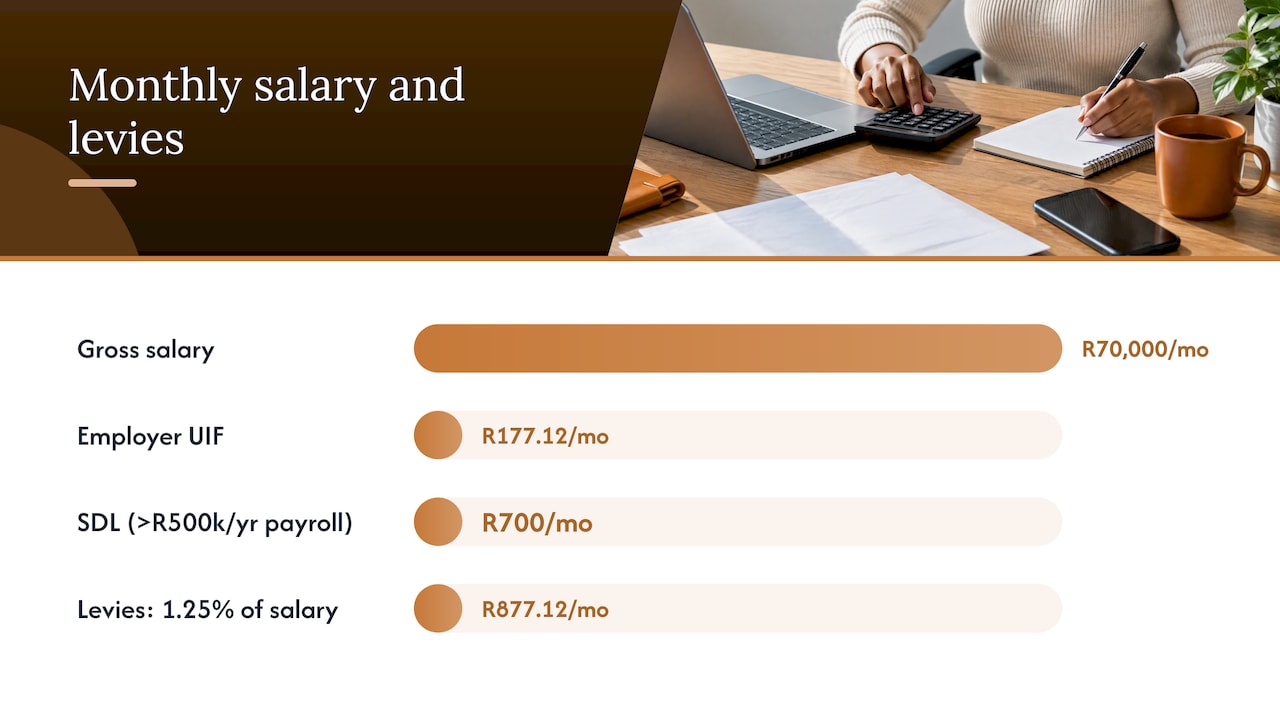
Take a developer on R70,000 gross a month. Employer UIF is capped at R177.12. SDL at 1% is R700, if your total payroll is above the R500,000 annual threshold. Together that is R877.12 a month, about 1.25% of salary, before COIDA and any benefits you choose to offer. The numbers are small, but each one needs registration, calculation and a monthly return. Our employer payroll taxes guide lists the registrations in order.
The enforcement climate
Do not assume a foreign employer with one remote hire will go unnoticed. The Department of Employment and Labour has been running large multi-agency inspections. In a July 2026 national operation, 114 workplaces were inspected and only three were compliant, and the Deputy Minister signalled that blitzes will intensify. Those targets were workplaces rather than remote teams, but the direction is clear: registration with BCEA, UIF and COIDA is checked, and the consequences include closures and criminal charges. A remote employee who is never registered is a liability that grows with each month.
How an Employer of Record works for an EU company
With an EOR, a licensed South African entity becomes the legal employer. You direct the daily work, set goals and manage the person as part of your team. The EOR handles the employment contract, payroll, statutory filings and employment administration.
In our model, the steps look like this:
- Choose the role and salary. Use our public employment cost calculator to see the total monthly cost before committing.
- Sign the service agreement. Contracts are issued within 48 hours.
- Employment contract. A BCEA-compliant contract is drawn up by our licensed local partner, including IP assignment where the role needs it.
- Onboarding. The employee is registered for PAYE, UIF, SDL and COIDA, and onboarding completes within days.
- Monthly payroll. Salary is paid in ZAR, and we file the EMP201 and other returns.
- Changes and exits. Raises, leave and terminations run through the same process, with dismissal guidance designed to keep you on the right side of the CCMA.
See our EOR services page and payroll services for the detail.
Data protection
Employee records fall under POPIA, and as an EU company you will also have GDPR obligations. We handle data under both, with EU data residency. If your team wants to review the paperwork, start with our POPIA guide for foreign employers and the data processing agreement checklist.
Our perspective
We do one country, and that shapes our view. Most EU founders we speak to are not worried about the 1% levies. They are worried about two things: who is legally responsible if something goes wrong, and whether a compliance error will cost more than the salary savings.
Our answer to the first is plain: the licensed local partner is the legal employer of record, and we say so in the contract rather than burying it. You direct the work, they carry the statutory obligations. Anyone offering an EOR should be willing to tell you exactly which entity signs your employee’s contract.
On the second, we think a flat price is the honest way to sell this. Because we cover one jurisdiction, we can charge a flat fee per employee, with no setup fees and no FX loading, rather than pricing for a catalogue of 150 countries. When a founder asks whether to use a contractor first and convert later, we usually say that if the person will work full time for you, start with employment. Conversions are possible, but the longer a contractor arrangement runs, the more history there is to unwind.
— Roel
Hiring talent, not just paperwork
An employment structure does nothing if you cannot find the right person. Many EU companies source candidates through remote job boards and recruiters, then discover they still need a legal employer. We can combine both: our talent sourcing service finds vetted candidates for skilled roles, and the employee goes straight onto payroll. If you are a US-based reader comparing structures, our page on US hiring in South Africa covers the differences, and for support roles see how to hire customer support in South Africa.
Employing in South Africa through us
Our Employer of Record service starts at £299 per employee per month (published as €350 or $399 in euros and dollars), with signed contracts within 48 hours and no setup fees. If you already use another provider, transfers are free. You can see the full price breakdown on our pricing page, or start from our home page if you want to talk to us about a first hire.
Before you hire: a short checklist
- Decide whether the role is truly full time and controlled by you. If yes, plan for employment.
- Budget salary plus employer UIF, SDL (if liable), COIDA and any benefits.
- Confirm who the legal employer will be and get it in writing.
- Make sure IP assignment is explicit and signed.
- Settle the data protection basis under POPIA and GDPR.
- Plan the exit process before the first day, not after the first problem.
FAQ
Can an EU company hire in South Africa without a local entity?
Yes. You can use an Employer of Record, which employs the person on your behalf through a licensed local entity. You still manage the work day to day, but the EOR handles the contract, payroll and statutory registrations. A contractor arrangement is possible for genuinely independent work, but it carries reclassification risk.
Is a South African contractor cheaper than an employee?
Only on paper. If the person works like an employee, South African law may treat them as one, and you could face claims for unpaid leave, severance and statutory contributions. The statutory employer costs are small, roughly 1% UIF (capped) and 1% SDL, so the saving from a contractor label is rarely worth the exposure.
Does the time zone work for European teams?
Very well. South Africa is within about one hour of CET, with no large overlap gaps. Daily meetings and live support hours need no special scheduling.
What happens if I need to end the employment?
You must follow a fair procedure and the BCEA notice periods, from one to four weeks depending on service length. Dismissal for misconduct or poor performance needs proper process, or the employee can take the matter to the CCMA. Seek local advice before acting, and keep records from the start.
Sources
- MJ Kotze Inc: SA developers working for foreign companies
- ExpressPlanner: how to classify employees vs independent contractors
- Labour Guide South Africa: BCEA summary
- Envoy Global: South Africa national minimum wage for March 2026
- SARS: Guide for employers, employees’ tax
- AnooreHR: South Africa payroll in 2026
- Govchain: register as an employer with SARS
Recommended
- Confirm the Legal Employer in South Africa: 6 Checks for US, UK, EU
- Hire in South Africa Fast for UK, EU & US HR: Contracts in 48 Hours
- Remote Hiring in South Africa: The 2026 Employer’s Guide to Compliant Scaling
- Employer of Record South Africa: The Complete Guide for International Businesses (2026)