

For U.S. companies that need to employ full-time staff in South Africa without forming a local entity, a South Africa specialist Employer of Record is the clearest path. Global platforms like Deel, Remote, and Multiplier cover many countries worldwide, but South Africa’s statutory requirements under the BCEA, LRA, and SARS demand local depth that multi-country generalists often handle through third-party partners rather than owned infrastructure.
The shortlist by category:
- South Africa specialist EOR (e.g., Expandtosouthafrica): Single-country depth, licensed local partner, ZAR payroll, PAYE/UIF/SDL/COIDA filings handled directly, flat monthly fee with no FX loading.
- Global owned-entity EOR (e.g., Remote, Oyster): Broad country coverage with owned entities in many markets; South Africa compliance included but depth varies.
- Budget/partner-based EOR (e.g., Multiplier, Papaya Global): Lower published entry prices; check whether SARS filings and statutory contributions are fully covered or subcontracted.
- HRIS-integrated platform (e.g., Deel): Strong HR tooling and contractor management; South Africa EOR available but priced for multi-country buyers.
Independent market reviews confirm there is no single universally best alternative: the right choice depends on compliance certainty, budget, and platform needs. For one-country South Africa hiring, specialist depth usually wins on both cost and legal clarity.
Table of Contents
- How do these Deel alternatives compare for South Africa hires?
- Why South Africa expertise changes your risk and cost equation
- How to choose between global EORs, budget providers, and a South Africa specialist
- Moving off Deel: how to migrate to a South Africa EOR cleanly
- Key Takeaways
- Why a South Africa specialist often matters more than you expect
- Expandtosouthafrica: a dedicated South Africa EOR with flat pricing and no surprises
How do these Deel alternatives compare for South Africa hires?
The table below maps provider categories against the dimensions that actually change the buying decision when you are employing full-time staff in South Africa.
| Dimension | SA Specialist EOR | Global Owned-Entity EOR | Budget/Partner EOR | HRIS-Integrated Platform |
|---|---|---|---|---|
| Monthly fee / pricing model | Flat per employee, no FX loading | €350/$399/£299 per employee per month | Lower published entry price; confirm inclusions | $400–$599/mo; contractor and EOR tiers |
| Country coverage | South Africa only | 150+ countries | many countries worldwide | 150+ countries |
| SA compliance depth | Licensed local partner; direct filings | Owned entity or strong partner | Partner-based; verify SARS coverage | Partner-based; verify SARS coverage |
| Payroll currency & FX | ZAR payroll, no FX loading | ZAR available; FX loading possible | ZAR available; FX loading likely | ZAR available; FX loading possible |
| Onboarding speed | Signed contract within 48 hours | Typically 1–2 weeks | Varies by partner | Typically 1–2 weeks |
| Termination/CCMA support | CCMA-safe dismissal guidance included | Available; depth varies | Limited; verify coverage | Limited; verify coverage |
| Talent sourcing | Vetted sourcing for skilled roles | Not typically included | Not typically included | Not typically included |
| API / integrations | Open REST API, public docs, sandbox keys | Published API; varies by plan | Limited API documentation | Strong API and HRIS integrations |
| Data residency / POPIA & GDPR | POPIA + GDPR, EU data residency | GDPR-aligned; POPIA coverage varies | Verify POPIA handling | Verify POPIA handling |
| Setup / migration fees | No setup fees; free transfers | Setup fees common | Setup fees possible | Setup fees common |
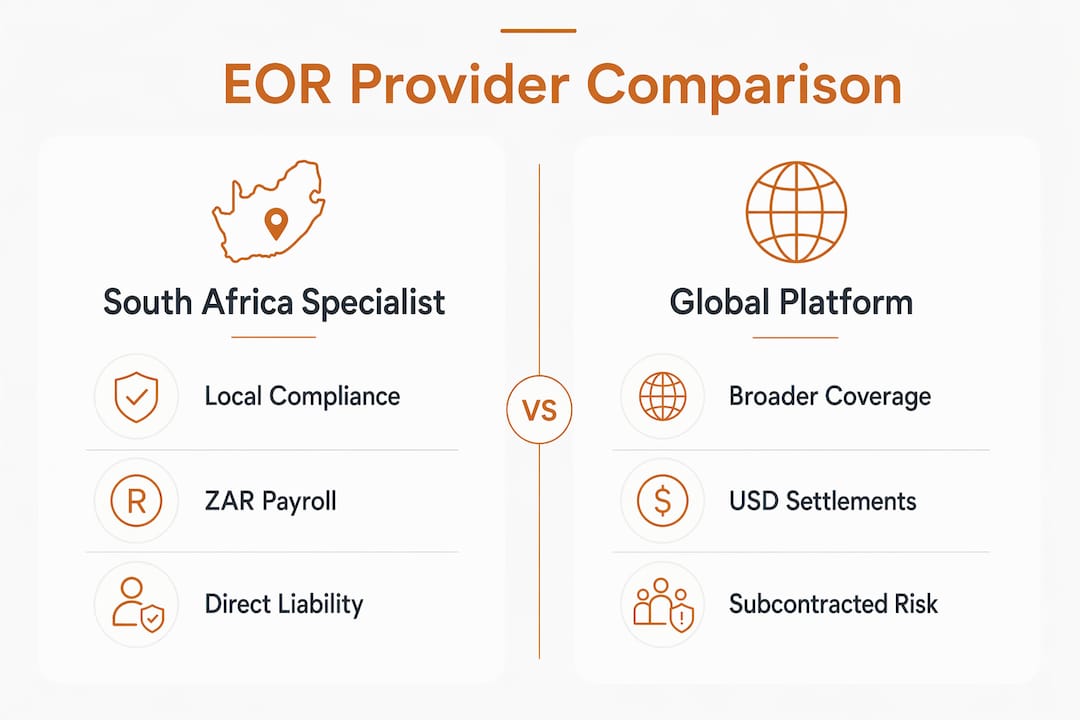
Reading the table: Finance-led buyers hiring one or two people in South Africa get the most predictable total cost from a specialist with flat pricing and no FX loading. Enterprise teams expanding across many markets simultaneously may accept a global platform’s higher per-seat cost for consolidated HRIS reporting. Budget providers can work for small teams, but published entry prices are starting points only: always request a run-rate that includes payroll taxes, employer contributions, and any FX fees before signing.
Why South Africa expertise changes your risk and cost equation
South Africa’s employer obligations are specific, time-sensitive, and non-negotiable. The BCEA sets working-time limits, leave entitlements, and notice periods. The LRA governs fair dismissal procedures and CCMA dispute resolution. SARS requires monthly PAYE submissions via EMP201, and employers must remit UIF, SDL, and COIDA contributions on schedule. POPIA governs employee data and cross-border transfers. A global EOR that routes South Africa through a third-party partner may not have direct visibility into all of these filing deadlines.
The statutory items your EOR must handle without exception:
- PAYE (EMP201): Monthly submission to SARS in ZAR; late or incorrect filings trigger penalties.
- UIF: Employer and employee contributions deducted and remitted monthly.
- SDL: Skills Development Levy, calculated on gross remuneration.
- COIDA: Employer registration and annual return for workplace injury cover.
- BCEA compliance: Leave accrual, working-time caps, and notice period calculations.
- CCMA procedures: Documented disciplinary process required before any dismissal; inadequate documentation creates direct financial liability.
- POPIA and cross-border data: Employee data transferred to U.S. systems must meet POPIA’s conditions for lawful processing.
Payroll and statutory filings must run in ZAR on the local schedule. An EOR that settles in USD and converts internally can introduce FX loading that compounds across a full year of payroll. Termination is the highest-risk moment: continuity of service, accrued leave, and notice pay calculations commonly produce higher-than-expected separation costs when contracts are closed without careful alignment. Vendors that supply sample calculation worksheets reduce those surprises materially.
A single-country specialist that owns the local compliance relationship, rather than subcontracting it, shortens onboarding time and removes a layer of ambiguity from the legal accountability chain.

How to choose between global EORs, budget providers, and a South Africa specialist
Choose by compliance depth, price transparency, and the service model that matches your hiring volume and risk tolerance. The entity model matters: providers with a licensed local partner or owned entity offer a cleaner legal accountability chain for disputes and terminations than those relying on ad-hoc third-party arrangements.
Decision criteria checklist:
- Entity ownership: owned entity or licensed local partner vs. unnamed third-party partner
- Published pricing and FX policy: flat fee vs. percentage of salary vs. salary band
- Payroll currency and bank settlement: ZAR payroll vs. USD conversion with FX loading
- Statutory filing coverage: PAYE, UIF, SDL, COIDA handled directly or subcontracted
- Termination and CCMA support: documented dismissal process and legal guidance included
- Contract templates: BCEA-compliant, customizable, and available for review before signing
- Data residency: POPIA-compliant handling and GDPR alignment for EU/U.S. data flows
- API and reporting: published docs, sandbox access, payroll export formats
- SLAs: onboarding timeline, payroll setup deadline, dispute response time
- Migration support: free transfers from existing EOR providers
Vendor questions worth asking in procurement:
- Who is the registered employer of record in South Africa, and can you name them?
- Do you perform SARS PAYE submissions directly, or via a third party?
- How do you calculate and remit UIF, SDL, and COIDA?
- Can you supply a sample South African employment contract before we sign?
- What are your SLAs for payroll setup, first payroll run, and CCMA dispute support?
- What is your FX policy, and is there any loading on ZAR payroll settlements?
Pro Tip: Ask your finance team to model the total employer cost over 12 months, including statutory contributions and any FX fees, not just the headline monthly fee. A lower list price with FX loading can exceed a flat-fee specialist’s total cost within three months.
Pick a South Africa specialist when you are hiring one to ten people in South Africa and need a clean liability chain, predictable ZAR payroll, and direct statutory filing coverage. A global multi-country EOR makes more sense when you are simultaneously expanding into five or more countries and need consolidated HRIS reporting across all of them.
Moving off Deel: how to migrate to a South Africa EOR cleanly
A staged migration minimizes legal, payroll, and employee-experience risk. The sequence: audit first, then transition contracts, then align payroll cutoffs, then start the new payroll run.
- Audit current contracts and payroll records. Confirm who is legally named as the employer on each South African employment contract today.
- Identify accrued entitlements. Map leave balances, notice periods, and any benefit accruals that must transfer or be paid out.
- Plan employee communications. Notify affected employees of the change in employer of record before any documents are signed.
- Align payroll cutoffs. Coordinate the last payroll run under the existing provider with the first run under the new EOR to avoid gaps or double deductions.
- Confirm PAYE reconciliation handover. Obtain the IRP5/IT3(a) records and PAYE reconciliation data from the outgoing provider for SARS continuity.
- Re-run onboarding documents. Issue new BCEA-compliant employment contracts under the new EOR’s licensed local partner.
- Schedule an overlap period. Where possible, run a parallel payroll check for the first month to catch discrepancies before they affect employees.
Key legal points to resolve: under the LRA, a transfer of employment that preserves continuity of service is preferable to termination and rehire, which resets accrued rights and can trigger CCMA exposure. Retain all disciplinary and payroll records for the statutory period. Providers that offer free transfers from other EOR providers reduce migration friction and cost.
Typical timeline with a South Africa specialist: signed contracts within 48 hours of completing documentation; first payroll run within the same monthly cycle when migration starts before the payroll cutoff date.
How we compared provider categories
This comparison is based on public pricing signals, entity model clarity, statutory coverage claims, published API documentation, and documented onboarding SLAs. Evidence types used:
- Published pricing pages and sample fee tables from vendor sites
- Regulatory checklists drawn from BCEA, LRA, and SARS guidance
- Vendor documentation covering payroll processes and API capabilities
- Published market reviews covering the EOR category
Provider categories rather than named competitors appear in the comparison table to keep the evaluation focused on capability. We favored sources with explicit South Africa coverage and flagged where statutory filing depth could not be confirmed from public documentation alone. Readers should request vendor sample contracts and SLA documents during procurement to verify claims independently.
Key Takeaways
For most U.S. companies hiring one to ten full-time employees in South Africa, a specialist EOR with a licensed local partner, direct SARS filings, and flat ZAR pricing delivers cleaner compliance and more predictable costs than a global multi-country platform.
| Point | Details |
|---|---|
| Specialist depth beats breadth | A South Africa specialist handles PAYE, UIF, SDL, and COIDA directly, reducing subcontracting risk. |
| Flat pricing lowers total cost | No FX loading and no setup fees make total employer cost predictable across a 12-month payroll cycle. |
| Entity model determines liability | The employer named on the contract bears CCMA and dismissal liability; confirm this before signing. |
| Migration requires staged steps | Audit contracts, align payroll cutoffs, and secure PAYE records before switching EOR providers. |
| Expandtosouthafrica offers flat monthly fees per employee with quick contract turnaround and free transfers from other EOR providers. |
Why a South Africa specialist often matters more than you expect
The conventional wisdom in the EOR market is that bigger platforms equal better coverage. For most countries, that logic holds. South Africa is one of the exceptions. The BCEA’s leave and working-time rules, the LRA’s fair-dismissal requirements, SARS’s monthly EMP201 cycle, and POPIA’s cross-border data conditions create a compliance stack that rewards local depth over geographic breadth. A platform managing 150 countries has strong incentives to standardize processes; South Africa’s statutory calendar does not accommodate standardization well.
The subtler risk is termination. CCMA proceedings are accessible, relatively fast, and frequently used. An EOR that cannot supply documented disciplinary records or a BCEA-compliant dismissal process leaves the named employer exposed. For a U.S. company that has never operated under South African labor law, that exposure is invisible until it becomes expensive. A specialist that builds CCMA-safe dismissal guidance into its standard service removes that blind spot before it matters.
That said, if you are hiring in South Africa, Germany, and Singapore simultaneously, a global platform’s consolidated reporting may justify the higher per-seat cost and the compliance trade-offs. The specialist case is strongest when South Africa is your primary or only international hiring market.
Expandtosouthafrica: a dedicated South Africa EOR with flat pricing and no surprises
Hiring full-time South African employees through a global platform built for 150 countries means paying for coverage you do not need and accepting compliance depth you cannot fully verify. Expandtosouthafrica does one country, done properly: BCEA-compliant employment contracts, ZAR payroll, direct PAYE/EMP201 submissions to SARS, and full UIF/SDL/COIDA handling, all through a licensed local partner.
The pricing is published and fixed: €350/$399/£299 per employee per month, with no setup fees and no FX loading. Signed contracts arrive within 48 hours. The platform includes an open REST API with public docs and sandbox keys for teams that need payroll automation, plus vetted talent sourcing for skilled roles when you need help finding the right hire. If you are currently on Deel or another global EOR, transfers are free.
To get started, visit the EOR services page for full statutory coverage details and pricing, or request a sample employment contract and onboarding timeline directly from the team.
Primary sources and further reading
- Employer of Record South Africa: The Complete Guide (2026): Detailed regulatory reference covering BCEA, LRA, PAYE/SARS, UIF/SDL, COIDA, and sample contract templates.
- EOR Services in South Africa: Statutory coverage details, flat-fee pricing, and how the licensed local partner model works.
- Remote Hiring in South Africa: The 2026 Employer’s Guide: Practical onboarding timelines, payroll practices, and compliance guidance for U.S., UK, and EU employers.
- Payroll Services in South Africa: ZAR payroll run cadence, bank settlement process, and payroll reporting formats.
- Deel Alternatives in 2026: 10 Best EOR Competitors Compared: Independent market review of EOR provider categories, pricing signals, and procurement considerations.
- Deel Alternatives: 10 Platforms for Global Contractor Management: Overview of budget and mid-market EOR options with notes on hidden costs and API capabilities.
Request sample employment contracts and SLA documents from any shortlisted vendor during procurement. Published pricing and coverage claims should always be verified against vendor documentation before signing.