

For international employers budgeting a South African accounting hire, the accountant salary South Africa range runs from roughly R15,000/month for a junior through R80,000/month for a senior, with a median salary around R35,000/month. Add employer-side statutory levies under SARS, BCEA, UIF, SDL, and COIDA plus a standard benefits buffer, and your realistic total employer cost typically lands significantly above gross salary.
Salary bands at a glance:
- Junior (0–2 years): roughly mid to low tens of thousands of rand per month
- Mid-level (3–6 years): tens of thousands of rand per month
- Senior (7+ years): upper tens of thousands of rand per month
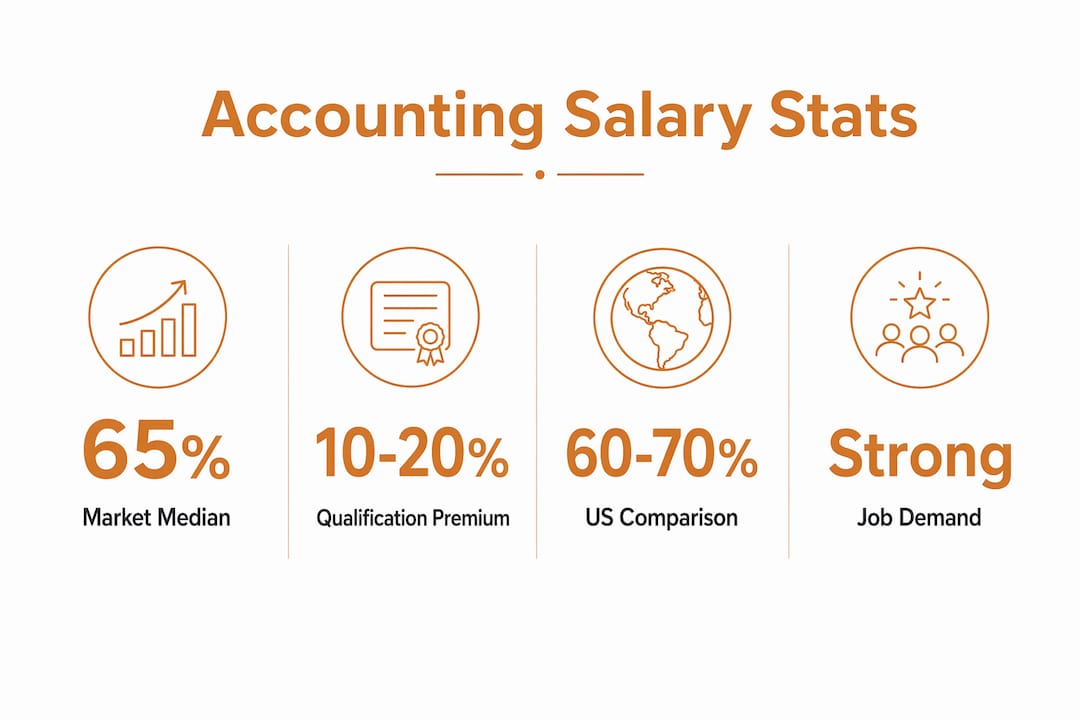
A professional designation (SAIPA, CIMA, or SAICA membership) typically adds a 10–20% premium over an undesignated BCom graduate at the same experience level. Gauteng (Johannesburg/Sandton) commands the highest rates; Cape Town and Durban run 5–15% lower. For context, the U.S. median for accountants and auditors sits around $93,520/year, making South African accounting talent 60–70% less expensive at current exchange rates.
Pro Tip: Always verify SAIPA, CIMA, or SAICA membership directly with the relevant body before extending an offer. A designation changes both the salary band you should budget and the seniority level the candidate reasonably expects.
Table of Contents
- How salary bands for accountants in South Africa were derived
- Is demand for South African accountants growing?
- How career progression shapes accounting salaries
- How industry sector affects what accountants earn
- Hire South African accountants without setting up a local entity
- Key Takeaways
How salary bands for accountants in South Africa were derived
The figures above draw on multiple data sources cross-referenced against current market listings, including Rand Tools, PayScale, and Indeed. PayScale reports an average junior accountant total compensation near R181,721/year, broadly consistent with the R15,000–R22,000/month junior band. Indeed’s Johannesburg data puts the junior average at R18,089/month, which aligns with the mid-point of that range.
On the statutory side, the governing frameworks are SARS (PAYE via EMP201 filings), the BCEA (minimum employment standards), UIF (Unemployment Insurance Fund), SDL (Skills Development Levy), and COIDA (Compensation for Occupational Injuries and Diseases). Employer-paid levies (SDL plus the employer’s UIF share) add roughly 1–2% on top of gross salary in most scenarios, with COIDA assessed separately. Benefits such as medical aid contributions and provident fund matching are not statutory but are standard market practice and should be budgeted as an additional layer. Use Expandtosouthafrica’s employment cost calculator to model a full cost-to-company figure for your specific hire.
Is demand for South African accountants growing?
Demand is strong and shows no sign of softening. South Africa produces a steady pipeline of BCom and accounting graduates, but candidates holding SAICA, SAIPA, or CIMA designations remain in short supply relative to employer demand, particularly in financial services, mining, and technology. International employers benefit from this dynamic: the talent pool is deep at the graduate and mid-level tiers, and the ±1-hour CET time zone overlap makes real-time collaboration with European teams genuinely practical, not just theoretically possible.
How career progression shapes accounting salaries
The typical path runs from graduate/junior accountant through articles (a SAICA or SAIPA training contract), then into a designated role, and eventually to financial manager or CFO level. Each transition carries a material salary step. A candidate completing SAICA articles moves from the R15,000–R22,000 junior band to the R28,000–R45,000 mid-level band almost immediately upon qualification. Reaching senior level (R50,000–R80,000/month) usually requires 7+ years plus a track record in a specific sector. For international employers reviewing accountant resumes, the articles completion date and designation registration year are the two most reliable seniority signals.
How industry sector affects what accountants earn

Financial services, mining, and large manufacturing firms consistently pay above the market median. NGOs, small retail, and early-stage startups tend to pay below it. A mid-level accountant in a Johannesburg bank may earn toward the top of the R28,000–R45,000 band; the same profile in a Cape Town NGO may sit near the floor. When you’re budgeting a hire, factor in both sector and city: a senior accountant in Sandton financial services can realistically command R75,000–R80,000/month, while a comparable role in a Durban manufacturing firm might settle at R55,000–R65,000/month.
Hire South African accountants without setting up a local entity
Knowing the salary bands is only half the picture. The other half is getting the employment structure right from day one: BCEA-compliant contracts, ZAR payroll, PAYE filings with SARS, UIF, SDL, COIDA, and data handling under POPIA.

Expandtosouthafrica handles every one of those obligations for a flat fee of $399 per employee per month, with no setup fees and no FX loading. Employment runs through a licensed South African partner, contracts are signed within 48 hours, and full onboarding completes within days. The service covers payroll in ZAR, all statutory filings, talent sourcing for vetted accounting candidates, and an open API for employment automation.
- ZAR payroll with full statutory filings (PAYE, UIF, SDL, COIDA)
- BCEA-compliant contracts via a licensed local partner
- POPIA and GDPR-compliant data handling with EU data residency
- Vetted talent sourcing for accounting roles
- Employment cost calculator and CCMA-safe offboarding guidance
Get a worked cost estimate for your specific hire at expandtosouthafrica.com/eor-services.
This article provides general information about South African employment costs and salary benchmarks. Confirm current statutory rates and contract requirements with SARS, the Department of Employment and Labour, or a qualified South African employment law professional for your specific situation.
Key Takeaways
South African accountant salaries run 60–70% below U.S. equivalents, making them among the most cost-effective qualified accounting hires available to international employers in 2026.
| Point | Details |
|---|---|
| Salary bands by seniority | Junior: R15,000–R22,000/month; mid-level: R28,000–R45,000/month; senior: R50,000–R80,000/month; median: R35,000/month. |
| Designation premium | SAIPA, CIMA, or SAICA membership adds 10–20% above an undesignated BCom graduate’s rate. |
| Regional variation | Gauteng pays the highest rates; Cape Town and Durban average 5–15% lower. |
| Total employer cost | Statutory levies (UIF, SDL, COIDA) add roughly 1–2% above gross; budget significantly above gross including benefits. |
| Expandtosouthafrica | Handles ZAR payroll, PAYE, UIF, SDL, COIDA, and BCEA contracts for $399/employee/month flat. |