

For startups hiring in South Africa, Expandtosouthafrica is the clearest recommendation. It is the only Employer of Record platform built exclusively for South Africa, which means every statutory filing, every contract clause, and every compliance touchpoint is handled by a licensed local partner with no partner-network ambiguity.
Two strengths separate it from global alternatives:
- Licensed local partner, BCEA-compliant contracts, and full statutory coverage: PAYE/EMP201 submissions to SARS, UIF, SDL, and COIDA are all handled, with CCMA-safe dismissal guidance included.
- Flat, transparent pricing with startup-friendly SLAs: €350 / $399 / £299 per employee per month, no setup fees, no FX loading, contracts signed within 48 hours, and full onboarding within days.
Two mandatory trust signals: POPIA and GDPR compliance with EU data residency, and complete statutory filings coverage from day one.
Table of Contents
- Why a South Africa specialist EOR matters for your startup
- How to choose an EOR for South Africa: criteria, questions, and red flags
- What Expandtosouthafrica covers and why it fits startups
- What does hiring in South Africa actually cost?
- Step-by-step: hiring a South African employee through Expandtosouthafrica
- Key Takeaways
- What most startup founders get wrong about EOR selection
- Expandtosouthafrica gets your South African team hired fast
- Primary sources and references
Why a South Africa specialist EOR matters for your startup
Generic global EOR platforms cover 150+ countries. That breadth is also their weakness. When a platform relies on a local partner network rather than owning its entities, it introduces third-party commercial-profile risk that surfaces during investor due diligence or M&A. Entity ownership vs. partner-network models is a material diligence issue VC firms examine closely, and a provider that cannot demonstrate owned local entities or clear legal authority creates friction in funding rounds.
South Africa’s statutory obligations are specific and non-negotiable:
- PAYE/EMP201 submissions to SARS every month
- UIF registration and employer contributions
- SDL (Skills Development Levy) where applicable
- COIDA registration and reporting
- BCEA and LRA compliant employment contracts and dismissal procedures
A generic EOR unfamiliar with South African labor law can miss SDL thresholds, mishandle COIDA registration, or produce contracts that do not meet BCEA minimum standards. Any of those gaps creates liability that lands on your company.
Data protection adds another layer. European founders must reconcile POPIA (South Africa’s data protection law) with GDPR. A provider without EU data residency options forces you to rely on standard contractual clauses alone, which is a harder argument to make to a European DPA.

Platform fragmentation is a separate risk. When EOR, payroll, and benefits run on different systems, reconciliation errors accumulate and termination responses slow down. Unified platforms reduce those risks materially as your headcount grows.
Pro Tip: Ask any EOR candidate directly: “Do you own the local employing entity in South Africa, or do you use a partner?” Then request the entity’s registration number. A provider that hesitates or cannot produce it within 24 hours is running a partner-network model.
How to choose an EOR for South Africa: criteria, questions, and red flags
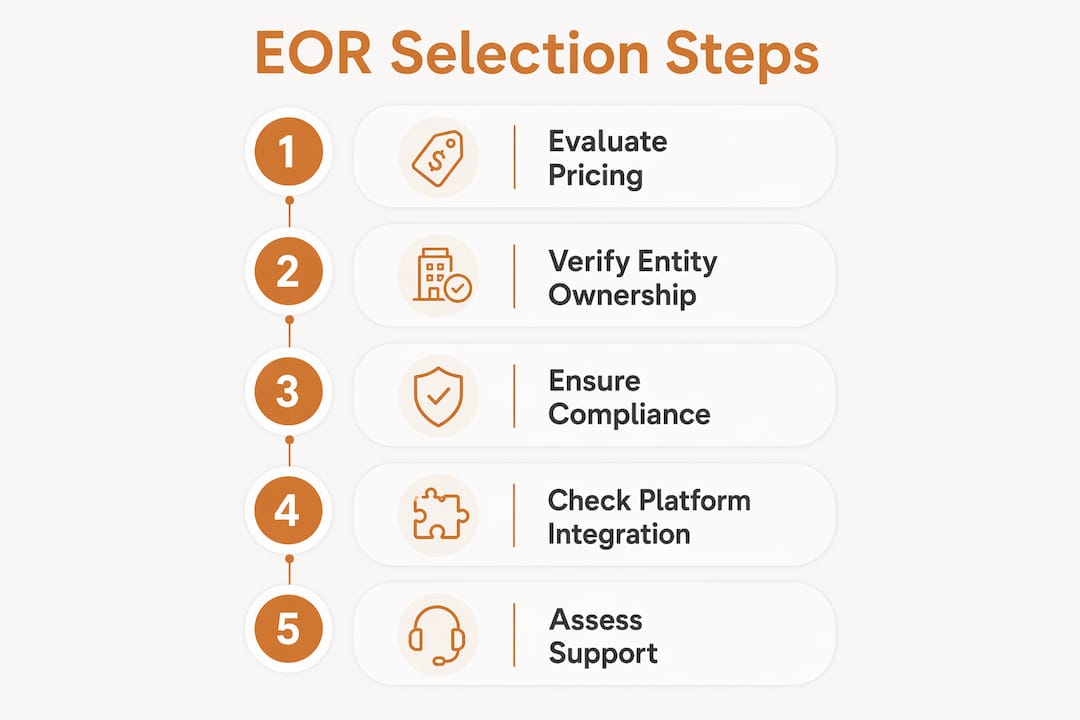
Evaluate providers against these criteria in priority order:
- Entity ownership: Does the provider own the South African employing entity, or does it rely on a third party?
- Pricing model: Flat fee per employee vs. percentage of salary. Flat fees are more predictable for startups on tight budgets.
- IP assignment clauses: VC diligence scrutinizes IP assignment language when an EOR sits between the worker and the startup. Jurisdiction-specific clauses and provider indemnification are non-negotiable.
- Statutory filings covered: PAYE/EMP201, UIF, SDL, COIDA, and BCEA/LRA compliance must all be explicitly listed in the service agreement.
- Data protection: POPIA compliance and EU data residency for European founders.
- Onboarding SLA: How quickly can contracts be signed and payroll go live?
- Termination support: CCMA-safe dismissal guidance and documented offboarding procedures.
- API and integrations: Open API with sandbox keys for payroll automation and reporting.
Ask providers for SOC 2 or ISO 27001 attestations and a sample HR diligence pack before signing. A provider experienced with VC diligence can produce these quickly.
Red flags to avoid:
- Undisclosed FX loading on salary payments
- Security deposits locked for months with no clear release terms
- Partner-network-only model with no owned local entity
- No CCMA-safe dismissal guidance or documented offboarding process
- Inability to produce a sample employment contract within 48 hours
| Dimension | What to evaluate |
|---|---|
| Pricing | Flat fee vs. % of salary; setup and offboarding fees |
| Local compliance depth | Licensed local partner; BCEA/LRA contract coverage |
| Entity ownership risk | Owned entity vs. partner network; VC diligence exposure |
| Statutory filings | PAYE/EMP201, UIF, SDL, COIDA explicitly listed |
| Data protection | POPIA compliance; EU data residency option |
| Onboarding SLA | Contract signing timeline; payroll go-live timeline |
| Termination support | CCMA-safe guidance; documented offboarding |
| API/integrations | Open API; sandbox keys; payroll automation |
What Expandtosouthafrica covers and why it fits startups
Expandtosouthafrica delivers employment through a licensed local partner, which means the employing entity is South African, registered, and auditable. That is the foundation every VC diligence checklist starts with.
Core services:
- BCEA-compliant employment contracts in ZAR
- Local ZAR payroll with PAYE/EMP201 submissions to SARS
- UIF, SDL, and COIDA statutory filings handled monthly
- Vetted talent sourcing for skilled roles including software developers, finance professionals, and operations staff
Platform features that matter to startups:
- Flat fee per employee per month, with no setup fees and no FX loading
- POPIA and GDPR compliance with EU data residency
- Open REST API with public documentation and sandbox keys
- Contracts signed within 48 hours; full onboarding within days
- Free transfers from other EOR providers
Startup trust signals: CCMA-safe dismissal guidance, a public employment cost calculator, and HR diligence packs available on request.
Expandtosouthafrica charges a single flat fee of $399 per employee per month with no setup costs and no FX loading. There are no security deposits locked for months, no percentage-of-salary surprises, and no hidden offboarding fees. What you see in the pricing is what you pay.
What does hiring in South Africa actually cost?
South Africa’s total cost of employment includes gross salary, statutory employer contributions, and the EOR fee. For a senior developer, a realistic breakdown looks like this:
| Component | Monthly amount (ZAR) |
|---|---|
| Gross salary | ZAR 68,900 |
| Total employer cost | ~ZAR 68,900 |
At current exchange rates, ZAR 68,900 is roughly $3,800 per month. A comparable senior developer in the UK or Germany typically costs $7,000–$9,000 per month in total employer cost, which puts the South Africa saving at 40–60% for skilled roles. That gap is consistent across engineering, finance, and operations functions.
EOR pricing globally ranges from roughly $99 to $650+ per employee per month depending on geography and provider features. Expandtosouthafrica’s $399 flat fee sits in the mid-range but covers a single country with full statutory depth, which is a different value proposition than a $599 global platform spreading overhead across 150 markets.
Hidden fees to watch for: FX margin on salary conversion, setup fees charged at contract start, offboarding fees, and security deposits held for 3–6 months. Flat-fee models with no FX loading eliminate the first two categories entirely.
Step-by-step: hiring a South African employee through Expandtosouthafrica
- Submit the hiring request with role details, proposed start date, and candidate information (or request talent sourcing).
- Contract signed within 48 hours. Expandtosouthafrica prepares a BCEA-compliant employment contract; both parties sign digitally.
- PAYE/EMP201 registration with SARS is confirmed or initiated for the new employee.
- UIF, SDL, and COIDA registrations are verified and contributions scheduled.
- Benefits enrollment is completed, including any statutory and supplemental benefits.
- Payroll cutover: the employee is added to the ZAR payroll run; first payroll goes live within days of contract signing.
- API sync (optional): connect your HRIS or finance system via the open REST API to automate payroll reporting and headcount data.
The only documents you need to provide: the candidate’s South African ID or passport, proof of address, and bank details. Expandtosouthafrica handles all statutory registrations and filings from that point forward. Specialist recruiters can also reduce time-to-hire significantly when you need to source candidates, as specialized hiring support shortens the pipeline for technical and senior roles.
Key Takeaways
For startups hiring in South Africa, Expandtosouthafrica delivers the clearest combination of licensed local entity ownership, full statutory coverage, and flat transparent pricing at $399 per employee per month.
| Point | Details |
|---|---|
| Entity ownership is non-negotiable | Always verify the EOR owns a South African entity; partner-network models create VC diligence risk. |
| Statutory filings must be explicit | Confirm PAYE/EMP201, UIF, SDL, and COIDA are all listed in the service agreement. |
| Flat fees protect your budget | Percentage-of-salary models and hidden FX loading can add hundreds of dollars per hire per month. |
| IP assignment clauses matter | Request jurisdiction-specific IP assignment language and provider indemnification before signing. |
| Expandtosouthafrica recommendation | Licensed local partner, BCEA-compliant contracts, $399/month flat fee, 48-hour contract SLA, and CCMA-safe offboarding. |
What most startup founders get wrong about EOR selection
The conventional wisdom says to pick the EOR with the most country coverage. For a startup hiring specifically in South Africa, that logic is backwards. A platform covering 150 countries spreads its compliance expertise thin. South Africa’s statutory framework, including COIDA registration, CCMA dismissal procedures, and the BCEA’s specific contract requirements, is detailed enough that surface-level coverage creates real liability.
The more important question is not “how many countries does this provider cover?” but “who legally employs my people in South Africa, and can you prove it?” A provider that cannot answer that question with a registration number and a sample employment contract is not ready for a VC diligence request. And that request will come.
Founders also underestimate IP assignment risk. When an EOR sits between the worker and the startup, jurisdiction-specific IP assignment clauses and indemnification are what protect your cap table during a fundraise or exit. A generic contract template that was not written for South African law is not adequate protection. Ask for the clause, read it, and get legal sign-off before the first hire.
The 40–60% salary savings South Africa offers versus UK or EU equivalents are real, but they only materialize cleanly when the EOR handles every statutory obligation correctly from day one. A compliance gap discovered during a Series A diligence process costs far more than the savings.
Expandtosouthafrica gets your South African team hired fast
Hiring in South Africa does not have to mean months of entity setup, compliance research, and payroll configuration. Expandtosouthafrica handles the entire employment stack for a single flat fee of $399 per employee per month, with no setup costs and no FX loading, so you can focus on building your product instead of navigating South African labor law.
Run the employment cost calculator to see your exact total employer cost before committing. Request a sample BCEA-compliant employment contract and HR diligence pack to validate compliance depth. When you are ready to move, the EOR services page walks you through onboarding in minutes. Contracts are signed within 48 hours. Your first South African hire can be on payroll within days.
Primary sources and references
- SARS PAYE/EMP201 guidance — statutory PAYE filing requirements and EMP201 submission schedules for South African employers
- POPIA overview (Information Regulator, South Africa) — data protection obligations for employers processing employee personal information in South Africa
- CCMA summary — Commission for Conciliation, Mediation and Arbitration: dismissal procedures, dispute resolution, and CCMA referral timelines
- Expandtosouthafrica EOR services — statutory filings covered, BCEA-compliant contract details, and pricing model
- Employment cost calculator — public tool for calculating total employer cost including UIF, SDL, COIDA, and EOR fee
- South Africa compliance knowledge base — country-specific hiring checklists, statutory rate updates, and POPIA/GDPR guidance
- Remote hiring guide — compliant scaling, CCMA-safe dismissals, and labor law overview for international employers
This article provides general information about South African employment law and EOR services. It is not legal or professional advice. Confirm current statutory rates and compliance requirements with SARS, the Information Regulator, or a qualified South African employment attorney for your specific situation.