

Deel is the better default for most companies. Choose Remote when owned-entity compliance or FX transparency is the priority. For South Africa hires specifically, Expandtosouthafrica delivers single-country depth that neither global platform can match at a comparable price.
Here is the quick shortlist:
- Startups with a broad hiring map: Deel. Its extensive country coverage and fast contractor onboarding reduce the risk of needing a second vendor as you scale.
- Scale-ups prioritizing compliance purity: Remote. Its owned-entity model in many countries shortens the compliance chain and reduces third-party handoffs on sensitive actions like terminations.
- Enterprises with complex HRIS needs: Deel. Immigration support, IT device management, and numerous integrations reduce tech-stack friction at scale.
- Contractor-heavy, cost-sensitive teams: Remote. Its contractor management starts at a lower monthly price than Deel—a gap that compounds quickly across a large contractor base.
- Single-country South Africa hires: Expandtosouthafrica. Flat monthly fee, BCEA-compliant contracts, ZAR payroll, and full statutory filings with no FX loading.
Table of Contents
- How does Deel compare to Remote? A side-by-side breakdown
- What does Deel actually offer, and where does it fall short?
- What does Remote offer, and when is it the better choice?
- Why Expandtosouthafrica is the specialist choice for South Africa hires
- How do Deel and Remote pricing actually compare, including hidden costs?
- What are the compliance risks of owned-entity vs. partner-based EOR models?
- How do you choose between Deel, Remote, and a South Africa specialist?
- What South Africa-specific support goes beyond basic country coverage?
- Key Takeaways
- The EOR decision most teams get wrong
- Expandtosouthafrica: the purpose-built EOR for South Africa hires
- Documents to request from vendors and resources for deeper research
How does Deel compare to Remote? A side-by-side breakdown
| Dimension | Expandtosouthafrica | Deel | Remote | RemoFirst | WorkMotion | HireGlobal | Oyster |
|---|---|---|---|---|---|---|---|
| EOR model | Licensed local partner (SA only) | Hybrid: owned entities + vetted partners | Owned entities (numerous countries) | Hybrid | Hybrid (EU-focused) | Varies | Hybrid |
| Countries covered | 1 (South Africa) | 150+ | 70–80+ | 150+ | 150+ | Varies | 110+ |
| Best for | SA-only hires, deep local compliance | Broad global hiring, contractor workflows | Compliance-first, owned-entity markets | Budget EOR, geographic fit check | European hires, works-council markets | Niche EOR comparison | Transparent pricing, distributed teams |
| EOR pricing (per employee/mo) | $399 flat | ~$599 | ~$599 | — | Custom | Custom | $599 |
| Contractor pricing (per contractor/mo) | N/A | $49 | $29 | Varies | Varies | Varies | ~$29–$49 |
| Payroll & payments | ZAR payroll, PAYE/UIF/SDL/COIDA | Multi-currency, wallets, cards | Multi-currency, interbank FX | Multi-currency | Multi-currency | Varies | Multi-currency |
| Benefits & insurance | Statutory SA benefits | Configurable global benefits | Configurable global benefits | Basic | Regional | Varies | Configurable |
| HRIS & integrations | Open REST API | 110+ integrations, IT mgmt, immigration | Core HRIS, fewer integrations | Basic | Mid-tier | Limited | Developer-friendly |
| Support / CSM | Dedicated local contact | Dedicated CSM (higher tiers) | Dedicated CSM, compliance focus | Standard | Standard | Varies | Standard |
| Termination / compliance risk | CCMA-safe dismissal guidance | Partner-layer risk in some markets | Lower risk (owned entities) | Varies | Varies | Varies | Varies |
| Time to onboard | Contracts signed within 48 hrs | Days to 2 weeks | Days to 2 weeks | Days | 1–2 weeks | Varies | Days to 2 weeks |
Who wins each column:
- Coverage breadth: Deel (150+ countries, hybrid model).
- Compliance purity: Remote (owned entities reduce intermediation risk).
- Contractor cost: Remote at $29/month vs. Deel at $49/month.
- South Africa depth: Expandtosouthafrica (single-country statutory expertise, flat fee, no FX loading).
- Enterprise integrations: Deel (110+ integrations, IT provisioning, immigration).
- Onboarding speed: Expandtosouthafrica (48-hour contract signing for SA hires).
Quick pros/cons per entrant:
- Expandtosouthafrica: ✓ Flat $399/mo, deep SA statutory compliance, fast onboarding. ✗ South Africa only.
- Deel: ✓ Widest coverage, mature contractor tools, strong HRIS. ✗ Partner-layer risk in some markets, FX spread not always transparent.
- Remote: ✓ Owned-entity model, no-FX-markup policy, lower contractor price. ✗ Smaller country footprint, fewer enterprise add-ons.
- RemoFirst: ✓ Competitive pricing. ✗ Thinner public track record; verify entity model per country.
- WorkMotion: ✓ European compliance depth. ✗ Limited outside Europe; custom pricing adds friction.
- HireGlobal: ✓ Worth including in RFPs for price benchmarking. ✗ Limited public differentiation; evaluate contract terms carefully.
- Oyster: ✓ Transparent pricing, developer-friendly tooling. ✗ Mid-tier coverage; fewer enterprise integrations than Deel.
What does Deel actually offer, and where does it fall short?
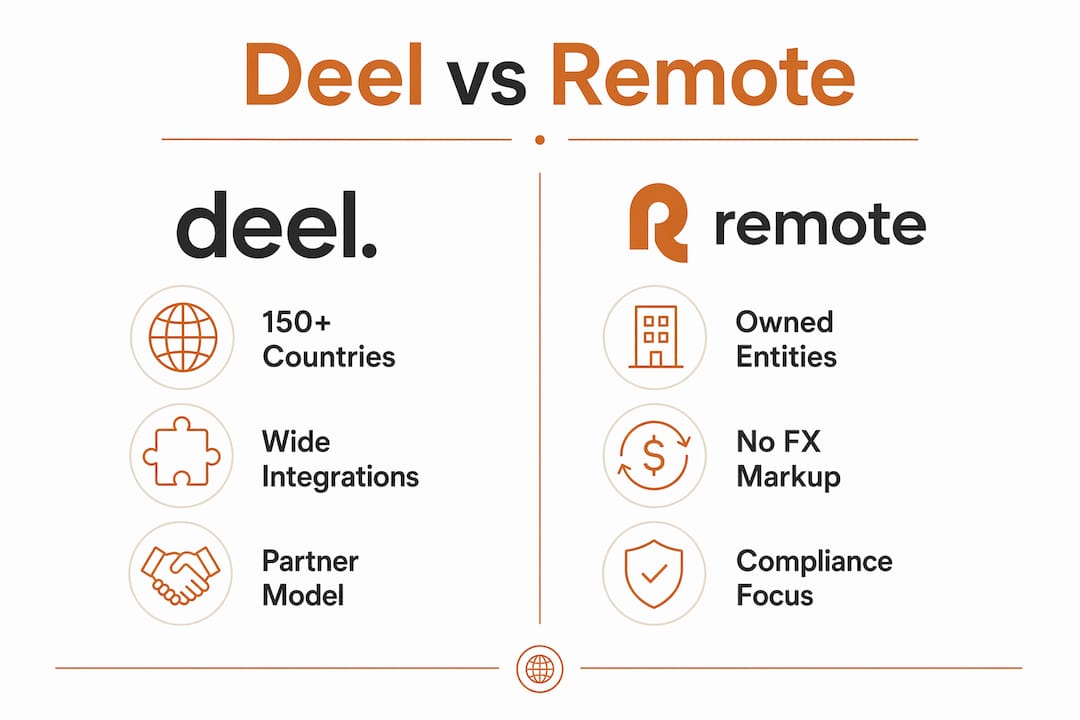
Deel started as a contractor payment tool and has since built one of the market’s more comprehensive global employment platforms. Today it covers EOR, contractor management, payroll, HRIS, IT device provisioning, immigration support, and equity management, making its breadth a key competitive advantage.
Reviewers on G2 rate Deel highly and consistently cite ease of setup and administration. The platform’s 110+ integrations with tools like Workday, BambooHR, and Slack reduce the manual work of syncing employment data across a tech stack. For enterprise buyers who need a single vendor to handle immigration paperwork, equipment provisioning, and contractor-to-employee conversions, Deel is the most complete option on the market.
The trade-offs are real, though. Deel’s 150+ country coverage relies on a hybrid model: owned entities in some markets, vetted local partners in others. In partner-based markets, you are adding a compliance layer between your company and the legal employer, which matters most during terminations and audits. Deel’s FX spread policy is also less transparent than Remote’s published interbank-rate commitment, so senior payrolls in non-USD currencies can carry hidden costs that only surface at scale.
Deel is the right default when:
- Your hiring map spans more than 10 countries, including tier-2 markets in Africa, LATAM, or APAC.
- You need frequent contractor-to-employee conversions with minimal friction.
- Your HR team wants a single platform for employment, IT provisioning, and immigration.
What does Remote offer, and when is it the better choice?
Remote’s defining architectural decision is entity ownership. Where Deel uses partners in many markets, Remote owns its legal entities in numerous countries, which shortens the compliance chain on sensitive processes like terminations, IP assignment, and works-council negotiations. G2 reviewers rate Remote 4.6/5, with particular praise for customer support responsiveness.

On pricing, Remote publishes a flat EOR fee at market rates and commits to a no-FX-markup policy using interbank rates. For companies paying senior engineers in major currencies, that FX policy can save money annually compared to providers that apply an undisclosed spread. Remote’s contractor management also starts at a lower monthly price, making it the more economical option for teams with a large contractor base.
The limitations are equally concrete. Remote’s country footprint is smaller than Deel’s, so if your hiring roadmap includes markets where Remote lacks an owned entity, you may need a second vendor. Remote also does not offer IT device management or immigration support, which matters for enterprise buyers who want a single-vendor solution.
Remote is the better pick when:
- You hire primarily in countries where Remote owns its legal entities.
- IP protection and compliance chain clarity are non-negotiable (common in fintech, defense, and healthcare).
- You manage a large contractor base and want the lower per-contractor price point.
Why Expandtosouthafrica is the specialist choice for South Africa hires
When your hiring need is South Africa specifically, a single-country specialist outperforms a global platform on every dimension that actually matters: statutory accuracy, local dispute resolution, and pricing predictability.
Expandtosouthafrica handles the full employment stack for South African hires:
- BCEA-compliant employment contracts signed within 48 hours.
- ZAR payroll processed locally, with PAYE filings via EMP201 to SARS.
- UIF, SDL, and COIDA statutory contributions handled end to end.
- CCMA-safe dismissal guidance for compliant offboarding under the Labour Relations Act.
- Vetted talent sourcing for skilled roles, bundled with EOR for a full hire-to-pay workflow.
- Open REST API with public docs and sandbox keys for teams that want to automate employment workflows.
The pricing is a flat $399/month per employee, with no setup fees and no FX loading. Compare that to Deel or Remote at ~$599/month, and the savings on a single senior hire run to $2,400/year before factoring in FX spread differences. South Africa also offers significant salary savings versus equivalent UK or EU roles for skilled positions, and the favorable CET time zone overlap facilitates real-time collaboration for European teams.
Pro Tip: When evaluating a global EOR for a South Africa hire, ask specifically which entity legally employs your worker, who handles CCMA disputes, and whether payroll is processed in ZAR or converted through a third-party FX desk. A specialist that answers all three questions directly is worth more than a platform that routes your query through a partner.
How do Deel and Remote pricing actually compare, including hidden costs?
Headline EOR pricing is similar for both Deel and Remote. The real cost differences appear in three places: contractor fees, FX policy, and pass-through costs.
| Cost dimension | Deel | Remote |
|---|---|---|
| EOR fee (per employee/mo) | Approximate market rate | Approximate market rate |
| Contractor management (per contractor/mo) | Approximately double the lower rate | Lower rate |
| FX policy | Platform spread (not always disclosed) | Interbank rate, no markup |
| Payroll setup fees | Varies by market | Varies by market |
| Benefits administration | Configurable; top-ups add cost | Configurable; top-ups add cost |
| Termination/severance handling | Included; partner-layer complexity in some markets | Included; cleaner in owned-entity markets |
For a team with many contractors, the per-contractor monthly price gap between Deel and Remote compounds to a significant annual difference. For a senior engineer paid in major currencies, a small FX spread applied by a platform versus an interbank-rate policy can represent meaningful additional annual costs.
Hidden costs to surface in every procurement conversation:
- FX spread percentage and whether it is disclosed in the contract.
- Local statutory pass-throughs (employer contributions that vary by country).
- Payroll file export rights and data portability terms.
- Benefits top-up costs above statutory minimums.
- Termination severance calculation methodology and who bears the risk.
- Setup fees for new countries or new legal entities.
Cost checklist for RFP responses: Ask vendors to quote against a named salary (e.g., $80,000/year), a named currency (USD, GBP, or EUR), a specific country, a benefits level (statutory only vs. enhanced), and your contractor headcount. Without those anchors, vendor quotes are not comparable.
What are the compliance risks of owned-entity vs. partner-based EOR models?
The entity model is the most consequential architectural decision in EOR procurement, and it is the dimension where Deel and Remote diverge most sharply.
Three model types and what they mean legally:
- Owned-entity model: The EOR provider is the legal employer in that country through a company it owns and operates. Compliance chain is short: your company → EOR provider → employee. Remote uses this model in its covered markets.
- Partner-sourced entity model: The EOR provider subcontracts the legal employer role to a vetted local partner. Compliance chain is longer: your company → EOR provider → local partner → employee. Deel uses this model in many of its 150+ markets.
- Payroll-only arrangement: The provider processes payroll but does not act as the legal employer. Your company retains the employment relationship and the associated legal risk.
Where the risk concentrates:
Involuntary terminations are the highest-risk event in any EOR relationship. In a partner-based market, the termination process involves an additional handoff, which can slow response times and introduce inconsistency in how local labor law is applied. Experts specifically flag termination risk as the scenario where partner-layer models create the most exposure.
IP assignment is a close second. In owned-entity markets, the EOR provider can include IP assignment clauses directly in its employment contracts. In partner-based markets, the assignment chain must run through the partner’s contract, which may not be drafted to your standards.
Operational controls to demand from any EOR vendor:
- Written confirmation of which entity legally employs your worker (company name, registration number, country).
- Named customer success manager with defined SLA for compliance queries.
- Audit rights over payroll records and statutory filings.
- Contract assignment language that protects you if the provider changes partners.
- Data residency confirmation and security certifications (SOC 2, ISO 27001, or equivalent).
How do you choose between Deel, Remote, and a South Africa specialist?
Work through this checklist before issuing an RFP.
- Map your hiring countries. List every country where you plan to hire in the next 18 months. If the list exceeds 10 countries or includes tier-2 markets, Deel’s broader coverage reduces the risk of adding a second vendor.
- Check Remote’s owned-entity list. If most of your target countries are on Remote’s owned-entity list, Remote’s compliance model is worth the narrower footprint.
- Count your contractors. If contractors represent more than 30% of your headcount, the $20/month per-contractor price gap between Deel and Remote becomes a meaningful annual line item.
- Assess FX exposure. Identify which currencies your payroll runs in. If you pay senior employees in GBP, EUR, or other major currencies, ask both vendors for their FX policy in writing.
- Define your benefits floor. Statutory minimums differ by country. Decide whether you need enhanced benefits (health insurance, retirement contributions above statutory) and ask vendors to quote with those included.
- Audit your integration requirements. List the HRIS, accounting, and equity tools your HR and finance teams use. Deel’s 110+ integrations cover more ground; Remote’s integration list is narrower.
- Set your ramp timeline. If you need a hire live within two weeks, confirm the vendor’s onboarding timeline for your specific target country before signing.
Must-ask vendor questions for your RFP:
- Which legal entity employs our worker? Provide the company name and registration number.
- Share a sample employment contract for our target country.
- What is your FX policy? Is the rate disclosed in the contract or set at time of payment?
- Walk us through your termination process for an involuntary dismissal in [target country].
- Where is our payroll data stored, and what certifications cover your data security?
- What are your audit rights provisions?
Walk away if a vendor:
- Cannot name the legal entity that will employ your worker.
- Describes its FX policy as “competitive” without disclosing the rate or spread.
- Cannot provide a sample contract before you sign a service agreement.
- Offers no dedicated point of contact for compliance escalations.
What South Africa-specific support goes beyond basic country coverage?
Country coverage is a checkbox. What separates a capable South Africa EOR from a platform that merely lists South Africa in its dropdown is the depth of local statutory knowledge and the speed of local dispute resolution.

South Africa’s employment framework is specific and consequential. The Basic Conditions of Employment Act (BCEA) governs leave entitlements, working hours, and notice periods. The Labour Relations Act (LRA) governs dismissal procedures and CCMA referrals. COIDA covers workplace injury compensation. PAYE filings run through SARS on the EMP201 form. UIF and SDL contributions are calculated and remitted monthly. A global platform that routes South Africa queries through a partner may not have the institutional knowledge to handle a CCMA dispute or a SARS audit query without delay.
Expandtosouthafrica’s South Africa compliance resources cover these statutory requirements in detail, and the platform’s local partner handles CCMA-safe dismissal guidance directly. For companies hiring software developers or other skilled roles, the salary benchmarks and hiring guide give finance teams a realistic cost model before they commit to a hire.
The ±1-hour CET time zone overlap is a practical advantage for European teams: your South African employee is reachable during most of the European working day, which matters for roles that require real-time collaboration. Combined with 40–60% salary savings versus equivalent UK or EU roles, South Africa offers a compelling cost-quality ratio for skilled technical and professional hires.
Key Takeaways
Deel is the stronger default for broad global hiring; Remote wins on compliance purity and FX transparency; Expandtosouthafrica is the purpose-built choice for South Africa hires at a lower monthly fee.
| Point | Details |
|---|---|
| Deel vs. Remote core trade-off | Deel offers 150+ country coverage and more integrations; Remote offers owned-entity compliance and a no-FX-markup policy. |
| Contractor cost gap | Remote’s contractor management starts at $29/month vs. Deel’s $49/month, a difference that compounds across large contractor bases. |
| EOR pricing parity | Both Deel and Remote list EOR fees around $599/month; hidden costs such as FX spreads and statutory pass-throughs can create meaningful differences. |
| Compliance risk focus | Owned-entity models (Remote) reduce termination and IP-assignment risk versus partner-based models (Deel in some markets). |
| Expandtosouthafrica for SA hires | Flat $399/month, BCEA-compliant contracts signed in 48 hours, ZAR payroll, and full statutory filings with no FX loading. |
The EOR decision most teams get wrong
The Deel vs. Remote comparison is usually framed as a feature race. More countries, more integrations, more payment options. That framing leads teams to pick the platform with the longest feature list and then discover the compliance gaps later, usually during a termination or an audit.
The more useful frame is: where does legal risk concentrate in your specific hiring map, and which vendor’s architecture reduces that risk at the points that matter most to your business?
Remote’s owned-entity model is not just a marketing claim. It is a structural decision that shortens the compliance chain at the exact moments when speed and clarity matter most: involuntary dismissals, IP disputes, and regulatory audits. If your hiring is concentrated in Remote’s covered markets and you have IP-sensitive roles, that architecture is worth the narrower country footprint.
Deel’s breadth, on the other hand, is genuinely valuable for companies with unpredictable hiring maps. If you are a scale-up that might need to hire in Colombia, Nigeria, and Vietnam within the same quarter, Deel’s hybrid model is the pragmatic choice, even knowing that some of those markets run through partners.
The mistake is treating these as equivalent options and choosing on price alone. They are different architectural bets. Make the choice deliberately, based on where your compliance risk actually lives.
Expandtosouthafrica: the purpose-built EOR for South Africa hires
If your hiring need is South Africa and only South Africa, a global platform typically charges $599/month with a partner-layer compliance model, while Expandtosouthafrica charges a flat $399/month per employee, with no setup fees, no FX loading, and no ambiguity about who legally employs your worker.
BCEA-compliant contracts are signed within 48 hours. ZAR payroll, PAYE, UIF, SDL, and COIDA filings are handled end-to-end by a licensed local partner. CCMA-safe dismissal guidance is included. Free transfers from other EOR providers mean you can switch without penalty if you are currently on a global platform paying more for less South Africa depth.
For companies hiring technical talent, the South Africa EOR services page includes a public employment cost calculator and transparent pricing. If you need the full compliance picture before committing, the 2026 South Africa employer guide covers BCEA, LRA, COIDA, and SARS requirements in detail. Request a quote directly from the site and get a signed contract within two business days.
Documents to request from vendors and resources for deeper research
Document checklist for vendor procurement:
- Sample EOR employment contract for your target country (request before signing).
- Entity registration documents confirming the legal employer’s company name and registration number.
- Written FX policy: rate source, spread percentage, and how it appears on payroll invoices.
- Payroll file export format and data portability terms.
- Insurance and benefits terms, including what is statutory and what is add-on.
- Audit rights clause: your right to review payroll records and statutory filing confirmations.
- Data residency and security certifications (SOC 2 Type II, ISO 27001, or equivalent).
External resources for validation:
- G2 Deel vs. Remote comparison: user ratings, feature-by-feature breakdown, and verified reviewer quotes.
- Compareor EOR comparison: pricing analysis and FX policy breakdown for Deel and Remote.
- FirmTools EOR analysis: compliance risk and entity model assessment.
- The Software Scout 2026 comparison: breadth vs. compliance purity framing and country coverage data.
- Expandtosouthafrica knowledge base: South African labour law, BCEA, COIDA, and SARS payroll guidance.