

Budgeting a South African data analyst hire starts with one number: PayScale’s 2026 average base salary of R305,517 per year, with a range from roughly R84,000 to R567,000 depending on experience. Glassdoor’s user-submitted data puts median total monthly pay at ZAR32,167, with higher-paying roles reaching up to ZAR44,206. Advertised listings on BeBee skew higher still, showing advertised salaries between R320,000 and R750,000, which reflects the gap between what employers post and what analysts actually accept.
Salary by seniority (approximate annual base):
- Entry-level (under 3 years): R84,000–R200,000
- Mid-career (4–9 years): R200,000–R400,000
- Senior (8+ years): R400,000–R567,000+
Beyond base salary, budget an additional 15–20% for statutory on-costs: PAYE processing, UIF, SDL, and COIDA employer contributions. A 13th-cheque or performance bonus averaging around R23,015 is common and should be treated as a near-guaranteed cost. Roles in Gauteng and Cape Town typically command a geographic premium over other provinces. Use the employment cost calculator to convert any base salary into a precise total employer cost before you finalize an offer.
Pro Tip: Don’t confuse data analyst pay with data scientist salary South Africa figures. Data scientists command significantly higher premiums due to machine learning and advanced modeling skills. Always benchmark to the specific technical stack your role requires.
Table of Contents
- How do you calculate total employer cost for a South African data analyst?
- How long does onboarding take when you use an Employer of Record?
- What should your hiring checklist cover for a South African data analyst?
- Direct hire vs. Employer of Record: which costs less?
- What US employers must know about South African employment law
- Which Employer of Record is best for hiring in South Africa?
- Expandtosouthafrica: flat-fee EOR built for South Africa
- Key Takeaways
How do you calculate total employer cost for a South African data analyst?
The formula is straightforward: Total annual employer cost = gross base salary + expected bonus/13th-cheque + statutory contributions (UIF, SDL, COIDA) + EOR monthly fee × 12 + any sourcing fees.

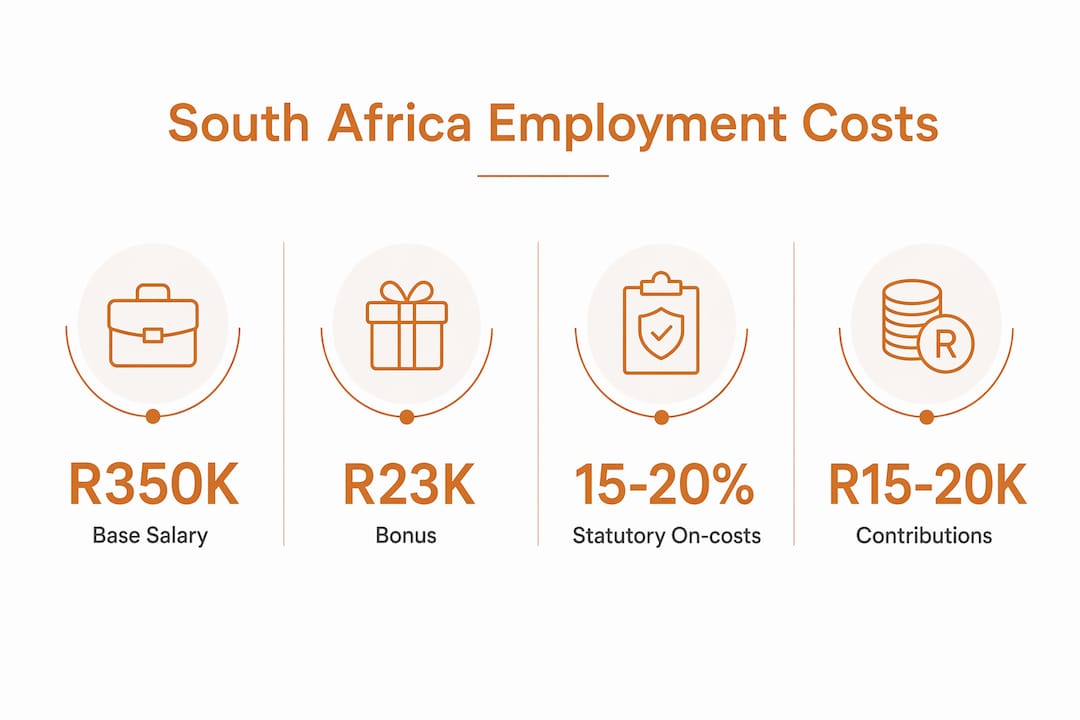
Take a mid-career analyst at R350,000 base. Add a R23,000 bonus, statutory contributions of roughly R15,000–R20,000, and an EOR fee of $399/month ($4,788 annually). Your realistic total lands between R420,000 and R440,000 before sourcing. That is still well below the equivalent cost for a comparable hire in the UK or EU, where salaries for the same role often run 40–60% higher. The employment cost calculator replaces estimated percentages with current statutory figures so your budget is defensible.
PAYE is withheld from the employee’s gross pay and remitted to SARS via the EMP201 return. UIF (Unemployment Insurance Fund) and SDL (Skills Development Levy) are employer obligations processed through payroll. COIDA (Compensation for Occupational Injuries and Diseases) is an annual employer assessment. None of these are optional, and all four must appear in your payroll model from day one.
How long does onboarding take when you use an Employer of Record?
With a specialist EOR, the timeline is measured in days, not months. A signed, BCEA-compliant employment contract can be in place within 48 hours of agreeing on terms. Full payroll onboarding, including SARS registration and statutory enrollment, typically completes within the first pay cycle. Compare that to establishing a South African subsidiary, which involves Companies and Intellectual Property Commission (CIPC) registration, tax registration with SARS, and COIDA registration — a process that routinely takes 8–12 weeks and requires local legal counsel.
For US-based HR teams, the practical implication is clear: an EOR removes the entity setup entirely. Your new analyst can start work within days of offer acceptance, with all statutory obligations handled locally and compliantly.
What should your hiring checklist cover for a South African data analyst?
Technical skills to verify:
- SQL proficiency (the baseline for most analyst roles)
- Python or R for data manipulation and reporting
- Power BI or Tableau for visualization and BI analyst work
- Familiarity with cloud data platforms (BigQuery, Snowflake, or Azure Synapse)
Interview questions that reveal real capability:
- “Walk me through a dashboard you built from raw data — what decisions did it drive?”
- “How do you handle missing or inconsistent data in a production pipeline?”
- “Describe a time your analysis changed a business decision.”
Red flags to watch for:
- Candidates who list tools but cannot explain methodology
- Vague answers about stakeholder communication (analysts who cannot translate data into business language rarely succeed in remote roles)
- No version-controlled portfolio or documented work samples
Pro Tip: Global vetting frameworks recommend a structured technical assessment before the final interview round — a short SQL or Python task calibrated to the role’s actual day-to-day work is more predictive than credentials alone.
Confirm whether the role is a data analyst, business analyst, or BI analyst before you benchmark pay. A business analyst in South Africa averages R38,888 per month, while PayScale’s business analyst data/Salary) shows an average of R389,267 annually. Mixing up role definitions inflates or deflates your offer, and candidates notice.
Direct hire vs. Employer of Record: which costs less?
| Cost category | Direct hire (own entity) | Employer of Record |
|---|---|---|
| Entity setup | R15,000 legal fees | None |
| Time to first hire | 8–12 weeks | Days |
| Payroll administration | In-house or outsourced | Included |
| PAYE/UIF/SDL/COIDA filings | Your responsibility | Handled by EOR |
| Monthly per-employee fee | None (but hidden overhead) | $399 flat |
| BCEA compliance risk | Yours | Transferred to EOR |
Direct hiring makes sense once you have five or more South African employees and a dedicated local HR function. Below that threshold, the entity setup cost and compliance overhead almost always exceed the EOR fee. For a single data analyst hire, the math strongly favors an EOR.
What US employers must know about South African employment law
South Africa’s employment framework is built on three primary statutes: the Basic Conditions of Employment Act (BCEA), the Labour Relations Act (LRA), and the Compensation for Occupational Injuries and Diseases Act (COIDA). The BCEA sets minimum notice periods, leave entitlements (21 consecutive days of annual leave), and working-hours limits. The LRA governs dismissal procedures and requires a fair reason plus a fair process — non-compliance creates CCMA (Commission for Conciliation, Mediation and Arbitration) exposure.
US employers often assume at-will employment applies globally. It does not. Terminating a South African employee without following the LRA’s procedural requirements can result in reinstatement orders or compensation awards. An EOR that provides CCMA-safe dismissal guidance is not a nice add-on; it is a material risk management tool.
Data privacy obligations also apply. The Protection of Personal Information Act (POPIA) governs how employee data is processed in South Africa, and any EOR you use must demonstrate POPIA compliance alongside GDPR alignment if your company is EU-based.
Which Employer of Record is best for hiring in South Africa?
Most global EOR platforms — those covering 150+ countries — treat South Africa as one line in a dropdown. Statutory filings, local labor law nuances, and CCMA procedures are handled by sub-contractors with variable accountability. For a US employer hiring one or two South African analysts, that generalist approach introduces compliance gaps that only surface when something goes wrong.
A single-country specialist handles South Africa’s statutory framework as its core product, not an edge case. That means BCEA-compliant contract templates, direct SARS filing relationships, COIDA registration, and CCMA-safe offboarding guidance built into the standard service. Pricing transparency matters too: flat monthly fees with no FX loading or hidden setup costs let you model total employer cost accurately before you sign.
For global talent acquisition teams evaluating EOR options, the key questions are: Does the provider file directly with SARS? Is the employment contract governed by South African law? Who legally employs your person, and is that disclosed upfront?
Expandtosouthafrica: flat-fee EOR built for South Africa
Hiring a South African data analyst at R350,000 base costs you a predictable total when you use Expandtosouthafrica. At a flat $399 per employee per month (€350/£299), with no setup fees and no FX loading, you get BCEA-compliant contracts signed within 48 hours, ZAR payroll processed locally, and all statutory filings handled: PAYE via EMP201 to SARS, UIF, SDL, and COIDA. Full onboarding completes within days.
Unlike generalist platforms that charge $400–$599/month for 150 countries, Expandtosouthafrica does one country properly. That means CCMA-safe dismissal guidance, free transfers from other EOR providers, vetted talent sourcing for skilled roles, and an open API with public docs and sandbox keys for HR teams that want to automate employment workflows. POPIA and GDPR compliance with EU data residency is standard.
Run your candidate’s salary through the employment cost calculator to get a line-by-line total before you make an offer, then review the full EOR services page to confirm scope. When you’re ready to move, contracts are signed within 48 hours.
Key Takeaways
South African data analysts cost US employers significantly less than equivalent UK or EU hires, but total employer cost always exceeds base salary once statutory on-costs and bonuses are included.
| Point | Details |
|---|---|
| Salary benchmarks | PayScale’s 2026 average is R305,517/year; senior roles reach R567,000+. |
| Total cost formula | Add bonus (~R23,015), UIF/SDL/COIDA, and EOR fee to base salary for true cost. |
| City premiums | Gauteng and Cape Town roles command higher pay than other provinces. |
| Legal compliance | BCEA, LRA, and POPIA apply from day one; at-will termination does not exist in South Africa. |
| Expandtosouthafrica | Flat $399/month EOR with BCEA contracts, SARS filings, and 48-hour contract signing. |
Recommended
- Hire software developers in South Africa (salaries + how to employ them) – Expand to South Africa
- Hire accountants in South Africa (salaries + how to employ them) – Expand to South Africa
- Employment cost calculator – Expand to South Africa
- Hire customer support in South Africa (salaries + how to employ them) – Expand to South Africa