

Permanent establishment (PE) risk is the chance that hiring someone in another country gives your company a taxable presence there, with corporate tax filings, payroll duties and penalties attached. It turns on what your people actually do and where, not on the label of their contract. For a South African hire, the practical answer is to settle three things before the first day: the role’s authority, where the work happens, and who runs the local payroll and filings. A single-country Employer of Record (EOR) takes the second and third off your desk, so you can concentrate on the first.
TL;DR
- A PE is a fixed place of business, or a dependent agent who habitually concludes contracts for you, that gives a country the right to tax part of your profits.
- The riskiest roles are those that negotiate and close deals, hold executive authority, or work from a home office that serves local customers.
- The 183-day rule is a common reference point for service PEs, not a universal safe harbor, and not a test every country uses.
- Consequences include corporate tax, employer payroll duties, VAT registration, interest and penalties, and reputational cost.
- Our flat fee starts from £299 per employee per month and includes the South African payroll and statutory filings your hire needs, without a local entity.
Table of Contents
- What a permanent establishment is
- What triggers PE risk when you hire one person abroad
- What an unrecognized PE costs
- How to manage PE risk when hiring in South Africa
- Where an Employer of Record fits
- What the cost looks like
- Hiring your first South African employee
- FAQ
- Sources
What a permanent establishment is
A permanent establishment is the tax concept that decides whether a foreign company is doing business in a country in a way that lets that country tax the profits. Most tax treaties follow the OECD model, which defines it as a fixed place of business through which the business of an enterprise is wholly or partly carried on. Its examples are a place of management, a branch, an office, a factory, a workshop, a mine, and a building site lasting more than twelve months.
There are two ways to end up with one:
- A fixed place of business. An office, a desk in a coworking space that is yours on a continuing basis, or, in some cases, a home.
- A dependent agent. A person who is not independent of you and habitually exercises authority to conclude contracts in your name. The same model carves out independent agents acting in the ordinary course of their own business.
The model also excludes activities that are only preparatory or auxiliary, such as storage, display, delivery, purchasing goods or collecting information. A person who simply gathers market information is in a different position from one who closes sales.
The UN version of the model, which developing countries often prefer, is somewhat stricter. It adds a services PE and uses a six-month rather than twelve-month threshold for construction projects. Which model applies to you depends on the specific tax treaty between your country and South Africa, so read that treaty rather than assuming the OECD wording.
What triggers PE risk when you hire one person abroad
For a startup, the question is rarely about factories. It is about one engineer, one account manager or one operations lead working from a home office in Cape Town or Johannesburg. Four factors matter most.
Authority to conclude contracts
The dependent-agent test is the one that catches sales hires. Under the 2010 UK legislation, for example, a company has a PE where an agent acting on its behalf habitually exercises authority to do business on its behalf. Since 2026, the UK rule also reaches a person who habitually plays the principal role leading to contracts that are concluded routinely without material change. Other countries are moving the same way.
What that means in practice: signing is not the only issue. KPMG’s 2026 survey of 63 jurisdictions found that where contracts are signed (78% of respondents) and where terms are negotiated (73%) were the most relevant criteria, and the substance of negotiations often outweighs the place of signature. KPMG also reports that most jurisdictions judge “habitually” on a qualitative basis, looking at repetition, continuity and involvement in the core business, not at a fixed number of days.
A developer, designer, finance analyst or support specialist who never negotiates prices or commits you to customers sits far from this test. A local sales lead who agrees pricing and terms with South African customers sits close to it.
The home office
In November 2025 the OECD adopted an update to its model that replaced the old commentary on home offices. A home or other remote location counts as a place of business only if all three conditions hold:
- It is fixed, meaning used continuously over an extended period.
- The individual spends at least 50% of working time there over a 12-month period.
- There is a commercial reason for the presence. Letting someone work from home simply to retain their services or save costs does not count as one.
This helps remote-first teams, but treat it as a reference point. KPMG’s EU Tax Centre expects the 50% threshold to be rarely treated as a binding safe harbor, because tax authorities weigh substance, the individual’s role and seniority, and contract terms. Not every country follows the update either. India, for instance, has recorded that it does not agree with the 50% threshold or the commercial-reason test, according to a summary of the country positions. If your hire serves local customers or works in real time across time zones from home, a commercial reason is easier to argue for the tax authority.
Seniority and the type of work
The same KPMG survey names seniority and role, especially C-suite executives, as key considerations, together with the regularity of cross-border work. A senior person who runs a region carries more risk than an individual contributor. Some countries go further than the model: Ogletree notes that Germany may treat IP created in-country as creating a PE, and India has rules on employing individuals in its territory even for non-revenue-generating activity. Always check the specific country, not the general principle.
Duration of services
Many treaties include a services PE that applies once personnel work on the same or a connected project for a period above a threshold. The UN model uses more than 183 days in any 12-month period. Some countries use shorter periods, and some have no threshold at all for a fixed place: PwC India notes that the Indian Supreme Court found a PE in a case where activities in India lasted only three days. Full-time employees in South Africa work there well beyond 183 days, so for an employee the day count is not what protects you. The role and its activities are.
What an unrecognized PE costs
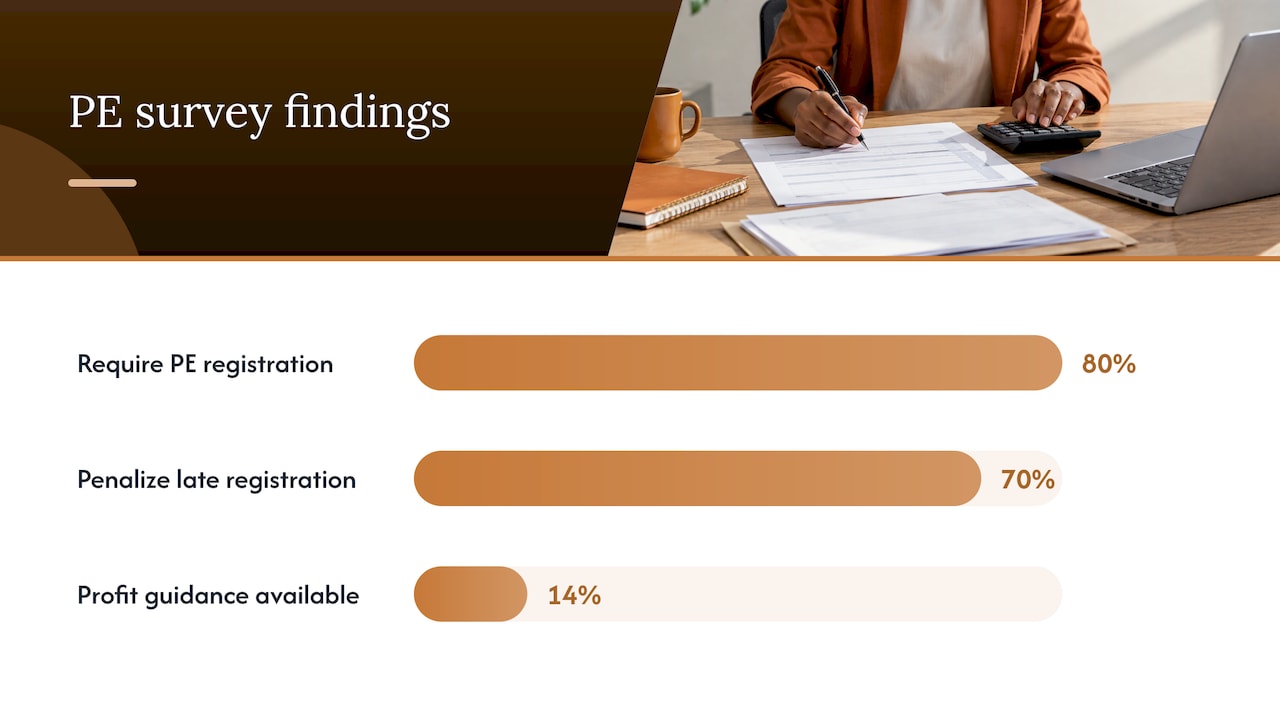
The tax itself is only part of the bill. Once a PE exists, KPMG’s survey describes a consistent set of obligations: corporate income tax registration and filing, employment tax and social security treating you as a local employer, profit attribution under the arm’s-length principle, VAT registration and local bookkeeping. Only about 14% of jurisdictions have specific guidance on attributing profit to remote-work PEs, so the calculation can be argued over.
The WTS Global PE Study found that 80% of countries require PE registration and 70% may impose penalties for late registration, and that failing to report a PE and pay the right taxes could qualify as tax fraud. Its authors conclude that the problem arises when obligations are not anticipated and surface through a customer request or an audit.
PwC UK adds further consequences: restated accounts, increased audits, penalties and interest, and immigration and social security issues for the employee.
What a South African PE would be taxed at
South Africa’s corporate income tax rate is 27%, and a branch of a foreign company pays the same 27%. That tax applies to profits attributable to the PE, not to your whole group’s profit. For a company whose South African team is a development or support function, attributable profit can be modest. The compliance load is what hurts: registration, annual returns and employer filings that a founder has not budgeted for.
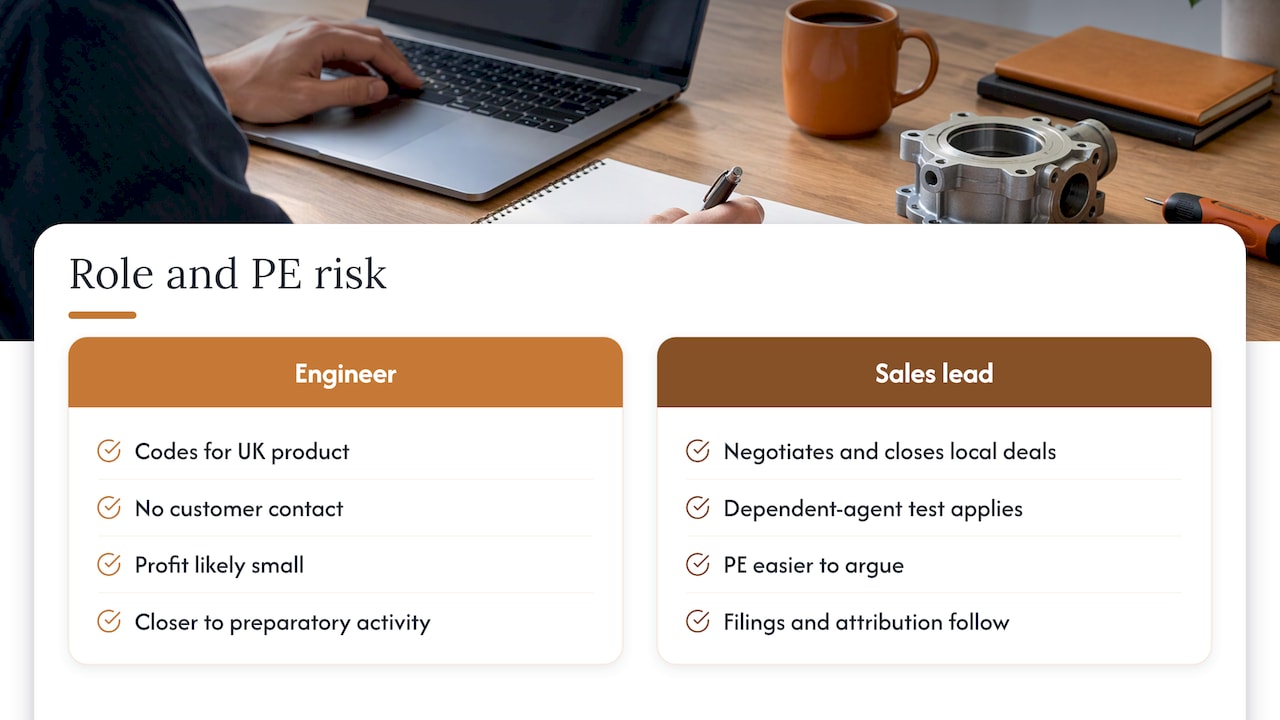
A worked example. Say a UK startup has one engineer in Johannesburg who writes code for the UK product and has no customer contact. Profit attributable to a South African PE is likely small, and the activity is closer to the preparatory side of the line. Now say the same startup hires a South African sales lead who negotiates and closes deals with local customers. Here the dependent-agent test is in play, a PE is far easier to argue, and filings, profit attribution and registration follow. Same country, same salary band, very different risk.
How to manage PE risk when hiring in South Africa
A sensible routine takes an afternoon per hire, and it is better done before the contract than after the audit.
- Map the role. Write down what the person will do each week: who they talk to, what they can commit you to, and whether they hold any authority over pricing or contract terms.
- Separate delivery from deal-making. Keep negotiation and final approval of customer contracts with people outside South Africa, and record that in the job description and in practice. The test looks at what happens, not what the paper says.
- Set the working location. Note where the person works, how often, and for what commercial reason. Avoid arrangements where a home office is designed around local customers.
- Differentiate by seniority. KPMG recommends that businesses apply a differentiated approach focused on the roles most likely to be scrutinized, since not every employee carries the same tax risk. Review senior and customer-facing roles first.
- Check the treaty and your home-country advice. Ask your own tax adviser how the treaty between your country and South Africa treats service and agent PEs, and whether your corporate group has Pillar Two exposure. That is a question for a qualified tax professional in your home country.
- Put the local employment layer in order. Whatever your PE position, the person needs a compliant contract, correct payroll and timely filings with the South African Revenue Service (SARS). Late or wrong filings create exactly the audit attention you are trying to avoid.
The sixth step is where hiring without an entity matters. Opening a company yourself means a registration, a bank account, payroll registration and ongoing filings, and it is the opposite of a light footprint. Our guide to hiring in South Africa without an entity walks through the alternative, and the entity cost breakdown shows what setup involves.
Where an Employer of Record fits
An EOR becomes the legal employer in the country. For South Africa, that means a licensed local partner issues the employment contract, runs payroll in rand and files the statutory returns: PAYE through the EMP201 return with SARS, UIF, SDL and COIDA. You keep directing the work day to day, which is why we say plainly who legally employs your people. Our page on the non-resident employer position in South Africa explains the PAYE side in more detail.
This matters for PE risk in two ways. First, it takes the employer administration, registrations and filings away from you, which are the first things a tax authority checks. Second, it gives you a clean record of how each role is employed. What the EOR does not change is the substance test: tax authorities look at who directs the activity and who receives the benefit, a point KBF Advisory makes in its 2026 analysis, adding that dependent-agent risk is highest where personnel negotiate key terms or secure commitments. RSM UK makes the same point: a PE can arise even when the EOR holds the employment relationship. So the EOR and your role design work together. Structure the role to avoid contract-closing authority, and let the EOR handle everything employment-related.
Why a single-country provider suits this
PE analysis is country-specific, and so is the employment layer around it. A provider covering one country can build every contract, payroll run and filing around South African rules: the Basic Conditions of Employment Act (BCEA), the Labour Relations Act, the COIDA assessment and SARS thresholds. Our guide to South African payroll and tax sets out those obligations. Our model is built on that one country, with data handled under POPIA and GDPR with EU data residency, and a time zone overlap with Europe of about plus or minus one hour.
What the cost looks like
Our EOR service starts from £299 per employee per month, which is the same as €350 or $399, with no setup fees and no FX loading. Compare that against the cost you would carry running the alternative yourself: an entity, a local payroll provider, statutory registrations, and a PE analysis that grows with each hire. The EOR cost guide itemizes what a South African hire costs in total, and our public employment cost calculator lets finance teams run the numbers per role. For skilled roles, typical savings versus UK and EU salaries run 40 to 60%.
Our view on PE risk
Founders usually ask us whether an EOR “removes” PE risk. The honest answer is that PE risk follows activity, so the best protection is a clear role design and a clean employment record. We built Expand to South Africa around one country so that the contract, the payroll and every SARS filing are handled by a licensed local partner who does only South African employment, and so that you always know who your legal employer is.
Where roles are engineering, product, finance, design or support, we think the case for hiring through us is strong: you get compliant employment in days, a flat fee you can budget, and guidance on compliant offboarding that follows South African dismissal law. Where a role touches customer contracts, we want you to see that early and design it with your tax adviser, not discover it in an audit.
The point of a single-country platform is depth. We would rather answer every South African question properly than cover 150 countries thinly.
Roel
Hiring your first South African employee
If you want to move from reading to acting, our EOR service gives you signed contracts within 48 hours and full onboarding within days, from £299 per employee per month. Companies already using another EOR can transfer to us free of charge, and contractors in South Africa can be converted to employees. If you need to find the person first, our talent sourcing service handles vetted candidates for skilled roles.
Developers can also automate the process: we offer an open API with public docs and sandbox keys, covered in our integration guide.
FAQ
Does the 183-day rule protect me from a permanent establishment?
No. The 183-day figure appears in many service PE provisions, but it is not universal. Some countries use shorter periods, and the fixed place of business and dependent agent tests have no day threshold in many treaties. A full-time employee will exceed 183 days anyway, so the relevant question is what the person does.
Can one remote employee create a PE?
Yes, in principle, if the home office meets the fixed-place test or the person acts as a dependent agent. Under the OECD’s 2025 commentary, a home office is a place of business only where it is fixed, used for at least 50% of working time over 12 months, and has a commercial reason. Role and seniority carry real weight in practice.
Which South African hires carry the least PE risk?
Roles with no authority to negotiate or conclude customer contracts and no local customer-facing function: engineering, design, data, finance operations and internal support. Customer-facing sales and executive roles deserve a closer look with your tax adviser before the contract is signed.
Do I still need tax advice if I use an EOR?
Yes, from your own corporate tax adviser. Your home-country treaty, group structure and the way you direct the role decide your PE position. We take care of the South African employment contract, payroll and filings, and you take the PE analysis to your adviser.
Sources
- OECD Model Double Taxation Convention 1977
- UN Committee of Experts, PE commentary update 2019
- OECD Model Tax Convention 2025
- UK Corporation Tax Act 2010, Part 24 Chapter 2
- HMRC International Manual INTM264300
- KPMG, navigating permanent establishment risk in a remote work era
- Country positions on the OECD home-office rules
- Ogletree, permanent establishment risks in cross-border employment
- UN Model Article 5 summary
- PwC India, the past, present and future of permanent establishment
- WTS Global PE Study
- PwC UK, permanent establishment risk review
- MJK Inc, corporate tax in South Africa
- KBF Advisory, EOR arrangements and PE risk
- RSM UK, international workforces and employer of record