

An employer of record (EOR) service is a company that becomes the legal employer of your worker in a country where you have no entity of your own. It signs the employment contract, runs payroll, pays the taxes and handles the statutory filings, while you direct the person’s daily work. For a US, UK or European company hiring in South Africa, that means a full-time employee on a compliant local contract without a subsidiary. We built Expand to South Africa for this one country: employer of record services in South Africa cost $399 per employee per month (€350 or £299), with no setup fees and no FX loading.
This guide explains what an EOR does, how it differs from a PEO, what to check before you sign, and what to expect when the country is South Africa.
TL;DR
- An EOR is the legal employer of your worker in another country. You manage the work; the EOR manages the contract, payroll, tax and statutory compliance.
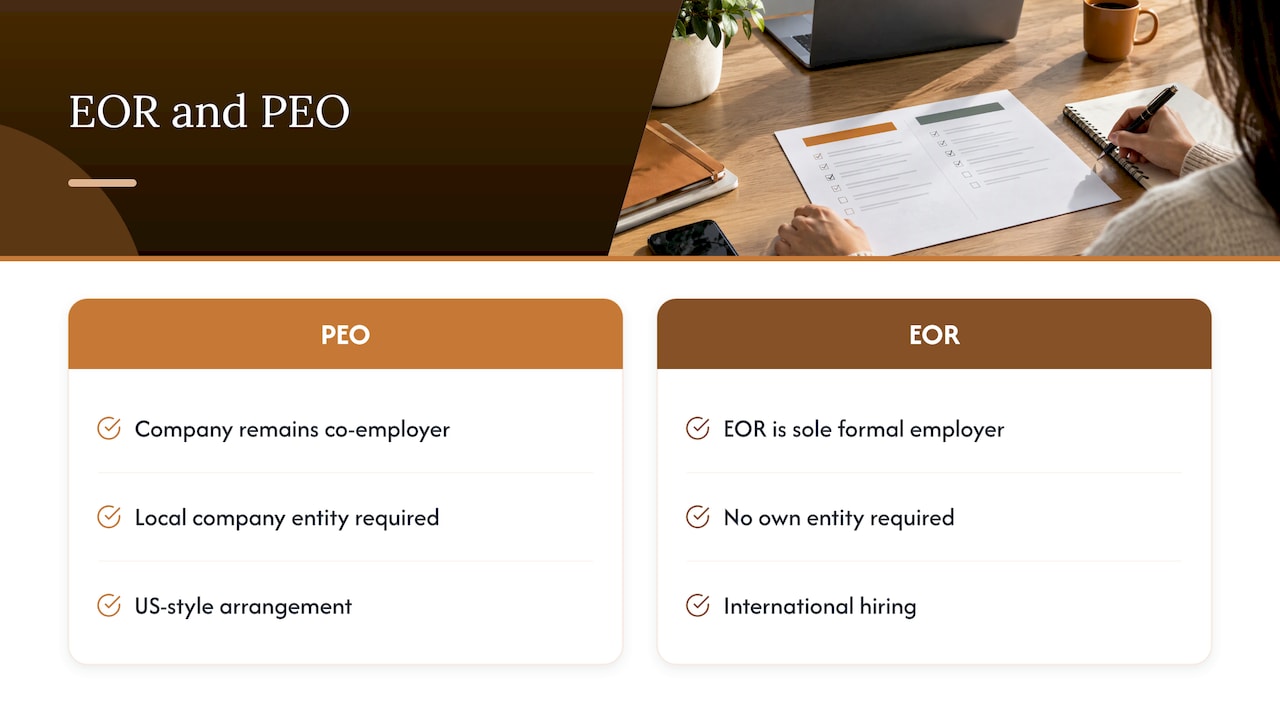
- A PEO shares employer status with you (co-employment), a model largely tied to the United States. An EOR is the sole formal employer, which is why it works across borders.
- Scope and liability allocation differ by provider and contract, so read the agreement for who is responsible for what.
- In South Africa we charge a flat $399 per employee per month (€350 or £299), with BCEA-compliant contracts, ZAR payroll, and PAYE, UIF, SDL and COIDA filings included.
- Skilled roles in South Africa typically cost 40 to 60% less in salary than comparable UK or EU roles, with a time zone within about one hour of CET.
Table of Contents
- What an employer of record service means
- How an EOR service works step by step
- EOR versus PEO: what “PEO meaning” really tells you
- When an EOR is the right call
- What to verify before you sign with any EOR
- What an EOR service costs
- Why South Africa works for an EOR hire
- Perspective
- Hiring in South Africa through us
- FAQ
- Sources
What an employer of record service means
Employment law is national. To put someone on payroll in a country, a business normally needs a registered entity there: a tax number, payroll registrations, a bank account, and someone who knows the local labour statutes. Setting that up takes months and carries a fixed cost before the first hire starts.
An EOR removes that step. It already has the local presence, and it employs the worker on your behalf. PwC describes the arrangement as a way to hire in a country without setting up your own local employment presence, with the EOR taking on administrative work. The worker is a real, permanent employee with a local contract, statutory benefits and payslips. You are the one who chooses the person, sets the goals and manages the output.
That split is the whole model:
| Task | Who handles it |
|---|---|
| Choosing the person, setting duties and targets | You |
| Day-to-day management and performance feedback | You |
| Employment contract under local law | The EOR |
| Payroll in local currency | The EOR |
| Income tax and social contribution filings | The EOR |
| Statutory leave, notice and termination procedure | The EOR, on your instruction |
The terms “employer of record services”, “international EOR” and “EOR without a subsidiary” all describe this same arrangement. The word “international” simply signals that the EOR sits in the worker’s country, not yours.
How an EOR service works step by step
- You find the person, or ask for help finding them. Many founders already have a candidate or a contractor they want to keep. Others need sourcing. We offer talent sourcing for skilled roles alongside the EOR service.
- You agree the terms of the role. Salary, title, start date, working hours and any role-specific clauses go into a local-law contract.
- The EOR issues the contract. With us, signed contracts follow within 48 hours and full onboarding within days. The contract is drafted to comply with the BCEA, South Africa’s Basic Conditions of Employment Act, which sets minimum terms such as working hours, leave and notice.
- The EOR runs payroll. Salary is paid in rand (ZAR) each month, and the statutory deductions and employer contributions are calculated and filed.
- You manage the work. Your team assigns tasks, runs stand-ups and reviews performance as with any colleague.
- Changes and exits go through the EOR. Raises, promotions, resignations and dismissals follow local procedure, because the EOR is the party that must follow it.
The point of step 6 matters more than it looks. In most countries, ending employment is where mistakes become expensive. In South Africa, dismissals can be referred to the CCMA, the Commission for Conciliation, Mediation and Arbitration, so procedure has to be right before the conversation happens. Our offboarding guidance is built around dismissals that hold up at the CCMA.
EOR versus PEO: what “PEO meaning” really tells you
A PEO, or professional employer organization, is a US-style arrangement. Under a PEO you and the provider act as co-employers: the PEO takes on payroll, benefits and some HR duties under its own tax accounts, but your company remains an employer too. Your company still needs to exist in the place where the people work.
An EOR is different in the one way that counts for international hiring: it is the sole formal employer. You do not need an entity, because the EOR’s entity is the one that employs. The co-employment concept behind a PEO is largely confined to the United States, and many foreign legal systems do not recognize it. That is why a service sold as a “global PEO” generally works, in practice, as an EOR.
For a US company with staff in Ohio or Illinois, a PEO can be a sensible domestic tool. For a worker in Cape Town or Johannesburg, you need an EOR. We cover the difference in more detail in EOR vs PEO in South Africa.
When an EOR is the right call
An EOR fits when you want one or a few employees in a country, and the cost and delay of an entity do not make sense. Typical situations among our readers:
- A startup hiring its first remote employee and not wanting to register a foreign company for one engineer.
- A company converting a contractor to an employee. Long-term contractors who work like staff can create misclassification exposure, and an employment contract resolves that. See our guide on how to hire in South Africa without setting up an entity.
- A team switching providers because of price, support or coverage. We transfer employees from other EOR providers at no charge.
- A technical team that wants to automate onboarding. We publish an open REST API with public documentation and sandbox keys, so a CTO can connect hiring to internal tooling.
If you plan dozens of hires in a country and expect a long presence, an entity can eventually make sense. Even then, many companies start with an EOR to test the market and move later.
What to verify before you sign with any EOR
PwC’s advice on EORs comes down to checking local law and the agreement itself. Its risk list includes local rules that may still treat the client as the actual employer, licensing or labor-lending requirements that the EOR must meet, inadequate pay or benefits compliance, and unresolved responsibility for liabilities. Turn that into a short list of questions:
- Who is the legal employer, by name? You should know which registered company signs the contract. We state plainly that a licensed local partner is the legal employer of your people in South Africa.
- Is the provider licensed where the work happens? Some countries regulate EORs or labor-lending arrangements. Ask for the legal basis.
- Which filings are included? Payroll, income tax, unemployment insurance and injury-on-duty cover should all be named. In South Africa these are PAYE, UIF, SDL and COIDA; we handle all four, including the EMP201 monthly declaration to SARS.
- How does the agreement allocate liability? Read the clauses on errors, penalties and termination claims.
- How is your intellectual property protected? The worker’s contract should assign work product to your business.
- What exactly is in scope? Recruitment, onboarding, HR support and reporting vary by provider and contract. Confirm each in writing rather than assuming.
- How is data handled? We process data under POPIA, South Africa’s data protection act, and GDPR, with EU data residency.
What an EOR service costs
EOR pricing usually takes one of three forms: a flat monthly fee per employee, a percentage of salary, or a lower headline fee with extras added for onboarding, currency conversion or contract changes. Compare on total monthly cost for one employee over twelve months, not the headline.
The lines to check:
- Monthly fee per employee
- Setup or onboarding fee
- FX markup on salary paid in local currency
- Fees for contract changes, termination or transfer
- Benefits administration charges
- Sourcing fees if you want the provider to find the person
Our price is one flat fee: $399 per employee per month (€350 or £299), with no setup fees and no FX loading. Broad multi-country platforms that cover around 150 countries list roughly $400 to $599 per month in our comparisons. A flat fee gives a finance lead a number that does not move with salary, which makes budgeting simple.
The EOR fee is only one part of the cost of an employee. Salary, employer contributions and any benefits sit on top. Our employment cost calculator shows the full monthly employer cost for a given salary, and South Africa employment cost walks through each component.
A worked example
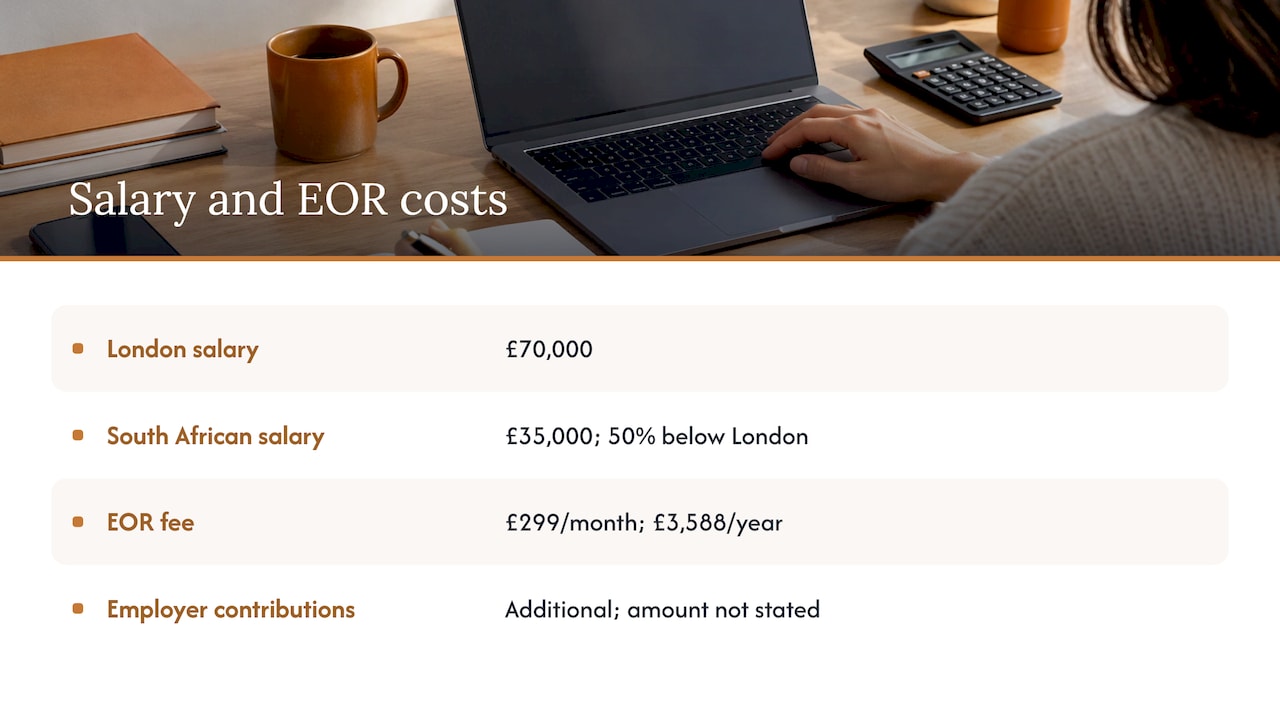
Take a mid-level software engineer in South Africa. For skilled roles, we typically see salaries 40 to 60% below UK or EU equivalents. Suppose a comparable London role costs you £70,000 in salary. A 50% saving puts the South African salary at £35,000. Add the EOR fee of £299 a month, £3,588 a year, and the statutory employer contributions the calculator shows, and the total remains well below the London figure while the person works in nearly the same hours. The exact figure depends on the salary and benefits you choose, so run your own numbers in the calculator.
Why South Africa works for an EOR hire
Three practical reasons come up for European, UK and North American teams:
- Talent depth. South Africa has an established pool of developers, finance staff, designers and support specialists, many with English-language experience in international teams.
- Time zone. South Africa is within about one hour of CET, so a European team shares nearly its whole working day with the hire. For US teams the morning overlaps with the East Coast.
- Cost. The 40 to 60% salary difference for skilled roles is what drives most first hires.
South Africa also has a strong labor framework, and this is where local depth pays off. The BCEA sets minimum conditions. The Labour Relations Act governs fairness in dismissal. COIDA, the Compensation for Occupational Injuries and Diseases Act, covers workplace injury and is assessed with an earnings cap. SARS, the revenue service, collects PAYE. Each has its own deadlines: the EMP201 monthly payment is due by the 7th. Our guides on South Africa payroll and tax and the payroll calendar lay these out.
Perspective
We built Expand to South Africa around a single belief: an EOR should know one country well, not 150 countries adequately. Every hire we onboard is governed by the same statutes, the same SARS procedures and the same CCMA practice, so our team handles the same questions repeatedly and builds the answers into the contract and the payroll run.
That focus is why we can publish one flat fee, why contracts are signed within 48 hours, and why our offboarding guidance is written with the CCMA in mind. It is also why we open our calculator and API to the public: a founder or a CTO should be able to see the cost and the integration before talking to anyone.
Our advice to a company hiring its first person in South Africa is simple. Decide the role, check the full employer cost, confirm in writing who the legal employer is, and start the contract. The rest is routine, and we handle it.
Roel
Hiring in South Africa through us
If you are ready to hire, our EOR service covers the contract, rand payroll and the PAYE, UIF, SDL and COIDA filings for $399 per employee per month (€350 or £299). If you need the candidate as well, talent sourcing is available for skilled roles, and employees on another EOR can transfer to us for free.
For the mechanics of the arrangement, see how an EOR works as the legal employer. For a full walk-through, read the complete guide to employer of record in South Africa.
FAQ
What does “employer of record” mean?
It is the organization that is the legal employer of a worker on behalf of another business. It signs the contract, pays the salary, withholds and files the taxes and meets local labor rules. The client company directs the daily work.
Is an EOR the same as a PEO?
No. A PEO shares employer status with your company, a co-employment model largely confined to the United States. An EOR is the sole formal employer, so you can hire in a country without your own entity there.
Can I hire in South Africa without a subsidiary?
Yes. With an EOR, a licensed local partner employs the person under a BCEA-compliant contract and runs payroll in rand. You manage the work, and you do not need to register a South African company.
How much does an EOR cost in South Africa?
Our service is $399 per employee per month (€350 or £299), with no setup fees and no FX loading. That covers the contract, payroll and statutory filings. Employee salary and employer contributions are separate, and the employment cost calculator shows the total.
What happens if I want to end an employment?
The EOR runs the process under South African law, because it is the legal employer. We provide guidance designed to keep dismissals procedurally sound and CCMA-safe, so talk to us before you act on a decision.