

If you employ people in South Africa, employment equity reporting is an annual filing with the Department of Employment and Labour, and it applies only to “designated employers”: those with 50 or more employees. Below that size you have no EE report to file. Above it, you submit two forms (EEA2 and EEA4) inside a fixed window every year, and since 2025 your numbers are measured against sector targets that can affect your access to state contracts. Not the US EEO-1 report, which is a separate American filing, but a South African statutory report with its own rules.
We are an Employer of Record platform that works in South Africa only, so this is the part of local law we expect foreign founders to meet early. Below is what the report is, who must file, what goes in it, when, and what changed recently.
TL;DR
- Only employers with 50 or more employees must file an EE report. Employers with 1 to 49 employees were removed from reporting from the 2025 period, according to the Department’s 25th Commission for Employment Equity annual report.
- The report is two forms: EEA2 (workforce profile and equity measures) and EEA4 (income differential statement). Incomplete forms count as not filed.
- The window opens each year on 1 September. Hand delivery closes on the first working day of October; online submission runs to 15 January of the following year.
- New five-year EE Plans started on 1 September 2025, and 2026 is the first year that first-year targets are assessed.
- A compliance certificate, needed for state contracts, now depends on sector targets as well as a filed report.
Table of Contents
- What employment equity reporting is
- Who must report
- What you submit: EEA2 and EEA4
- The annual reporting window
- What changed in 2025 and 2026
- A preparation routine for the first report
- What this means for first hires
- Hiring in South Africa without a local entity
- FAQ
- Sources
What employment equity reporting is
The Employment Equity Act requires designated employers to analyze their workforce, set numerical targets and report on progress toward a workforce that reflects the country’s population. The report goes to the Director-General of the Department of Employment and Labour under section 21 of the Act.
The Act protects all employers’ workers and job applicants, with narrow exceptions such as the National Defence Force and the intelligence services, as a basic guide from a South African compliance body notes. The reporting duty is narrower: it falls on designated employers.
Three terms you will meet:
- Designated groups: the EEA2 form defines these as Black people (Africans, Coloureds and Indians), women and people with disabilities who are South African citizens by birth, descent or qualifying naturalisation.
- Occupational levels: the job bands, from top management down to unskilled, across which you report your headcount.
- EE Plan: your multi-year plan with annual numerical targets. The current plan period runs from 1 September 2025 to 31 August 2030, under the 2025 Regulations.
Who must report
A 2026 compliance guide from a major South African law firm states that employers with 50 or more employees and all organs of state must report, and that smaller employers must report only if designated through a collective agreement.
The Employment Equity Amendment Act No. 4 of 2022 took effect on 1 January 2025. The ILO’s 2026 report on South Africa says it lets the Minister set sector-specific targets, lightens the load on businesses with 1 to 49 employees and makes a compliance certificate a prerequisite for state contracts.
What the threshold means for a foreign company
Most foreign companies arrive with one to ten South African hires, far below 50. For them the practical point is the threshold itself: you are not a designated employer until your South African headcount reaches 50, so plan for it before you get there. Headcount counts everyone on the books, so a growth plan that goes from 40 to 70 South African staff changes your obligations in one hiring round.
How the 50-employee count applies to your own structure depends on who the legal employer is. That is a question to settle with your provider before you grow, and our team can walk you through how it applies to your setup.
What you submit: EEA2 and EEA4
The annual submission has two parts.
EEA2, the employment equity report. It covers a twelve-month period and includes employer details, a workforce profile by race, gender and disability across occupational levels, recruitment, promotions, terminations, skills development, numerical goals, consultation, barriers and affirmative action measures, and monitoring. The form itself must be signed by the CEO or accounting officer.
EEA4, the income differential statement. Required under section 27(1) of the Act, it assesses the pay gap between your highest- and lowest-paid employees and pay inequalities by race and gender across occupational levels. The form instructions say it must include all employees, foreign nationals and short-term temporary staff among them.
Two practical points:
- The EEA2 instructions say that an employer who fails to complete every area fully and accurately is deemed not to have reported. A filed but incomplete form is not a filing.
- The Department’s online system guidance advises checking the workforce profile tables first, having the system email the report to the CEO or accounting officer for approval, and notes that no changes are allowed after submission.
An employer that cannot report must notify the Director-General in writing by the last working day of August of the same year, using form EEA14 with reasons and evidence. Employers that have closed, merged or ceased operating use the same form to update their status, according to the Department’s 2026 notice. You must also keep a copy of each report for five years after submission, under regulation 10(14).
The annual reporting window
The pattern repeats every year:
| Step | Timing |
|---|---|
| Reporting period opens | 1 September |
| Hand-delivered or posted reports close | First working day of October |
| Online submission closes | 15 January of the following year |
| Notice if you cannot report (EEA14) | Last working day of August |
These come from the Employment Equity Regulations. For the 2026 cycle the Department confirmed the same pattern: opening 1 September 2026, manual reports due 1 October 2026 and online reports due 15 January 2027. Check the Department’s online portal for the current year’s dates. It accepts online submissions only; faxed and emailed reports are not accepted.
Hand-delivered reports must be signed by the CEO or accounting officer. Online is the route most employers use, partly because of the longer window.
What changed in 2025 and 2026
Three changes matter most.
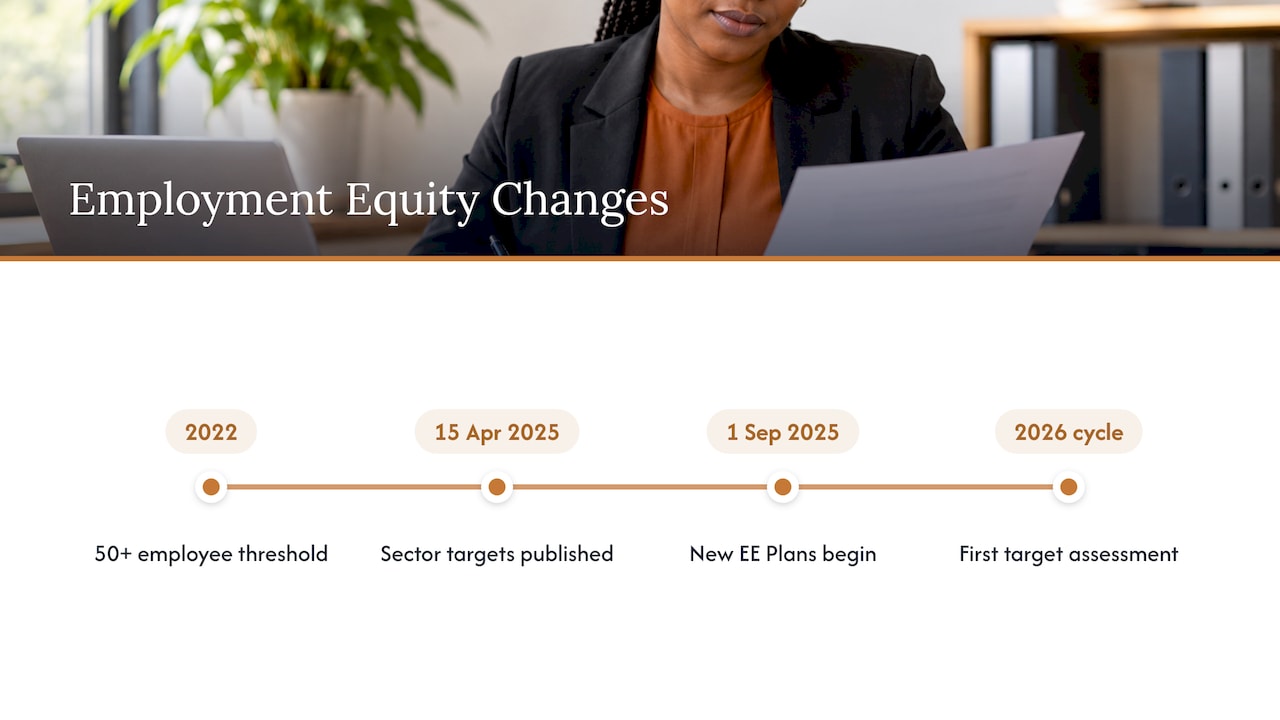
Small employers dropped out. After the 2022 amendment, “designated employer” refers only to employers with 50 or more employees, per the Department’s annual report.
Sector targets arrived. The Minister published the General Administrative Regulations and the five-year sector numerical targets on 15 April 2025. New EE Plans began on 1 September 2025, and the ILO notes that the first assessment of first-year targets falls in the 2026 cycle. Your EE Plan must set annual targets for all designated groups in the four upper occupational levels, tied to the sector targets and the economically active population, plus targets for people with disabilities.
Targets have consequences, with room for reasons. A law firm guideline on the amendments explains that the Minister may issue a compliance certificate only where the employer met its sector’s targets or showed a reasonable ground for not doing so, and has filed a section 21 report with clean CCMA, court and minimum-wage records. No penalty or disadvantage follows where reasonable grounds justify missing a target.
The same guideline stresses that reporting is more than administration: the forms need accurate information and evidence of implementation behind them.
A preparation routine for the first report
If you are approaching 50 South African employees, start a year ahead.
- Map every role to an occupational level. Do it at hire, not in December.
- Record designated-group status and disability data consistently, with employee consent and in line with POPIA, South Africa’s data protection law.
- Consult. The regulations expect you to consult registered trade unions or employee representatives when analyzing your workforce and setting targets.
- Build the EEA4 pay data from payroll. Gross remuneration by level and by race and gender needs a clean ZAR payroll record. Our payroll services page explains how we run ZAR payroll and the statutory filings that sit alongside it.
- Keep your records in one system. A single employee record from recruitment through offboarding makes workforce profile tables far easier to verify; this overview of the employee lifecycle from recruitment to offboarding shows the idea.
- File early in the window and keep your copy for five years.
Before hiring at scale, read our guide to South African labour law for foreign employers, which covers the BCEA and LRA, the other statutes you will meet beside the Employment Equity Act.
What this means for first hires
EE reporting is one of several local obligations, alongside PAYE through the EMP201 return with SARS, UIF, SDL and COIDA. For a company with a handful of South African staff, those payroll filings are the live duties each month, and EE reporting is a planning question for later.
Our view on EE reporting
We work in one country only, and that shapes how we see this topic. Foreign founders often hear about employment equity as a vague risk. It is not vague: it is a defined threshold, two named forms and a fixed window. The risk is arriving at 50 employees without having collected the data the forms need.
Our approach is to treat South African law as a design constraint from the first hire: BCEA-compliant contracts, ZAR payroll and statutory filings run through a licensed local partner, with openness about who legally employs your people. That clarity is what lets you plan headcount, pay structures and targets with confidence instead of discovering obligations in January.
If you are planning to grow a South African team, talk to us early about how thresholds like this one apply to your setup.
Roel
Hiring in South Africa without a local entity
If you are hiring your first South African employees, our Employer of Record service lets you employ full-time staff without setting up a local entity. It costs from £299 per employee per month, with no setup fees or FX loading. Contracts are BCEA-compliant, payroll runs in ZAR, and PAYE (EMP201), UIF, SDL and COIDA filings are handled through our licensed local partner. See our pricing for the full picture.
If you also need people, our talent sourcing service finds vetted candidates for skilled roles, and skilled hires typically cost 40 to 60% less than comparable UK or EU salaries.
FAQ
Is employment equity reporting mandatory?
Yes, for designated employers, meaning those with 50 or more employees, plus organs of state. Employers with 1 to 49 employees no longer have to submit reports from the 2025 period. Smaller employers can still be designated through a collective agreement, per the 2026 compliance guide.
What are the four designated groups?
The Act’s designated groups are Black people (Africans, Coloureds and Indians), women and people with disabilities who are South African citizens. Black people are counted as three population groups, which is why you may see them listed as four groups in total. The EEA2 form carries the full definition.
What is the difference between EEA2 and EEA4?
EEA2 is the equity report: workforce profile, recruitment, promotions, skills development and your targets. EEA4 is the income differential statement, showing pay gaps across levels by race and gender. Designated employers submit both together.
Is this the same as the US EEO-1 report?
No. EEO-1 is a US federal filing to the Equal Employment Opportunity Commission. South African employment equity reporting goes to the Department of Employment and Labour under a different Act, with different forms, groups and deadlines.
Sources
- Employment Equity Compliance Guide, September 2026 (Cliffe Dekker Hofmeyr)
- 25th CEE Annual Report, Department of Employment and Labour
- Basic Guide to Employment Equity Reports (APSO)
- Employment Equity Regulations, 2025
- EEA2 form
- EEA2 form instructions
- EEA4 form
- Department of Employment and Labour notice on EE reporting
- Employment Equity online portal
- ILO information on ratified Conventions, South Africa, 2026
- 2023 Employment Equity Amendments and 2025 Regulations Guideline