

An IRP5 is the annual tax certificate a South African employer issues to each employee, showing what the employee earned and how much PAYE (pay-as-you-earn income tax) was withheld. If you employ someone in South Africa, you are responsible for getting it right and delivering it on time, and the employee will use it to file their own return. For a foreign company without a local entity, the simplest way to meet that duty is to employ through a South African Employer of Record (EOR) whose licensed local partner runs the payroll and statutory filings. Our EOR service starts from £299 per employee per month, and the rest of this guide shows what the certificate involves so you can judge the workload.
TL;DR
- An IRP5 shows income and PAYE withheld for one tax year. It is issued where tax was deducted; an IT3(a) is issued where none was.
- Employers must deliver it within 60 days after the tax year ends, or within 14 days after an employee leaves, and only after an acceptable EMP501 reconciliation has been submitted.
- Errors can only be fixed by the employer, by revising the certificate and resubmitting the reconciliation. SARS cannot change them.
- The South African tax year runs 1 March to the end of February, so the cycle is out of step with US and UK calendars.
- Employing through an EOR means the local partner handles the payroll and filings behind the certificate.
Table of Contents
- What an IRP5 is and what it shows
- IRP5 or IT3(a): which certificate applies
- When employers must issue the certificate
- How the certificate reaches SARS and the employee
- What employees do with it
- Worked example: checking a certificate
- When a certificate is wrong or missing
- Why foreign employers rarely want to run this themselves
- Our offer
- Perspective
- FAQ
- Sources
What an IRP5 is and what it shows
The South African Revenue Service (SARS) is the national tax authority. An IRP5 is the certificate that shows all income paid or payable and the employee tax deducted or withheld for a given tax year. Think of it as the South African counterpart to a US W-2 or a UK P60, although the layout and the filing mechanics differ.
According to a professional guide from RSM South Africa, the certificate carries:
- the transaction year, assessment year and reconciliation period;
- a unique certificate number;
- the employer’s name, address and PAYE, SDL and UIF registration numbers;
- the employee’s ID number and tax reference number;
- a set of numeric source codes that break down income and deductions.
The codes you will meet most often are 3601 (income), 3605 (annual payments such as bonuses), 3701 (travel allowance), 4005 (medical aid contributions) and 4102 (PAYE deducted and paid to SARS). SARS publishes the full list in its 2026 guide to certificate codes, which also covers 3699 (gross remuneration used to calculate tax) and 4115 (PAYE on retirement fund benefits).
SDL is the Skills Development Levy and UIF is the Unemployment Insurance Fund contribution. Both are employer-side registrations that appear on the certificate. If you want the wider picture of these payroll taxes, our employer payroll taxes guide and overview of what employers pay and when cover them.
IRP5 or IT3(a): which certificate applies
Both documents report an employee’s earnings. The difference is whether tax was deducted.
| IRP5 | IT3(a) | |
|---|---|---|
| Issued when | PAYE was deducted | No PAYE was deducted |
| Key codes | 4101, 4102 or 4115 greater than zero | 4150 (reason for no deduction) |
| Must not contain | Code 4150 | Codes 4102 or 4115 |
| Typical case | Salaried employee above the tax threshold | Employee earning below the threshold, or with non-taxable earnings |
The rules come from SARS’s employer reconciliation specification (V25-3-0, May 2026), which also states that an IRP5 cannot be indicated if the PAYE number starts with 0, 1, 2, 3 or 9. On an IT3(a), code 4150 gives the reason: 02 means the employee earned less than the tax threshold, and 04 covers non-taxable earnings.
For most skilled, full-time hires you will be issuing IRP5s. The threshold at which PAYE starts changes with each national budget, so check it against our PAYE thresholds page when you set a salary.
When employers must issue the certificate
The obligation sits in paragraph 13(2) of the Fourth Schedule to the Income Tax Act. SARS’s 2026 guide to completing and submitting employee tax certificates sets these deadlines:
- Continuing employees: within 60 days after the end of the tax year (which ends in February).
- Leavers: within 14 days after the employee leaves your service.
- Employer ceasing to employ: within 14 days after you stop being an employer.
The Commissioner can approve a longer period. The same guide says certificates cannot be delivered until SARS has accepted an EMP501, which is the employer’s reconciliation of the PAYE, SDL and UIF you declared monthly against your payroll records. That ordering matters: the certificate is the output of the reconciliation, not a standalone document you can produce early.
The annual reconciliation covers 1 March to 28 or 29 February. There is also an interim reconciliation for 1 March to 31 August, which SARS now treats as an integral part of the employer reconciliation. Late submission can bring penalties and interest.
The annual filing season has opened on 1 April and closed on 31 May, according to the South African Payroll Association’s 2025/2026 FAQ, with test submissions possible beforehand. SARS announces the exact window each year, so confirm it on SARS’s site and in our 2026 payroll calendar rather than relying on last year’s dates.
How the certificate reaches SARS and the employee
The certificate data travels to SARS inside your EMP501. Govchain’s IRP5 guide notes that this usually puts it on the employee’s eFiling profile before the PDF or paper copy arrives, and that SARS’s validation rejects certificates that fail its checks, so they will not pre-populate the employee’s return.
Submission channels have limits. SARS’s guide to the employer reconciliation process states:
- a SARS branch accepts a maximum of five IRP5/IT3(a) certificates;
- eFiling accepts a maximum of 50 certificates per reconciliation;
- employers with more than 50 must use e@syFile Employer;
- once you choose a channel for a reconciliation, you use it for every later transaction in that tax period.
A small team of a few South African hires sits comfortably within eFiling, but the channel choice is locked in, so it is worth settling before filing season.
Format rules that changed recently
SARS’s 2026 guide says certificates submitted after 28 February 2025 should use the 2026 format: HTML5 for manual certificates, prescribed validation rules for CSV files, and a ZipCentralFile created by e@syFile Employer. All fields are mandatory.
The May 2026 specification adds that its import-file rules took effect for payroll suppliers on 1 March 2026, with changes on SARS systems in September 2026. Its revision history lists new source codes added in February 2026 and validation changes to several codes in May 2026. The import file is limited to 20 income source codes and 12 employee and employer deduction codes, so sub-codes must be consolidated into main codes on the certificate. Employment Tax Incentive (ETI) data is required for the full 12 months in the final submission and 6 months in the interim, though no ETI fields print on the employee’s IRP5.
The practical lesson: the payroll system behind your certificates has to track SARS’s specification as it moves, and a spreadsheet will not.
What employees do with it
Your employee does not just file the IRP5 away. They use it in their annual income tax return, the ITR12. SARS’s comprehensive ITR12 guide explains:
- the certificate data you submitted via the EMP501 pre-populates the return, and the employee must verify it;
- SARS cannot alter or delete that data, so errors must be fixed by the party that supplied it, which is you;
- the return holds a maximum of 15 certificates, with any excess combined on the 15th page;
- certificates should be kept for five years.
This is why accuracy matters beyond compliance. An employee who finds a wrong figure in their return cannot correct it themselves, and the fix lands on your desk.
Worked example: checking a certificate
Take a hypothetical employee paid a steady monthly salary through the tax year. Two quick checks, drawn from Sarstax’s 2026 IRP5 guide, catch most problems:
- PAYE: add up the monthly PAYE deductions on the payslips and compare the total with code 4102.
- UIF: code 4141 should equal 1% of earnings, up to the monthly ceiling.
Small rounding differences are normal. A large gap points to an error. In that case you trace it to the payroll run, correct it, and resubmit. The hypothetical figures here are illustrative; use your own payslips.
When a certificate is wrong or missing
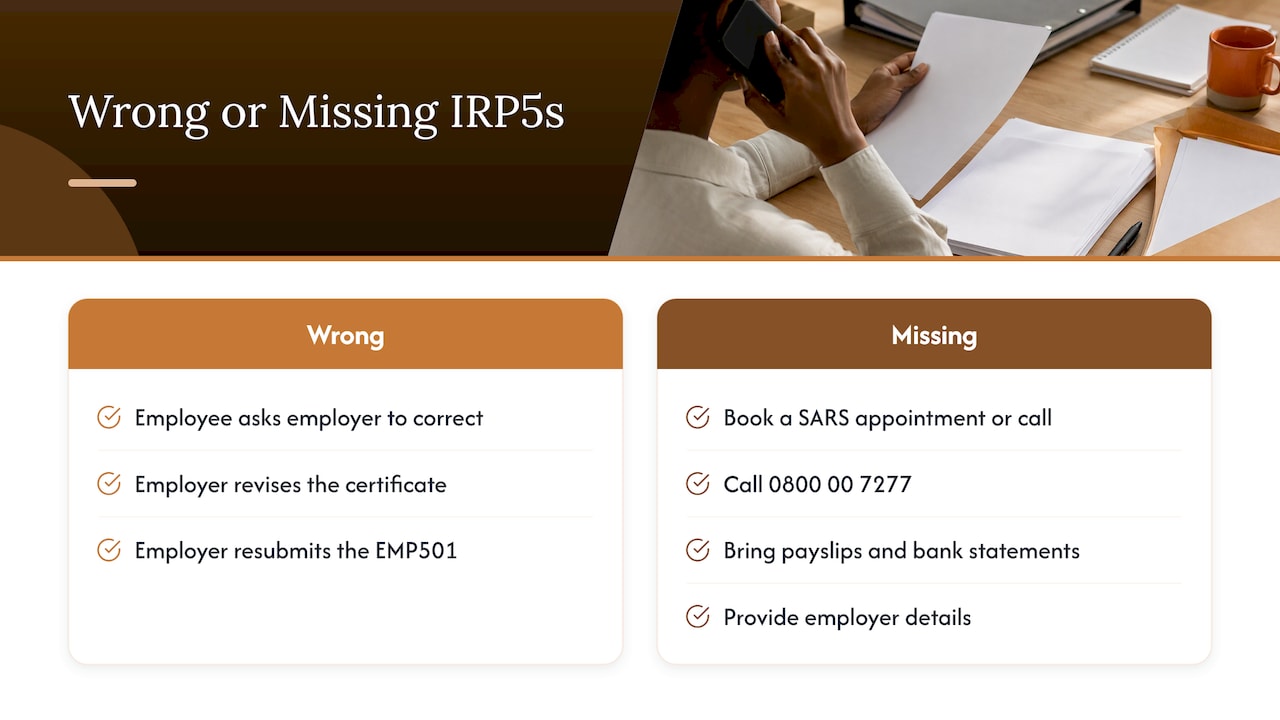
Responsibility is clear. The Office of the Tax Ombud, in Case 15, directs complaints about incorrect certificate information or missing certificates to the employer, not to SARS. SARS’s own FAQ on wrong employer information says the employee stays responsible for the signed return and must ask the employer to correct incorrect certificate information.
Only the employer can correct a certificate: by revising it and resubmitting the EMP501. Manual capture in eFiling is, according to TaxProof, limited to a lump-sum certificate whose transaction year differs from its year of assessment, so ordinary errors cannot be patched on the employee’s side.
If an employer never supplies a requested certificate, the employee can book a SARS appointment or call 0800 00 7277, and will need payslips, bank statements showing salary payments, and the employer’s details. You do not want a staff member in that position over your payroll. Our guide to fixing EMP501 reconciliation problems walks through the eight steps behind a clean resubmission.
Why foreign employers rarely want to run this themselves
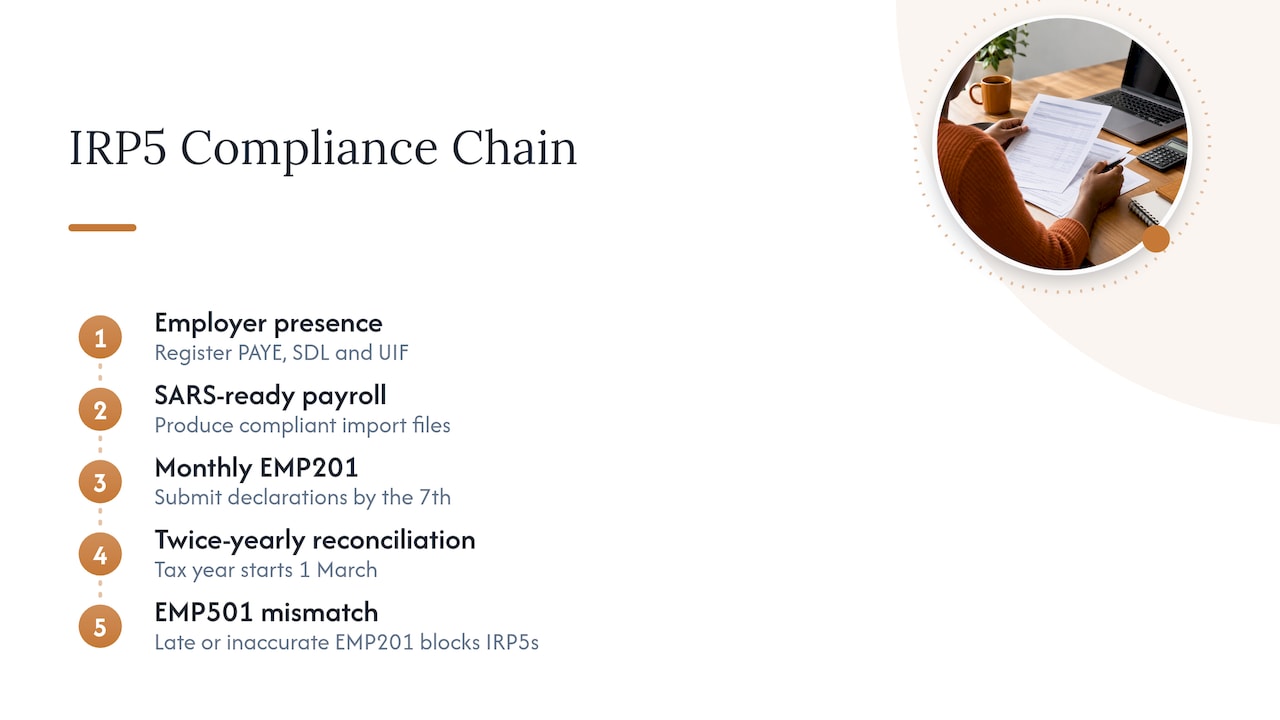
To issue IRP5s directly you need a registered South African employer presence, PAYE, SDL and UIF registrations, a payroll that produces SARS-compliant import files, monthly EMP201 declarations by the 7th, and a twice-yearly reconciliation cycle on a 1 March tax year. Each link in that chain feeds the next: a late or inaccurate EMP201 shows up as a mismatch in the EMP501, and that mismatch blocks the certificates. Our pages on EMP201 deadlines and EMP201 penalties show how quickly that compounds.
For a startup hiring its first person in Cape Town or Johannesburg, setting up a subsidiary to issue one certificate a year is disproportionate. This is the case for an Employer of Record built for one country. Our EOR delivers employment through a licensed local partner that handles BCEA-compliant contracts, ZAR payroll and the statutory filings: PAYE (EMP201 with SARS), UIF, SDL and COIDA. You keep managing the work; the filings that produce the IRP5 sit with the partner, and the details of who legally employs your people are disclosed openly.
The same logic applies if you are converting South African contractors to employees or moving from another EOR. We offer free transfers from other EOR providers, and our payroll services page explains how the payroll side works.
Our offer
Expand to South Africa is an Employer of Record for South Africa only. Employment starts from £299 per employee per month, with no setup fees or FX loading, and signed contracts come within 48 hours. Hiring through us means the payroll and statutory filings behind each certificate are handled by the local partner. You can see the full pricing here, and our South Africa payroll and tax guide goes deeper on the annual cycle.

If you also need to find the person, our talent sourcing service covers vetted candidates for skilled roles.
Perspective
Foreign founders often treat the IRP5 as a year-end afterthought. It is the end of a chain that starts with the first payslip. A correct certificate depends on a correct monthly EMP201, a clean reconciliation and a payroll that follows SARS’s specification as it changes.
That is why we do one country only. A platform spread across 150 countries cannot give South African payroll the attention that a 1 March tax year, source codes and a two-stage reconciliation demand. We built Expand to South Africa so a UK or US company can hire here at a flat fee, see its employment cost in our public calculator, and know that the local partner handles the filings.
The result we care about is quiet: your employee opens their tax return in July, the figures are already there, and they are right.
Roel
FAQ
What is an IRP5 in South Africa?
It is the annual tax certificate an employer gives each employee, showing income paid and PAYE withheld for the tax year. Employees use it to complete their income tax return. Where no tax was deducted, the employer issues an IT3(a) instead.
When must an employer issue an IRP5?
Within 60 days after the tax year ends for continuing employees, and within 14 days after an employee leaves, per SARS’s 2026 guide. Certificates can only be delivered after SARS accepts the EMP501 reconciliation.
Can an employee fix a wrong IRP5 themselves?
No. SARS cannot alter or delete certificate data on the return, so the employer must correct the certificate and resubmit the reconciliation. The employee should ask the employer to make the correction before signing the return.
Do foreign companies without a South African entity issue IRP5s?
The duty falls on the legal employer. With an Employer of Record, the licensed local partner handles ZAR payroll and statutory filings, so you do not build the reconciliation process yourself.
How long should certificates be kept?
Employees should keep them for five years after filing, in case SARS asks for verification, as SARS’s ITR12 guide states.
Sources
- The employee IRP5 or IT3(a) tax certificate explained
- Employee guide to your IRP5 (RSM South Africa)
- SARS guide PAYE-AE-06-G06: certificate codes 2026
- SARS PAYE Employer Reconciliation BRS V25-3-0
- SARS guide PAYE-AE-06-G08: completion and submission of tax certificates 2026
- IRP5, EMP501 and year-end filing FAQ (SAPA)
- IRP5: what it is, when it’s issued (Govchain)
- A guide to the employer reconciliation process (SARS)
- Comprehensive guide to the ITR12 income tax return (SARS)
- IRP5 certificate guide 2026 (Sarstax)
- Fairness for all: Case 15 (Office of the Tax Ombud)
- SARS FAQ: what happens if my employer sends SARS the wrong information
- What should I do if my IRP5 is missing from my SARS return? (TaxProof)
- SARS FAQ: I don’t see my IRP5 on my return